(57) A closure sequence control arrangement for a door comprising first and second door
leaves (1,2) hinged to opposite sides of a door frame (3), the door having a first
closer unit (4) and a first pivot arm (5) for closing the first door leaf (1) and
a second door closer unit (6) and a second pivot arm (7) for closing the second door
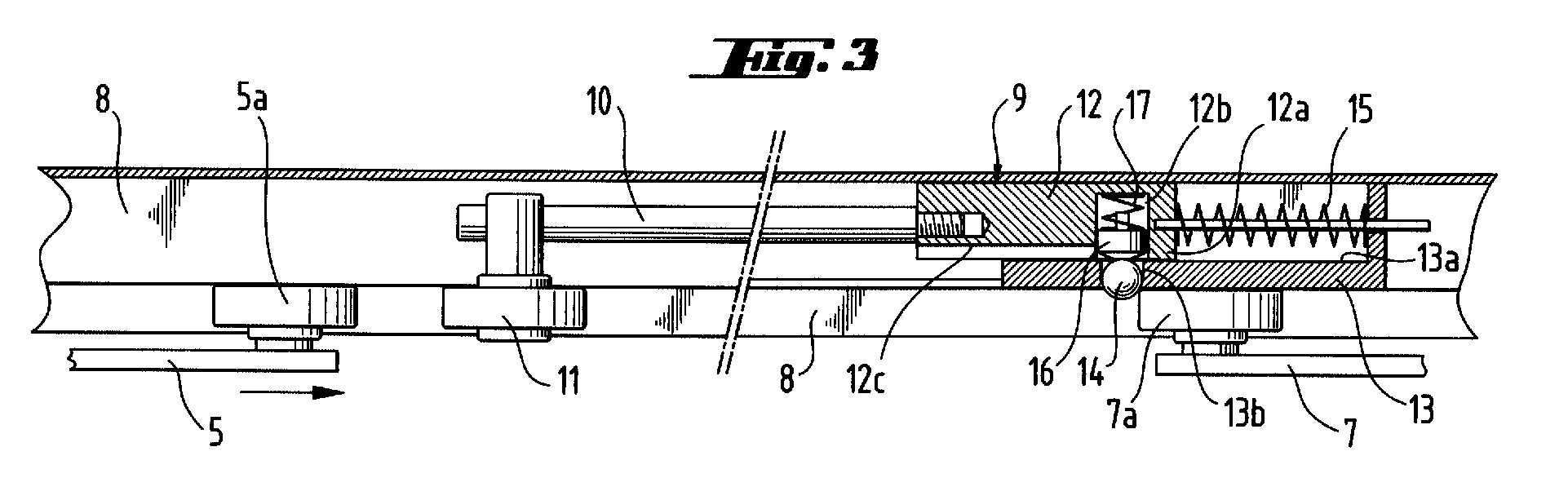
leaf (2). The arrangement includes guide rail means (8) or the like supported on the
door frame (3) for guiding ends (5a,7a) of the pivot arms (5,7) remote from the door
closers, and closure sequence control means (9) cooperating with the guide rail means
(8). The closure sequence control means (9) include a connection piece (10,11,12)
arranged in the guide rail means (8) between the ends (5a,7a) of the pivot arms and
movable against the force of a spring (15), a support element (13) stationarily supported
to the guide rail means (8), and a movable blocking member (14). The closure sequence
control means (9) are arranged in cooperation with the opposite ends (5a,7a) of the
pivot arms at the end phase of the closing movement of the door leaves so that the
blocking member (14) prevents movement of the end (7a) of the second pivot arm (7)
in the guide rail means (8) until the end (5a) of the first pivot arm (5) affects
the blocking member (14) through the connection piece (10,11,12) so that the blocking
member (14) allows closing of the second door leaf (2). The blocking member (14) is
received in a guide aperture (13b) in the support element (13) so that, in its blocking
position, the blocking member (14) projects partly from the guide aperture (13b) into
the path of movement of the end (7a) of the second pivot arm (7).
|
|
