(57) Usually, a voice-operated control system for the remote control of electronic entertainment
appliances is composed of a microphone, a signal processing means, a voice detector
and a system manager for controlling the system. The voice-detection means itself
is based on a pattern detection by means of which each spoken command is compared
with stored information. In this context, there is the problem that the voice detectors
do not unambiguously detect the patterns and as a result do not have the necessary
immunity to interference if there is acoustic interference, in particular as a result
of sound playback of the appliance. The commands then have to be uttered repeatedly
until they are detected. In the case of very severe interference, voice-operated control
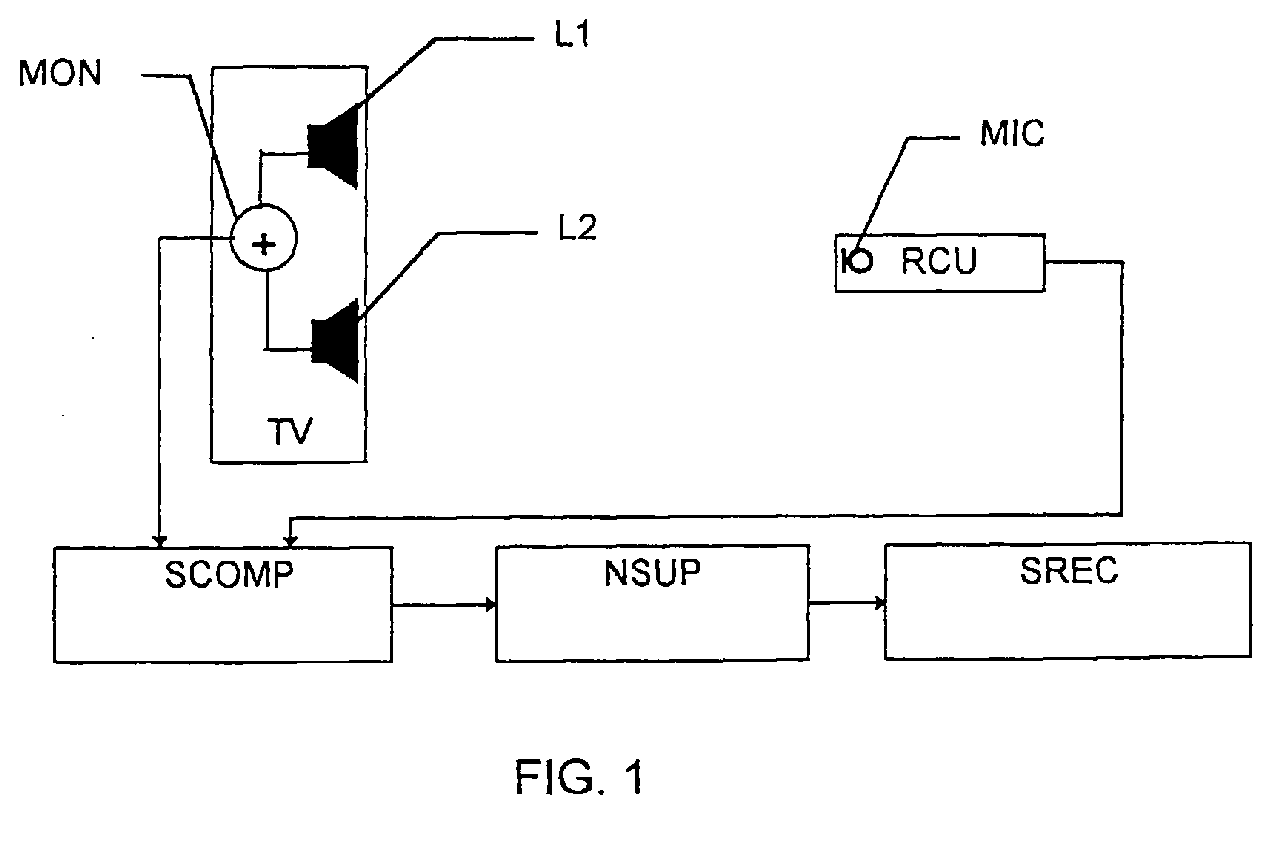
may then even be completely impossible. According to the invention, the immunity to
acoustic interference is improved in that a sound-compensation unit is provided in
which the audio signals emitted by the appliance are estimated at the location of
the microphone or the microphones by modelling the transmission paths in the space
between the loudspeakers and the microphones, and are used to correct the microphone
signal.
|
|
