|
(11) | EP 0 870 503 A1 |

| (12) | EUROPEAN PATENT APPLICATION |
| published in accordance with Art. 158(3) EPC |
|
|
|
|
|||||||||||||||||||
| (54) | MALIGNANT TUMOR METASTASIS INHIBITORS |
| (57) Drugs containing compounds represented by general formula (I) wherein R1 represents -O-R2 , -S-R2 , -CH2 -R2 or -CH=R2 , wherein R2 represents a C1-10 hydrocarbon chain optionally substituted by one or more hydroxyl groups, which are
useful as a malignant tumor metastasis inhibitor without showing any particularly
serious side effect.
|
TECHINICAL FIELD
[0001] The present invention relates to malignant tumor metastasis inhibitors. More specifically, it relates to malignant tumor metastasis inhibitors containing an active vitamin D or a derivative thereof as an active ingredient.
BACKGROUND ART
[0002] The cure rate of malignant tumors is more and more increasing by early diagnosis and progress of therapies, but metastases of malignant tumors are often beyond current therapies and pose one of important medical problems. At present, chemotherapies are used to arrest metastases following removal of tumors with unsatisfactory results, so that it would be desirable to develop more effective inhibitors against malignant tumor metastases.
[0003] Bone tissues are one of the most favored sites of metastases of malignant tumors, as a report shows that bone metastases occurred in about 30% of all the cancer cases from autopsy. Among malignant tumors, cancers of the lung, breast, prostate or the like are particularly known to be likely to metastasize to bone.
[0004] Vitamin D compounds are known to show a wide variety of physiological activities such as calcium metabolism regulation, growth inhibition or differentiation-inducing of tumor cells or the like, and immunoregulation. Vitamin D derivatives having an oxygen atom at the 22-position which are particularly preferred compounds as malignant tumor metastasis inhibitors of the present invention are known to have very little side effects commonly associated with this type of vitamin D compounds which induce hypercalcemia and they have been reported to be effective for psoriasis, secondary hyperparathyroidism or the like (for example, see JP No. 183534A/1988, JP No. 86382/1994, etc.). They are also known to have antitumor effects, but have not been reported yet to show inhibitory effects against metastases of malignant tumors.
[0005] It is an object of the present invention to provide a malignant tumor metastasis inhibitors, and particularly a pharmaceutical agents for inhibiting bone metastases of a malignant tumors.
DISCLOSURE OF THE INVENTION
[0006] As a result of extensive research of malignant tumor metastasis inhibitors, it has been found that vitamin D derivatives of the general formula (I):
wherein R1 represents -O-R2, -S-R2, -CH2-R2 or -CH=R2 where R2 represents a C1-C10 chain hydrocarbon group which may be substituted by one or more hydroxyl groups, and R3 represents a hydrogen atom or a hydroxyl group are effective as malignant tumor metastasis inhibitors, particularly as inhibitors against bone metastases of malignant tumors, and thus accomplished the present invention.
[0007] Therefore, the present invention relates to malignant tumor metastasis inhibitors containing a compound of the general formula (I):
wherein R1 represents -O-R2, -S-R2, -CH2-R2 or -CH=R2 where R2 represents a C1-C10 chain hydrocarbon group which may be substituted by one or more hydroxyl groups, and R3 represents a hydrogen atom or a hydroxyl group, as an active ingredient.
BRIEF DESCRIPTION OF THE DRAWINGS
[0010] FIG. 3 is a soft X-ray photograph showing an age-matched normal mouse (normal) on the first day of the malignant tumor metastasis inhibitory experiment of Example 1.
[0011] FIG. 4 is a soft X-ray photograph showing a vehicle-treated mouse on the first day of the malignant tumor metastasis inhibitory experiment of Example 1.
[0012] FIG. 5 is a soft X-ray photograph showing an OCT 1 µg/kg-treated mouse on the first day of the malignant tumor metastasis inhibitory experiment of Example 1.
[0013] FIG. 6 is a soft X-ray photograph showing an age-matched normal mouse (normal) on the 11th day after starting the malignant tumor metastasis inhibitory experiment of Example 1.
[0014] FIG. 7 is a soft X-ray photograph showing a vehicle-treated mouse on the 11th day after starting the malignant tumor metastasis inhibitory experiment of Example 1.
[0015] FIG. 8 is a soft X-ray photograph showing an OCT 1 µg/kg-treated mouse on the 11th day after starting the malignant tumor metastasis inhibitory experiment of Example 1.
[0016] FIG. 9 is a soft X-ray photograph showing an age-matched normal mouse (normal) on the 22nd day after starting the malignant tumor metastasis inhibitory experiment of Example 1.
[0017] FIG. 10 is a soft X-ray photograph showing a vehicle-treated mouse on the 22nd day after starting the malignant tumor metastasis inhibitory experiment of Example 1.
[0018] FIG. 11 is a soft X-ray photograph showing an OCT 1 µg/kg-treated mouse on the 22nd day after starting the malignant tumor metastasis inhibitory experiment of Example 1.
[0019] FIG. 12 is a soft X-ray photograph showing an age-matched normal mouse (normal) on the 29th day after starting the malignant tumor metastasis inhibitory experiment of Example 1.
[0020] FIG. 13 is a soft X-ray photograph showing a vehicle-treated mouse on the 29th day after starting the malignant tumor metastasis inhibitory experiment of Example 1.
[0021] FIG. 14 is a soft X-ray photograph showing an OCT 1 µg/kg-treated mouse on the 29th day after starting the malignant tumor metastasis inhibitory experiment of Example 1.
BEST MODE FOR CARRYING OUT THE INVENTION
[0022] The compound of the general formula (I) is preferably represented by the general formula (II):
wherein R4 represents -O-R2 or -CH2-R2 where R2 represents a C1-C10 chain hydrocarbon group which may be substituted by one or more hydroxyl groups, more preferably represented by the general formula (III):
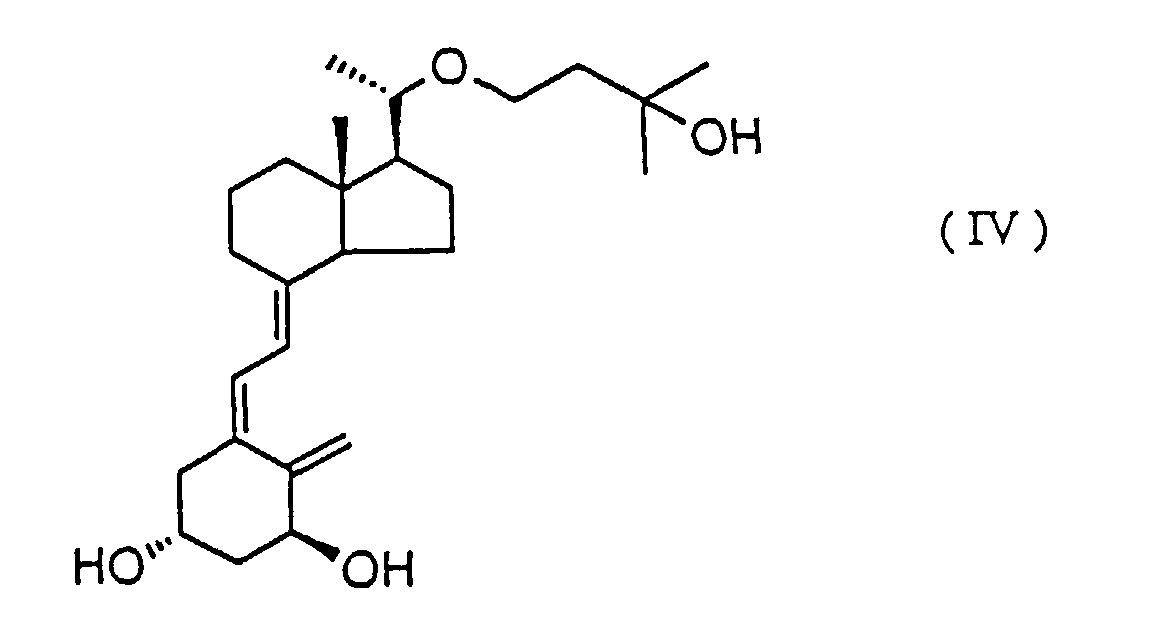
wherein R2 has the same meaning as defined above. Still preferably, R2 is a C1-C10 alkyl group substituted by one or more hydroxyl groups. Most preferably, a malignant tumor metastasis inhibitor of the present invention is a compound of the formula (IV):
[0023] In addition to the compound of the formula (IV), the compound of the general formula (I) preferably includes the following specific examples:
- the compound of the formula (V): 1α(OH) vitamin D3:
- the compound of the formula (VI), 1α, 25(OH)2 vitamin D3:
- the compound of the formula (VII), 1α, 24R(OH)2 vitamin D3:
- the compound of the formula (VIII), EB1089:
- the compound of the formula (IX), KH1060:
[0025] Vitamin D derivatives of the present invention are known compounds, as described in JP 74656A/1991, WO94/14766, WO95/27697, JP 506965A/1992, JP 503669A/1992, for example.
[0026] As used herein, the term "C1-C10 chain hydrocarbon group" may be straight or branched and may contain one or more unsaturated bonds such as double or triple bond. The unsaturated bond is preferably a double bond. The C1-C10 chain hydrocarbon group preferably contains no unsaturated bond or one double bond thereon.
[0027] The C1-C10 chain hydrocarbon group moiety with no unsaturated bond includes, for example, methyl, ethyl, n-propyl, i-propyl, n-butyl, i-butyl, s-butyl and t-butyl groups as well as pentyl, hexyl, heptyl, octyl, nonyl and decanyl groups, preferably 3-methylbutyl, 3-ethylpentyl, 4-methylpentyl, 3-(n-propyl)hexyl, 4-ethylhexyl, 5-methylhexyl, 6-methylheptyl, 5-ethylheptyl and 4-(n-propyl)heptyl groups, more preferably, 3-methylbutyl, 3-ethylpentyl, 4-methylpentyl and 4-ethylhexyl groups, most preferably 3-methylbutyl group.
[0028] The chain hydrocarbon group may or may not be substituted by one or more hydroxyl groups, and in the former case, the number of the hydroxyl groups is, for example, one, two or three, preferably one or two, more preferably one.
[0029] Examples of the C1-C10 alkyl group substituted by one or more hydroxyl groups include 3-hydroxy-3-methylbutyl, 2-hydroxy-3-methylbutyl, 4-hydroxy-3-methylbutyl, 2,3-dihydroxy-3-methylbutyl, 2,4-dihydroxy-3-methylbutyl, 3,4-dihydroxy-3-methylbutyl, 3-hydroxy-3-ethylpentyl, 2-hydroxy-3-ethylpentyl, 4-hydroxy-3-ethylpentyl, 2,3-dihydroxy-3-ethylpentyl, 2,4-dihydroxy-3-ethylpentyl, 3,4-dihydroxy-3-ethylpentyl, 4-hydroxy-4-methylpentyl, 3-hydroxy-4-methylpentyl, 5-hydroxy-4-methylpentyl, 3,4-dihydroxy-4-methylpentyl, 3,5-dihydroxy-4-methylpentyl, 4,5-dihydroxy-4-methylpentyl, 3-hydroxy-3-(n-propyl)hexyl, 4-hydroxy-3-(n-propyl)hexyl, 2-hydroxy-3-(n-propyl)hexyl, 2,3-dihydroxy-3-(n-propyl)hexyl, 3,4-dihydroxy-3-(n-propyl)hexyl, 2,4-dihydroxy-3-(n-propyl)hexyl, 3-hydroxy-4-ethylhexyl, 4-hydroxy-4-ethylhexyl, 5-hydroxy-4-ethylhexyl, 3,4-dihydroxy-4-ethylhexyl, 3,5-dihydroxy-4-ethylhexyl, 4,5-dihydroxy-4-ethylhexyl, 4-hydroxy-5-methylhexyl, 5-hydroxy-5-methylhexyl, 6-hydroxy-5-methylhexyl, 4,5-dihydroxy-5-methylhexyl, 4,6-dihydroxy-5-methylhexyl, 5,6-dihydroxy-5-methylhexyl, 5-hydroxy-6-methylheptyl, 6-hydroxy-6-methylheptyl, 7-hydroxy-6-methylheptyl, 5,6-dihydroxy-6-methylheptyl, 5,7-dihydroxy-6-methylheptyl, 6,7-dihydroxy-6-methylheptyl, 4-hydroxy-5-ethylheptyl, 5-hydroxy-5-ethylheptyl, 6-hydroxy-5-ethylheptyl, 4,5-dihydroxy-5-ethylheptyl, 4,6-dihydroxy-5-ethylheptyl, 5,6-dihydroxy-5-ethylheptyl, 3-hydroxy-4-(n-propyl)heptyl, 4-hydroxy-4-(n-propyl)heptyl, 5-hydroxy-4-(n-propyl)heptyl, 3,4-dihydroxy-4-(n-propyl)heptyl, 3,5-dihydroxy-4-(n-propyl)heptyl and 4,5-dihydroxy-4-(n-propyl)heptyl groups, preferably 3-hydroxy-3-methylbutyl, 2-hydroxy-3-methylbutyl, 2,3-dihydroxy-3-methylbutyl, 3,4-dihydroxy-3-methylbutyl, 3-hydroxy-3-ethylpentyl, 2,3-dihydroxy-3-ethylpentyl, 3,4-dihydroxy-3-ethylpentyl, 4-hydroxy-4-methylpentyl, 3,4-dihydroxy-4-methylpentyl, 4,5-dihydroxy-4-methylpentyl and 4-hydroxy-4-ethylhexyl groups, more preferably 3-hydroxy-3-methylbutyl, 3-hydroxy-3-ethylpentyl and 4-hydroxy-4-methylpentyl groups, most preferably 3-hydroxy-3-methylbutyl group.
[0030] Examples of the chain hydrocarbon group containing one or more unsaturated bonds include the above-mentioned hydrocarbon groups wherein one or more, preferably one bond is an unsaturated bond, preferably double bond. Particularly preferred examples of the chain hydrocarbon group containing one or more unsaturated bonds include =CH-CH=CH-CH(CH2CH3)2 and those further having hydroxy substituent(s) include =CH-CH=CH-CH(CH2CH3)2OH.
[0032] In addition to the compound of the general formula (I) as an active ingredient, the malignant tumor metastasis inhibitors of the present invention may contain pharmaceutically acceptable carriers including excipients and auxiliaries which facilitate formulation of said active compound.
[0033] Excipients include, but are not limited to, sugars such as lactose, sucrose, mannitol and sorbitol; celluloses; and/or fillers such as calcium phosphate.
[0034] Auxiliaries such as binders, rheology modulators, lubricants, and stabilizers may be added according to the necessity.
[0035] The dosage form of the agents of the present invention includes formulations for oral administration which are prepared by conventional formulation techniques of vitamin D compounds and formulations for parenteral administration, e.g. solutions such as injections based on an aqueous solvent, non-aggressive formulations such as collunaria, and formulations for external administration such as creams, ointments, but preferably formulations for oral administration and injections.
[0036] The malignant tumor metastasis inhibitors of the present invention can be administered to arrest further spread of a metastasis which has already occurred at the time of diagnosis of a cancer or can be prophylactically administered even in case of an early cancer which has not been metastasized yet. They can also be administered to prevent metastases following surgery or radiation therapy or to arrest micrometastases. The malignant tumor metastasis inhibitors of the present invention may be applied to any type of malignant tumors, but they are particularly effective against metastases of cancers of the lung, breast and prostate, especially to bone.
[0037] The pharmaceutical agents of the present invention is preferably systemically administered by an oral route or as an injection, but may also be topically administered by an external route or the like.
[0038] The dosage of the vitamin D derivatives of the present invention will vary depending on the age, sex, condition or other factors of the patient, but usually ranges from 0.01 to 1000 µg, preferably 0.1 to 100 µg, especially 1 to 20 µg per day. The frequency of administration is not specifically limited, e.g. said dosage may be administered in a single dose or in divided doses of up to about three times daily.
EXAMPLES
[0039] The following example illustrates the present invention more in detail. In this example, 22-oxa-1α,25-dihydroxyvitamin D3 (OCT) of the formula (IV):
was used as an active ingredient.
Example 1: Experiment on bone metastasis mice
[0040] Preventive effects of OCT on bone metastases were studied using a bone metastasis model prepared with Hara cells derived from human lung cancer.
[0041] A test of preventive effects of OCT on bone metastases of Hara cells was started on the 20th day after 5 x 10⁵ Hara cells were transplanted into the heart of nude mice, at which time the body weight of the animals began to slightly decrease but neither rise in Ca nor clear bone metastasis image on soft X-rays was observed. On that day, the animals were grouped by body weight, and a vehicle (n=9) or 1 µg/kg of OCT (n=9) was orally administered to each animal 4 to 5 times per week for six weeks (29 times in total). At different instants during the administration period, the body weight and Ca level in blood were measured and soft X-ray photographs were taken.
[0042] Fig. 1 shows changes in Ca level in blood of the tested animals in function of time. The tested animals of the vehicle group (n=9) showed Ca levels in blood of 1.34±0.03 mM on the first day of the test, then 1.46±0.25 mM after 15 doses on the 22nd day after starting the test, and 1.67±0.7 mM after 20 doses on the 29th day after starting the test. In contrast, the group treated with 1 µg/kg of OCT (n=9) showed Ca levels of 1.32±0.04, 1.37±0.04 and 1.34±0.16 mM, respectively, indicating that OCT has a tendency to suppress the rise in Ca level in blood. Age-matched normal mice with no Hara cells transplanted (normal in Fig. 1; n=4) showed Ca levels in blood of 1.31±0.01, 1.32±0.05 and 1.29±0.01 mM, respectively.
[0043] Fig. 2 shows changes in body weight of the tested animals. The body weights of the tested animals of the vehicle group (n=9) changed from 23.60±1.08 g on the first day of the test to 23.20±1.10 g after 15 doses on the 22nd day after starting the test, and then 21.78±3.87 g after 20 doses on the 29th day after starting the test. In contrast, the group treated with 1 µg/kg of OCT (n=9) showed body weights of 23.61±1.57, 24.51±1.27 and 25.00±1.20 g, respectively, indicating that OCT significantly suppressed body weight decrease on the 29th day (p<0.05). Age-matched normal mice with no Hara cells transplanted (normal in Fig. 2; n=4) showed body weights of 25.19±2.08, 26.53±1.60 and 27.50±1.66 g, respectively.
[0044] Figs. 3 to 14 are soft X-ray photographs of the left crus bone of one individual from each group of tested animals, i.e. age-matched normal mice (normal), vehicle-treated mice and OCT 1 µg/kg-treated mice. Figs. 3 to 5 are soft X-ray photographs for these individuals in this order on the first day of the test, Figs. 6 to 8 on the 11th day, Figs. 9 to 11 on the 22nd day and Figs. 12 to 14 on the 29th day after starting the test, respectively. Accordingly, soft X-ray photographs showing changes with time for the same individual are given in Figs. 3, 6, 9 and 12 for a normal mouse, Figs. 4, 7, 10 and 13 for a vehicle-treated mouse, and Figs. 5, 8, 11 and 14 for a mouse treated with 1 µg/kg of OCT, respectively.
[0045] From these soft X-ray photographs of tested animals, no metastasis image was observed in any individual on the first day of the test. However, a clear bone metastasis was observed in one animal of the vehicle group on and after the 11th day after starting the test as evidenced from a shadow which appeared in the left curs bone in Figs. 7, 10 and 13, and also observed in another animal on the 29th day after starting the test. These animals both died by the 32nd day after starting the test. A metastasis image was observed in further two animals, i.e. four animals in total, by the end of the test and all of them died by the 42nd day after starting the test. In contrast, no bone metastasis image was observed during the administration period and no death was observed in the group treated with 1 µg/kg of OCT.
INDUSTRIAL APPLICABILITY
1. A malignant tumor metastasis inhibitor containing a compound of the general formula
(I):
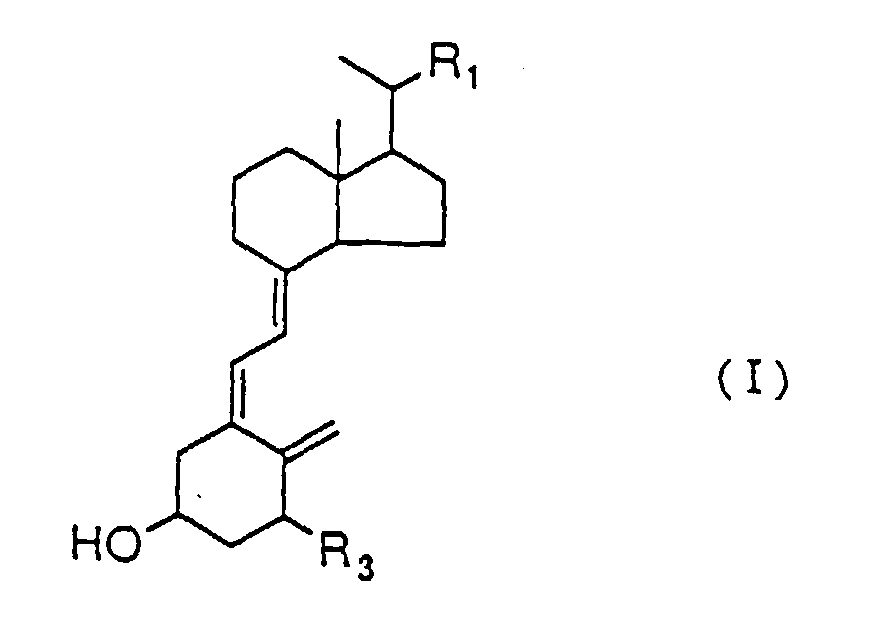
wherein R1 represents -O-R2, -S-R2, -CH2-R2 or -CH=R2 where R2 represents a C1-C10 chain hydrocarbon group which may be substituted by one or more hydroxyl groups, and R3 represents a hydrogen atom or a hydroxyl group, as an active ingredient.
wherein R1 represents -O-R2, -S-R2, -CH2-R2 or -CH=R2 where R2 represents a C1-C10 chain hydrocarbon group which may be substituted by one or more hydroxyl groups, and R3 represents a hydrogen atom or a hydroxyl group, as an active ingredient.
2. The malignant tumor metastasis inhibitor of Claim 1 wherein R3 is a hydroxyl group.
3. The malignant tumor metastasis inhibitor of Claim 2 wherein the active ingredient
is a compound of the general formula (II):
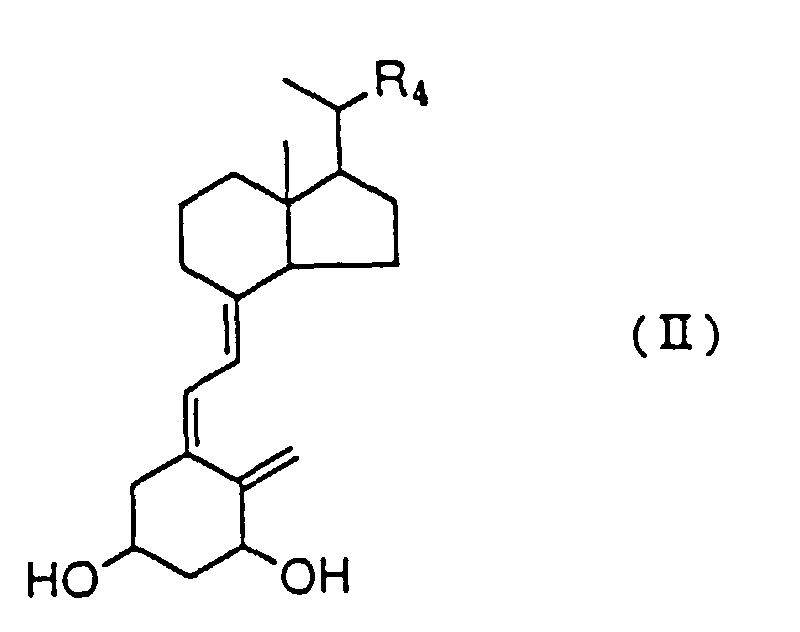
wherein R4 represents -O-R2 or -CH2-R2 where R2 is as defined in Claim 1.
wherein R4 represents -O-R2 or -CH2-R2 where R2 is as defined in Claim 1.
4. The malignant tumor metastasis inhibitor of Claim 3 wherein the active ingredient
is a compound of the general formula (III):
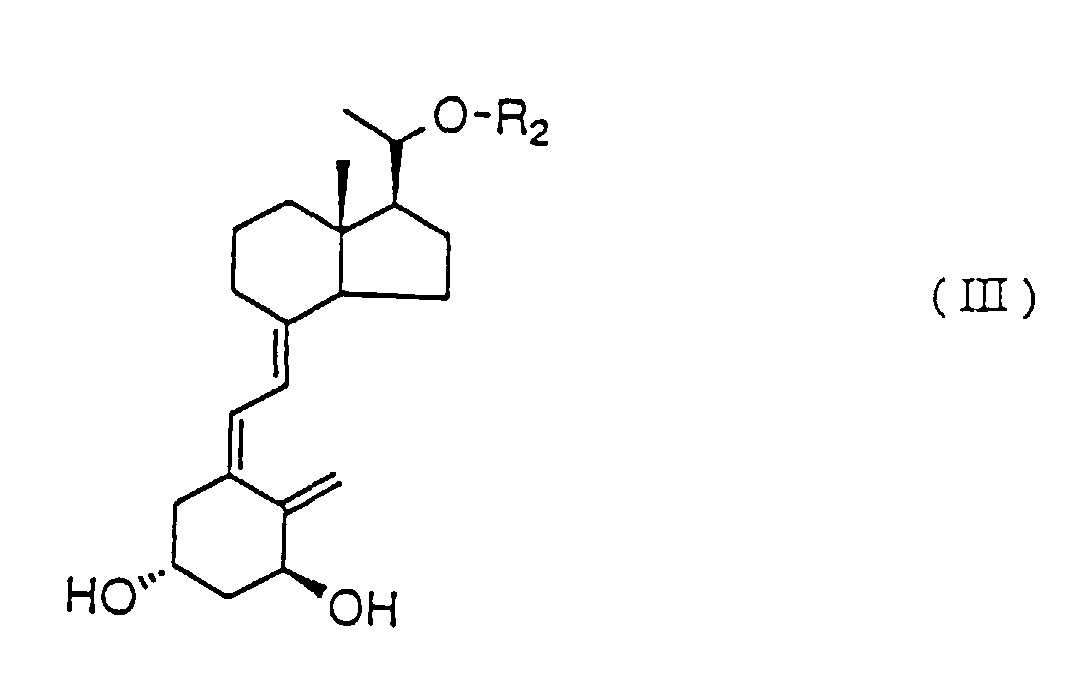
wherein R2 is as defined in Claim 1.
wherein R2 is as defined in Claim 1.
5. The malignant tumor metastasis inhibitor of Claim 4 wherein R2 is a C1-C10 alkyl group substituted by one or more hydroxyl groups.
6. The malignant tumor metastasis inhibitor of Claim 5 wherein the active ingredient
is a compound of the formula (IV):