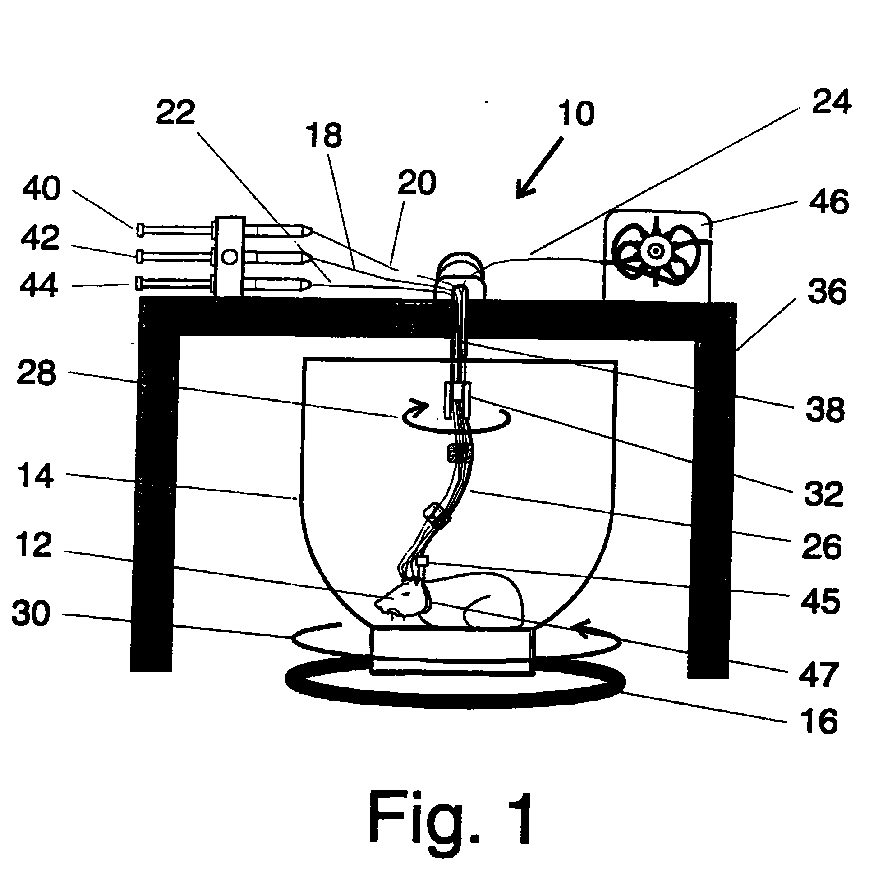
(57) A movement-responsive system (10) for conducting tests on freely-moving animals is
disclosed. The invention includes a container (14) for housing the animal (12), a
mechanism (16) for rotating the cage (14) in response to rotational movement of the
animal and one or more test leads (18,20,22,24) connected to the animal for performance
of biomedical tests such as infusion, in vivo ultrafiltration, laser-doppler monitoring
of blood flow, electrical stimulation and in vivo microdialysis. The container (14)
is caused to rotate in the opposite (counter-rotation) direction of the sensed direction
of rotation of the animal (12) so that the one or more test leads (18,20,22,24) do
not become entangled, twisted, disconnected, or clamped. The rotating mechanism includes
a simple, reliable sensor assembly (32) including a pair of strategically placed,
close-ended limit detectors (70,72) which are activated by a triggering element (84)
which is also a part of the sensor assembly. The sensor assembly is mounted on a counter-balanced
arm (38) which is responsive to upward and downward movements of the animal (12).
No complex control system is required for the present invention yet adjustment of
the sensitivity of the rotating mechanism is easy to accomplish and may be performed
by the average user of the apparatus. Further, the leads may all be continuous, thereby
eliminating problems caused by the use of liquid swivels with independently rotating
halves or by commutator connectors.
|
|
