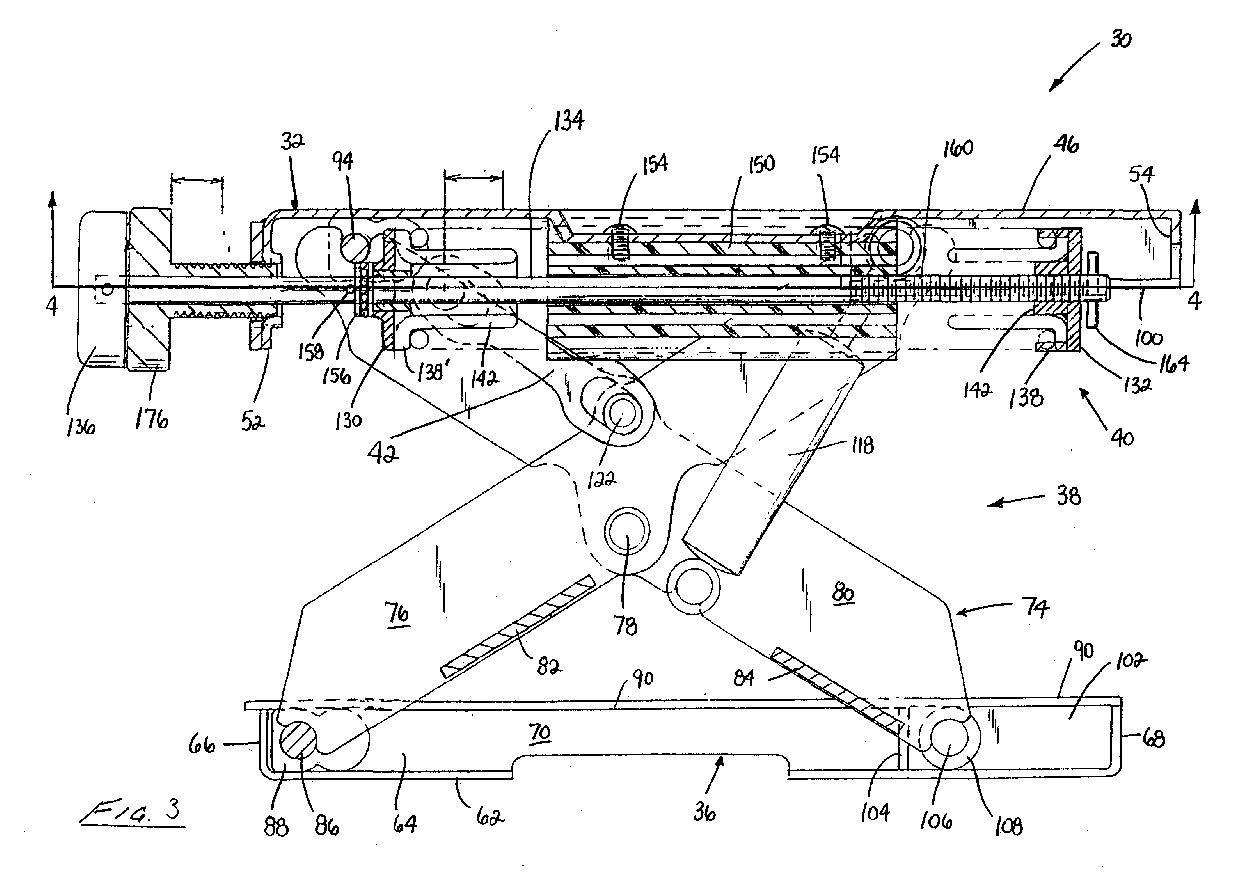
(57) A vehicle seat suspension (30) having a scissors arm linkage (38) disposed between
a platform (32) and base (36) with a link pivotally connected at one end to a scissor
arm of the linkage at a point spaced from a pivot interconnecting scissor arms of
the linkage and operably connected at its other end to a slide carried by the platform
(32) for communicating scissor linkage motion to a spring carrier (40) also connected
to the link. The carrier includes at least one coil spring (128) held captive in compression
between two spaced apart brackets (130, 132), one of which is pivotally connected
to the end of the link adjacent the slide. The point of pivotal attachment of the
link to the scissor arm is spaced from the linkage pivot to create a moment about
the pivot tending to resist collapse of the linkage when force from the spring is
communicated to the linkage. To adjust suspension weight resistance, the brackets
(130, 132) are in communication with a rod (134) attached to a knob that is rotated
to changing the distance between the brackets thereby changing the amount by which
the spring is compressed. To change seat height, another knob is rotated to move the
rod (134), springs (128), and brackets (130, 132) in unison toward or away from the
front of the suspension causing the linkage to controllably expand or collapse. By
this suspension construction, weight adjustment is advantageously substantially independent
of height adjustment.
|
|
