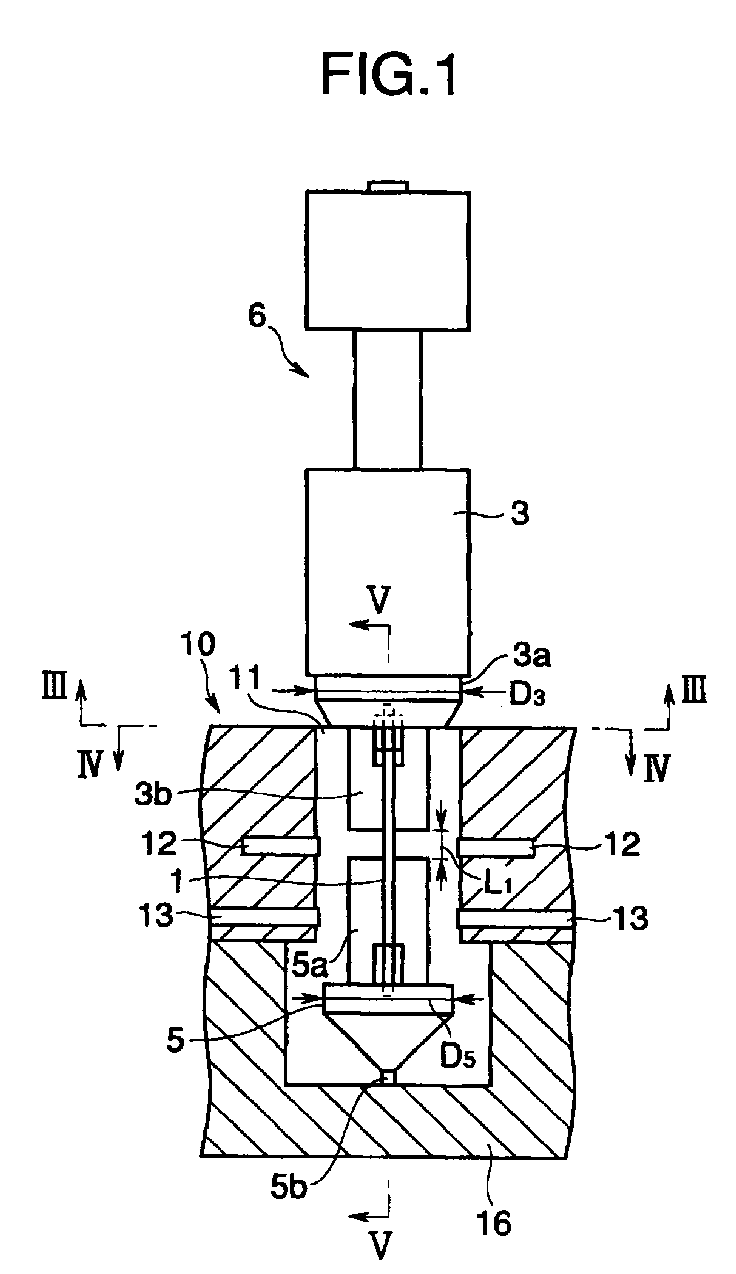
(57) A connection pin (6, 20) is used to electrically connect a first pattern (12, 14)
and a corresponding second pattern (13, 15) of at least one set of patterns (12,13)
formed in a matrix board (10) and crossing one over the other. The connection pin
(6, 20) is inserted into a through-hole (11) formed in the matrix board (10). The
through-hole (11) extends through the first and second patterns at an intersection
of the first and second patterns. The connection pin (6, 20) includes a fitting portion
(3), abutting portion (5), and electrical conductor (1, 2) between the fitting portion
(3) and abutting portion. The conductor (1, 2) generally extends along the through-hole
(11) and has a pair of resiliently deformable ends (1c-1f). One deformable end is
mounted to the fitting portion (3) and the other deformable end is mounted to the
abutting portion (5). When the connection pin (6) is inserted into the through-hole
(11), the abutting portion (5, 5b) abuts the extreme end of the through-hole (11).
A further insertion of the connection pin (6) causes the fitting and abutting portions
(3, 5) to move toward each other. This causes the conductor (1, 2) to resiliently
deform so that the conductor (1, 2) laterally extends into electrical contact with
the first and second patterns (12 13). The connection pin (6) may include a plurality
of conductors (1, 2) with an insulating material between adjacent conductors in order
to accomplish electrical connection between the first and second patterns of a plurality
of sets of patterns (12,13,14,15).
|
|
