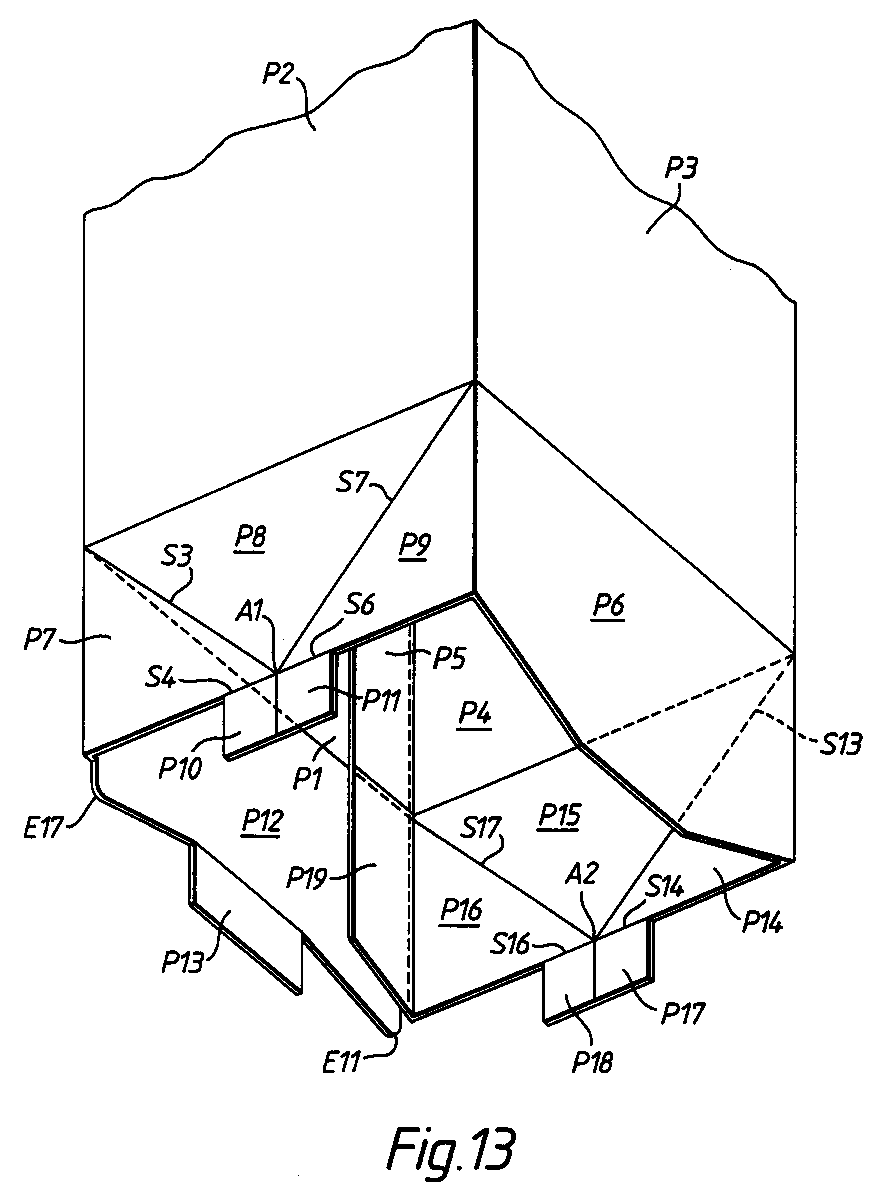
(57) A bottom end closure of a carton to be heat- and pressure-sealed has four substantially
rectangular panels P6, P7-P9, P12 and P14-P16 of which the panels P7-P9 and P14-P16
are divided by score lines S3,S7 and S13,S17 into inner, triangular sub-panels P8
and P15 and outer triangular sub-panels P7, P9 and P14, P16 and have central lugs
formed by pairs of small, rectangular sub-panels P10,P11 and P17,P18 providing for
gas-tightness at the apices A1 and A2 in the sealed closure. Score lines S4,S6 and
S14,S16 provide lines of weakness across the whole widths of the roots of the central
lugs, so that the lugs, when each folded upon itself, can adjust to the orientation
of an outwardly folded panel P13 during tucking of the panel P13 inwards of the lugs,
which are sandwiched between the panels P6 and P13. In the blank, the lugs and the
panels P6 and P13 are so dimensioned that they can interdigitate with the corresponding
lugs and panels of the bottoms of a row of identical blanks. Edge portions E11 and
E17 of protrusions of the panel P12 commence adjacent to and parallelly with the vertical
edges of the panel P12 and continue convexly curvedly towards the panel P13, to co-operate
with the folds between the panel P6, on the one hand, and the sub-panels P9 and P14,
on the other hand, to enhance production and maintenance of self-alignment of the
closure.
|
|
