| (57) A coding is carried out by designating the reference number of a partial sequence
having the maximum length coincidence from the coded partial sequences registered
in a dictionary with regard to a received character sequence, designating a new reference
number to a partial sequence which is obtained by adding one character to a reference
number obtained as a code word, and registering the new reference number designated
partial sequence in the dictionary. A decoding is carried out by searching partial
sequences registered in the dictionary using a code word represented by the reference
number of the partial sequence, designating a new reference number to a partial sequence
which is obtained by adding the beginning character of the currently restored partial
sequence to the previously processed code word, and registering the new reference
number designated partial sequence in the dictionary. According to the invention,
the following steps are provided :
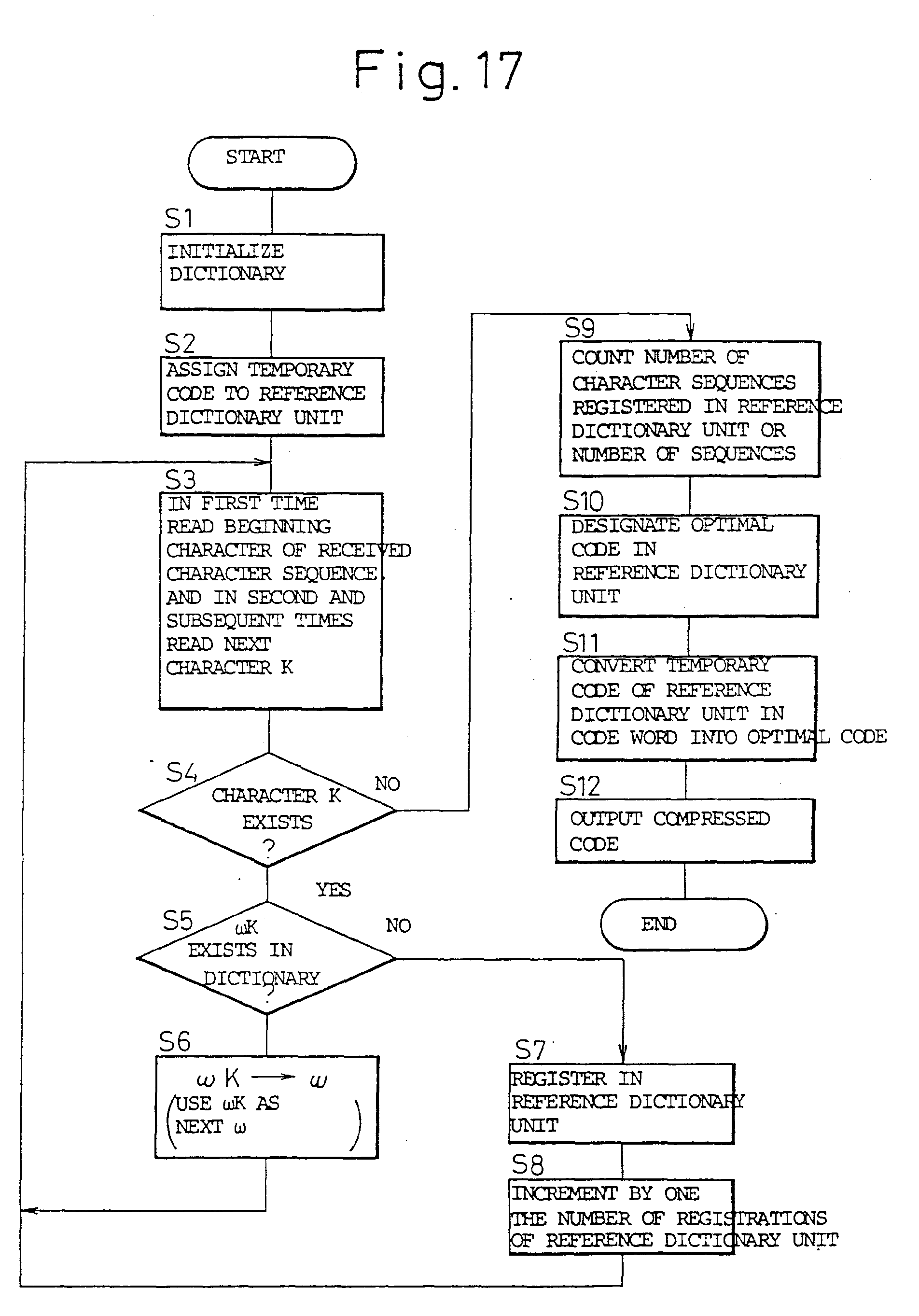
constituting a reference dictionary from a plurality of reference dictionary units
comprising the groups of difference beginning characters;
coding successive different partial sequences of the received character sequence by
constituting a code word by an indication representing a reference dictionary unit
and an indication representing a register position of a partial sequence having the
maximum length coincidence from the partial sequences registered in a reference dictionary;
deriving transition probability between the beginning character of a partial sequence
and the last character of a preceding partial sequence between the group of characters,
and calculating transition probability between reference dictionaries; and
if the transition probability of a partial sequence with regard to the preceding partial
sequence is more than a predetermined value, representing a code word, as a variable
length code word, by an indication having the length shorter than that of a code word
assigned to a partial sequence having less transition probability.
|
|
