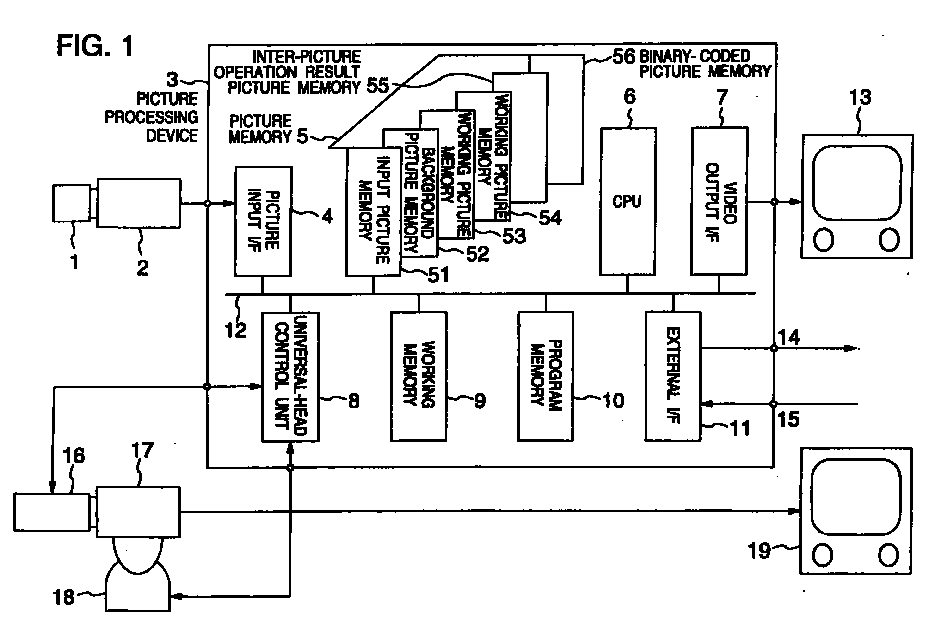
(57) A system for processing a tracking picture of an intruding object includes a TV camera
(2) provided with an imaging lens (1) of a wide field of view for outputting a video
signal used for detecting the intruding object, a TV camera (17) provided with a zoom
lens (16) for outputting a video signal used for monitoring a magnified tracking picture
of the intruding object, the TV camera mounted on an electric pan head (18), a picture
processing device (3) for processing and operating the video signal inputted from
the TV camera provided with the imaging lens of the wide field of view and outputting
a rotation control signal for rotating the electric pan head by a necessary amount
of angle and a zooming control signal for zooming the zoom lens by a necessary amount.
The system images the object intruding into a given monitoring area while automatically
tracking it with the zoom lens. Further, the method executed in the system includes
step (101, 102, 103) of detecting a difference between the video signal inputted from
the TV camera and a reference background video signal, step (104, 105) of classifying
a change of a detecting state from the change of the numbers of objects detected in
the continuous input video signal, step (106) of creating and saving as connecting
information a location of detected object at each time, area of a region occupied
by the detected object, a pixel pattern of the detected object from the change of
the detection state, and step (107, 110 to 116) of correcting the detection location
of the object detected as a split state and a trace of objects detected as a connected
state.
|
|
