|
(11) | EP 0 881 229 A2 |

| (12) | EUROPEAN PATENT APPLICATION |
|
|
|
|
|||||||||||||||||||||||
| (54) | Alkylated antibiotic hexapeptides |
| (57) The present invention is directed to N1-alkylated derivatives of desleucyl A82846B. These derivatives are useful as antibacterials
and also as starting materials from which further antibacterial compounds are prepared.
|
[0001] The present invention is directed to glycopeptides and is directed in particular to derivatives of desleucyl-A82846B and its N DISACC variations, also referred to as "hexapeptides" of A82846B. These derivatives are alkylated on the N1 amine of the hexapeptide. The derivatives are useful as antibacterials.
DETAILED DESCRIPTION OF THE INVENTION
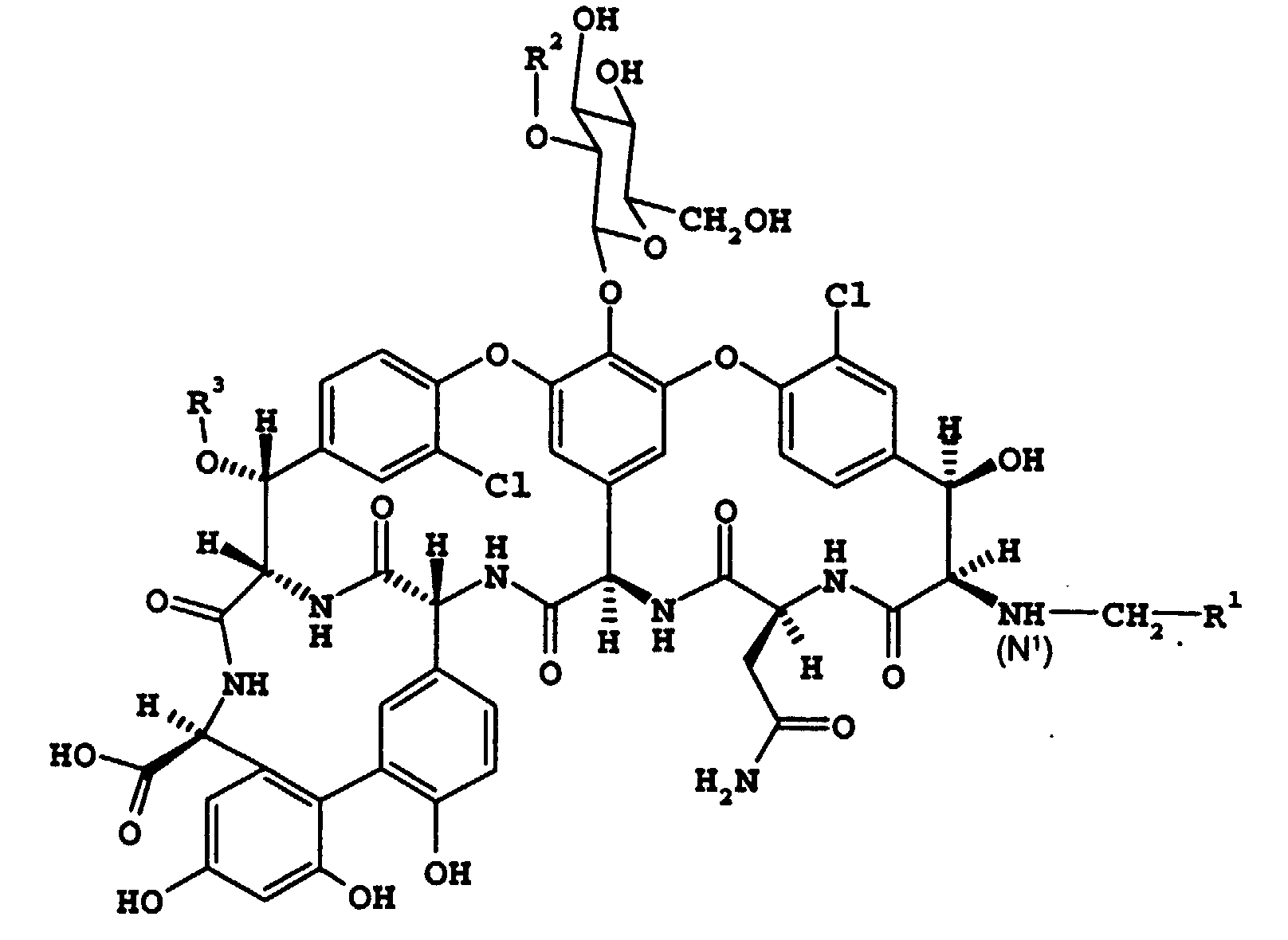
[0002] The present invention is directed to alkylated A82846B hexapeptides of the formula
wherein R1 represents
alkyl of C1-C11,
alkyl of C1-C11-R1a, or
R1a-(linker(0 or 1)-R1a )0 or 1,
wherein each R1a is independently phenyl or phenyl substituted by one or two substituents, each of which is independently halo, hydroxy, loweralkyl of C1-C8, loweralkoxy of C1-C8, loweralkylthio of C1-C4, or trifluoromethyl, and "linker" is -O-, -CH2-, or -O-(CH2)n-wherein n is 1-3; R2 represents hydrogen or an epivancosaminyl radical of the formulawherein R2a represents hydrogen or -CH2-R1 wherein R1 is defined as above and may be the same or different than the R1 on the N1 position; and wherein R3 represents an epivancosaminyl radical of the formula
wherein R3a is hydrogen, or, when R2 is an epivancosaminyl and R2a thereon is -CH2-R1, R3a can also represent -CH2-R1 identical to that on the N1-position; and the pharmaceutically acceptable salts thereof.
[0003] The alkylated A82846B hexapeptides of the present invention are in general prepared by reductive alkylation of the corresponding A82846B hexapeptides of the formula:
wherein R2 is as defined above. In carrying out the reductive alkylation, the A82846B hexapeptide is first reacted with an aldehyde of the formula R1-CHO, wherein R1 is as defined above. This results in the formation of a Schiff's base, which is thereafter reduced to obtain the desired alkylated A82846B hexapeptide. Both reaction steps are carried out in a polar solvent, such as DMF, methanol, or a mixture of the same, and at temperatures of from 25° to 100°C, preferably 60° to 70°C. Preferred reducing agents are sodium borohydride and especially sodium cyanoborohydride.
[0004] In a further embodiment, the hexapeptide, aldehyde, and reducing agent, especially sodium cyanoborohydride, are all mixed together at one time. This embodiment is preferred for the reaction with nonbenzylic aldehydes, but may be used as well for the reaction with benzylic aldehydes.
[0005] Reductive alkylation of the A82846B hexapeptide can result in alkylation of more than one site. The N1-position reacts preferentially, but alkylation may also occur at the NDISACC and/or NMONOSACC sites in the molecule. Different alkyl groups on the N1-position and the NDISACC location are conveniently achieved by starting with an A82846B hexapeptide with the desired NDISACC group already present, and thereafter alkylating the N1-position.
[0006] The starting A82846B hexapeptides are themselves synthesized from the parent glycopeptides:
wherein R2a is as defined above. This synthesis is by the "Edman degradations", a two-step process for the cleavage of the N-terminal residue of a peptide or protein. In the present invention, the above parent glycopeptide is first reacted with an isothiocyanate of the formula SCN-R4, to obtain an intermediate NLEU-(thiocarbamoyl)-A82846B compound of the formula
[0007] In the foregoing formula, R4 represents
alkyl of C1-C10,
phenyl,
naphthyl, or
phenyl substituted by one or two substituents, each of which is independently halo,
loweralkyl of C1-C4, loweralkoxy of C1-C4, benzyloxy, nitro, or
[0008] This reaction is conveniently carried out in water with pyridine, at a temperature of 25°-30°C, employing a slight excess of the isothiocyanate reactant. The NLEU-(thiocarbamoyl)A82846B intermediate can be separated in conventional manner or can be employed after removal of reaction solvent in the second step of the Edman degradation.
[0009] In the second step, the N LEU-(thiocarbamoyl)A82846B is reacted with an organic acid, preferably trifluoroacetic acid, in a non-polar solvent such a dichloromethane. The reaction proceeds at temperatures of from 0°C to 35°C but is preferably carried out at temperatures of from 0°C to 25°C. The reaction is generally complete in several hours. The resulting hexapeptide product is separated and purified if desired in conventional procedures.
[0010] The second step of the Edman degradation can in some instances result in loss of the disaccharide epivancosamine. Longer reaction times can be used to obtain the NDISACC-desepivancosaminyl compound (R2=hydrogen).
[0011] The compounds of the present invention readily form salts, which can be prepared in conventional manner.
Preparation of NLEU -(phenylthiocarbamoyl)-NDISACC-(p-(p-chlorophenyl)benzyl)A82846B
[0013] NDISACC-(p-(p-Chlorophenyl)benzyl)A82846B trihydrochloride (100.0 mg, 0.0526 mmol) was dissolved in 10 ml H2O - pyridine (1:1 v/v) and treated with phenyl isothiocyanate (0.010 ml, 0.083 mmol). The resulting mixture was stirred at room temperature for 1 hr at which time HPLC analysis indicated complete consumption of the starting material. The reaction mixture was concentrated in vacuo and the crude product was purified by preparative HPLC to give 76.6 mg (76% yield) of the title compound. FAB-MS: calc. for C93H102Cl3N11O26S 1925.5, obtained 1928.5 (M+3).
Preparation of NDISACC -(p-(p-chlorophenyl)benzyl)-desleucyl-A82846B from isolated thiourea
[0014] A sample of the purified NLEU-(phenylthiocarbamoyl)-NDISACC-(p-(p-chlorophenyl)benzyl)A82846B (63.3 mg, 0.0327 mmol) was suspended in 10 ml CH2Cl2, cooled to 0 °C, then treated with trifluoroacetic acid (0.10 ml). After 1 hr the reaction mixture was warmed to room temperature and stirred an additional 2 hr. The solvent was removed in vacuo and the crude product was purified by preparative HPLC to give 25.3 mg (46% yield) of the title compound as a white powder. FAB-MS: calc. for C79H84Cl3N9O25 1663.5, obtained 1666.4 (M+3)
Preparation of NDISACC - (p-phenylbenzyl)desleucyl-A82846B without isolation of thiourea intermediate
[0015] NDISACC -(p-Phenylbenzyl)A82846B (41.0 mg, 0.0233 mmol) was dissolved in 4 ml H2O - pyridine (1:1 v/v) and treated with phenyl isothiocyanate (0.0040 ml, 0.033 mmol). The resulting mixture was stirred at room temperature for 3 hr at which time HPLC analysis indicated complete consumption of the starting material. The reaction mixture was concentrated in vacuo to give the crude thiourea intermediate as a white solid. The thiourea derivative was then suspended in 10 ml CH2Cl2, cooled to 0 °C, then treated with trifluoroacetic acid (0.25 ml). After 30 minutes the reaction mixture was warmed to room temperature and stirred an additional 1 hr. The solvent was removed in vacuo and the crude product was purified by preparative HPLC to give 14.0 mg (37% yield) of the title compound as a white powder. FAB-MS: calc. for C79H85Cl2N9O25 1629.5, obtained 1632.5 (M+3).
Preparation of Example 19
[0016] A sample of purified desleucyl-A82846B (141 mg, 0.0962 mmol), 8-phenyloctanal (28 mg, 0.137 mmol), and sodium cyanpborohydride (35 mg, 0.556 mmol) were dissolved in 20 ml DMF-MeOH (1:1 v/v). The resulting mixture was heated to 65°C and stirred for 1 hour at which time HPLC analysis revealed complete consumption of the starting material. The reaction mixture was cooled to room temperature, concentrated in vacuo, and the crude product purified by preparative HPLC to give 20 mg (13% yield) of Example 19.
Preparation of Example 3
[0017] A sample of purified desleucyl-A82846B (140 mg, 0.0956 mmol) and 4-phenylbenzaldehyde (30 mg, 0.165 mmol) was dissolved in 20 ml DMF-MeOH (1:1 v/v). The resulting mixture was heated to 65 °C and stirred for 1.5 hours, sodium cyanoborohydride (27 mg, 0.429 mmol) was added and the reaction stirred for an additional 1.5 hours at which time HPLC analysis revealed consumption of the starting material. The reaction mixture was cooled to room temperature, concentrated in vacuo, and the crude product purified by preparative HPLC to give 38 mg (24% yield) of Example 3.
[0019] Analytical: Reactions were monitored by analytical HPLC using a Waters C18 µBondapak or Novapak C18 column (3.9x300 mm) and UV detection at 280 nm. Elution was accomplished with a linear gradient of 5% CH3CN - 95% buffer to 80% CH3CN - 20% buffer over 30 minutes. The buffer used was 0.5% triethylamine in water, adjusted to pH 3 with H3PO4.
[0020] Preparative: Crude reaction mixtures were purified by preparative HPLC using a Waters C18 Nova-Pak column (40x300 mm) and UV detection at 280 nm. Elution was accomplished with a linear gradient of 5% CH3CN - 95% buffer to 80% CH3CN - 20% buffer over 30 minutes. The buffer used was 0.5% triethylamine in water, adjusted to pH 3 with H3PO4. The desired fractions were subsequently desalted with a Waters C18 Sep-Pak (35 cc) followed by lyophilization.
[0021] Compounds were desalted as follows. A Waters Sep-Pak cartridge was pre-wet with methanol (2-3 column volumes) then conditioned with water (2-3 column volumes). The sample, dissolved in a minimum volume of water, was loaded onto the Sep-Pak column which was then washed with water (2-3 column volumes) to remove the unwanted salts. The product was then eluted with an appropriate solvent system, typically 1:1 CH3CN/H2O, CH3CN, and/or methanol. The organic solvent component was removed in vacuo and the resulting aqueous solution lyophilized to give the final product.
[0022] Representative compounds of the present invention are listed in the following table:
TABLE I
| EX # | NAME | FAB-MS | M + X | Analytical HPLC*, min |
| 1 | N1-(12-PHENYL-n-DODECYL)DESLEUCYL-A82846B | 1710.5 | 3 | 21.1 |
| 2 | N1-(12-PHENYL-n-DODECYL)NDISACC-(p-PHENYLBENZYL)DESLEUCYL-A82846B | 1876.1 | 2 | 22.9 |
| 3 | N1-(p-PHENYLBENZYL)DESLEUCYL-A82846B | 1632.5 | 3 | 14.1 |
| 4 | N1,NDISACC-BIS(p-PHENYLBENZYL)DESLEUCYL-A82846B | 1798.4 | 3 | 17.4 |
| 5 | N1-BENZYL-NDISACC-(p-PHENYLBENZYL)DESLEUCYL-A82846B | 1722.7 | 3 | 14.9 |
| 6 | N1,NMONOSACC-DIBENZYL-NDISACC-(p-PHENYLBENZYL)DESLEUCYL-A82846B | 1812.9 | 3 | 16.5 |
| 7 | N1-NDISACC-DIHEXYLDESLEUCYL-A82846B | 1633 | 1 | 14.2 |
| 8 | N1, NDISACC, NMONOSACC-TRI-n-HEXYLDESLEUCYL-A82846B | 1718.2 | 3 | 16.7 |
| 9 | N1,NDISACC-BIS(p-HYDROXYBENZYL)DESLEUCYL-A82846B | 1679.1 | 4 | 9.9 |
| 10 | N1-n-HEXYLDESLEUCYL-A82846B | 1549.6 | 2 | 11.8 |
| 11 | N1-n-HEXYL-NDISACC-(p-PHENYLBENZYL)DESLEUCYL-A82846B | 1716.8 | 3 | 16.2 |
| 12 | N1 BENZYLDESLEUCYL-A82846B | 1556.3 | 3 | 10.1 |
| 13 | N1 (p-HYDROXYBENZYL)DESLEUCYL-A82846B | 1572.1 | 3 | 9.0 |
| 14 | N1 -(6-PHENYL-n-HEXYL)DESLEUCYL-A82846B | 1626.1 | 3 | 15.5 |
| 15 | N1, NDISACC-BIS(6-PHENYL-n-HEXYL)DESLEUCYL-A82846B | 1785.4 | 2 | 19.1 |
| 16 | N1,NDISACC-BIS(10-PHENYL-n-DECYL)DESLEUCYL-A82846B | 1898.7 | 3 | 24.5 |
| 17 | N1-(p-HYDROXYBENZYL)-NDISACC-(p-PHENYLBENZYL)DESLEUCYL-A82846B | 1737.3 | 2 | 14.1 |
| 18 | N1-(10-PHENYL-n-DECYL)DESLEUCYL-A82846B | 1682.6 | 3 | 19.7 |
| 19 | N1-(8-PHENYL-n-OCTYL)DESLEUCYL-A82846B | 1653.6 | 2 | 17.6 |
| 20 | N1-(6-PHENYL-n-HEXYL)-NDISACC-(p-PHENYLBENZYL)DESLEUCYL-A82846B | 1792.5 | 3 | 18.4 |
| 21 | N1-(p-(3-PHENYL-n-PROPOXY)BENZYL)DESLEUCYL-A82846B | 1690.3 | 3 | 15.9 |
| 22 | N1-(p-(3,5-BIS-(TRIFLUOROMETHYL)PHENYL)BENZYL)DESLEUCYL-A82846B | 1768.2 | 3 | 17.5 |
| 23 | N1-(p-(n-OCTYLOXY)-BENZYL)DESLEUCYL-A82846B | 1683.5 | 2 | 18.3 |
| 24 | N1-(p-(METHYLTHIO)-BENZYL)DESLEUCYL-A82846B | 1602.1 | 3 | 13.6 |
| 25 | N1,NDISACC-BIS(p-(METHYLTHIO)BENZYL)DESLEUCYL-A82846B | 1738.1 | 3 | 11.3 |
| 26 | N1-(p-(3,5-BIS-(TRIFLUOROMETHYL)PHENYL)BENZYL)-NDISACC-(p-PHENYLBENZYL)DESLEUCYL-A82846B | 1934.6 | 3 | 19.4 |
| 27 | N1-(p-(3,5-BIS-(TRIFLUOROMETHYL)PHENYL)BENZYL)-NDISACC-(p-(p-CHLOROPHENYL)BENZYLDESLEUCYL-A82846B | 1968.5 | 3 | 21.2 |
| 28 | N1-(6-PHENYL-n-HEXYL)-NDISACC-(p-(p-CHLOROPHENYL)BENZYL)DESLEUCYL-A82846B | 1826.6 | 3 | 19.3 |
| *Waters C18 µBonsapak |
[0023] The compounds of the present invention are useful for the treatment of bacterial infections. Therefore, in another embodiment, the present invention is directed to a method for controlling a bacterial infection in a host animal, typically a warm-blooded animal, which comprises administering to the host animal an effective, antibacterial amount of a compound of the present invention. In this embodiment, the compounds can be used to control and treat infections due to various bacteria, but especially gram-positive bacteria. In a preferred embodiment, the compounds are used to control and treat infections due to bacteria resistant to existing antibacterials. For example, certain bacteria are resistant to methicillin, and yet others are resistant to vancomycin and/or teicoplanin. The present compounds provide a technique for controlling and treating infections due to such resistant bacterial species.
[0024] In carrying out this embodiment of the invention, the compounds of the present invention can be administered by any of the conventional techniques, including the oral route and parenteral routes such as intravenous and intramuscular. The amount of compound to be employed is not critical and will vary depending on the particular compound employed, the route of administration, the severity of the infection, the interval between dosings, and other factors known to those skilled in the art. In general, a dose of from about 0.5 to about 100 mg/kg will be effective; and in many situations, lesser doses of from about 0.5 to about 50 mg/kg will be effective. A compound of the present invention can be administered in a single dose, but in the known manner of antibacterial therapy, a compound of the present invention is typically administered repeatedly over a period of time, such as a matter of days or weeks, to ensure control of the bacterial infection.
[0025] Also in accordance with known antibacterial therapy, a compound of the present invention is typically formulated for convenient delivery of the requisite dose. Therefore, in another embodiment, the present invention is directed to a pharmaceutical formulation comprising a compound of the present invention, in combination with a pharmaceutically-acceptable carrier. Such carriers are well known for both oral and parenteral routes of delivery. In general, a formulation will comprise a compound of the present invention in a concentration of from about 0.1 to about 90% by weight, and often from about 1.0 to about 3%.
1. A compound of the formula
wherein R1 represents
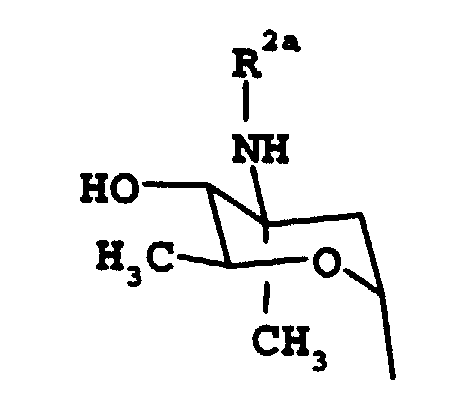
wherein R2a represents hydrogen or -CH2-R1 wherein R1 is defined as above and may be the same or different than the R1 on the N1 position; and wherein R3 represents an epivancosaminyl radical of the formula
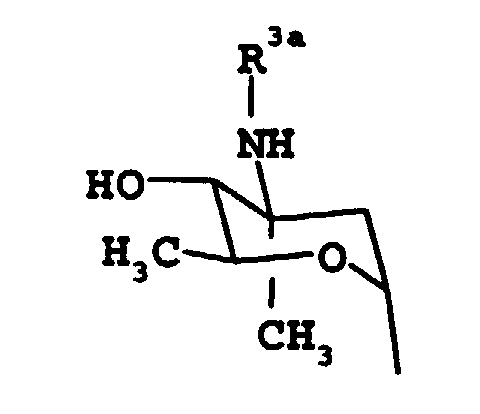
wherein R3a is hydrogen, or, when R2 is an epivancosaminyl and R2a thereon is -CH2-R1, R3a can also represent -CH2-R1 identical to that on the N1-position; or a pharmaceutically acceptable salt thereof.
wherein R1 represents
alkyl of C1-C11,
alkyl of C1-C11-R1a, or
R1a-(linker(0 or 1)-R1a)0 or 1,
wherein each R1a is independently phenyl or phenyl substituted by one or two substituents, each of which is independently halo, hydroxy, loweralkyl of C1-C8, loweralkoxy of C1-C8, loweralkylthio of C1-C4, or trifluoromethyl, and "linker" is -O-, -CH2-, or -O-(CH2)n-wherein n is 1-3; R2 represents hydrogen or an epivancosaminyl radical of the formulawherein R2a represents hydrogen or -CH2-R1 wherein R1 is defined as above and may be the same or different than the R1 on the N1 position; and wherein R3 represents an epivancosaminyl radical of the formula
wherein R3a is hydrogen, or, when R2 is an epivancosaminyl and R2a thereon is -CH2-R1, R3a can also represent -CH2-R1 identical to that on the N1-position; or a pharmaceutically acceptable salt thereof.
2. A compound of Claim 1 in which R1 is R1a -(linker(0 or 1)-R1a)0 or 1 as defined.
3. A compound of Claim 1 in which R2 is an epivancosaminyl radical wherein R2a represents -CH2-R1.
4. A compound of Claim 3 in which R2a is p-phenylbenzyl.
5. A compound of Claim 3 in which R2a is p-(p-chlorophenyl)benzyl.
6. A pharmaceutical formulation comprising a compound of Claims 1 in combination with
a pharmaceutically-acceptable diluent or carrier.
7. A method of treating a bacterial infection in a host comprising the step of administering
to the host an effective amount of a formulation of Claim 6.
8. A method of Claim 7 wherein the bacterial infection is attributable to a vancomycin-resistant-enterococcus.
9. A process for the preparation of a compound as claimed in Claim 1 which comprises
reductively alkylating a parent glycopeptide of the formula
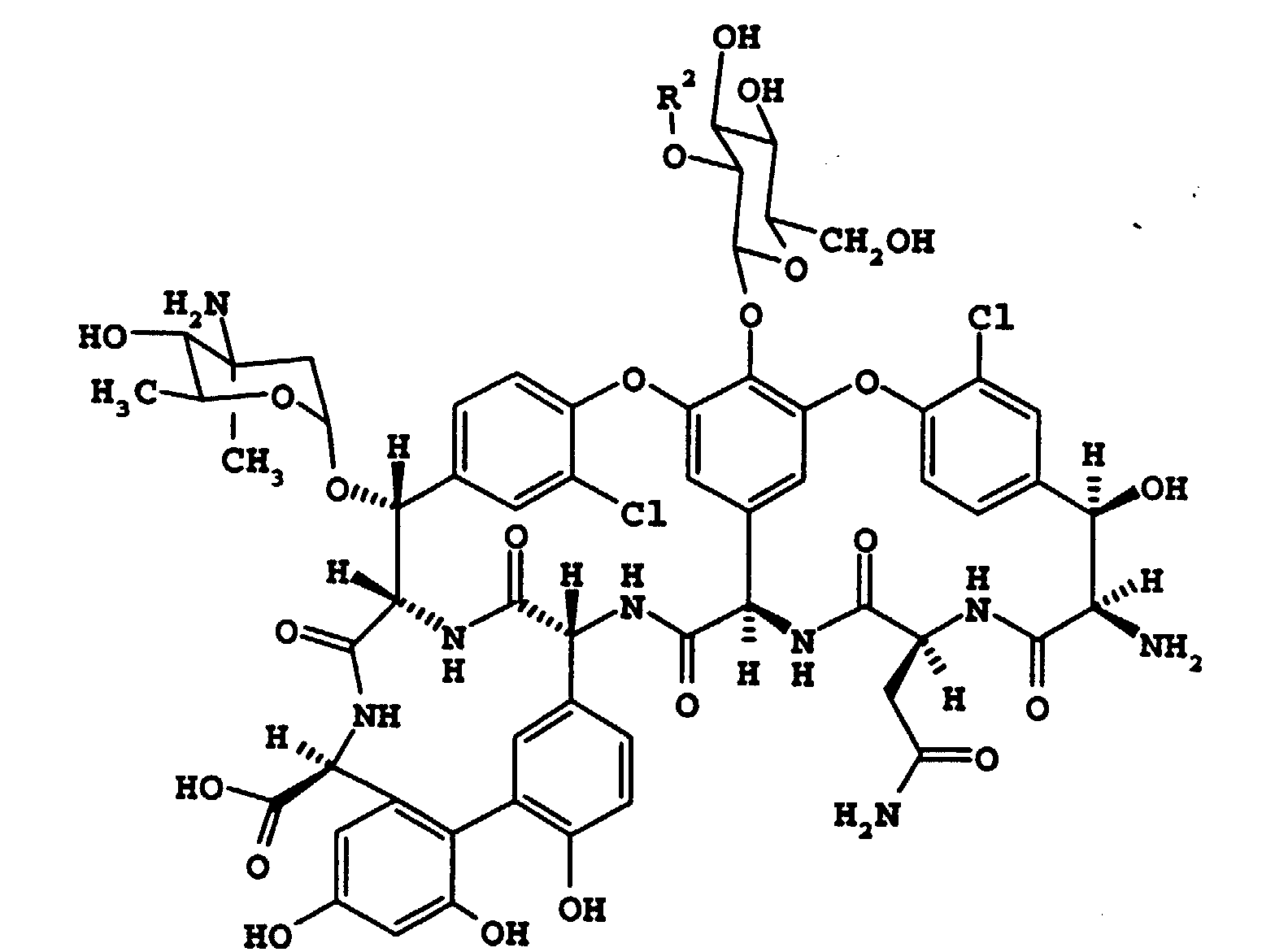
wherein R2 is as defined in Claim 1, with an aldehyde of the formula R1 CHO, wherein R1 is as defined in Claim 1, and if desired, thereafter forming a pharmaceutically acceptable salt.
wherein R2 is as defined in Claim 1, with an aldehyde of the formula R1 CHO, wherein R1 is as defined in Claim 1, and if desired, thereafter forming a pharmaceutically acceptable salt.