|
(11) | EP 0 881 464 A2 |

| (12) | EUROPEAN PATENT APPLICATION |
|
|
|
|
|||||||||||||||||||||||
| (54) | Vibratory rotation sensor |
| (57) The invention is a method for obtaining linear measures of one or more parameters
pm of a device having one or more input ports i and an output port where m takes on integer values from 1 to M, M being an integer equal to or greater than 1, and i takes on integer values from 1 to I, I being a integer equal to or greater than 1. The device causes one or more input signals
Gi(pm)Eei(t) fed into one or more input ports to be transformed into an output signal comprising
a summation over i of Gi(pm)Hi(pm)Eoi(t) at the output port. The function Gi(pm) is a weighting function associated with the i'th input port, Eei(t) is an excitation signal associated with the i'th input port, and Eoi(t) is the transformation of the excitation signal Eei(t) that results from Eei(t) traversing the path from the input port i to the output port. The signals Eei(t) and Eoi(t) are both independent of the parameter pm. The product function Gi(pm)Hi(pm) is representable by a power series of order Nim in pm, the value of Nim depending on a specified accuracy of representation. The method comprising the steps
(1)generating one or more linearizing weighting functions Gil(pm) for which the output signal is a linear measure of the parameter pm to the specified accuracy of representation, (2) feeding the input signals Gil(pm)Eei(t) into the device; and (3) using a component of the output signal as a linear measure
of each of the one or more parameters pm. |
[0001] This invention relates generally to vibratory rotation sensors and more specifically to the electronics associated with such rotation sensors.
[0002] A prior-art vibratory rotation sensor (VRS) 10 consisting of an outer member 12, a hemispherical resonator 14, and an inner member 16, all made of fused quartz and joined together with indium, is shown unassembled in Fig. 1. The inertially-sensitive element is the thin-walled, 5.8-cm-diameter hemispherical resonator 14 positioned between the outer member 12 and the inner member 16 and supported by the stem 26.
[0003] A ring forcer electrode 20 and sixteen discrete forcer electrodes 22 are deposited on the interior surface of the outer member 12. In the assembled VRS 10, the ring forcer electrode 20 and the sixteen discrete forcer electrodes 22 are in close proximity to the exterior metalized surface 32 of the hemispherical resonator 14. In the assembled VRS, eight pickoff electrodes 24 deposited on the inner member 16 are in close proximity to the interior metalized surface 30 of the hemispherical resonator 14.
[0004] Capacitive forces can be exerted on the hemispherical resonator 14 by means of appropriate forcing voltage differences between the hemispherical resonator 14 and the ring forcer electrode 20 to cause the hemispherical resonator to vibrate in the lowest-order inextensional (or flexing) mode. A standing wave is established having four antinodes at 90-degree intervals about the circumference with four nodes offset by 45 degrees from the antinodes. The 0-degree and 180-degree antinodal points oscillate 90 degrees out of phase with 90-degree and the 270-degree antinodal points. The standing wave causes the shape of the rim of the hemispherical resonator to change from circular to elliptical (with semi-major axis through the 0-degree/180-degree antinodes) to circular to elliptical (with semi-major axis through the 90-degree/270-degree antinodes.
[0005] Rotation of the VRS 10 about an axis normal to the plane of the hemispherical-resonator rim 34 causes the standing wave to rotate in the opposite direction with respect to the VRS by an angle proportional to the angle of rotation of the VRS 10. Thus, by measuring the angle of rotation of the standing wave with respect to the VRS 10, one can determine the angle of rotation of the VRS 10.
[0006] The vibrational mode of the hemispherical resonator 14 is excited by placing a DC bias voltage on the hemispherical resonator 14 and an AC voltage on the ring forcer electrode 20, the frequency of the AC voltage being twice the resonant frequency of the hemispherical resonator 14.
[0007] The standing-wave pattern angle with respect to the VRS 10 is determined by measuring the currents that flow into and out of the pickoff electrodes 24 as the hemispherical resonator 14 vibrates and the capacitances of the pickoff electrodes 24 with respect to the hemispherical resonator vary. An x axis signal Ix is obtained from the combination I0-I90+I180-I270 where the subscripts identify the angular orientations relative to the x axis of the electrodes from which the currents originate. Similarly, a y axis signal Iy is obtained from the combination I45-I135+I225-I315. The tangent of twice the standing-wave pattern angle with respect to the 0-degree (i.e. x) axis is given by the ratio of Iy to Ix.
[0008] As a result of nonuniformities in the thickness of the hemispherical resonator 14, the establishment of a first standing wave will lead to the development of a second wave oscillating in phase quadrature with antinodes coinciding with the nodes of the first standing wave. The development of a second standing wave can be inhibited by placing appropriate voltages on the sixteen discrete forcer electrodes 22.
[0009] A DC bias voltage is typically maintained on the hemispherical resonator 14 in order to reduce the magnitudes of the AC forcing voltages applied to the ring forcer electrode 20 and the discrete forcer electrodes 22 and to make the force exerted on the resonator a linear action of the AC driving voltages. The presence of the DC bias voltage results in slow changes in the electrical properties of the VRS which have been attributed to capacitance changes caused by charge-migration phenomena taking place at or within the outer member 12 and the inner member 16. These slow changes have resulted in an unacceptably large performance degradation over time and special means have to be provided to compensate for these effects.
SUMMARY OF THE INVENTION
[0010] The invention is a method for obtaining linear measures of one or more parameters pm of a device having one or more input ports i and an output port where m takes on integer values from 1 to M, M being an integer equal to or greater than 1, and i takes on integer values from 1 to I, I being an integer equal to or greater than 1. The device causes one or more input signals Gi(pm)Hi(pm)Eoi(t) fed into one or more input ports to be transformed into an output signal comprising a summation over i of Gi(pm)Hi(pm)Eoi(t) at the output port The function Gi(pm) is a weighting function associated with the i'th input port, Eei(t) is an excitation signal associated with the i'th input port, and Eoi(t) is the transformation of the excitation signal Eei(t) that results from Eei(t) traversing the path from the input port i to the output port. The signals Eei(t) and Eoi(t) are both independent of the parameter pm. The product function Gi(pm)Hi(pm) is representable by a power series of order Nim in pm, the value of Nim depending on a specified accuracy of representation. The method comprises the steps (1) generating one or more linearizing weighting functions Gil(pm) for which the output signal is a linear measure of the parameter pm to the specified accuracy of representation, (2) feeding the input signals Gil(pm)Eei(t) into the device; and (3) using a component of the output signal as a linear measure of each of the one or more parameters pm.
[0011] In a particular implementation of the method, Gil(pm) is obtained by setting Gil(pm)Hi(pm) equal to Aipm where Ai is an arbitrary constant.
[0012] In applying the method to a vibratory rotation sensor, the device becomes a vibratory rotation sensor comprising a resonator with attached resonator electrode and a housing with a plurality of attached housing electrodes. Each of the housing electrodes corresponds to an input port and the resonator electrode corresponds to the output port. The linearizing weighting function associated with a particular port i is Gil(zi) where the quantity (1+zi) is the distance between the resonator electrode and the i'th housing electrode in units of the distance between the same electrodes when the resonator is not vibrating. The linearizing weighting function Gil(zi) associated with a particular port i is proportional to zi(1+zi). In an alternative configuration, the linearizing weighting function Gil(zi) associated with a particular port i is proportional to (1-zi)(1+zi).
[0013] The parameter zi is calculated from the maximum flexing amplitudes di and dq of the inphase and quadrature vibration modes respectively expressed in the same units as zi, the angle θ between the antinodal axis of the inphase standing wave with respect to the zi electrode position, the angular frequency of vibration ω of the resonator, and the phase angle φ associated with the vibration of the resonator. Estimates of di, dq, θ, ω, and φ are provided by the vibratory rotation sensor.
[0014] In the whole-angle-tracking mode, the value of he maximum quadrature flexing amplitude dq can be set equal to zero in calculating zi and still realize a satisfactory representational accuracy of the output signal taken as a linear representation of zi. An additional simplification can be obtained by approximating
by a constant γ in calculating zi.
BRIEF DESCRIPTION OF THE DRAWINGS
DESCRIPTION OF THE PREFERRED EMBODIMENTS
[0018] An embodiment of the invention as part of a vibratory rotation sensor for which the control and readout is accomplished with multiplexed signals is described in this section. The vibratory rotation sensor consists of a resonator, a housing to which the resonator is attached, and multiplex electronics. The resonator can be any rotationally-symmetric thin-walled object having standing-wave vibration modes. The prior art typically suggests that the resonator be hemispherical in shape.
[0019] A simplified method for determining the parameters of the standing waves and controlling the dynamics of the resonator is illustrated in Fig. 2. The standing waves are describable with respect to x and y axes fixed with respect to the resonator. The orientation of the inphase standing wave with respect to the resonator can be specified by the orientation angle θ of an inphase antinodal axis measured clockwise from the x axis. The deviation of the resonator rim from a circle along the inphase antinodal axis is assumed to vary as
where ω is the vibration frequency, t is time, and φ is an arbitrary phase angle. The orientation of the quadrature standing wave with respect to the resonator is specified by the orientation angle
of a quadrature antinodal axis measured clockwise from the x axis. The deviation of the resonator rim from a circle along the quadrature antinodal axis is assumed to vary as
.
[0020] The circumferentially-continuous resonator electrode 42, deposited on the interior surface of the resonator, is biased to a DC voltage VB and is connected through a DC-blocking capacitor 43 to the amplifier-demultiplexer 44. Eight electrodes 46 attached to the VRS housing are equally spaced about the circumference in close proximity to the resonator electrode 42, the uppermost xp electrode being centered on the x-axis. The eight electrodes 46 are supplied with the driving voltages Vxp(t), Vxn(t), Vyp(t), and Vyn(t) from the multiplexer 48 where
The excitation voltages
and
are components in the xr-yr tracking-angle coordinate system of Fig. 2 (denoted by the r in the subscripts). The preferred embodiments of the excitation voltages include the sinusoids
and
. There are a variety of poriodic functions F(ωxrt +Ψxr) which may be utilized instead of the sinusoids including ordinary square waves.
[0021] The weighting functions Gxp(x), Gxn(y), Gyp(x), and Gyn(y) are functions of x and y where x and y are the flexing amplitudes of the resonator electrode 42 at the xp and yp electrode positions respectively divided by the gap between the resonator electrode 42 and the electrodes 46 when the resonator is not excited. Positive x or y values are associated with gaps that are larger than the non-excited gap, and negative x or y values are associated with gaps that are smaller. The reasons for the presence of these functions will be discussed later.
[0022] The xr-axis is rotated clockwise from the x-axis by the tracking angle θr. The excitation voltages designed not to affect the parameters of a standing wave on the resonator. The angular frequencies ωxr and ωyr and phases Ψxr and Ψyr depend on the type of multiplexing being used. The forcing voltages Vcx(t)Uxp(t), Vcx(t)Uxn(t), Vcy(t)Uyp(t), and Vcy(t)Uyn(t) (expressed as components in the x-y coordinate system) cause forces to be applied to the resonator for the purpose of controlling the parameters of the one or more standing waves on the resonator. The functions Uxp(t), Uxn(t), Uyp(t), and Uyn(t) are generated by control unit 50 and supplied to multiplexer 48. The voltages Vcx(t) and Vcy(t) are predetermined functions used to isolate the forcing voltages from the excitation voltages.
[0023] The current I(t) flowing from the resonator electrode 42 into the amplifier-demultiplexer 44 is given by
where
The capacitances Cxp, Cxn, Cyp, and Cyn are the capacitances of the xp, xn, yp, and yn electrodes 46 with respect to the resonator electrode 42. The angular frequencies ωUxp, ωUxn, ωUyp, ωUyn, are those associated with the corresponding U's and are typically equal to or less than 2ω where ω is the resonator vibration frequency. The symbol Kl denotes a constant. The phase differences between the driving voltages and the resulting currents are of no relevance and have been ignored in the equations above.
[0024] The capacitices are given by
The quantity Co is the capacitance of the electrode pairs when the resonator is not excited, and x,y, -x, and -y are the flexing amplitudes of the resonator electrodes 42 at the xp, yp, xn, and yn electrode positions respectively divided by the gap between the resonator electrode 42 and the electrodes 46 when the resonator is not excited.
[0025] Substituting for the capacitances in the current equations, we obtain
The determination of the standing wave parameters is simplified if the currents are linear functions of x and y. This result can be achieved by defining the G functions as follows:
It may be preferable to use only two G factors where
The sum of the currents then becomes
Here, we can obtain the desired linear relationships by defining the G functions as follows:
The sum of the currents I(t) is then given by
[0026] The linearization process described above as applied to vibratory rotation sensors can be generalized in the following way. Let us assume a device having one or more input ports and an output port which transforms an input signal Gi(pm)Eei(t) into an output signal consisting of the summation over i of the signals Gi(pm)Hi(pm)Eco(t). The index i takes on integer values from 1 to I which identify I input ports. The symbol pm denotes the m'th of M parameters which characterize the operation of the device and/or the environment in which it operates. The signal Eei(t) is the excitation signal associated with the i'th input port. The signal Eoi(t) is the transformation of the excitation signal Eei(t) that results from Eei(t) traversing the path from the input port i to the output port The function Gi(pm) is the weighting function associated with the i'th input port. The function Hi(pm) describes the functional dependence on pm of the transformation of the input signal at the i'th input port to the output port The transformation of the input signal into the output signal provides a means for obtaining a measure Gi(pm)Hi(pm) of pm
[0027] Let us postulate that Gi(pm)Hi(pm) can be represented by a power series of order Nim in pm where Nim depends on a specified accuracy of representation. A linearizing weighting function Gil(pm) is one which results in Gil(pm)Hi(pm) being a linear measure of pm to within the specified accuracy of representation.
[0028] The linearizing weighting action Gil(pm) can be obtained from the equation
where Aim is an arbitrary constant.
[0029] In the case of the vibratory rotation sensor discussed above, assume that the xp electrode is the input port and the resonator electrode is the output port. Then
If the input port to the vibratory rotation sensor feeds the xp electrode directly and the xn electrode through an inverter, then
[0030] The quantities x and y are expressed in terms of the vibration mode parameters by the equations
The quantities di and dq are the maximum flexing amplitudes respectively of the inphase and quadrature modes divided by the gap between the resonator electrode 42 and the electrodes 46 when the resonator is not excited, θ is the angle between the antinode of the inphase standing wave and the x-axis, ω is the angular frequency of vibration of the resonator, and φ is a arbitrary phase angle.
[0031] The quantities x and y are not directly available in the vibratory rotation sensor, but can be determined from the equations above. Since the quantity dq is maintained near zero, x and y can also be approximated by the first terms in the expressions above. In the whole-angle-tracking mode, the tracking angle θr is maintained nearly equal to θ. Consequently, θr can be substituted for θ in the equations above. These approximations to x and y generally result in an output signal that includes components that can be taken as linear representations of x and y with an acceptable accuracy of representation.
[0032] A further approximation is to use only the first terms in the equations above and replace the quantity cos(ωt+φ) by a constant γ. Analysis shows that a value of (3/4)½ for γ will provide adequate accuracy.
[0034] The current I(t) is transformed into the voltage V(t) by the amplifier-demultiplexer 44:
where KV and KF are constants,
and
The signals Rx(t) and Ry(t) are the desired outputs from a demultiplexing process applied to V(t) since they contain the standing wave parameters di, dq, θ-θr, ω, and φ.
[0035] Signals Sx(t) and Sy(t) containing the signals Rx(t) and Ry(t) are extracted by amplifier-demultiplexer 44. The operating principle of the demultiplexer portion of the amplifier-demultiplexer 44 depends on the form of the voltages Vmxr(t), Vmyr(t), Vcx(t), Vcy(t) and the values of ωxr, ωyr, Ψxr, and Ψyr.
[0036] For frequency-division multiplexing, Vmxr(t), Vmyr(t), Vcx(t), and Vcy(t) are all equal to a constant, ωxr, ωyr, and |ωxr-ωyr| are greater than about 6ω, and Ψxr, and Ψyr are arbitrary constants. The signals Rx(t) and Ry(t) which contain the standing-wave parameters are obtained by performing two product demodulations of V(t), one with respect to cos(ωxrt+Ψxr) and the other with respect to cos(ωyrt+Ψyr). If a periodic function other than a sinusoid is being used, then the demodulations proceed using replicas of the periodic functions. A product demodulation consists of multiplying the input voltage by the reference sinusoid (or replica) and lowpass filtering the product, the cutoff frequency of the lowpass filter being about 3ω. The results of the above process are the signals SFDMx(t) and SFDMy(t):
where KFDM is a constant. Because the upper limit to the frequency spectrums of Fx(t) and Fy(t) are about 3ω, these quantities are eliminated by the demultiplexing process.
[0037] For phase-vision multiplexing, ωxr and ωyr have the same value ωo, ωo being greater than about 6ω, and Ψxr-Ψyr is equal to π/2 radians. The signals SPDMx(t) and SPDMy(t) are obtained by performing product demodulations of V(t) with respect to cos(ωot+Ψx) and with respect to cos(ωot+Ψy) (or with respect to replicas of the periodic functions being used).
where KPDM is a constant.
[0038] For one form of time-division multiplexing, ωxr and ωyr have the same value ωo with ωo being greater than about 6ω and Ψxr, and Ψyr are equal to an arbitrary number Ψo. The voltages Vmxr(t) and Vmyr(t) are proportional to square waves which take on values of 0 and 1, only one of which being equal to 1 at any given time and the duration of a "1" value being equal to an integer times 2π/ω. The voltages Vcx(t), and Vcy(t) are both equal to a constant. The signals STDMx(t) and STDMy(t) are obtained by performing a product demodulation of V(t) with respect to cos(ωot+Ψo) (or replica) followed by parallel multiplications with Vmxr(t) and Vmyr(t):
where KTDM is a constant. It should be noted that Rx(t) and Ry(t) are available only when Vmxr(t) and Vmyr(t) are non-zero.
[0039] The same results are obtained (except possibly for the value of the constant KTDM) if Vmxr(t), Vmyr(t), Vcx(t), and Vcy(t) are proportional to square waves which take on values of 0 and 1, only one of the square waves being equal to 1 at any given time, and the duration of a "1" value being equal to an integer times 2π/ω. This mode of operation may be desirable in that it completely isolates the forcing voltages Vcx(t)Uxp(t), Vcx(t)Uxn(t), Vcy(t)Uyp(t), and Vcy(t)Uyn(t) from each other and from the excitation voltages Vmxr(t)cos(ωot+ψo) and Vmyr(t)cos(ωot+Ψo).
[0040] For another form of time-division multiplexing, ωo equals and Vmxr(t), Vmyr(t), Vcx(t), and Vcy(t) are proportional to square waves which take on values of 0 and 1, only one of the square waves being equal to 1 at any given time, and the duration of a "1" value being equal to a integer times 2π/ω. Multiplying V(t) in parallel operations by Vmxr(t) and by Vmyr(t) gives the same results as in the first form of time-division multiplexing.
[0041] For code-division multiplexing, ωxr, ωyr, Ψxr, and Ψyr are all equal to 0, Vcx(t), and Vcy(t) are constants, and Vmxr(t) and Vmyr(t) are proportional to square waves which take on pseudo-random sequences of values of - 1/T and 1/T and satisfy the following conditions:
where the subscripts i and j stand for any of the subscripts mxr, myr, cx, and cy. The integration time interval T should be less than 2π/3ω. The signals SCDMx(t) and SCDMy(t) are obtained by separately multiplying V(t) by Vmxr(t) and Vmyr(t) and then integrating over T:
where KTDM is a constant and n is a integer. It should be noted that the signals SCDMx(t) and SCDMy(t) provide information concerning the standing-wave parameters at intervals of T.
[0042] The voltages Ux(t) and Uy(t) typically may include three components:
where the subscripts a, q, and r identify the amplitude, quadrature and rate control voltages. It is not necessary to isolate these components from one another in all applications. However, if isolation is desired, the following substitutions can be made in the foregoing equations.
With these substitutions, any constraints imposed on Vcx(t) and Vcy(t) also apply to Vcax(t), Vcqx(t), Vcrx(t), Vcay(t), Vcqy(t), and Vcry(t) For example, equations (1) become
[0043] One possible time-division-multiples configuration is a sixteen-slot frame of duration 32π/ω synchonized to the flexure rate of the resonator. The multiplex control voltages are as shown in Fig. 3. When θr equals θ, the xr axes coincide with the antinodal axes and the yr axes coincide with the nodal axes. Eight slots are assigned to reading out the yr signal component, 4 slots to reading out the xr signal component, and 1 slot each to applyinf amplitude, quadrature, and rate forces to the resonator. For a vibration fiequency of 4 kHz, readouts of the xr and yr signal components would be available at a rate of 2 kHz and 1 kHz respectively. The control voltages would be applied at a rate of 0.25 kHz.
[0044] In general, the signals Sx(t) and Sy(t) exiting from the amplifier-demultiplexer 44 have the form
where KVx and KVy each equals KV except in the case of time-division multiplexing when KVx equals KVVmx(t) and KVy equals KVVmy(t).
[0045] In order to extract the standing-wave parameters ffom the signals Sx(t) and Sy(t), a stable and precise replica of the resonator vibration signal cos(ωt+φ) is required. The replica is obtained from a voltage-controlled oscillator in replica generator 52 wherein the voltage-controlled oscillator is phase-locked to the in-phase standing-wave antinodal signal. The first step of the process is to multiply Sx(t) and Sy(t) first by the replica signal cos(ωrt+φr) and lowpass filter the results and then by the phase-shifted replica sin(ωrt+φr) and lowpass filter the results. The results of this process are:
where K is a constant.
[0046] The next step is to form the following combinations of products of the Six(t), Siy(t), Sqx(t), and Sqy(t):
With Li(t) as the error signal, the phase-locked loop will lock up with the replica phase φr equal to φ and ωr equal to ω.
[0047] The difference between the standing-wave orientation angle and the tracking angle θ-θr, can be determined from the equation
and the signs of Six(t) and Siy(t). The quantity S(t) can be used as the error signal in a control loop which generates θr and causes on average θ to equal θr and d/dt(θ - θr) to equal 0. The digitally-synthesized tracking angle θr is used in generating
and
which are supplied to the multiplexer 48. With φr equal to φ, ωr equal to ω, and θr equal to θ, the quantities di and dq can be determined from the first and fourth of equations 28.
[0049] The difference between E(t) and a specified number is used as the error signal in the amplitude control loop which causes the total energy in the combined inphase and quadrature standing waves, which is proportional to di2 + dq2 , to equal the specified number.
[0050] The quantity Q(t) is used as the error signal in the quadrature control loop which results in the quadrature standing-wave amplitude dq to be zero. When this loop is closed, the amplitude control loop maintains the inphase amplitude di at a specified value.
[0051] The use of the above control variables can be shown to be optimum. It will be apparent to those skilled in the art that there are many choices of control variables that are suboptimium but still practical.
[0052] The outputs of the control unit 50 are the functions Uxp(t), Uxn(t), Uyp(t), and Uyn(t) together with di, dq, the sine and cosine of ωrt+φr, and the sine and cosine of 2θr, which are all supplied to multiplexer 48.
[0053] Additional details concerning vibratory rotation sensors are contained in U.S. Patent 4,951,508 by Loper, Jr. et al. dated August 28, 1990 which is incorporated by reference.
[0054] According to its broadest aspect the invention relates to a method for obtaining linear measures of one or more parameters pm of a device having one or more input ports i and an output port, m taking on integer values from 1 to M, M being an integer equal to or greater than 1, i taking on integer values from 1 to I, I being an integer equal to or greater than 1, the device causing one or more input signals Gi(pm)Eei(t) fed into one or more input ports to be transformed into an output signal.
1. A method for obtaining linear measures of one or more parameters pm of a device having one or more input ports i and an output port, m taking on integer values from 1 to M, M being an integer equal to or greater than 1, i taking on integer values from 1 to I, I being an integer equal to or greater than 1, the device causing one or more input
signals Gi(pm)Eei(t) fed into one or more input ports to be transformed into an output signal comprising
a summation over i of Gi(pm)Hi(pm)Eoi(t) at the output port, Gi(pm) being a weighting function associated with the i'th input port, Eei(t) being an excitation signal associated with the i'th input port, Eoi(t) being the transformation of the excitation signal Eei(t) that results from Eei(t) traversing the path from the input port i to the output port, Eei(t) and Eoi(t) being independent of the parameter pm, the product function Gi(pm)Hi(pm) being representable by a power series of order Nim in pm, the value of Nim depending on a specified accuracy of representation, the method comprising the steps:
generating one or more linearizing weighting functions Gil(pm) for which the output signal is a linear measure of the parameter pm to the specified accuracy of representation;
feeding the input signals Gil(pm)Eei(t) into the device;
using a component of the output signal as a linear measure of each of the one or more parameters pm.
2. The method of claim 1 wherein Gil(pm)Hi(pm) is equal to Aimpm where Aim is a arbitrary constant.
3. The method of claim 1 wherein the device is a vibratory rotation sensor comprising
a resonator with attached resonator electrode and a housing with a plurality of attached
housing electrodes, each of the housing electrodes being a input port ad the resonator
electrode being the output port, the linearizing weighting function associated with
a particular port i being Gil(zi), the quantity (1+zi) being the distance between the resonator electrode and the i'th housing electrode in units of the distance between the same electrodes when the
resonator is not vibrating.
4. The method of claim 3 wherein the linearizing weighting function Gil(zi) associated with a particular port i is proportional to zi(1+zi).
5. The method of claim 3 wherein the linearing weighting function Gil(zi) associated with a particular port i is proportional to (1-zi)(1+zi).
6. The method of claim 3 wherein zi is calculated from the maximum flexing amplitudes di and dq of the inphase and quadrature vibration modes respectively expressed in the same
units as zi, the angle θ between the antinodal axis of the inphase standing wave with respect
to the zi electrode position, the angular frequency of vibration ω of the resonator, and the
phase angle φ associated with the vibration of the resonator, estimates of di, dq, θ, ω, and φ being provided by the vibratory rotation sensor.
7. The method of claim 6 wherein the value of the maximum quadrature flexing amplitude
dq is set equal to zero in calculating zi.
8. The method of claim 7 wherein
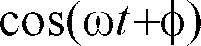
is approximated by a constant γ in calculating zi.
is approximated by a constant γ in calculating zi.
9. A method for obtaining linear measures of one or more parameters pm of a device having one or more input ports i and an output port, m taking on integer values from 1 to M, M being an integer equal to or greater than 1, i taking on integer values from 1 to I, I being an integer equal to or greater than 1, the device causing one or more input
signals Gi(pm)Eei(t) fed into one or more input ports to be transformed into a output signal.