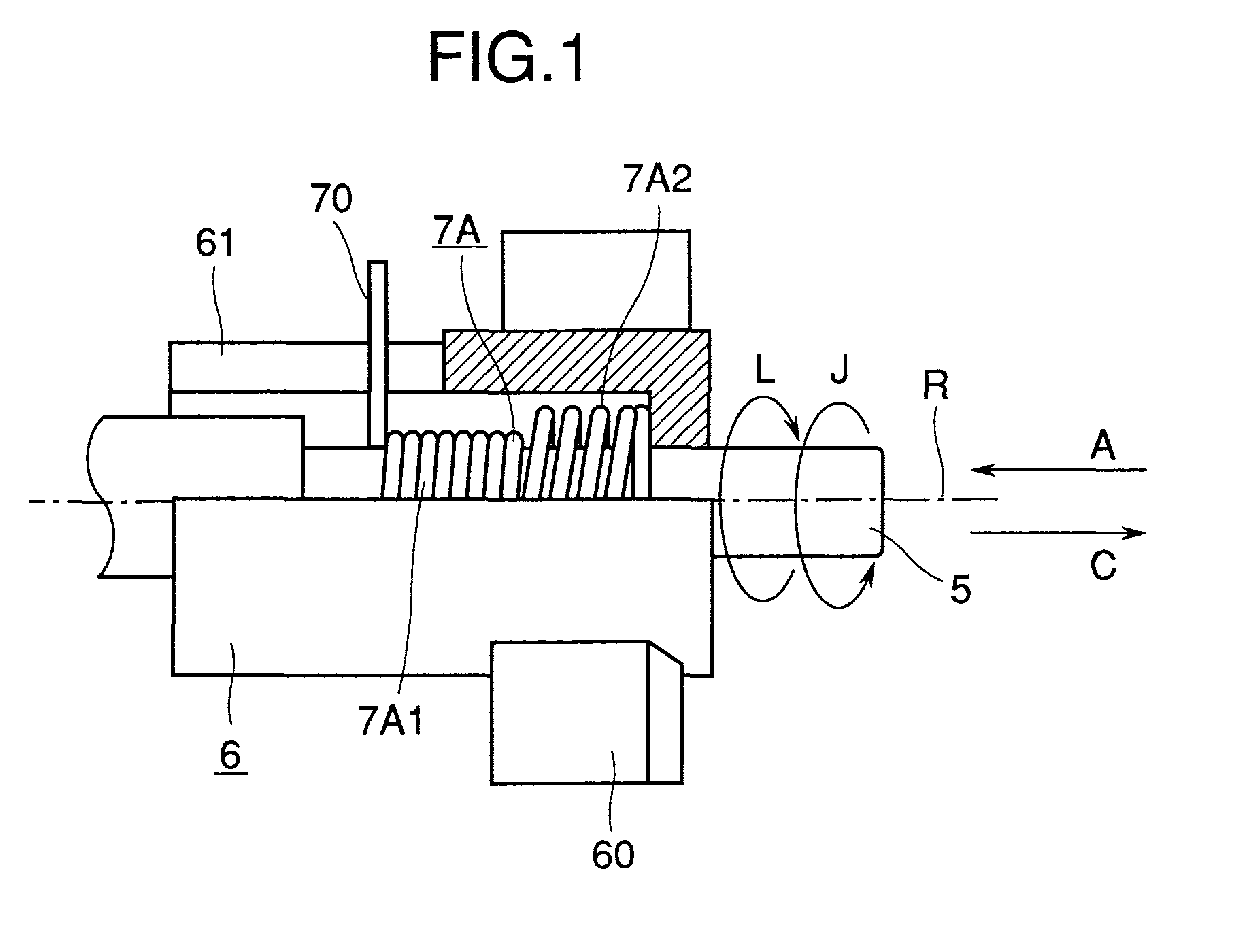
(57) A one way clutch includes a shaft (5), a rotation-transmitting member (7), and a
rotating member (6, 6A, 6B, 6C, 6D, 6E). The rotating shaft (5) is rotatable about
its rotational axis (R) in a first direction (J) and in a second direction (L) opposite
to the first direction (J). The rotating shaft (5) extends through the rotation-transmitting
member (7) which is in the form of a coil spring. When the shaft (5) rotates in the
second direction (L), the spring (7) tightly engages the shaft (5) and rotates together
with the shaft (5) to transmit rotation of the shaft (5) to the rotating member (6,
6A, 6B, 6C, 6D, 6E). When the shaft (5) rotates in the first direction (J), the spring
(7) loosely engages the shaft (5) not to transmit the rotation of the shaft (5) to
the rotating member (6, 6A, 6B, 6C, 6D, 6E). The rotating member (6, 6A, 6B, 6C, 6D,
6E) fits over and engages the spring (7) such that the rotating member (6, 6A, 6B,
6C, 6D, 6E) is axially movable along, but not rotatable relative to the spring (7).
The rotating member (6, 6A, 6B, 6C, 6D, 6E) is yieldably biased in a third direction
parallel to the rotational axis such that the rotating member (6, 6A, 6B, 6C, 6D,
6E) is allowed to yieldably move in a fourth direction opposite to the third direction
when an external rotational load is applied to the rotating member in the fourth direction.
Thus, the rotating member (6, 6A, 6B, 6C, 6D, 6E) is prevented from being locked.
|
|
