(57) An adaptive filter which is realized as an FIR filter employing stochastic gradient
algorithm comprises a step size controller for controlling step size αc(n) so as to minimize the mean squared estimation error ε(n) at each time n. The step size controller regards a step size αc(n)opt which satisfies δε(n+1)/δαc (n) opt = 0 at each time n as a theoretical optimum step
size, and sets the step size αc(n) at each time n so as to be approximately equal to the theoretical optimum step size
αc(n)opt. For example, when the adaptive filter employs stochastic gradient sign algorithm
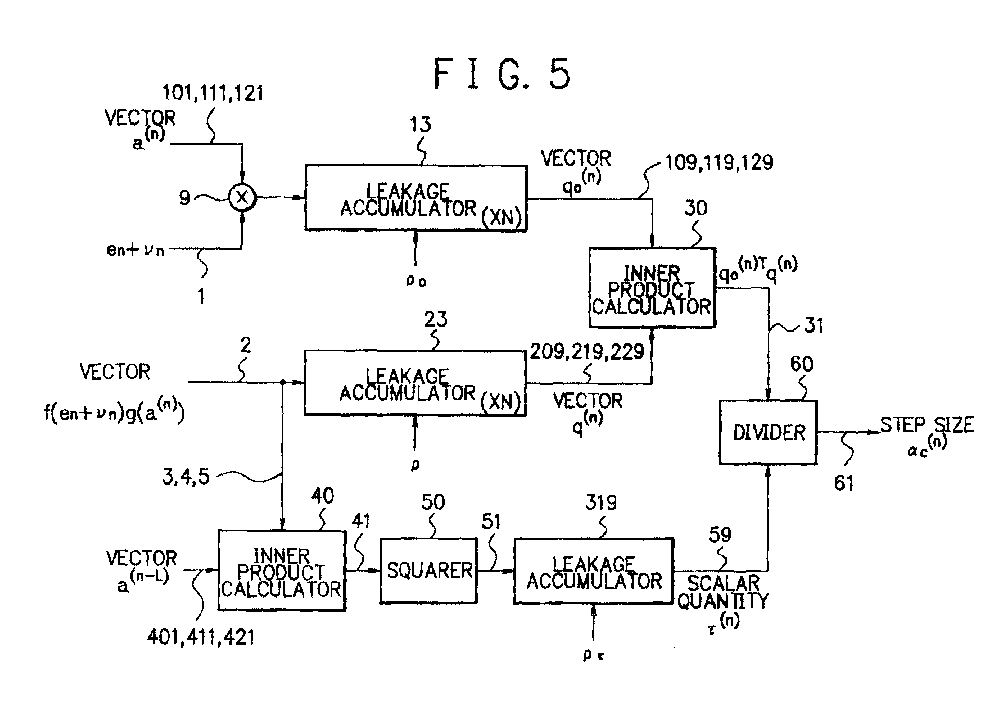
as the tap weight control algorithm, the step size controller provided with a leakage
accumulator (13) calculates a vector q(n) one by one according to the update equation: q(n+1) = (1-ρ)q(n) + ρsgn(en + νn) (|en
+ νn|)1/2 a(n) (ρ : leakage coefficient, en: an error signal sequence component, νn: an additive noise sequence component, a(n): an input signal sequence vector), and sets the step size αc(n) at each time n as: αc (n) = β ∥ q(n) ∥ 2 (β = 1.07870520/trace(Ra2), Ra = E[a(n)a(n)T]).
By the step size controller, both faster convergence of the adaptive filter and smaller
residual mean squared estimation error after convergence can be attained.
|
|
