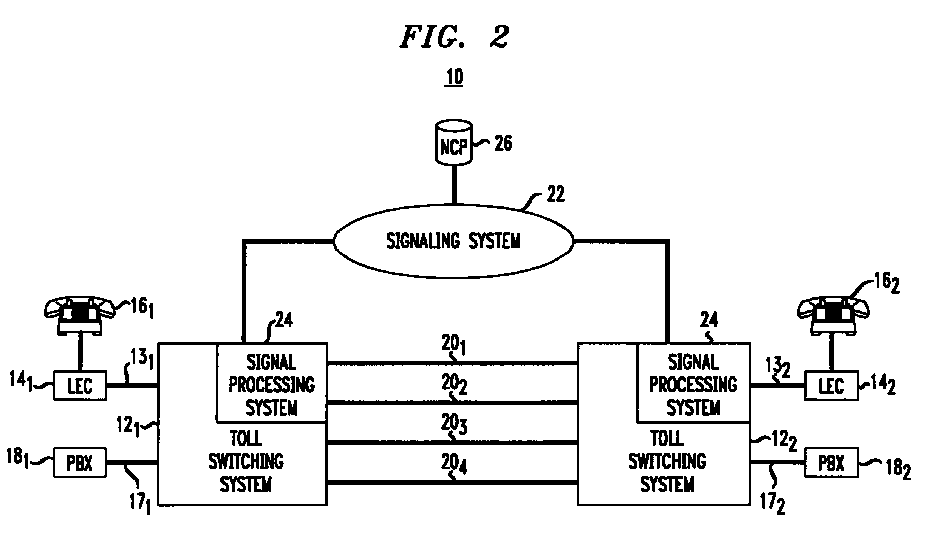
(57) A telecommunications network (10) includes an Originating Switching System (121) and a Terminating Switching System (122) linked by a plurality of trunks (201-204). For an incoming call it receives, the Originating Switching System establishes
a Circuit Selection Capability Indicator (CSCI) that determines what enhancement,
if any, the Originating Switching System will provide to the call. The Originating
Switching System also utilizes the CSCI to select an appropriate trunk that is compatible
with type of call enhancement, if any, to route the call to the Terminating Switching
System which also enhances the call in accordance with the CSCI. The signal processing
system per-all-control (SPCC) concept allows different types of calls which are routed
on the same trunk to get different call quality enhancements (such as True Voice®
and Echo Control), depending on the call type. SPCC allows a call quality enhancement
to be applied to an individual call on a per call basis, and these enhancements can
be different at the OSS and TSS, which could give different types of enhancements
to the calling party and called party. SPCC allows new signal processing "sound flavors",
to be developed on the SPS, and these new sound flavors offered as a new service feature
through CSCI Table updates in the switch, without software development. The SPCC concept
provides an evolutionary path for current overlay networks implemented for specialized
signal processing requirements, in particular the dedicated TV off network for True
Voice® enhancement avoidance, and the dedicated EC off network to avoid echo cancellation
for example for SDS services. The PCC capability of SPCC trunks allows the control
of the TV Enhancement and the Echo Cancellation on a per call basis, thereby allowing
the SPCC trunks to be used in a shared manner for calls requiring TV enhancement,
calls requiring TV enhancement avoidance, and for data calls requiring no echo cancellation.
The benefits are a) a very flexible per-call-control capability within a single integrated
network, b) cost effectiveness, c) robustness to load surges, and d) improved network
efficiency.
|
|
