| (19) |
 |
|
(11) |
EP 0 887 132 A3 |
| (12) |
EUROPEAN PATENT APPLICATION |
| (88) |
Date of publication A3: |
|
14.11.2001 Bulletin 2001/46 |
| (43) |
Date of publication A2: |
|
30.12.1998 Bulletin 1998/53 |
| (22) |
Date of filing: 29.05.1998 |
|
|
| (84) |
Designated Contracting States: |
|
AT BE CH CY DE DK ES FI FR GB GR IE IT LI LU MC NL PT SE |
|
Designated Extension States: |
|
AL LT LV MK RO SI |
| (30) |
Priority: |
04.06.1997 JP 14633697
|
| (71) |
Applicant: MITSUI MINING & SMELTING CO., LTD. |
|
Tokyo (JP) |
|
| (72) |
Inventors: |
|
- Hayashi, Takao
Shimonoseki-shi, Yamaguchi (JP)
- Nakamura, Yoshinobu
Shimonoseki-shi, Yamaguchi (JP)
- Shimamura, Hiroyuki
Tokyo (JP)
|
| (74) |
Representative: Casalonga, Axel et al |
|
BUREAU D.A. CASALONGA - JOSSE Morassistrasse 8
80469 München
80469 München (DE) |
|
| |
|
| (54) |
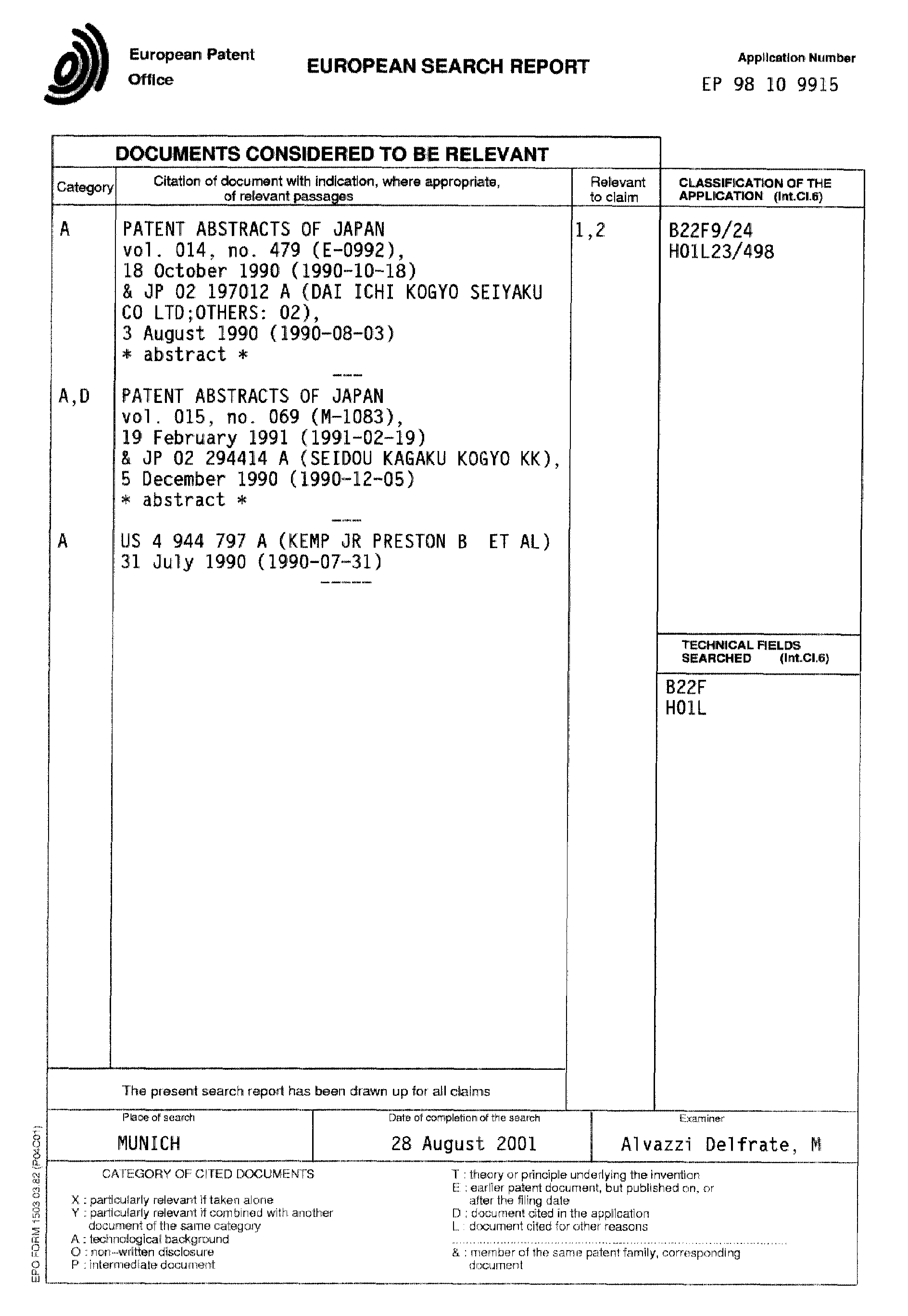
Copper fine powder and method for preparing the same |
(57) Copper fine powder has an electrical resistance in its powdery state of not more
than 1×10
-3Ω·cm; a BET specific surface area ranging from 0.15 to 0.3 m
2/g; a tap density of not less than 4.5 g/cc; a product of the tap density and the
particle size, of not less than 13, the particle size being calculated from the specific
surface area and ; a particle size distribution observed in the microtrack measurement
as expressed in terms of D
50 and D
90 ranging from 4 to 7 µm and 9 to 11 µm, respectively; and a weight loss through hydrogen-reduction
of not more than 0.30%. The copper fine powder is prepared by adding an alkali hydroxide
to an aqueous copper salt solution containing divalent copper ions maintained at not
less than 55 °C in an amount of not less than the chemical equivalent to form cupric
oxide; then gradually adding a reducing sugar to the reaction system while maintaining
the temperature of the system to not less than 55°C to reduce the cupric oxide to
cuprous oxide; followed by filtration and washing, re-suspension to form a slurry,
gradual addition of a hydrazine reducing agent to the slurry in the presence of a
pH buffer capable of maintaining the pH to 5.5 to 8.5 to thus reduce the cuprous oxide
to metal copper.