|
(11) | EP 0 887 703 A1 |

| (12) | EUROPEAN PATENT APPLICATION |
|
|
|
|
|||||||||||||||||||||||
| (54) | Light-sensitive silver halide color photographic material |
| (57) Light- sensitive silver halide color photographic multilayer material which comprises
a support base having coated thereon at least a blue light sensitive silver halide
emulsion layer, associated with yellow dye forming couplers, containg a) a yellow
dye forming DIR coupler having a 1,2,4-triazolyl group attached to the coupling position,
from which the 1,2,4-triazolyl group is released during development, such 1,2,4-triazolyl
group comprising an alkoxy- or aryloxy-carbonyl hydrolizeable group attached to a
benzylthio substituent on the 1,2,4-triazolyl group, and b) a yellow dye forming malonodiamino
DIR coupler in the coupling position having a group which supplies a compound with
development inhibiting properties when the group is released from the coupling position
during development, wherein said group is a 4,7-dihalogen-2-benzotriazolyl group. |
FIELD OF THE INVENTION
[0001] The present invention refers to a light-sensitive silver halide color photographic multilayer material, in at least one blue light-sensitive layer associated with yellow dye forming couplers containing the combination of two different DIR (Development Inhibitor Releasing) couplers capable of releasing a development inhibiting compound upon reaction with the developing agent oxidation product.
STATE OF THE ART
[0002] Light-sensitive color photographic materials, which make use of the substractive process for color reproduction, are known to comprise silver halide emulsion layers which are selectively sensitive to blue light, green light and red light and are associated with yellow dye, magenta dye and cyan dye forming couplers which (upon reaction with a primary amine type oxidized color developing agent) form complementary colors. For instance, a acylacetanilide type coupler is used to form a yellow colored image; a pyrazolone, pyrazolotriazole, cyanacetophenone or indazolone type coupler is used to form a magenta colored image; a phenolic, such as phenole or naphthole, type coupler is used to form a cyan colored image.
[0003] Usually, light-sensitive color photographic materials comprise non-diffusing couplers independently incorporated in each light-sensitive layer of the material (incorporated coupler materials). Consequently, a light-sensitive color photographic material in general comprises a blue-sensitive silver halide emulsion layer (or layers) which contains a yellow coupler and is mainly sensitive to blue light (substantially to wavelengths lower than about 500 nm), a green-sensitive silver halide emulsion layer (or layers) which contains a magenta coupler and is mainly sensitive to green light (substantially to wavelengths between about 500 and 600 nm) and a red- sensitive silver halide emulsion layer (or layers) which contains a cyan coupler and is mainly sensitive to red light (substantially to wavelengths higher than about 590 nm).
[0004] It is also known to incorporate in a light-sensitive color photographic material a compound which during development is capable of releasing a development inhibitor upon reaction with the oxidation product of a color developer agent. Typical examples of such compounds are DIR couplers which have a group with development inhibiting properties when it is released by the coupler itself. These groups are introduced into the coupling position of the coupler. Examples of DIR couplers are described by C.R. Barr, J.R. Thirtle and P.W. Wittum, Photographic Science and Eng., vol. 13, pp. 74-80 (1969) and ibid. pp. 214,217 (1969, or in US patents 3,227,554; 3,615,506; 3,617,291; 3,701,783; 3,933,500; 4,095,984; 4,146,396; 4,149,886 and 4,477,563.
[0005] The purpose of DIR couplers is that of reducing granularity and improving image sharpness through intralayer or intraimage effects (i.e. within the same layer or the same colored image) and improving color reproduction through interlayer or interimage effects within different layers or different colored images). Usually, however, in the light-sensitive emulsion layer where DIR couplers are used, they cause interimage effects mainly in the high density regions of the negative image, while it is often desirable to have interimage effects in low density regions, which much more affect the image characteristics such as color saturation and brilliancy.
[0006] The concept of using two or more different DIR compounds in light-sensitive materials was described for instance in US 4,015,988 which teaches the use of a DIR coupler with a DIR hydroquinone compound. The combination did not however give positive results due to a large desensitization of the hydroquinone DIR compound. Patent application JP 51-113,625 describes the simultaneous use of mercapto type compounds which release the development inhibitor, such compounds having different coupling activities. Patent application JP 56-137,353 describes the simultaneous use of development inhibitor releasing compounds, one of which having a "timing" group and the other not having such "timing" group. DD patent 246,636 describes the use of a combination of two DIR compounds, the former defined as a movable compound and the latter as an unmovable one. US 4,355,100 describes the simultaneous use of two development inhibitor releasing compounds, the former having an amino group and the latter not having such amino group. US 5,126,236 describes the combination of DIR compounds or of DIR precursors or of compounds which release a DIR compound upon reaction with the oxidized developer agent.
[0007] However, all above cited patents, where the combination of at least two DIR compounds is described, do not solve the problem of obtaining a better interimage effect and a better granularity and, at the same time, less sensitivity decreases.
[0008] Patent application EP 747,763 describes a DIR yellow coupler of the type having a 1,2,4-triazolyl group attached to the coupling position, from which the 1,2,4-triazolyl group is released during development, such 1,2,3-triazolyl group comprising a hydrolizable alkoxy- or aryloxy-carbonyl group attached to a benzylthio substituent on the 1,2,4-triazolyl group.
[0009] US 5,006,452 on the contrary describes a color photographic material containing a DIR coupler having a 4,7-dihalogen-2-benzotriazolyl type group which is released during development upon oxidation with a developer agent. US 5,332,656 describes a color photographic material containing the combination of a) a yellow dye forming diketomethylene coupler in its active coupling position having a 4,7-dihalogen-2-benzotriazolyl group which provides a compound having development inhibiting properties when the group is released from the active coupling position upon color development reaction, and b) a yellow dye forming alkoxybenzoyl-acetanilide coupler having a releasable 3-hydantoine group linked to the active coupling position.
[0010] An object of the present invention is that of obtaining, for medium and low speed films, a higher inhibition action given by DIR couplers to obtain a reduced granularity, above all in low density regions where the granularity problems are more severe, and a higher color purity. It is another object of the present invention that of obtaining better interimage effects, but at the same time reducing to the minimum the sensitivity decrease in all layers.
SUMMARY OF THE INVENTION
[0011] A light-sensitive silver halide color photographic multilayer material which comprises a supporting base having coated thereon at least one blue light-sensitive silver halide emulsion layer, associated with yellow dye forming couplers, containing a) a yellow dye forming DIR coupler having a 1,2,4-triazolyl group attached to the coupling position thereof, from which the 1,2,4-triazolyl group is released during development, such 1,2,4-triazolyl group comprising a hydrolizable alkoxy- or aryloxy-carbonyl group attached to a benzylthio substituent on the 1,2,4-triazolyl group and b) a yellow dye forming malonodiamide DIR coupler having, in the coupling position thereof, a 4,7-halogen-2-benzotriazolyl group which gives a compound having development inhibiting properties when the group is released from the coupling position during development.
[0012] Said light-sensitive silver halide color material containing the yellow- dye forming DIR coupler combination, upon exposure and development, gives color images having a reduced granularity and a higher color purity, reducing to the minimum the speed decrease of all layers.
DETAILED DESCRIPTION OF THE INVENTION
[0013] Yellow dye forming DIR couplers having a 1,2,4-triazolyl group attached to the coupling position thereof, to be used in the present invention, may be represented by the following formula (I):
wherein
R1 represents an alkyl, aryl or NHR5 group, where R5 is an alkyl or aryl group, R2 represents an alkyl or aryl group, TIME represents a "timing" group,
n is 0 or 1, R3 represents an alkyl group or phenyl group, and R4 represents a hydrogen atom or an alkyl group.
[0014] In formula (I) above, the alkyl group represented by R1, R2 and R5 preferably has from 1 to 18 carbon atoms and may be substituted or unsubstituted. Preferred examples of alkyl group substituents comprise an alkoxy, aryloxy, cyano, amino, acylamino group, a halogen atom, a hydroxy, carboxy, sulfo, heterocyclic group, etc. Practical examples of useful alkyl groups are an iso-propyl, iso-butyl, tert.-butyl, iso-amyl, tert.-amyl, 1,1-dimethylbutyl, 1,1-dimethythexyl, 1,1-diethylhexyl, 1,1-dimethyl-1-methoxyphenoxymethyl, 1,1-dimethyl-1-ethylthiomethyl, dodecyl, hexadecyl, octadecyl, cyclohexyl, 2-methoxyisopropyl, 2-fenoxyisopropyl, α-aminoisopropyl, α-sucinimidoisopropyl group.
[0015] The aryl group represented with R1, R2 and R5 preferably has a total of from 6 to 35 carbon atoms and comprises in particular a substituted phenyl group and an unsubstituted phenyl group. Preferred examples of substituents in the aryl group comprise a halogen atom, a nitro, cyano, thiocyano, hydroxy, alkoxy (preferably having from 1 to 15 carbon atoms, such as methoxy, isopropoxy, octyloxy, etc.), aryloxy (phenoxy, nitrophenoxy, etc.), alkyl (preferably having form 1 to 15 carbon atoms, such as methyl, ethyl, dodecyl, etc.), alkenyl (preferably having from 1 to 15 carbon atoms, such as allyl), aryl (preferably having from 6 to 10 carbon atoms, such as phenyl, tolyl, etc.), amino (for example an unsubstituted amino group or an alkylamino having from 1 to 15 carbon atoms, such as diethylamino, octylamino, etc.), carboxy, acyl (preferably having from 2 to 16 carbon atoms, such as acetyl, decanoyl, etc.), alkoxycarbonyl (preferably having a 1 to 20 carbon atom alkyl unit, such as methoxycarbonyl, butoxycarbonyl, octyloxycarbonyl, dodecyloxycarbonyl, 2-methoxyethoxycarbonyl, etc.), aryloxycarbonyl (preferably having a 6 to 20 carbon atom alkyl unit, such as phenoxycarbonyl, tolyloxycarbonyl, etc.), carbamoyl (such as ethylcarbamoyl, octylcarbamoyl, etc.), acylamino (preferably having from 2 to 21 carbon atoms, such as acetamido, octanamido, 2,4-ditert.-pentyl-fenoxyacetamido, etc.), sulfo, alkylsulfonyl (preferably having from 1 to 15 carbon atoms, such as methylsulfonyl, octylsulfonyl, etc.), arylsulfonyl (preferably having from 6 to 20 carbon atoms, such as phenylsulfonyl, octylphenylsulfonyl, etc.), alkoxysulfonyl (preferably having from 1 to 15 carbon atoms, such as methoxysulfonyl, octyloxysulfonyl, etc.), aryloxysulfonyl (preferably having from 6 to 20 carbon atoms, such as phenoxysulfonyl, etc.), sulfamoyl (preferably having from 1 to 15 carbon atoms, such as diethylsulfamoyl, octylsulfamoyl, methyloctadecylsulfamoyl, etc.), sulfonamino group (preferably having from 1 to 15 carbon atoms, such as methylsulfonamino, octylsulfonamino, etc.), and the like.
[0016] TIME is a "timing" group which links the coupler residue with 1,2,4-triazolyl group and is released together with 1,2,4-triazolyl group during the coupling reaction with the oxidation product of a color developing agent and in its turn releases the 1,2,4-triazolyl group later on during development. Examples of timing groups represented with TIME in formula (I) comprise for examples the following groups:
wherein Z is an oxygen or sulfur atom and is attached to the couplers, m is 0 or 1, R8 is hydrogen or an alkyl with from 1 to 4 carbon atoms or an aryl group from 6 to 10 carbon atoms, X is hydrogen, halogen, cyano, nitro, alkyl with 1 to 20 carbon atoms, alkoxy, alkoxycarbonyl, acylamino, aminocarbonyl group, etc., as described in US 4,248,962,
where the left portion is attached to the coupler and Z is oxygen or sulfur or
R9, R10 and R11 each are hydrogen, alkyl or aryl groups and Q is a 1,2- or 1,4-phenylene or naphthylene group, as described in US 4,409,323.
[0017] The alkyl group represented with R3 and R4 preferably is a lower 1 to 4 carbon atom alkyl group, such as methyl, ethyl, propyl, isopropyl, n-butyl and tert-butyl.
[0018] Preferred examples of DIR yellow dye forming couplers according to the present invention are represented by general formula (II):
wherein R3 and R4 each represent a substituent as defined for formula (I), TIME and n are as defined for formula (I), R6 represents an alkyl or an aryl group, R7 is a halogen atom, an alkyl group (having from 1 to 20 carbon atoms) or an aryl group (with from 6 to 10 carbon atoms, and Ball is a hydrophobic ballasting group.
[0019] In the preceding formula (II), the alkyl group represented with R6 preferably has from 3 to 8 carbon atoms and more preferably is a branched-chain alkyl group (such as for instance an iso-propyl, tert-butyl or tert-amyl group) and the aryl group represented with R6 preferably is a phenyl group which may be substituted with a alkyl or alkoxy group having from 1 to 5 carbon atoms (for instance a 2- or 4-alkylphenyl group such as a 2-methylphenyl, or a 2- or 4-alkoxyphenyl group, such as 2-methoxyphenyl, 4-isopropoxyphenyl or 2-butoxyphenyl). R7 represents a halogen atom (such as chlorine) or an alkyl or alkoxy group having from 1 to 4 carbon atoms (such as methyl, ethyl, propyl, isopropyl, n-butyl, tert-butyl, methoxy, ethoxy, propoxy, iso-propoxy, n-butoxy and tert-butoxy).
[0020] In the preceding formula, "Ball" is a ballasting group, for example an organic group of such sizes and shape as to make the group to which it is attached non-diffusing from the layer where it is coated in a photographic material. Such ballasting group comprises a hydrophobic organic residue having from 8 to 32 carbon atoms linked to the coupler directly or through a divalent linking group, such as for instance an alkylene, imino, ether, thioether, carbonamido, sulfonamido, ureido, ester, imido, carbamoyl and sulfamoyl group. Specific examples of useful ballasting groups comprise (linear, branched or cyclic) alkyl, alkenyl, alkoxy, alkylaryl, alkylaryloxy, alkylamidoalkyl, alkoxyalkyl, alkoxyaryl groups, or alkyl groups substituted with an aryl or a heterocyclic group, aryl groups substituted with an aryloxyalkoxycarbonyl group and residues containing both an alkenyl and a long alkenyl chain aliphatic group and a carboxy group or a water-soluble sulfo group, as described for example in US 3,337,344; 3,418,129; 4,138,258 and 4,451,559 and in GB 1,494,777.
[0021] Other specific examples of yellow-dye forming DIR couplers are presented by general formula (III):
wherein
R3 and R4 each represents a substituent as defined in formula (I); TIME and n are as defined in formula (I); R12 represents a branched-chain alkyl group, preferably having from 3 to 8 carbon atoms (such as for example an isopropyl, isobutyl, tert-butyl or tert-amyl group); R13 represents an alkyl group preferably having from 8 to 22 carbon atoms (such as for instance a dodecyl, tetradecyl, hexadecyl or octadecyl group), a phenoxyalkyl group, preferably having from 10 to 32 carbon atoms (such as for instance a γ-(2,4-ditert-amylphenoxypropyl), an alkoxyophenylgroup, preferably having from 10 to 32 carbon atoms or an aralkyl group, preferably having from 10 to 32 carbon atoms.
[0022] When the term "group" in this invention is used to describe a chemical compound or substituent, the described chemical material includes the basic group, ring or residue and that group, ring or residue bearing conventional substituents. Where the term "unit" is used to describe a chemical compound or substituent, only a chemical unsubstituted material is intended to be included, For example, "alkyl group" includes not only such alkyl unit, like methyl, ethyl, butyl, octyl, stearyl, etc., but even those units bearing substituent groups such as halogen, cyano, hydroxyl, nitro, amino, carboxylate, etc. On the other hand, "alkyl unit" comprises only methyl, ethyl, stearyl, cyclohexyl, etc.
[0023] Specific yellow dye forming DIR couplers of formula (I) to be used in the present invention are illustrated hereinbelow, even if the invention is not limited thereto.
[0024] The yellow dye forming DIR couplers having a 1,2,4-triazolyl group attached to the coupling position thereof to be used in the present invention can be prepared according to the conventional procedures for the preparation of DIR couplers, see for instance EP patent application 747,763.
[0025] Yellow dye forming malonodiamide DIR couplers of the present invention are characterized by having a 4,7-dihalogen-2-benzotriazolyl group attached to the active methylene group (active coupling position) of the yellow dye forming coupler through the nitrogen atom in the 2-position of such group, the remaining 5 and 6 positions of such group being substituted or not substituted.
[0026] Yellow dye forming malonodiamide DIR couplers of the present invention may be represented by formula (IV):
wherein R14 and R15, the same or different, each represent a halogen atom (chlorine, bromine, iodine and fluorine) and R16 and R17, the same or different, each represent a hydrogen atom, a halogen atom (chlorine, bromine, iodine and fluorine), an amino group, an alkyl group having from 1 to 4 carbon atoms (methyl, ethyl, butyl, chloromethyl, trifluoromethyl, 2-hydroxyethyl, etc.), an alkoxy group having from 1 to 4 carbon atoms (methoxy, chloromethoxy, ethoxy, buthoxy, etc.), a hydroxy group, a cyano group, an aryloxy group (phenoxy, p-methoxyphenoxy, etc.), an acyloxy group (acyloxy, benzoyloxy, etc.), an acyl group (acyl, benzoyl, etc.), an alkoxycarbonyl (methoxycarbonyl, butyloxycarbonyl, etc.), an aryloxycarbonyl (benzoxycarbonyl, etc.), an acylamino group (acetamido, benzamido, etc.), an alkylsulfonyl group (methylsulfonyl, chloromethylsulfonyl, etc.), an arylsulfonyl group (phenylsulfonyl, naphthylsulfonyl, etc.), an alkoxysulfonyl group (ethoxysufonyl, buthoxysulfonyl, etc.), an aryloxysulfonyl (phenoxysulfonyl, 2-methoxyfenoxysulfonyl, etc.) or a ureido group (phenylureido, butanureido, etc.); R18 and R19 each represent an alkyl group (with 1 to 20 carbon atoms) or an aryl group (with from 3 to 20 carbon atoms, especially a phenyl group).
[0027] In the above reported formula (IV), the alkyl group represented with R18 and R19 preferably has from 1 to 18 carbon atoms and may be substituted or non substituted. Preferred examples of the alkyl group substituents comprise an alkoxy, aryloxy, cyano, amino, acylamino group, a halogen atom, a hydroxy, carboxy, sulfo, heterocyclic group, etc. Practical examples of useful alkyl groups are an iso-propyl, an iso-butyl, a tert.-butyl, an iso-amyl, a tert.-amyl, a 1,1-dimethylbutyl, a 1,1-dimethylhexyl, a 1,1-diethylhexyl, a 1,1-dimethyl-1-methoxyfenoxymethyl, a 1,1-dimethyl1-ethylthiomethyl, a dodecyl, a hexadecyl, an octadecyl, a cyclohexyl, a 2-methoxyisopropyl, a 2-fenoxyisopropyl, an α-aminoisopropyl, an α-succinimidoisopropyl group, etc.
[0028] In particular, the yellow dye forming DIR malonodiamide couplers according to the present invention may be represented with formula (V):
wherein R16 and R17 are the same as defined in formula (IV); R20 and R21 each represent a hydrogen or a halogen atom (chlorine, bromine, iodine and fluorine); R22 and R23 each represent a halogen atom, a nitro, cyano, thiocyano, hydroxy, alkoxy (preferably having from 1 to 15 carbon atoms, such as methoxy, isopropoxy, octyloxy, etc.), aryloxy (preferably having up to 20 carbon atoms, such as phenoxy, nitrophenoxy, etc.), alkyl (preferably having from 1 to 15 carbon atoms, such as methyl, ethyl, dodecyl, etc.), alkenyl (preferably having from 1 to 15 carbon atoms, such as allyl), aryl (preferably having up to 10 carbon atoms, e.g. from 6 to 10 carbon atoms, such as phenyl, tolyl, etc.), amino (for instance unsubstituted amino or alkylamino having from 1 to 15 carbon atoms such as diethylamino, octylamino, etc.), carboxy, acyl (preferably having from 2 to 16 carbon atoms such as acetyl, decanoyl, etc.), alkoxycarbonyl (where the alkyl unit preferably has from 1 to 20 carbon atoms, such as methoxycarbonyl, butoxycarbonyl, octyloxycarbonyl, dodecyloxycarbonyl, 2-methoxyethoxycarbonyl, etc.), aryloxycarbonyl (where the aryl unit preferably has from 6 to 20 carbon atoms, such as phenoxycarbonyl, tolyloxycarbonyl, etc.), carbamoyl (such as ethylcarbamoyl, octylcarbamoyl, etc.), acylamino (preferably having from 2 to 21 carbon atoms, such as acetamido, octanamido, 2,4-ditert.-pentyltenoxyacetamido, etc.), sulfo, alkylsulfonyl (preferably having from 1 to 15 carbon atoms such as methylsulfonyl, octylsulfonyl, etc.), arylsulfonyl (preferably having from 6 to 20 carbon atoms such as phenylsulfonyl, octyloxyphenylsulfonyl, etc.), alkoxysulfonyl (preferably having from 1 to 15 carbon atoms such as methoxysulfonyl, octyloxysulfonyl, etc.), aryloxysulfonyl (preferably having from 6 to 20 carbon atoms such as phenoxysulfonyl, etc.), sulfamoyl (preferably having from 1 to 15 carbon atoms such as diethylsulfamoyl, octylsulfamoyl, methyloctadecylsulfamoyl, etc.), sulfonamino (preferably having from 1 to 15 carbon atoms such as methylsulfonamino, octylsulfonamino, etc.) group, and the like.
[0029] The total number of carbon atoms made up by R22 and R23 preferably is comprised between 6 and 35.
[0030] More in particular, the yellow dye forming malonodiamide DIR couplers according to the present invention may be represented with formula (VI):
wherein R24 and R25 each represent an alkyl group having from 1 to 20 carbon atoms (such as methyl, ethyl, dodecyl, etc.) and R26 and R27 each represent a low alkyl group having from 1 to 4 carbon atoms (such as methyl, ethyl, butyl, etc.).
[0031] Specific examples of yellow dye forming malonodiamide DIR couplers to be used in the present invention are reported hereinbelow as illustrative examples.
[0032] The yellow dye forming malonodiamide DIR couplers to be used in the present invention can be synthesized by following methods which are known from the DIR coupler synthesization, as described in US 5,006,452.
[0033] The yellow dye forming malonodiamide DIR couplers to he used in the present invention may be hydrophilic couplers (Fischer type couplers) having a water solubilizing group, for instance a carboxy, hydroxy, sulfo group, etc., or hydrophobic couplers. The methods for adding the couplers to a hydrophilic colloidal solution or to a silver halide gelatin photographic emulsion or dispersing therein said couplers may be the conventional ones known in the art, such as for instance the solid dispersion method, the latex dispersion method and, preferably, the oil dispersion method. For example, the hydrophobic couplers of the present invention can be dissolved a water insoluble high-boiling solvent and the resulting solution can be emulsified in a water medium as described for instance in US 2,304,939; 2,322,027, etc., or said hydrophobic couplers are dissolved in said water insoluble high boiling organic solvent in combination with low-boiling organic solvents and the resulting solution can be emulsified in the water medium as described for instance in US 2,801,170; 2,801,171; 2,949,360, etc. Typical high-boiling known solvents comprise phthalic acid esters (e.g. dibutylphthalate and dioctylphthalate), phosphoric acid esters (e.g. tricresylphosphate and trioctylphosphate) and N-substituted amides (e.g. N,N-diethyllauramide). Typical low-boiling known solvents include ethylacetate, butylacetate, methylethylketone, cyclohexanone, 2-ethoxyethylacetate, dimethylformamide, etc. Specific examples of the latex dispersion method are described in US 4,199,363.
[0034] The DIR couplers to be used in the present invention are preferably incorporated into silver halide emulsion layers. Preferably, they are incorporated into blue-sensitive or sensitized silver halide emulsions layers, associated with yellow dye forming couplers. More preferably, the yellow dye forming DIR couplers having a 1,2,4-triazolyl group attached to the coupling position to be used in the present invention and the yellow dye forming malonodiamide DIR couplers of the present invention are both incorporated into blue high sensitive silver halide emulsion layers. The quantity of yellow dye forming DIR couplers, having a 1,2,4-triazolyl group attached to the coupling position, to be incorporated ranges from about 0.010 to about 0.100 grams per square meter, preferably from about 0.020 to about 0.040 grams per square meter of the color photographic element, in a weight ratio with respect to the silver halide present in the blue high sensitivity layer from about 0.045 to about 0.090. The quantity of the yellow dye forming malonodiamide DIR couplers to be incorporated, on the contrary, ranges from about 0.005 to about 0.040 grams per square meter, preferably from 0.010 to 0.030 grams per square meter of the color photographic element, in a weight ratio with respect to the silver halide quantity present in the blue high-sensitivity layer from about 0.020 to about 0.050.
[0035] The photographic elements of the present invention are preferably color multilayer elements comprising a blue-sensitive or sensitized silver halide layer associated with yellow dye forming color couplers, a green sensitized silver halide layer associated with magenta dye forming color couplers and a red sensitized silver halide emulsion layer associated with cyan dye forming color couplers. Each layer may consist of a single emulsion layer or of multiple emulsion sub-layers sensitive to a given region of the visible spectrum. If the multilayer materials contain blue, green or red sensitive multiple sub-layers, there may be relatively more sensitive or less sensitive sub-layers. The photographic elements may contain additional layers, such as filtering layers, interlayers, protective layers, sublayers, and the like.
[0036] The term "associated" is used to mean that the coupler is positioned in such a relationship with the silver halide emulsion that the coupler and the layer are capable of interacting to give rise to an image-wise correspondence between the silver image formed upon development and the colored image formed by the coupler. This is achieved by positioning the coupler either into the silver halide emulsion layer or into a colloidal layer adjacent thereto which may be light insensitive. Preferred couplers to be used in the present invention comprise those which are not diffusing due to the presence of a hydrophobic ballasting group in their molecule.
[0037] The most useful cyan dye forming couplers are the conventional phenolic and α-naphtholic compounds. Examples of cyan couplers may be selected among those described in US 2,369,929; 2,474,293; 2,895,826; 3,311,476; 3,253,924; 3,419,390; 3,458,315; 3,476,563 and 3,591,383; in GB 1,201,110 and in Research Disclosure 308119, VII, 1989.
[0038] The most useful magenta dye forming couplers are the conventional pyrazolone type or indazolone, cyanoacetyl, pyrazolotriazole type compounds, etc.; particularly preferred compounds are the pyrazolone type couplers. Magenta dye forming couplers are described for instance in US 2,600,788; 2,983,608; 3,062,653; 3,127,269; 3,311,476; 3,419,391; 3,519,429; 3,558,319; 3,582,322; 3,615,506; 3,834,908 and 3,891,445 and in Research Disclosure 308119, VII, 1989.
[0039] The silver halide emulsion used in the present invention may be a silver chloride, silver bromide, silver chlorobromide, silver iodobromide and silver chloroiodobromide fine dispersion in a hydrophilic binder. The hydrophilic binder may any hydrophilic polymer selected among those conventionally used in photography, comprising gelatin, a gelatin derivative, such as acylated gelatin, graft gelatin, etc., albumin, gum arabic, agar agar, a cellulose derivative, such as hydroxyethylcellulose, carboxymethylcellulose, etc., a synthetic resin, such as polyvinylalcohol, polyvinylpyrrolidone, polyacrylamide, etc. Preferred silver halides are silver iodobromide or silver iodobromochloride containing from 1 to 20% iodide moles. The silver halide grains may have any crystal shape, such as a cubical, octahedrical, tabular shape or a mixed crystal shape. The silver halide may have uniform grain sizes or a broader size distribution. The silver halide sizes may range from about 0.1 to about 5 mm. The silver halide emulsion may be prepared by using a single jet, a double jet method or a combination of these methods or may be ripened using for instance an ammonia, a neutralization, an acid method, etc. The emulsions which are used in the present invention may be chemically and optically sensitized as described in Research Disclosure 17643, III and IV, December 1978 and in Research Disclosure 308119, III, 1989. They may contain optical brighteners, antifogging agents and stabilizers, filtering and antihalo dyes, masked dyes, development accelerator releasing couplers, hardeners, coating adjuvants, plasticizers and lubricants and other auxiliary substances, such for instance described in Research Disclosure 17643, V, VI, VIII, X, XI and XII, December 1978 and in Research Disclosure 308119, V, VI, VIII, X, XI and XII, 1989. The photographic emulsion layers and the photographic element layers may contain various colloids, alone or in combination, such as binders, as described for instance in Research Disclosure 17643, IX, December 1978. The above described emulsions may be coated onto various support bases (cellulose triacetate, paper, resin-coated paper, polyesters, such as for example polyethylene terephthalate or polyethylene naphthalate support bases) by adopting various methods, as described in Research Disclosure 17643, XV and XVII, December 1978 and in Research Disclosure 308119, XVII, 1989. The light-sensitive silver halides contained in the photographic elements of the present invention, after exposure, may be processed to form a visible image by associating the silver halide to an alkaline water medium in the presence of a developer agent contained in the water medium or in the element. Formulations and techniques are described in Research Disclosure 17643, XIX, XX and XXI, December 1978 and in Research Disclosure 308119, XIX and XX, 1989.
[0040] The present invention is now described with more details by making reference to the following examples.
EXAMPLE 1
[0041] A multilayer color photographic element (Sample 101, comparison example) was prepared by coating layers of the hereinafter reported composition onto a transparent cellulose acetate film support provided with a gelatin underlayer. In the hereinafter reported compositions, the coating quantity of silver halides (expressed as silver-equivalent), gelatin and other additions are reported in grains per square meter (g/m2). All silver halide emulsions were stabilized with 4-hydroxy-6-methyl-1,3,3a,7-tetrazaindene and spectrally sensitized with suitable sensitizing dyes for the red, green and blue light of the spectrum.
| Layer 1 (Antihalo Layer) | |
| Black colloidal silver | 0.190 |
| Gelatin | 1.270 |
| Dye 1 | 0.023 |
| Dye 2 | 0.037 |
| Magenta Masked Coupler MM-1 | 0.028 |
| Magenta Masked Coupler MM-2 | 0.014 |
| Layer 2 (Interlayer) | |
| Gelatin | 1.100 |
| Dye 1 | 0.016 |
| BARC | 0.062 |
| UV-1 | 0.056 |
| UV-2 | 0.056 |
| Compound 1 | 0.051 |
| Layer 3 (Red-Sensitive Low Sensitivity Layer) | |
| Silver iodobromide emulsion (AgI 2.5% moles, average diameter 0.22 µm) | 0.580 |
| Gelatin | 1.180 |
| Cyan Coupler C-1 | 0.280 |
| DIR Coupler D-1 | 0.016 |
| Cyan Masked Coupler CM-1 | 0.007 |
| Dye 1 | 0.001 |
| Dye 2 | 0.009 |
| Layer 4 (Red-Sensitive Medium Sensitivity Layer) | |
| Silver Iodobromide Emulsion (AgI 6% moles, average diameter 0.60 µm) | 0.610 |
| Gelatin | 0.790 |
| Cyan Coupler C-1 | 0.204 |
| DIR Coupler D-1 | 0.012 |
| Masked Cyan Coupler CM-1 | 0.036 |
| Dye 1 | 0.001 |
| Layer 5 (Red-Sensitive High Sensitivity Layer) | |
| Silver Iodobromide Emulsion (AgI 12% moles, average diameter 1.10 µm) | 0.640 |
| Gelatin | 0.970 |
| Cyan coupler C-1 | 0.094 |
| Cyan Coupler C-2 | 0.015 |
| DIR Coupler D-1 | 0.008 |
| Cyan Masked Coupler CM-1 | 0.018 |
| Dye 1 | 0.002 |
| Layer 6 (Interlayer) | |
| Gelatin | 1.170 |
| Compound-1 | 0.070 |
| Hardener H-1 | 0.074 |
| Layer 7 (Green-Sensitive Low Sensitivity Layer) | |
| Silver Iodobromide Emulsion (AgI 2.5% moles, average diameter 0.22 µm) | 0.520 |
| Gelatin | 1.160 |
| Magenta Coupler M-1 | 0.311 |
| DIR Coupler D-2 | 0.011 |
| Masked Magenta Coupler MM-1 | 0.016 |
| Masked Magenta Coupler MM-2 | 0.008 |
| Compound-1 | 0.010 |
| Dye 1 | 0.006 |
| Layer 8 (Green-Sensitive Medium Sensitivity Layer) | |
| Silver Iodobromide Emulsion (AgI 6.0% moles, average diameter 0.60 µm | 0.900 |
| Gelatin | 1.300 |
| Magenta Coupler M-1 | 0.089 |
| DIR Coupler D-2 | 0.050 |
| Masked Magenta Coupler MM-1 | 0.038 |
| Masked Magenta Coupler MM-2 | 0.019 |
| Compound-1 | 0.014 |
| Layer 9 (Green-Sensitive High Sensitivity Layer) | |
| Silver Iodobromide Emulsion (AgI 12.0% moles, average diameter 1.10 µm) | 0.830 |
| Gelatin | 0.970 |
| Magenta Coupler M-2 | 0.150 |
| DIR Coupler D-2 | 0.002 |
| Masked Magenta Coupler MM-1 | 0.026 |
| Masked Magenta Coupler MM-2 | 0.013 |
| Compound-1 | 0.013 |
| Layer 10 (Interlayer) | |
| gelatin | 1.040 |
| Layer 11 Yellow Filter Layer) | |
| Gelatin | 1.040 |
| Yellow Colloidal Silver | 0.056 |
| Hardener H-1 | 0.065 |
| Layer 12 (Blue-Sensitive Low Sensitivity Emulsion Layer) | |
| Silver Iodobromide Emulsion (AgI 2.5% moles, average diameter 0.22 µm) | 0.236 |
| Silver Iodobromide Emulsion (AgI 6.0% moles, average diameter 0.60 µm) | 0.294 |
| Gelatin | 1.020 |
| Yellow Coupler Y-1 | 0.834 |
| Compound (I-1) of the present invention | 0.044 |
| Layer 13 (Blue-Sensitive High Sensitivity Emulsion Layer) | |
| Silver Iodobromide Emulsion (AgI 12% moles, average diameter 1.10 µm) | 0.460 |
| Gelatin | 0.990 |
| Yellow Coupler Y-1 | 0.231 |
| Compound (I-1) of the present invention | 0.025 |
| Cyan coupler C-2 | 0.010 |
| Layer 14 (1st Protective Layer) | |
| Unsensitized Silver bromide Lippmann Emulsion | 0.207 |
| Gelatin | 1.150 |
| UV-1 | 0.098 |
| UV-2 | 0.098 |
| Compound-2 | 0.134 |
| Layer 15 (2nd Protective Layer) | |
| Gelatin | 0.860 |
| Polymethylmethacrylate Matting Particles | 0.014 |
| (Ethylmethacrylate-Methacylic Acid) Copolymer Matting Agent | 0.175 |
| Hardener H-2 | 0.388 |
[0042] Another multilayer color photographic material was then prepared (Comparison Sample 102), containing in layer 13 (blue-sensitive high-sensitivity emulsion layer), Compound II-1 of the present invention instead of Compound I-1 of the present invention at the same molar quantity (30 micromoles/m2). Other multilayer color photographic materials (Samples 103 to 107 of the present invention) were then prepared like Sample 101, with the exception of having used in combination Compound I-1 and II-1, both of the present invention, in a quantity as reported in the following Table 1 (mg/m2), both added into the blue-sensitive high-sensitivity Layer 13.
[0043] Samples of each film were exposed to a white light source having a color temperature of 5,500°K. All exposed samples were developed with a standard C41 processing, as described in British Journal of Photography, 12 July 1974, pages 597-598. The speeds of the red sensitive, green-sensitive and blue-sensitive layers, respectively obtained at a density of 0.2 and 1.0 above minimum density and the granularity ("Gran.") of the green-sensitive layer, obtained at an optical density of 0.7, were measured.
Table 1
| Samples | Comp. I-1 (g/m2) | Comp. II-1 (g/m2) | Speed 0.2 red | Speed 0.2 green | Speed 0.2 blue | Speed 1.0 red | Speed 1.0 green | Speed 1.0 blue | Gran. 0.7 |
| 101 (compar.) | 0.032 | / | 2.15 | 2.15 | 2.36 | 0.78 | 0.78 | 1.20 | 5.9 |
| 102 (compar.) | - | 0.035 | 2.04 | 2.00 | 2.20 | 0.69 | 0.70 | 1.08 | 5.4 |
| 103 (invention) | 0.021 | 0.009 | 2.12 | 2.13 | 2.35 | 0.79 | 0.77 | 1.16 | 5.4 |
| 104 (invention) | 0.042 | 0.009 | 2.10 | 2.05 | 2.29 | 0.80 | 0.70 | 1.06 | 5.2 |
| 105 (invention) | 0.021 | 0.017 | 2.10 | 2.07 | 2.32 | 0.76 | 0.75 | 1.11 | 5.1 |
| 106 (invention) | 0.042 | 0.017 | 2.08 | 2.02 | 2.28 | 0.73 | 0.70 | 1.06 | 5.1 |
| 107 (invention) | 0.030 | 0.013 | 2.10 | 2.05 | 2.31 | 0.78 | 0.70 | 1.08 | 5.1 |
[0044] The above reported Table shows that Comparison Samples 101 and 102 did not give good sensitometrical results. In fact, Comparison Sample 101, containing Compound I-1 of the present invention but not Compound II-1 of the present invention, showed good speed values, but a too high and unacceptable granularity. On the contrary, Comparison Sample 102, containing Compound II-1 of the present invention, but not Compound I-1 of the present invention, showed a good granularity, but too low and unacceptable speed values.
[0045] Samples from 103 to 107, all containing both Compounds I-1 and II-1 of the present invention, on the contrary gave positive results showing a very good granularity, even better than that obtained with Sample 102 (where only Compound II-1 of the present invention was present) and undergoing only a very slight decrease of the speed values in all layers.
1. A light-sensitive silver halide color multilayer photographic material which comprises
a support base having coated thereon at least one silver halide emulsion layer containing
a) a yellow dye forming DIR coupler having a 1,2,4-triazolyl group attached to the
coupling position, such 1,2,4-triazolyl group comprising a hydrolizable alkoxy- or
aryloxy-carbonyl group attached to a benzytlthio substituent on the 1,2,4-triazolyl
group and b) a yellow dye forming malonodiamide DIR coupler having in the coupling
position thereof a 4,7-dihalogen-2-benzotriazolyl group.
2. The color photographic multilayer material of claim 1, where the yellow dye forming
DIR couplers having a 1,2,4-triazolyl group attached to the coupling position may
be represented by formula (I):
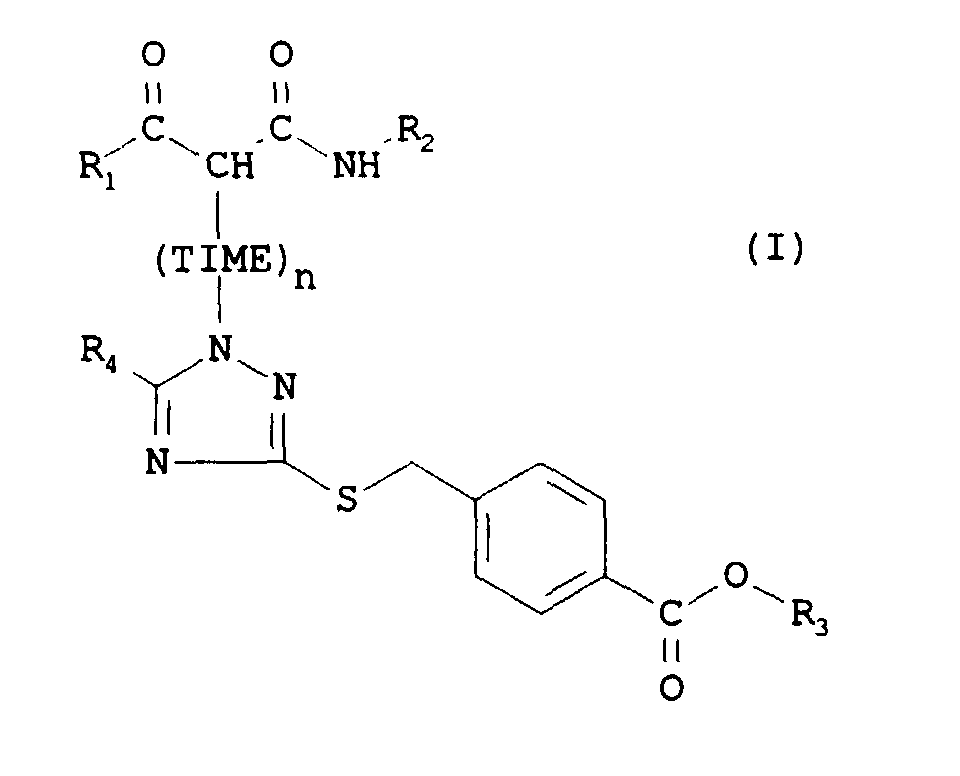
wherein
R1 represents an alkyl group, an aryl group or a -NHR5 group, where R5 represents an alkyl or aryl group; R2 represents an alkyl or aryl group; TIME represents a "timing" group; n is 0 or 1; R3 represents an alkyl or phenyl group and R4 represents a hydrogen atom or an alkyl group.
wherein
R1 represents an alkyl group, an aryl group or a -NHR5 group, where R5 represents an alkyl or aryl group; R2 represents an alkyl or aryl group; TIME represents a "timing" group; n is 0 or 1; R3 represents an alkyl or phenyl group and R4 represents a hydrogen atom or an alkyl group.
3. The color photographic multilayer material of claim 1, where the yellow dye forming
DIR couplers having a 1,2,4-triazolyl group attached to the coupling position may
be represented by formula (II)
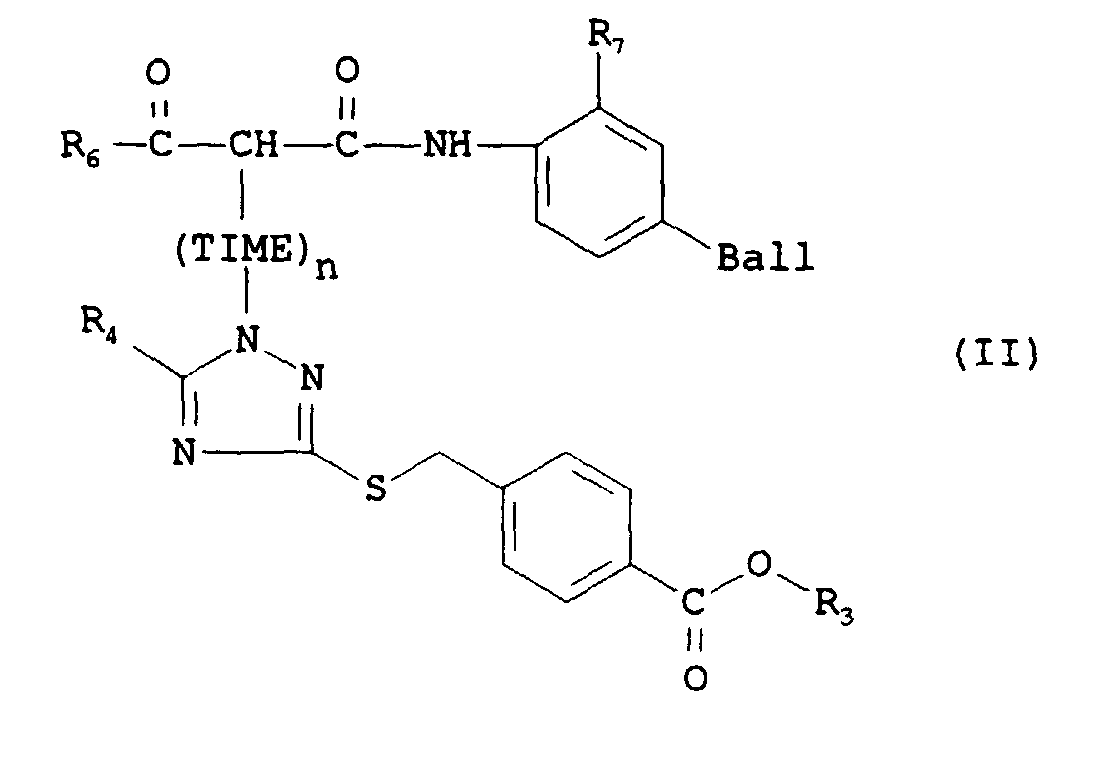
where
R3 represents an alkyl or phenyl group; R4 represents a hydrogen atom or an alkyl group; TIME represents a "timing" group; n is 0 or 1; R6 represents an alkyl or aryl group; R7 represents a halogen atom, an alkyl or aryl group and Ball is a hydrophobic ballasting group.
where
R3 represents an alkyl or phenyl group; R4 represents a hydrogen atom or an alkyl group; TIME represents a "timing" group; n is 0 or 1; R6 represents an alkyl or aryl group; R7 represents a halogen atom, an alkyl or aryl group and Ball is a hydrophobic ballasting group.
4. The color photographic multilayer material of claim 1, where the yellow dye forming
DIR couplers having a 1,2,4-triazolyl group attached to the coupling position may
be represented by formula (III)
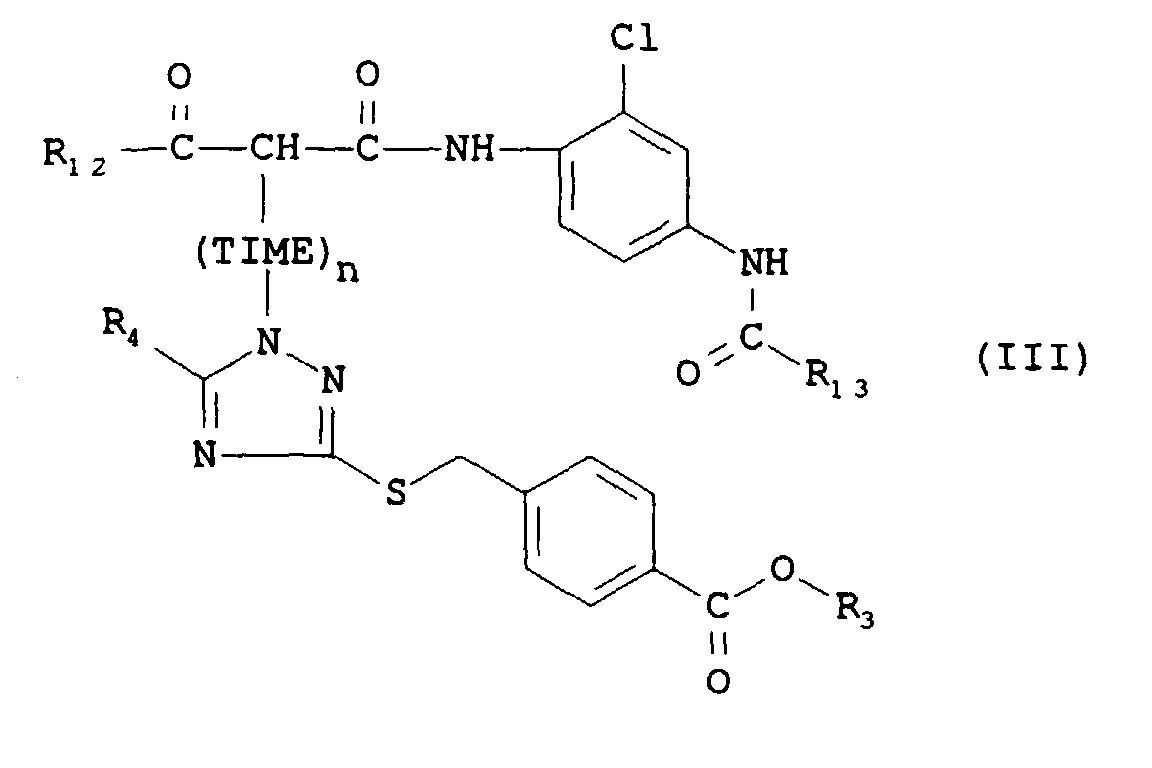
where
R3 represents an alkyl or phenyl group; R4 represents a hydrogen atom or an alkyl group; TIME represents a "timing" group; n is 0 or 1; R12 represents a branched-chain alkyl group, R13 represents an alkyl, phenoxyalkyl, alkoxyphenyl or aralkyl group.
where
R3 represents an alkyl or phenyl group; R4 represents a hydrogen atom or an alkyl group; TIME represents a "timing" group; n is 0 or 1; R12 represents a branched-chain alkyl group, R13 represents an alkyl, phenoxyalkyl, alkoxyphenyl or aralkyl group.
5. The color photographic multilayer material of claim 1, where the yellow dye forming
malonodiamide DIR couplers may be represented by formula (IV):
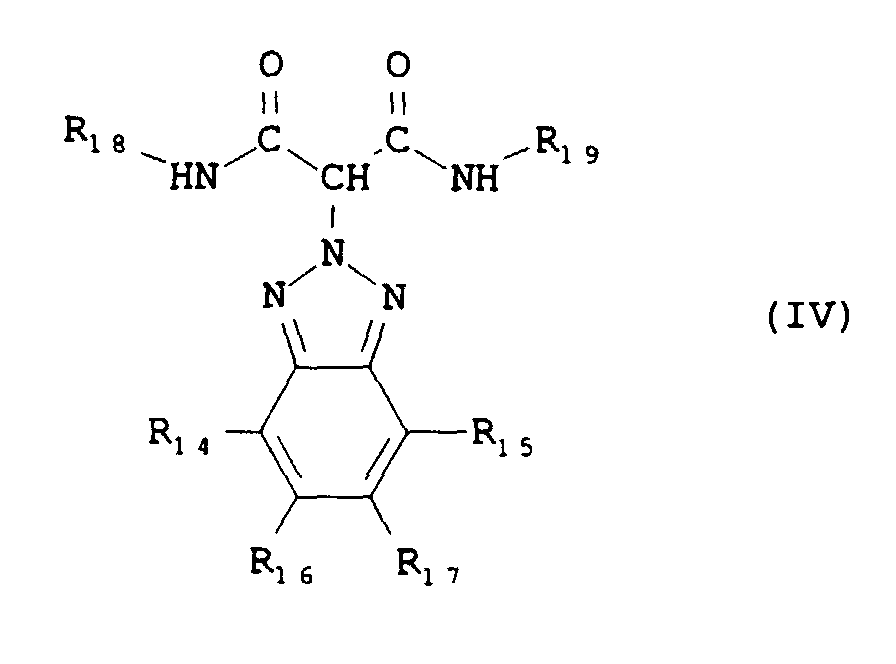
wherein R14 and R15, the same or different, each represent a halogen atom and R16 and R17, the same or different, each represent a hydrogen atom, a halogen atom, an amino, alkyl, alkoxy, hydroxy, cyano, aryloxy, acyloxy, acyl, alkoxycarbonyl, aryloxycarbonyl, acylamino, alkylsulfonyl, arylsulfonyl, alkoxysulfonyl, aryloxysulfonyl or ureido group; R18 and R19 each represent an alkyl or aryl group.
wherein R14 and R15, the same or different, each represent a halogen atom and R16 and R17, the same or different, each represent a hydrogen atom, a halogen atom, an amino, alkyl, alkoxy, hydroxy, cyano, aryloxy, acyloxy, acyl, alkoxycarbonyl, aryloxycarbonyl, acylamino, alkylsulfonyl, arylsulfonyl, alkoxysulfonyl, aryloxysulfonyl or ureido group; R18 and R19 each represent an alkyl or aryl group.
6. The color photographic multilayer material of claim 1, where the yellow dye forming
malonodiamide DIR couplers may be represented by formula (V):
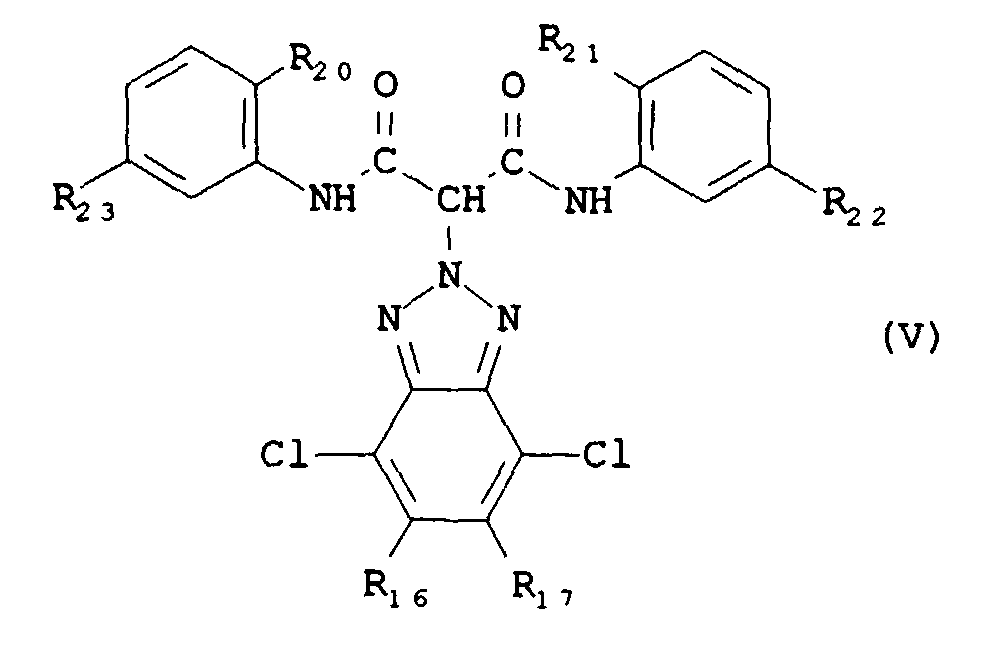
wherein R16 and R17, the same or different, each represent a hydrogen atom, a halogen atom, an amino, alkyl, alkoxy, hydroxy, cyano, aryloxy, acyloxy, acyl, alkoxycarbonyl, aryloxycarbonyl, acylamino, alkylsulfonyl, arylsulfonyl, alkoxysulfonyl, aryloxysulfonyl or ureido group; R20 and R21 each represent a hydrogen or halogen atom; R22 and R23 each represent a halogen atom, a nitro, cyano, thiocyano, hydroxy, alkoxy, aryloxy, alkyl, alkenyl, aryl, amino, carboxy, acyl, alkoxycarbonyl, aryloxycarbonyl, carbamoyl, acylamino, sulfo, alkylsulfonyl, arylsulfonyl, alkoxysulfonyl, aryloxysulfonyl, sulfamoyl, sulfonamino group.
wherein R16 and R17, the same or different, each represent a hydrogen atom, a halogen atom, an amino, alkyl, alkoxy, hydroxy, cyano, aryloxy, acyloxy, acyl, alkoxycarbonyl, aryloxycarbonyl, acylamino, alkylsulfonyl, arylsulfonyl, alkoxysulfonyl, aryloxysulfonyl or ureido group; R20 and R21 each represent a hydrogen or halogen atom; R22 and R23 each represent a halogen atom, a nitro, cyano, thiocyano, hydroxy, alkoxy, aryloxy, alkyl, alkenyl, aryl, amino, carboxy, acyl, alkoxycarbonyl, aryloxycarbonyl, carbamoyl, acylamino, sulfo, alkylsulfonyl, arylsulfonyl, alkoxysulfonyl, aryloxysulfonyl, sulfamoyl, sulfonamino group.
7. The color photographic multilayer material of claim 1, where the yellow dye forming
malonodiamide DIR couplers may be represented by formula (VI):
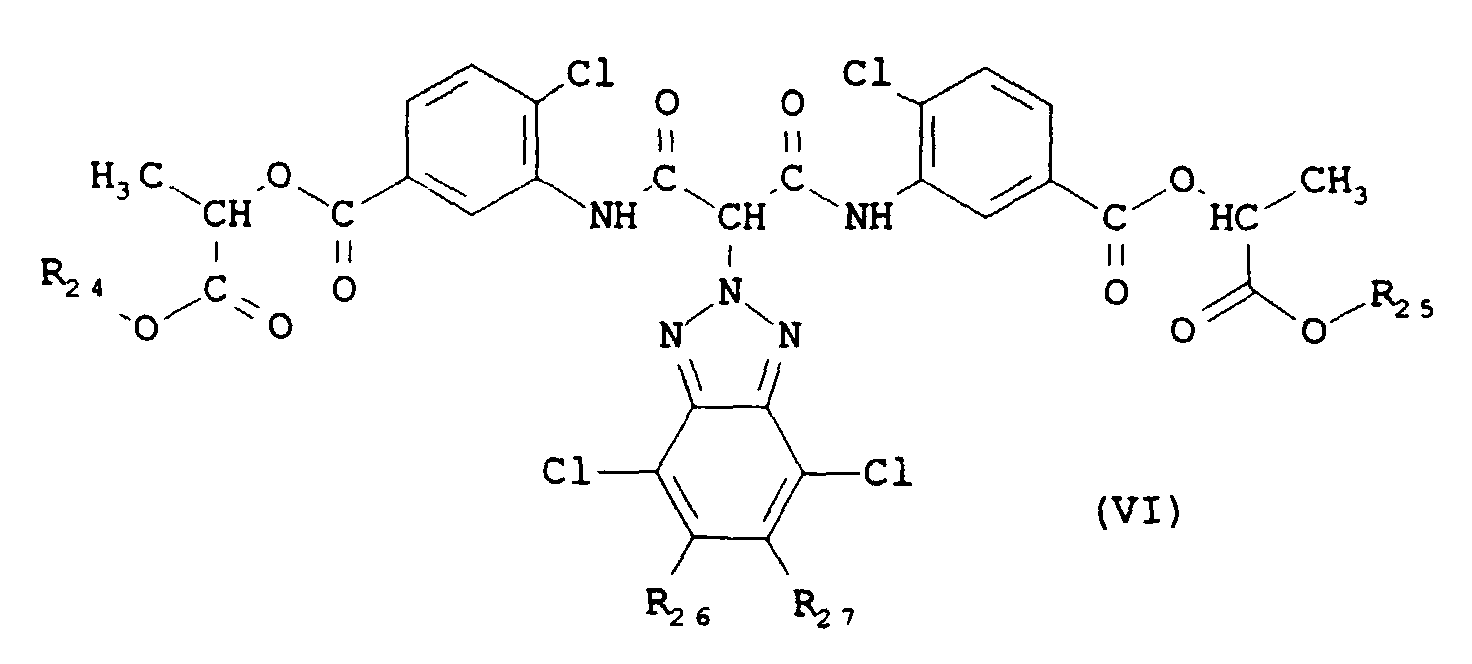
wherein R24 and R25 each represent an alkyl group having from 1 to 20 carbon atoms, and R26 and R27 each represent a low carbon atom alkyl group having from 1 to 4 carbon atoms.
wherein R24 and R25 each represent an alkyl group having from 1 to 20 carbon atoms, and R26 and R27 each represent a low carbon atom alkyl group having from 1 to 4 carbon atoms.
8. The color photographic multilayer material of claim 1 where the yellow dye forming
DIR couplers having a 1,2,4-triazolyl group attached to the coupling position are
added in a quantity from 0.010 to 0.100 grams per square meter of the photographic
material.
9. The color photographic multilayer material of claim 1, where the yellow dye forming
malonodiamide DIR couplers are added in a quantity from 0.005 to 0.040 grams per square
meter of the photographic material.
10. The color photographic multilayer material of claim 1, where the yellow dye forming
DIR couplers having a 1,2,4-triazolyl group attached to the coupling position are
present in a blue-sensitive silver halide emulsion layer, associated with yellow dye
forming couplers.
11. The color photographic multilayer material of claim 1, where the yellow dye forming
malonodiamide DIR couplers are present in a blue-sensitive silver halide emulsion
layer, associated with yellow dye forming couplers.
12. The color photographic multilayer material of claim 1, where the yellow dye forming
DIR couplers having a 1,2,4-triazolyl group attached to the coupling position and
the yellow dye forming malonodiamide DIR couplers are both present in a blue-sensitive
high-sensitivity silver halide emulsion layer, associated with yellow dye forming
couplers.