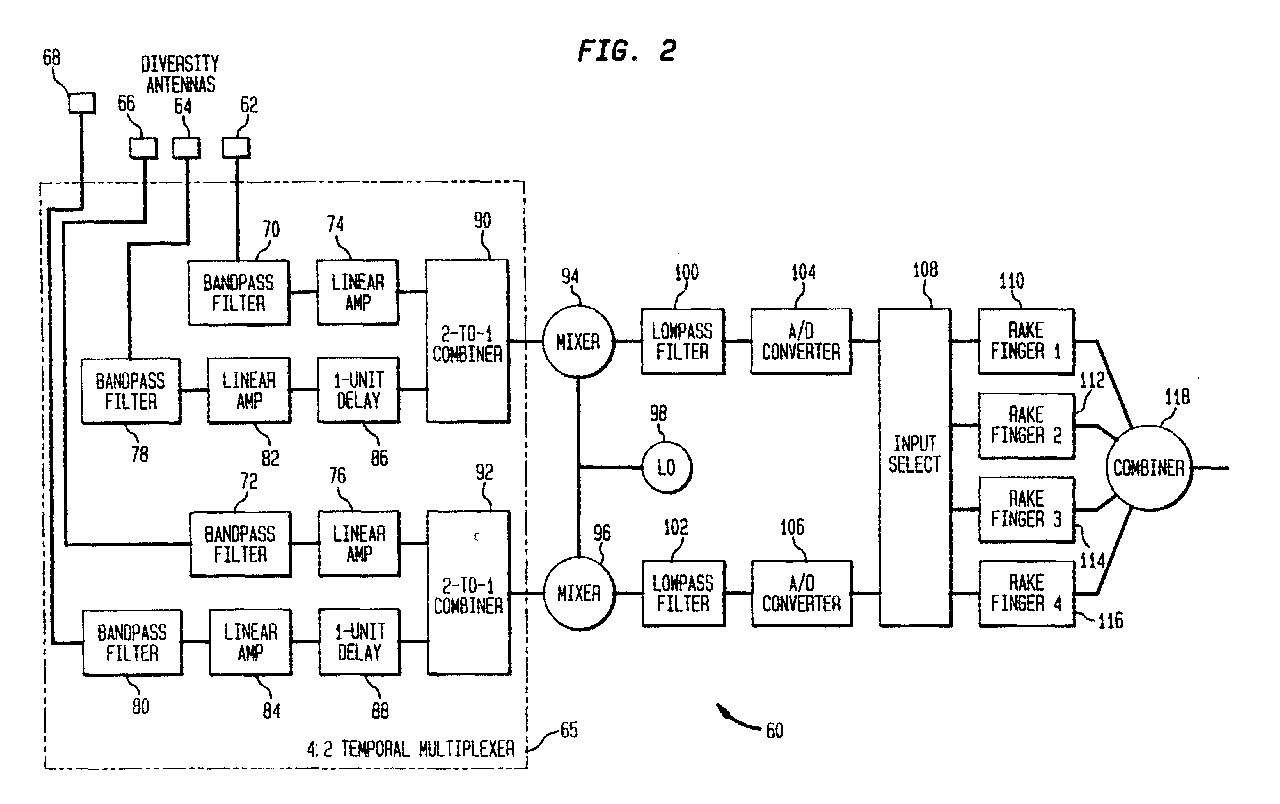
(57) An improved CDMA base station (60) for insuring a constant supply of energy to each
of a plurality of rake fingers (110-116), thus improving gain, includes a plurality
of pairs of diversity antennas (62,64; 66,68). The energy from the first antenna (64,
68) of each pair is subjected to a delay while the energy from the second antenna
(62, 66) of each pair is not subjected to a delay. The added delay (86, 88) is greater
than the chip time of the rake fingers. The signals from each pair of antennas is
combined (90, 92) and converted to digital form (104, 106). The energy from all the
antennas is then routed to the rake fingers (110-116), with the energy from each antenna
being routed to one of the rake fingers. The energy from the rake fingers is then
combined (118) into a single data stream. In an alternative approach, the base station
includes a plurality of diversity antennas. The energy from each of the diversity
antennas is subjected to a different amount of delay. The delay difference must again
be greater than the chip time of the rake fingers. The energy from the antennas is
combined, converted to digital format, and routed to each of a plurality of rake fingers,
with the energy from each antenna being routed to the rake finger. The energy from
the rake fingers is then combined into a single output data stream.
|
|
