|
(11) | EP 0 895 128 A1 |

| (12) | EUROPEAN PATENT APPLICATION |
|
|
|
|
|||||||||||||||||||||||
| (54) | Azine-containing photoconductive element |
| (57) A photoconductive element containing a transport substance and an azine, wherein
the azine selected is a transport substance having the molecular formula:
wherein R1-R6 can be different or the same constituents, selected from the group: a hydrogen atom and C1-C4 alkyl groups. The transport substance is preferably a tri-aryl amine or a substituted stilbene compound. These photoconductive elements reduce the deterioration of the photoelectrical properties. |
[0001] The invention relates to a photoconductive element containing a transport substance and an azine. Photoconductive elements of this kind are known, for example, from JP-61043753. The azine compound is present in order to counteract in use any gradual deterioration of photoelectric properties (optical fatigue). However, the azines mentioned in this Japanese Patent Application have the disadvantage in the products that the photoelectric properties of the photoconductive element are drastically impaired. This deterioration in photoelectric properties increases with increasing quantity of azine.
The object of the invention is to provide a photoconductive element which when used exhibits a reduction in the deterioration of the photoelectric properties, the other properties being retained.
To this end, according to the invention, the azine selected is a compound having the molecular formula:
wherein R1-R6 can be different or the same constituents, selected from the group: hydrogen and C1-C4 alkyl groups.
A particular advantage of these transport layers with a transport substance and azine is that the crystallisation sensitivity, the tendency to crystallisation of the transport substance in the transport layer binder, is drastically reduced.
[0002] More particularly, the transport substance in the photoconductive elements is selected from the group of tri-aryl amines and substituted stilbenes, such as compounds in accordance with the following general formula:
where R7, R9 and R10 may be different or the same substituents, selected from the group C1-C4 alkyl groups, and R8 may be a hydrogen atom, a C1-C4 alkyl group or an aryl group or an alkyl substituted aryl group.
The photoconductive elements selected are preferably those having as stilbene a compound in which R7, R9 and R10 represents a hydrogen atom and R10 a hydrogen atom or a methyl group.
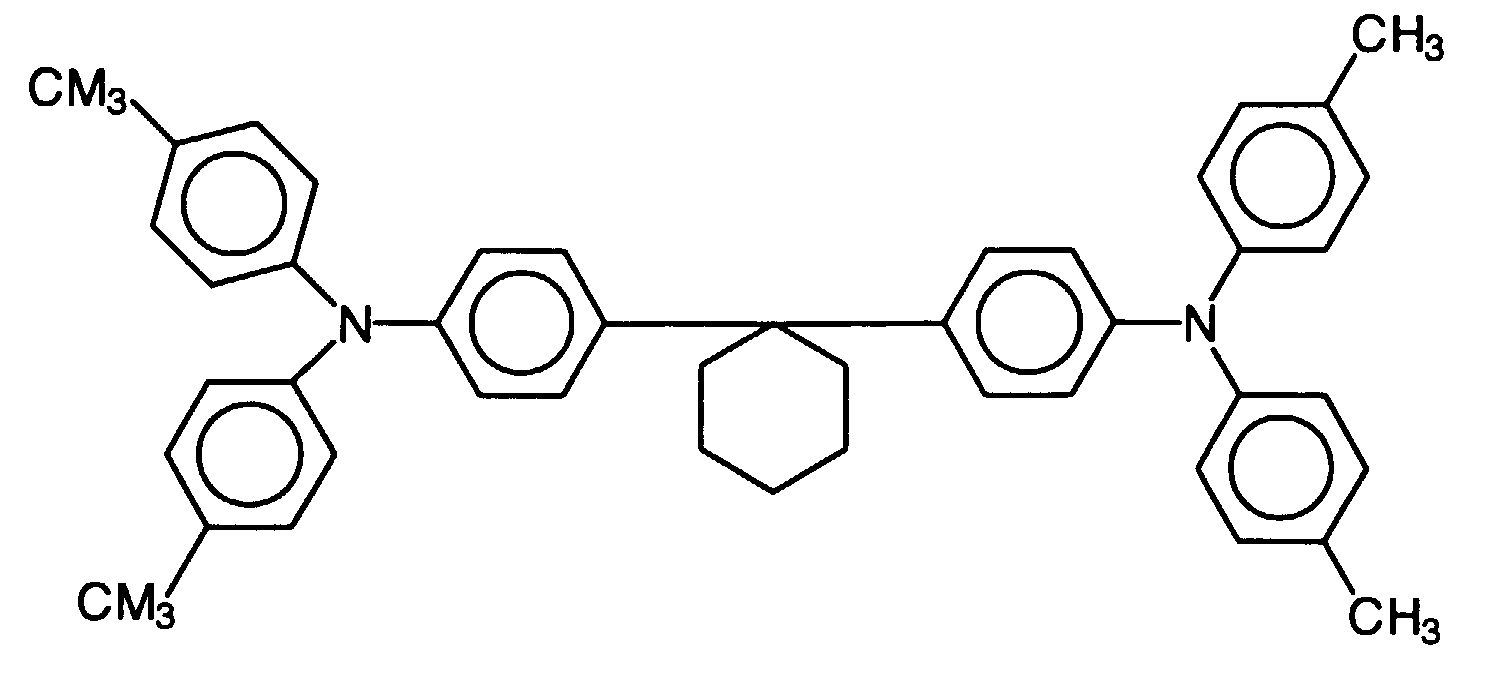
In another embodiment a tri-aryl amine with the following molecular formula is used:
[0003] Single-layer or multi-layer photoconductive elements can be used in the invention.
In a single-layer photoconductive element, a charge-generating pigment, a transport substance and azine are applied in one layer to a conductive substrate. In practice it has been found favourable to apply the charge-generating compounds and the transport substances in different layers to a conductive substrate. Multi-layer photoconductive elements of this kind are referred to, for example, in US Patents Nos. 3 713 820, 3 725 058, 3 824 099, 3 837 851, 3 839 034 and 3 898 084.
The radiation-sensitive compound or compounds in the charge-generating layer may be of organic or inorganic type.
Where inorganic material is used it is generally present in the form of finely divided particles in a binder or in the form of a homogeneous film obtained, for example, by vapour coating. Selenium is a frequently used inorganic material. If organic material is used it may, for example, be present in the form of a film-forming organic polymer, such as, for example, polyvinyl carbazole or polyvinyl pyrene or in the form of finely divided pigment particles dispersed in a binder such as, for example, Phenelac Blue and derivatives of this compound.
However, pigment binder layers of this kind have a number of disadvantages in respect of uniformity and controllability of the photoelectric properties. Methods are therefore proposed in which the radiation-sensitive charge-generating pigments are applied in molecular divided form.
The advantage of this is that the charge-generating layers can be thinner and smoother than the pigment binder layers. Charge-generating layers which contain radiation-sensitive compounds in molecular divided form are, for example, referred to in US Patents Nos. 4 123 270 and 4 286 040 and GB-A-1 172 355.
At the present time, use is made of organic photoconductive pigments such as perylene pigments, bisazo pigments, quinone pigments and phthalocyanine pigments. Pigments of this kind can easily be vaporised and then be applied to a suitable substrate in order thus to obtain extremely thin homogeneous charge-generating layers. A charge transport layer is then applied to these layers and possibly a hard protective top layer.
Preferably, use is made of a vapour-coated layer of perylene compounds of the following molecular formulae:
or a vapour-coated layer of a mixture of these compounds.
The charge transport layer must permit transport for charge carriers such as, for example, holes.
The transport substances can be dissolved in a suitable binder for the purpose, such as polycarbonate (for example Lexan™, ICI and polyester carbonates). The substrate may contain an organic layer such as Mylar (du Pont™) or Melinex (ICI™) or another substrate suitable for the purpose, a semi-conductive layer or a conductive layer such as aluminum, chromium, nickel, etc. If necessary, the polymeric substrate can be made conductive by the application of one or more thin metal layers such as aluminum, chromium, nickel, etc. The substrate may be a metal roller or a flexible endless strip of paper or plastic.
The invention will now be explained hereinafter with reference to the following examples
[0004] The Table gives a number of examples of photoconductive elements. Example 1 is a photoconductive element having a perylene generating layer above which is a transport layer which contains tritolylamine (TTA).
[0005] This photoconductive TTA element initially has a reasonably high Vrest, which is greatly increased after just 1 hour exposure to ambient light (TL light). With the admixture of azine 1 in accordance with the formula
the initial Vrest is lowered somewhat while after 1 hour exposure to ambient light the Vrest light is increased.
This value is hardly increased even after exposure to light in a copier or printer.
[0006] Accordingly, the photoconductive elements according to the invention have the advantage that the properties remain substantially constant after long periods of use and it is much easier to handle the material outside the copier or printer in ambient light. Azines according to the above-mentioned Japanese Patent Application are unsuitable. In Examples 4-5, TTA and an azine-2 in accordance with the molecular formula
and in Examples 6 and 7 TTA and another azine-3 in accordance with the molecular formula:
were added in various ratios. At the very start these photoconductive elements already had an unacceptably high Vrest.
[0007] Photoconductive elements according to Examples 8 and 9 contain a vapour-coated perylene layer as generating layer and a transport layer containing a stilbene.
Stilbene-1 has the molecular formula:
and stilbene-2 has a the molecular formula:
[0008] These photoconductive elements exhibit a considerable Vrest deterioration after exposure to CAT light. This deterioration was completely eliminated after adding a small quantity of azine-1 to these stilbenes. These photoconductive elements do not exhibit any deterioration even after exposure to the ambient light.
[0009] Examples 12 and 13 contain an evaporated perylene layer as a generation layer and a thin transporting layer containing a tri-aryl amine, TAPC.
[0011] The photoconductor of example 12 also shows a large increase in the Vrest value after exposure to TL light.
When azine-1 is added in a small amount this increase is clearly eliminated (Example 13).
1. A photoconductive element containing a transport substance and an azine, characterised
in that the azine selected is a transport substance having the molecular formula:

wherein R1-R6 can be different or the same constituents, selected from the group: a hydrogen atom, C1-C4 alkyl groups.
wherein R1-R6 can be different or the same constituents, selected from the group: a hydrogen atom, C1-C4 alkyl groups.
2. A photoconductive element according to claim 1, characterised in that the transport
substance is selected from the group: triaryl amines and substituted stilbenes.
3. A photoconductive element according to claim 2, characterised in that the substituted
stilbene compound is a compound having the molecular formula:
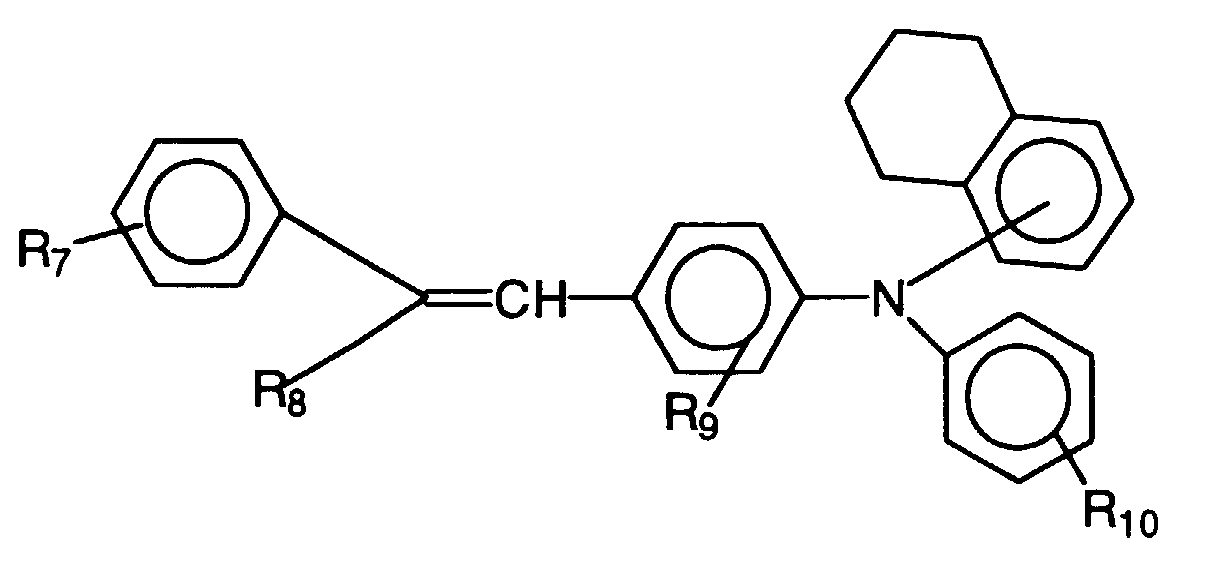
where R7, R9 and R10 may be different or the same substituents, selected from the group: hydrogen atom and C1-C4 alkyl groups and R8 can be a substituent selected from the group: hydrogen atom, C1-C4 alkyl groups and an aryl group and alkyl substituted aryl groups.
where R7, R9 and R10 may be different or the same substituents, selected from the group: hydrogen atom and C1-C4 alkyl groups and R8 can be a substituent selected from the group: hydrogen atom, C1-C4 alkyl groups and an aryl group and alkyl substituted aryl groups.
4. A photoconductive element according to claim 3, characterised in that R7 - R9 is a hydrogen atom and a methyl group is selected as R10.
5. A photoconductive element according to claim 3, characterised in that R7, R9 and R10 is a hydrogen atom and R8 a phenyl group.
6. A photoconductive element according to claim 2 characterized in that the tri-aryl
amine is selected as tritolyl amine.
7. A photoconductive element according to claim 2 characterized in that the tri-aryl
amine is a compound having the molecular formula: