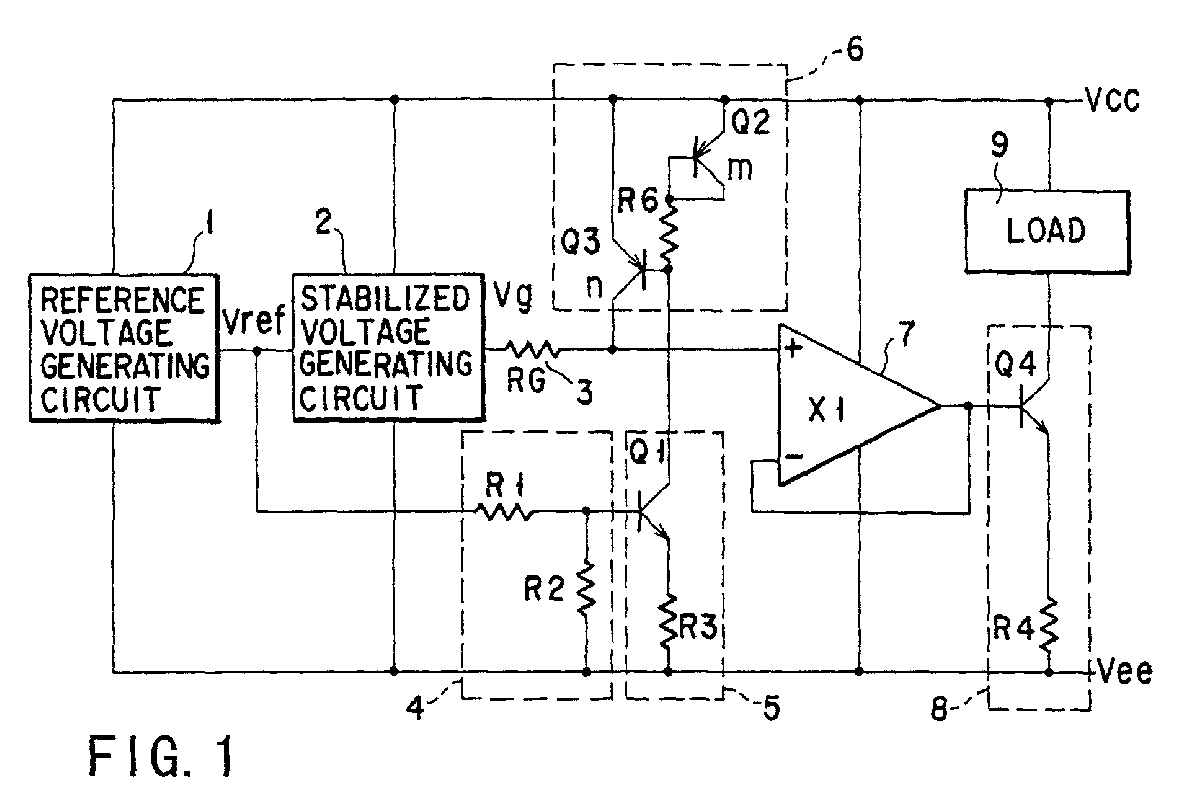
(57) A temperature dependent constant-current generating circuit includes a reference
voltage generating circuit (1) for generating a stable reference voltage against the
power supply voltage and a temperature change, a stabilized voltage generating circuit
(2) for generating a stabilized voltage based on the reference voltage, a voltage
divider (4) for dividing the reference voltage, a common-emitter amplifier (5) for
amplifying an output voltage from the voltage divider, a current mirror circuit (6)
for outputting a current in a direction opposite to an output current from the amplifier,
a current-to-voltage conversion resistor (3) connected between the output terminal
of the stabilized voltage generating circuit and the output terminal of the current
mirror circuit, a buffer amplifier (7) for receiving a voltage generated at the current
input terminal of the resistor, and a current feedback output-stage amplifier (8)
driven by an output from the buffer amplifier. The constant-current generating circuit
can generate a DC bias current which faithfully follows temperature variations in
threshold current of an LD and has a high temperature compensation characteristic
precision, and is a small-size, low-cost circuit and can be used in an LD driving
circuit for fiber-optic subscriber systems including FTTH and optical links.
|
|
