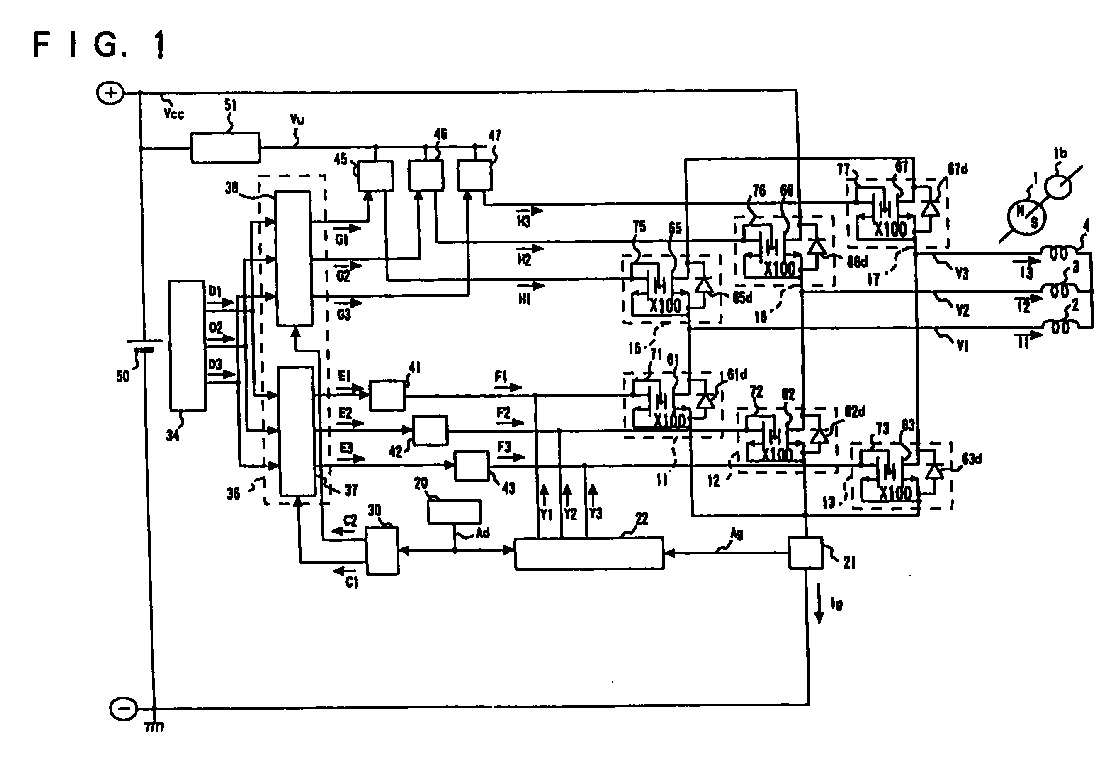
(57) First FET power transistors (61, 62, 63) of first power amplifying parts (11, 12,
13) and second FET power transistors (65, 66, 67) of second power amplifying parts
(15, 16, 17) form current paths from a DC power source (50) to three-phase windings.
Three-phase first amplified current signals (F1, F2, F3) varying smoothly in rising
and falling slopes are supplied to conduction control terminal sides of the first
power amplifying parts (11, 12, 13). Three-phase second amplified current signals
(H1, H2, H3) varying smoothly in rising and falling slopes are supplied to conduction
control terminal sides of the second power amplifying parts (15, 16, 17). A switching
control part (21, 22) performs simultaneous on-off switching of the conduction control
terminal sides of the first power amplifying parts (11, 12, 13), thereby causing first
FET power transistors (61, 62, 63) of the first power amplifying parts (11, 12, 13)
to perform high-frequency on-off switching. As a result, three-phase drive currents
to the windings vary smoothly, thereby reducing motor vibration. And also, power loss
of the FET power transistors is reduced remarkably, thereby improving power efficiency
of a motor.
|
|
