|
(11) | EP 0 898 402 A2 |

| (12) | EUROPEAN PATENT APPLICATION |
|
|
|
|
|||||||||||||||||||||||
| (54) | Detection circuit |
| (57) In a detection circuit for ASK or OOK modulation, the received modulated signal is
ac coupled to a dc restoration circuit 3 and amplified at 4. The dc restoration is
carried out on signal peaks corresponding to "mark" intervals of the modulated signal.
Data may be recovered even in the presence of high levels inband continuous interfering
signals. |
[0001] This invention relates to detection circuits and more particularly to circuits used to detect low level signals in the presence of interfering continuous wave (CW) signals.
[0002] Amplitude Shift Key (ASK) or On-Off Key (OOK) modulation is commonly used in low cost RF systems for use in short range digital control or monitoring systems such as automotive Remote Keyless Entry, security sensor monitoring and garage door opening. In OOK modulation, a transmitter is switched on and off to create a data signal comprising "mark" and "space" periods. The received signal may have varying amplitudes during the "mark" periods because of variation in distance between the transmitter and receiver. In ASK modulation, the data signal may be produced by switching a transmitter between high and low amplitude outputs in which energy is transmitted during "space" periods in addition to during the "mark" periods. In some forms of ASK modulation, intermediate amplitude levels may be used to provide a non-binary code. OOK modulation may be considered to be a form of ASK modulation.
[0003] The low cost systems mentioned above are of an unlicensed category and commonly occupy narrow regions of the RF spectrum, eg. 433.92 ± 0.875 MHZ. Since these bands are not rigorously controlled however it is highly probable that there will be high level transmissions in the vicinity which can "jam" the wanted signal, interfering to such an extent that data is not recoverable at a receiver. Such interfering signals may be derived from many types of sources, for example, from amateur radio transmissions.
[0004] Receivers used in these low cost RF systems may be Tuned Radio Frequency (TRF), super-regenerative discrete designs and superhet integrated circuit designs for example. Transmissions to be detected are typically irregular and of short duration, say less than one second.
[0005] Suitable receivers often use highly selective RF filters prior to the Low Noise Amplifier (LNA) and at IF, although their bandwidths must allow for transmission frequency tolerances in excess of ± 100 kHz, with equally slack Voltage Controlled Oscillator (VCO) tolerances in the receiver for reasons of cost. Data rates are low, normally 0.4 to 5 kBits/s. Consequently, the signal bandwidth into a detector may be in the region of ± 300 kHz whilst the final data bandwidth is less than 5 kHz. Data filters may be employed to reduce noise bandwidth and increase sensitivity. However, the detector, being non-frequency selective, will detect on all signals, wanted and un-wanted, in the wide IF passband, giving high risk of jamming occurring.
[0006] A number of superhet designs for these applications use Logarithmic IF amplifiers and a Received Signal Strength Indicator (Log RSSI) as a detector. It is well known that these circuits are not capable of detecting signals in the presence of CW jammers of similar RF level. However the benefit of Log RSSI detectors is their instant response time over a very wide range of signal level, ideal for OOK signals, compared to using a linear IF amplifier with automatic gain control.
[0007] In band continuous interfering IF signals reduce the sensitivity of the RSSI detector to the wanted signal, as the output is a log function of the input RF level during the 'mark' and 'space' periods. Also during the 'mark' period such interfering IF signals produce a signal modulated at the beat frequency (fw-fj), where fw is the wanted IF signal and fj is the jamming signal. This reduces the mean level of the wanted signal after it is filtered by a data filter to the extent that, for a jamming signal at the same level or greater than the wanted signal, the output data signal is zero. Figure 1 shows part of the beat frequency envelope during the 'mark' period of the wanted signal when the interferer is 6dB higher in power.
[0008] Figure 2 is an explanatory diagram of the detected signal at the RSSI output of the log amplifier. Mean signal levels during "mark" and "space" periods are shown with the levels for "mark" and "space" periods being inverted when compared to the wanted signal without interferer. The modulation component V is impressed on the wanted signal and when data is present (not shown in the diagram) the "mark" and "space" amplitudes will vary with it.
[0009] The RSSI output is put through a data filter to reduce the noise bandwidth. However the CW jamming signal produces a beat frequency such that there is no longer a low frequency data component present, as shown in Figure 3.
[0010] Typically systems using Log RSSI detectors are only capable of detecting wanted signals with signal level ratios of:
[0011] According to the invention there is providcd a detection circuit for a modulated signal having mark and space intervals comprising dc restoration means for dc restoring a received modulated signal on signal peaks corresponding to mark intervals to give a dc restored signal and reject interfering signals. The signal applied to the dc restoration means may undergo some processing prior to being applied to the dc restoration means. The received modulated signal is ac coupled to the dc restoration means.
[0012] This invention considerably reduces the effect of beat frequencies due to jamming signals in the IF, enabling the wanted signal to be detected in the presence of a jamming signal level ratio of:
[0013] By using the invention, it is possible to recover a low level wanted ASK signal from CW interferer which would otherwise prevent the wanted signal from being recovered. An anti-jam ASK detection circuit in accordance with the invention may enable ASK and OOK signals to be detected in the presence of +20dB CW jamming signals relative to the wanted "mark" level. This gives an overall improvement of +23dB over the RSSI detector alone.
[0014] The detection circuit may also be used as the detector directly on the signal output of a linearly automatic gain controlled IF amplifier where greater performance improvement may be realised.
[0015] According to a first feature of the invention, a receiver includes a detection circuit in accordance with the invention.
[0016] According to a second feature of the invention, a system includes a transmitter for transmitting a modulated signal having mark and space intervals and a receiver incorporating a detection circuit in accordance with the invention.
[0017] One way in which the invention may be performed is now described by way of example with the reference to the accompanying drawings in which:
Figure 4 is a schematic block diagram of a detector circuit in accordance with the invention;
Figures 5(a), 5(b), 6(a), 6(b), 7, 8(a) and 8(b) are explanatory diagrams relating to the operation of the circuit shown in Figure 4; and
Figure 9 is a circuit realisation of part of the arrangement shown in Figure 4.
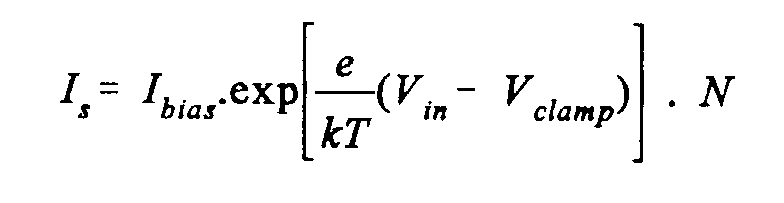
[0018] With reference to Figure 4, a detector circuit in accordance with the invention comprises a log RSSI detector 1. An ASK modulated signal is received at the input of the amplifier. In the absence of a jamming signal, the input to the log amplifier takes the form shown in Figure 5(a). When jamming is present however, the signal is corrupted and may appear as shown in Figure 5(b). Figures 6(a) and 6(b) show the wave forms at the output of the log amp RSSI detector I in the absence and presencc respectively of a jamming signal. As can be seen, the jamming signal has a considerable effect on the output signal. The output of log RSSI 1 is applied to a coupling and dc restoration capacitor 2 and to dc restoration circuit 3. The ac coupled signal at capacitor 2 is dc restored on the signal peaks defined by the higher RF level corresponding to the "mark". The lower signal which corresponds to the "space" is not used for dc restoration because of its very much lower signal to noise ratio. Following dc restoration, the signal is applied to a transconductance amplifier 4 which amplifiers the peak of the signal non-linearly, such that the output current, Is is
where Ibias is the nominal dc current in the transistor with no input signal, and (Vin - Vclamp) is the dc restored input signal relative to the clamp level. N is a multiplying factor which is dependent on the amplitude and the mark/space ratio of the wanted signal, e is the electron charge, k is Boltzmann's constant and T is temperature in Kelvin.
[0019] The current Is from the transconductance amplifier 4 is summed at 5 with an amplifier standby current to give an output which corresponds to the amplified peaks of the signal during the "mark" period of the wanted signal. This gives an output signal Vout , where Vout =-R.(Is- Ibias). The resulting output signal is then applied to a data filter 6 and data slicer 7 to provide a data output signal. The capacitor 2, dc restoration circuit 3, transconductance amplifier 4 and summing amplifier 5 may be considered to form an anti-jam detection circuit 8, as indicated by a broken line in Figure 4.
[0020] As the output signal from the summing amplifier 5 has a relatively large differential between the mean levels during the "mark" and "space" intervals of the wanted signal, the data slicer 7 is capable of slicing the signal even in the presence of CW interferers of greater than 20dB higher. Figure 7 illustrates the relative difference between the mean output levels of the "mark" interval and the "space" interval together with the signal V at the output of the summing amplifier 5 in the absence of data. Figures 8(a) and 8(b) show the output of the anti-jam circuit 8 with and without respectively a jamming signal.
[0021] Figure 9 is a circuit realisation of the arrangement shown in Figure 4. In this circuit, a PNP Q1 serves a dual function as the dc restoration circuit, discharging the coupling capacitor C during signal peaks, and also as a non-linear high gain amplifier. The coupling capacitor C, as in many dc restoration circuits, stores the charge for the dc restoration voltage.
1. A detection circuit for a modulated signal having mark and space intervals comprising:
dc restoration means (3) for dc restoring a received modulated signal such that signal
peaks correspond to mark intervals to give a dc restored signal and reject interfering
signals..
2. A circuit as claimed in 1 and including ac coupling (2) to the dc restoration means
(3) for coupling the received modulated signal thereto.
3. A circuit as claimed in claim 1 or 2 and including a transconductance amplifier (4)
for amplifying said dc restored signal.
4. A circuit as claimed in claim 3 wherein said transconductance amplifier (4) amplifies
the peak of said dc restored signal non-linearly such that its output current Is is
in accordance with the equation:-
5. A circuit as claimed in claim 3 or 4 and including means for summing the output of
said amplifier (4) to give an output signal corresponding to amplified peaks of the
signal during mark intervals of the received modulated signal.
6. A circuit as claimed in claim 5 and including a data slicer (7) to which said output
signal is applied.
7. A circuit as claimed in any preceding claim wherein common means (Q1) provides said
dc restoration means and also acts as a non-linear high gain amplifier.
8. A circuit as claimed in any preceding claim and including a log RSSI detector (1)
and the received modulated signal being applied to the dc restoration means from said
log RSSI detector (1).
9. A circuit as claimed in any of claims 1 to 7 and including an IF amplifier (1) and
the received modulated signal being applied to said dc restoration means from said
IF amplifier.
10. A receiver comprising a detection circuit (8) as claimed in any preceding claim.
11. An RF system comprising transmitter means for transmitting a modulated signal having
mark and space intervals and a receiver as claimed in claim 10.
12. A circuit reciever or system as claimed in any preceding claim wherein the modulated
signal is OOK modulated.