|
(11) | EP 0 899 373 A1 |

| (12) | EUROPEAN PATENT APPLICATION |
|
|
|
|
|||||||||||||||||||
| (54) | Method of whitening lignin-containing pulp during manufacture |
| (57) A process to increase the whiteness of a lignin-containing pulp is disclosed which
comprises adding to an aqueous slurry comprising a lignin-containing pulp, during
pulp manufacture, a fluorescent whitening agent and optionally a chelating agent. |
[0001] The present invention relates to a method that can be used in pulp mills for whitening lignin-containing pulps. More particularly it teaches the use of fluorescent whitening agents instead of bleach chemicals to obtain desired target brightness values while maintaining desirable fiber characteristics of pulps that contain significant amounts of lignin.
[0002] Numerous processes are known to convert various types of wood, recycled paper and other fibrous raw materials into pulp suitable for making paper. In general these processes can be categorized as mechanical pulping processes, chemical pulping processes and combinations thereof. The properties of the pulp are determined by the raw materials and the processing parameters. Therefore, the end use of the paper will usually dictate both the raw materials to use and suitable processing parameters.
[0003] In a chemical pulping process to produce kraft paper, much of the lignin and hemicellulose in the wood employed is removed or solubilized by a series of chemical treatments. To obtain pulp suitable for white paper such as writing paper, additional bleaching steps are necessary which remove most of the remaining lignin. The resulting low lignin or substantially lignin-free papers possess high strength and a brightness value of 85 or more. However they are relatively expensive due to the numerous treatment steps, the effluent treatment costs, and the fact that somewhat more than half of the dry weight of the wood is lost during the chemical treatments.
[0004] In mechanical pulping processes, such as the refiner mechanical pulp and thermomechanical pulp (TMP) processes, the fibers are separated by a combination of heat and mechanical energy. Such processes produce paper at a lower cost since the treatment costs are reduced, and the yield, based on the dry weight of the wood, is usually about 95% since there is no chemical removal of the wood components. Chemithermomechanical pulp (CTMP) processes, in which some degree of chemical treatment is applied either to the wood chips before thermomechanical pulping or to the pulp after it, and semimechanical pulp (SMP) processes, wherein there is a somewhat greater degree of chemical digestion of the wood chips before thermomechanical pulping, are also employed. The yield, based on the dry weight of the wood, is somewhat reduced by these chemical treatments since there is some removal of the wood components, but it is still substantially higher than that from a purely chemical pulping process.
[0005] Pulps from mechanical processes are bleached, if desired, prior to the paper-making step, with chemicals that do not remove lignin, such as alkaline hydrogen peroxide or sodium dithionite, resulting in paper having a brightness value of up to about 80. In addition to the lower brightness values, paper from a mechanical pulping process has lower light stability, strength and permanence compared to paper prepared from a chemical pulping process. A major market for paper prepared by mechanical pulping processes is paper for newspapers.
[0006] The general area of pulp manufacturing/bleaching is reviewed very completely in a Monograph entitled Pulp Bleaching, Carlton Dence and Douglas Reeve, Editors, TAPPI Press (1996).
[0007] For some end uses, pulp which is a blend of chemical and mechanical pulps is advantageously employed. For example recycled paper usually contains paper made from both chemical and mechanical pulps, but often predominantly the latter. Thus the amount of lignin can vary greatly, at one extreme being about the same as that found in the wood chips from which the pulp was prepared and, at the other end, being close to zero in high brightness bleached chemical pulps suitable for high quality white paper manufacture.
[0008] The brightness standard is measured as the reflectance of light in the blue range (457 nm) in comparison to magnesium oxide as 100% white. In the United States brightness is usually measured with the General Electric brightness meter. Thus a GE brightness value of 80 corresponds to 80% of the brightness of magnesium oxide, as measured with the GE meter.
[0009] For many end uses the color, or more precisely the lack of color of the pulp is a critical parameter. It is therefore highly desirable to be able to increase the whiteness or brightness of lignin-containing pulps, and hence the whiteness of the resulting products, in a cost-effective nianner. It is also highly desirable to be able to do this without brightness being the primary determinant of other pulp properties. Traditionally, pulps are bleached to the desired brightness and the fiber furnish is chosen to give roughly appropriate properties, often with the desired physical properties taking a back seat to brightness.
[0010] For example, typical bleaching to high brightness with peroxide and caustic allows for a gain in brightness, but at the expense of drainage, bulk, strength, opacity, and yield. This limits the market potential for pulps containing high lignin contents to relatively "lower end" applications such as paper toweling, and prevents entry into higher performance end markets such as printing and writing and coated paper applications.
[0011] It is well known that paper prepared from chemical pulping processes in combination with bleaching, i.e. substantially lignin-free paper, can be, and usually is, whitened by addition of fluorescent whitening agents, both to the pulping stage and to the preformed sheets as a surface coating. Indeed a number of fluorescent whitening agents are marketed for this express purpose. However, it has also been common knowledge that fluorescence is inhibited by lignin. This effect has precluded the use of fluorescent whitening agents in making paper from pulps containing significant amounts of lignin, such as those from mechanical pulping processes.
[0012] Even with bleached kraft type chemical pulps, fluorescent whitening agents (also referred to as optical brighteners) traditionally have not been used directly with at the pulp mill, even though the process would be technically straightforward. Rather it has been left to the papermaker (where there is better understanding of the fiber and fluorescent whitening agent chemistry) to purchase pulps having an appropriate starting brightness and to add fluorescent whitening agents and other materials to obtain the desired target brightness levels in the resulting paper. The use of optical brighteners as an alternative to bleaching during the manufacture of traditional kraft type chemical pulps is not typically practiced.
[0013] Copending application 08/766,909 discloses that it is possible to increase the whiteness of paper made from a lignin-containing pulp by adding to an aqueous slurry of the lignin-containing pulp, in the paper-making step, a fluorescent whitening agent. However, the use of optical brighteners as a bleaching alternative in high-lignin-containing pulps during manufacture at the pulp mill is unknown.
[0014] Now, surprisingly, it has been found that it is possible to increase the whiteness of a lignin-containing pulp by a process which comprises adding to an aqueous slurry comprising a lignin-containing pulp, during pulp manufacture, prior to the drying step or paper making step if the pulp is not isolated, an effective amount of a fluorescent whitening agent. While the fluorescent whitening agent can be added to the aqueous slurry comprising the lignin-containing pulp at any processing step, to minimize losses, it is advantageously added in the latter stages of pulp manufacture, prior to the final dewatering and drying steps. Preferably it is added after completion of the last bleaching step.
[0015] By "a lignin-containing pulp" is meant any pulp that still contains 5% or more of lignin by weight on a dry basis. By definition, lignin is that portion of the pulp which is insoluble in 72 weight percent sulfuric acid. Suitable test procedures for lignin content are given in TAPPI T 223 and ASTM D 1106.
[0016] The process of this invention is useful to produce significant whitening of pulps containing from about 5% lignin on a dry weight basis up to 100% of the lignin present in an equivalent amount of wood chips. Thus the process can be employed, e.g. on relatively low-lignin-containing pulps such as certain bleached kraft pulps up to and including higher lignin content pulps such as thermomechanical pulps, bleached chemi-thermomechanical pulps, and even deinked bleached thermomechanical pulps. Preferably the pulps contain at least 10% of lignin by weight on a dry weight basis; most preferably they contain at least 15%. The range of brightness that can be obtained varies from about 50 to 90+ depending on starting pulp brightness and the type of pulp employed.
[0017] It is known to employ chelating agents in processes to bleach pulps from mechanical pulping processes. See V. N. Gupta , Pulp Paper Mag. Can., 71 (18), T391-399 (1970). The addition of a chelating agent to an aqueous pulp slurry controls the natural yellowing tendency of glucuronic acids, extractives and lignin present in the pulp by removing or minimizing iron and other heavy metals such as copper, zinc and manganese metals that catalyze color-forming side reactions. The iron and other heavy metals are converted into the form of their highly soluble chelates and largely removed in the dewatering steps. This decreases the incorporation of the heavy metal ions into the pulp. Additionally the chelating agent sequesters the salts of iron and other heavy metals which remain and which, in their own right would otherwise relax the excited state of fluorescent whiteners and render them ineffective .
[0018] Depending on the processing parameters used in the pulp mill, this metal control step may be done as matter of course in pulping processes where reductive bleaching (e.g., bisulfite, hydrosulfite, or formamidine sulfite bleaching) or oxidative bleaching (e.g., peroxy- or peroxide bleaching) is employed. The addition of a chelating agent to an aqueous pulp slurry, if necessary, should be carried out prior to the addition of the fluorescent whitening agent.
[0019] The background level of residual iron and other heavy metals and their ions in wood chips is generally about 10-25 ppm, although it is rather dependent on geography and species considerations. The amount of iron and other heavy metals and their ions in the water used in pulping mills varies widely. Significant additional amounts of iron and other heavy metals and their ions are introduced during mechanical pulping of wood chips as well as in recycling newsprint. Thus the amount of iron and other heavy metals and their ions in the aqueous pulp during manufacture is may be several hundred parts per million by weight, based on the dry weight of the pulp, at some stages of pulp manufacture.
[0020] Often it is not necessary to add a chelating agent prior to addition of the fluorescent whitening agent due to the common use of peroxy bleaching, which requires prior addition of chelating agents to be effective. However, a chelating agent is advantageously employed if the aqueous slurry comprising the lignin-containing pulp still contains from 25 to 500 ppm by weight, based on the dry weight of the pulp, of salts of iron and other heavy metals at the processing stage where the fluorescent whitening agent is to be added. At the high end of this range the brightness gain is moderated by iron relaxation of the fluorescent whitening agent, the dulling of the pulp due to the natural color of the heavy metal salts, and the catalytic effect of the metals on peroxy-species or reductive species (which in turn react with the cellulose and impact pulp properties). Initial levels of salts of iron and other heavy metal ions of 25 to 100 ppm give the biggest improvement in brightness when the aqueous pulping slurry is treated with a chelating agent prior to combination with a fluorescent whitening agent. In general there is no practical advantage to reducing the content of iron and other heavy metals and their ions below the residual background level found in the wood chips.
[0021] Heavy metal contents can be determined by standard analytical procedures such as atomic absorption spectroscopy or inductively coupled plasma analysis. Once the type and amounts of the various heavy metals are known, the amount of the chelating agent to employ to reach 100 ppm or less, preferably about 25 ppm or less, can readily be calculated or determined from tables. It is not harmful to use a small excess. Thus, depending on the heavy metal content of the aqueous pulping slurry prior to the addition of the fluorescent whitening agent, the chelating agent selected and the degree of whiteness improvement desired, from 0 up to about 1% by weight, based on the dry weight of the pulp, of a chelating agent may be advantageously employed An additional and substantial benefit of chelate treatment is to open the fiber matrix to make it more accessible to the fluorescent whitening agent.
[0022] All types of chelating agents are suitable in the present invention, i.e. those that offer thermodynamic or kinetic control of metal ions. However preference is given to chelating agents that offer thermodynamic control, that is, chelating agents that form a stable, isolable, complex with a heavy metal ion. Within this group it is particularly preferred to use aminocarboxylic acid chelates. Well known and commercially available members of this class include ethylenediaminetetraacetic acid (EDTA), diethylenetriaminepentaacetic acid (DTPA), hydroxyethylethylenediaminetriacetic acid (HEDTA) and nitrilotriacetic acid (NTA).
[0023] Mixtures of thermodynamic and kinetic-controlling chelating agents (e.g. citrates, keto acids, gluconates, heptagluconates, phosphates, and phosphonates ) also work well in reducing the content of free heavy metal ions in the pulp to acceptable levels. A number of these kinetic-controlling chelating agents are also commercially available. Kinetic controlling chelating agents are those which do not form a stable, isolable, complex with a heavy metal ion.
[0024] Fluorescent whitening agents are substances that absorb light in the invisible ultraviolet region of the spectrum and reemit it in the visible portion of the spectrum, particularly in the blue to blue violet wavelengths. This provides added brightness and can offset the natural yellow cast of a substrate such as pulp or paper made from it.
[0025] Fluorescent whitening agents useful in the present invention may be selected from a wide range of chemical types such as 4,4'-bis-(triazinylamino)-stilbene-2,2'-disulfonic acids, 4,4'-bis-(triazol-2-yl)stilbene-2,2'-disulfonic acids, 4,4'-dibenzofuranyl-biphenyls, 4,4'-(diphenyl)stilbenes, 4,4'-distyryl-biphenyls, 4-phenyl-4'-benzoxazolyl-stilbenes, stilbenyl-naphthotriazoles, 4-styryl-stilbenes, bis-(benzoxazol-2-yl) derivatives, bis-(benzimidazol-2-yl) derivatives, coumarins, pyrazolines, naphthalimides, triazinyl-pyrenes, 2-styryl-benzoxazoles or -naphthoxazoles, benzimidazole-benzofurans and oxanilides, or a mixture thereof.
[0026] Preferred 4,4'-bis-(triazinylamino)-stilbene-2,2'-disulfonic acids are those having the formula:
in which R1 and R2, independently, are phenyl, mono- or disulfonated phenyl, phenylamino, mono- or disulfonated phenylamino, morpholino, -N(CH2CH2OH)2, -N(CH3)(CH2CH2OH), -NH2, -N(C1-C4alkyl)2, -OCH3, -Cl, -NH-CH2CH2SO3H, CH2CH2OH or ethanolaminopropionic acid amide; and M is H, Na, Li, K, Ca, Mg, ammonium, or ammonium that is mono-, di-, tri- or tetra-substituted by C1-C4alkyl, C1-C4hydroxyalkyl or a mixture thereof. Preferably M is Na, Li or K.
[0027] Especially preferred compounds of formula (1) are those in which each R1 is 2,5-disulfophenyl and each R2 is morpholino, -N(C2H5)2, -N(CH2CH2OH)2 or ethanolaminopropionic acid amide; or each R1 is 3-sulfophenyl and each R2 is NH(CH2CH2OH) or N(CH2CH2OH)2; or each R1 is 4-sulfophenyl and each R2 is N(CH2CH2OH)2, N(CH2CHOHCH3)2, morpholino, or ethanolaminopropionic acid amide; or each R1 is phenylamino and each R2 is morpholino, NH(CH2CH2OH), N(CH2CH2OH)CH3, N(CH2CH2OH)2 or ethanolaminopropionic acid amide, and, in each case, the sulfo group is SO3M in which M is sodium.
[0029] Preferred 4,4'-bis-(triazol-2-yl)stilbene-2,2'-disulfonic acids are those having the formula:
in which R3 and R4, independently, are H, C1-C4alkyl, phenyl or monosulfonated phenyl; and M is H, Na, Li, K, Ca, Mg, ammonium, or ammonium that is mono-, di-, tri- or tetra-substituted by C1-C4alkyl, C1-C4-hydroxyalkyl or a mixture thereof. Preferably M is Na, Li or K.
[0030] Especially preferred compounds of formula (2) are those in which R3 is phenyl, R4 is H and M is sodium.
[0031] Preferred 4,4'-dibenzofuranyl-biphenyls are those of the formula:
in which Ra and Rb, independently, are H or C1-C4alkyl, and M is H, Na, Li, K, Ca, Mg, ammonium, or ammonium that is mono-, di-, tri- or tetra-substituted by C1-C4alkyl, C1-C4-hydroxyalkyl or a mixture thereof. Preferably M is Na, Li or K.
[0033] Preferably, the 4,4'-distyryl-biphenyls used are those of the formula:
in which R5 and R6, independently, are H, SO3M, SO2N(C1-C4alkyl)2, O-(C1-C4alkyl), CN, Cl, COO(C1-C4alkyl), CON(C1-C4alkyl)2 or O(CH2)3N®(CH3)2An-, in which M is H, Na, Li, K, Ca, Mg, ammonium, or ammonium that is mono-, di-, tri- or tetra-substituted by C1-C4alkyl, C1-C4-hydroxyalkyl or a mixture thereof, An- is an anion of an organic or inorganic acid or a mixture thereof, and n is 1. Preferably M is Na, Li or K and An- is a formate, acetate, propionate, glcolate, lactate, acrylate, methanephosphonate, phosphite, dimethyl or diethyl phosphite anion, or a mixture thereof.
[0034] Especially preferred compounds of formula (4) are those in which each R6 is H and each R5 is a 2-SO3M group in which M is sodium or each R5 is O(CH2)3N⊕(CH3)2 An-, in which An- is acetate. Most especially preferred is the compound of the formula:
[0035] Preferred 4-phenyl-4'-benzoxazolyl-stilbenes have the formula:
in which R7 and R8, independently, are H, Cl, C1-C4alkyl or SO2-C1-C4alkyl.
[0036] Preferably, the stilbenyl-naphthotriazoles used are those of the formula:
in which R9 is H or Cl; R10 is SO3M, SO2N(C1-C4alkyl)2, SO2O-phenyl or CN; R11 is H or SO3M; and M is H, Na, Li, K, Ca, Mg, ammonium, or ammonium that is mono-, di-, tri- or tetra-substituted by C1-C4alkyl, C1-C4hydroxyalkyl or a mixture thereof. Preferably M is Na, Li or K.
[0037] Especially preferred compounds of formula (6) are those in which R9 and R11 are H and R10 is 2-SO3M in which M is Na.
[0038] Preferably, the 4-styryl-stilbenes used are those of the formula:
in which R12 and R13, independently, are H, SO3M, SO2N(C1-C4alkyl)2, O-(C1-C4alkyl), CN, Cl, COO(C1-C4alkyl), CON(C1-C4alkyl)2 or O(CH2)3N⊕(CH3)2 An- in which An- is an anion of an organic or inorganic acid, in particular a formate, acetate, propionate, glcolate, lactate, acrylate, methanephosphonate, phosphite, dimethyl or diethyl phosphite anion , or a mixture thereof and M is H, Na, Li, K, Ca, Mg, ammonium, or ammonium that is mono-, di-, tri- or tetra-substituted by C1-C4alkyl, C1-C4hydroxyalkyl or a mixture thereof. Preferably M is Na, Li or K.
[0039] Especially preferred compounds of formula (7) are those in which each of R12 and R13 is 2-cyano or 2-SO3M in which M is sodium or O(CH2)3N⊕(CH3)2An- in which An- is acetate.
[0040] Preferred bis-(benzoxazol-2-yl) derivatives are those of the formula:
in which R14, independently, is H, C(CH3)3, C(CH3)2-phenyl, C1-C4alkyl or COO-C1-C4alkyl, and X is -CH=CH- or a group of the formula:
or
[0041] Especially preferred compounds of formula (8) are those in which each R14 is H and X is
or one group R14 in each ring is 2-methyl and the other R14 is H and X is -CH=CH-; or one group R14 in each ring is 2-C(CH3)3 and the other R14 is H and X is
[0042] Preferred bis-(benzimidazol-2-yl) derivatives are those of the formula:
in which R15 and R16, independently, are H, C1-C4alkyl or CH2CH2OH; R17 is H or SO3M; X1 is -CH=CH- or a group of the formula:
and M is H, Na, Li, K, Ca, Mg, ammonium, or ammonium that is mono-, di-, tri- or tetra-substituted by C1-C4alkyl, C1-C4-hydroxyalkyl or a mixture thereof. Preferably M is Na, Li or K.
[0043] Especially preferred compounds of formula (9) are those in which R15 and R16 are each H, R17 is SO3M in which M is sodium and X1 is -CH=CH-.
[0044] Preferred coumarins are those of the formula:
in which R18 is H, Cl or CH2COOH, R19 is H, phenyl, COO-C1-C4alkyl or a group of the formula:
and R20 is O-C1-C4alkyl, N(C1-C4alkyl)2, NH-CO-C1-C4alkyl or a group of the formula:
in which R1 and R2, independently, are phenyl, mono- or disulfonated phenyl, phenylamino, mono- or disulfonated phenylamino, morpholino, -N(CH2CH2OH)2, -N(CH3)(CH2CH2OH), -NH2, -N(C1-C4alkyl)2, -OCH3, -Cl, -NH-CH2CH2SO3H or -NH-CH2CH2OH, R3 and R4, independently, are H, C1-C4alkyl, phenyl or monosulfonated phenyl and R21 is H, C1-C4alkyl or phenyl.
[0046] Preferably, the pyrazolines used are those having the formula:
in which R22 is H, Cl or N(C1-C4alkyl)2, R23 is H, Cl, SO3M, SO2NH2, SO2NH-(C1-C4alkyl), COO-C1-C4alkyl, SO2-C1-C4alkyl, SO2NHCH2CH2CH2N⊕(CH3)3 or SO2CH2CH2N⊕H(C1-C4alkyl)2 An-, R24 and R25 are the same or different and each is H, C1-C4alkyl or phenyl, R26 is H or Cl, An- is an anion of an organic or inorganic acid, and M is H, Na, Li, K, Ca, Mg, ammonium, or ammonium that is mono-, di-, tri- or tetra-substituted by C1-C4alkyl, C1-C4hydroxyalkyl or a mixture thereof. Preferably M is Na, Li or K.
[0047] Especially preferred compounds of formula (13) are those in which R22 is Cl, R23 is SO2CH2CH2N⊕H(C1-C4alkyl)2 An- in which An- is phosphite and R24, R25 and R26 are each H; or those having the formula:
or
[0048] Preferred naphthalimides are those of the formula:
in which R27 is C1-C4alkyl or CH2CH2CH2N⊕(CH3)3 An- in which An- is an anion of an organic or inorganic acid, R28 and R29, independently, are O-C1-C4-alkyl, SO3M or NH-CO-C1-C4alkyl; and M is H, Na, Li, K, Ca, Mg, ammonium, or ammonium that is mono-, di-, tri- or tetra-substituted by C1-C4alkyl, C1-C4hydroxyalkyl or a mixture thereof. Preferably M is Na, Li or K.
[0050] Preferred 2-styryl-benzoxazole- or -naphthoxazole derivatives are those having the formula:
in which R31 is CN, Cl, COO-C1-C4alkyl or phenyl; R32 and R33 are the atoms required to form a fused benzene ring or R33 and R35, independently, are H or C1-C4alkyl; and R34 is H, C1-C4alkyl or phenyl.
[0051] Preferred benzimidazole-benzofuran derivatives are those having the formula:
in which R36 is C1-C4alkoxy; R37 and R38, independently, are C1-C4alkyl; and An- is an anion of an organic or inorganic acid.
[0052] A particularly preferred compound of formula (21) is that in which R36 is methoxy, R37 and R38 are each methyl and An- is methane sulfonate.
[0053] Preferred oxanilide derivatives include those having the formula:
in which R39 is C1-C4alkoxy, R41 is C1-C4alkyl, C1-C4alkyl-SO3M or C1-C4alkoxy-SO3M in which M is H, Na, Li, K, Ca, Mg, ammonium, or ammonium that is mono-, di-, tri- or tetra-substituted by C1-C4alkyl, C1-C4hydroxyalkyl or a mixture thereof, preferably Na, Li or K, and R40 and R42 are the same and each is hydrogen, tert. butyl or SO3M, in which M is as defined for R41.
[0055] In the above classes of fluorescent whitening agents, it is advantageous to employ those that have a high affinity for the cellulosic or the lignin portion of the pulp fibers. A preferred group of such fluorescent whitening agents are those that are substituted by sulfonic acid groups, especially 2 to 6 sulfonic acid groups. It is especially preferred to employ those that have 2 sulfonic acid groups as the primary fluorescent whitening agents.
[0056] It is known that fluorescent whitening agents may exhibit a green or bluish cast at high dosage levels, e.g. at dosage levels of about 2% by weight, based on the dry weight of the pulp. This is a normal expected effect and is unchanged by the presence of a metal chelating agent in the inventive process. This effect can be counteracted by the use of appropriate levels of mixtures of fluorescent whitening agents, particularly mixtures which contain fluorescent whitening agents having a more reddish cast.
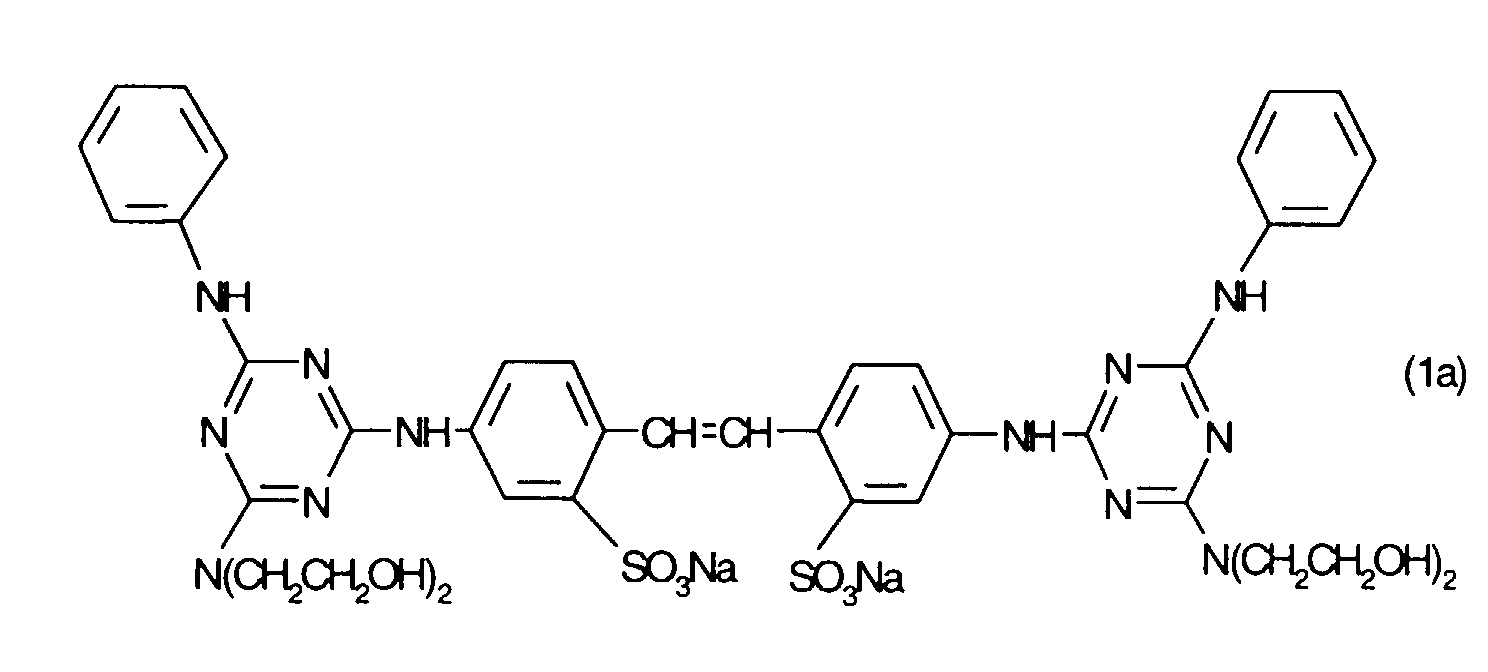
[0057] One preferred aspect of the present invention is to extend the effectiveness of the primary fluorescent brightener, in particular a fluorescent whitening agent that has 2 sulfonic acid groups, with a more highly active and lower affinity whitener such as a fluorescent whitening agent that has 4 or 6 sulfonic acid groups. This allows the tailoring of the brightener mix to optimize the development of fluorescence and shade, as well as the economics of the process. Use of a mixture of the fluorescent whitening agents of the formulae (1a) and (1b) is particularly preferred in this regard. Especially preferred is a mixture comprising 30 to 90 parts by weight of a compound of the formula (1a) with 70 to 10 parts by weight of the compound of the formula (1b), most especially a mixture of 50 to 70 parts by weight of a compound of the formula (1a) with 50 to 30 parts by weight of the compound of the formula (1b). Judicious choice of the optical brighteners allows the manufacturer to achieve the desired brightness targets in the pulp mill while simultaneously balancing other bleach parameters to provide the desired physical properties such as bulk, stiffness, curl, opacity, fiber strength, drainage, etc. The use of fluorescent whitening agents also gives benefits in shade properties, for example in blueness (b* value), that are desirable in the marketing of these pulps.
[0058] Another preferred aspect of the present invention is to employ mixtures of the same or different types of disulfo fluorescent whitening agents. Especially preferred are mixtures comprising a compound of the formula (1a) and/or (1c) with the compound of the formula (4a). Such mixtures may comprise 5 to 95 parts by weight of a compound of the formula (1a) and/or (1c) with 95 to 5 parts by weight of the compound of the formula (4a), preferably a mixture of 60 to 90 parts by weight of a compound of the formula (1a) and/or (1c) with 40 to 10 parts by weight of the compound of the formula (4a) and especially a mixture of 75 to 85 parts by weight of a compound of the formula (1a) and/or (1c) with 25 to 15 parts by weight of the compound of the formula (4a), the sum of the parts being in each case 100.
[0059] The fluorescent whitening agents comprising the mixtures may be added to the aqueous pulp separately or as a blend.
[0060] The above fluorescent whitening agent mixtures give superior results, particularly with regard to blueness (b* value), compared to the same weight of the individual compounds.
[0061] The amount of the fluorescent whitening agent to employ will vary from 0.01 up to about 2% by weight, based on the dry weight of the pulp, depending on the degree of whiteness improvement desired. Preferably from 0.1 to 1.5% is used; most preferably 0.2 to 0.8% is used.
[0062] Prior to its isolation or forming paper, a pulp is subjected to a series of chemical treatments and extractions. As indicated above, the fluorescent whitening agent is preferably added in the latter steps of the pulping process to minimize physical and chemical losses. Most preferably the fluorescent whitening agent is added after completion of the bleaching steps and prior to the final dewatering, fluffing and drying. At this stage of pulp manufacture, the pulp usually has a reasonable pH (preferably between 4 and 10) and a very fluid consistency which promotes rapid mixing of the fluorescent whitening agent throughout the pulp. Typically, at this stage of pulp manufacture, the solids content is 5-15% by weight, based on the dry weight of the pulp.
[0063] While the fluorescent whitening agent does work at high consistencies (> 50% solids by weight, based on the dry weight of the pulp) in the present invention, the final pulp is more subject to mottling due to incomplete mixing relative to the time it takes for the fluorescent whitening agent to fix onto the fiber. Therefore, advantageously, the solids content based on the dry weight of the pulp is below 50%, preferably below 30%. Most preferably it is between 5-15% by weight when the fluorescent whitening agent is added.
[0064] Another reason for preferring to add the fluorescent whitening agent after the final bleaching stage is that the amount of fluorescent whitening agent to add can easily be varied at this point in the pulping process to adjust the brightness to the appropriate level. While some residual peroxide or reductive bleaching chemicals may still be present at this stage, this does not adversely affect the inventive process.
[0065] It is also noteworthy that variations in the temperature do not appear to be a negative factor. The fluorescent whitening agents work well within the wide temperature range, typically 70-150° F (21-62° C), encountered during the bleaching and subsequent stages of pulp manufacture.
[0066] In the process of the present invention, even if a chelating agent was employed in earlier steps, for example during bleaching, it is still advantageous to supply additional chelating agent to the lignin-containing pulp prior to the addition of the fluorescent whitening agent in order to control the amount of salts of iron and other heavy metals within the ranges taught above. Additionally, the presence of a chelating agent is also advantageous as an aid in dispersing the fluorescent whitening agent in the pulp to minimize mottling. This is especially important if the fluorescent whitening agent is added to high consistency pulps, for example after dewatering and just prior to going into the fluffer and drying stages.
[0067] Additives which are known to enhance the effectiveness of fluorescent whitening agents may also be used in the present invention, provided they are within the limits of what is acceptable to the end user of the pulp. Thus another preferred aspect of the present invention comprises using a fluorescent whitening agent in combination with an additive, for example a substance used to promote UV absorption and "bloom" of the fluorescent whitener in paper or a material that effectively allows the optical brightener to develop a higher degree of fluorescent whitening by cleaning the pulp fibers. Suitable additives include cationic starch, polyvinyl alcohol and enzymes. Suitable enzymes include cellulases and hemicelllulases. The addition of polyvinyl alcohol is particularly preferred. For example, addition of polyvinyl alcohol to the pulp at the 1.25% level, based on the dry weight of the pulp, can increase the effectiveness of an optical brightener by up to four more GE units, compared to the same fluorescent whitening agent without use of the additive.
Example 1
[0069] To a continuously flowing aqueous pulp slurry containing about 8% by weight, based on the dry weight of the pulp, of a bleached but not dewatered CTMP, i.e. a peroxide bleached chemi-thermomechanical pulp having an iron content of about 10 ppm and a lignin content which typically corresponds to 85-90% of the lignin present in an equivalent amount of wood chips, at a temperature between 50-65 degrees Centigrade and a pH between 7 and 8, is continuously added, in the ratio of 2.3 parts per 1000 parts of slurry, both based on the "as is" weight of the pulp slurry, an aqueous liquid containing 12.5% by weight of the fluorescent whitening agent Tinopal® HW (Ciba Specialty Chemicals Corp, Consumer Care Division, High Point, NC) of the formula
[0070] The time between the Tinopal HW addition to the pulp slurry before the mixture is dewatered and dried is less than ten (10) minutes. As a result of this addition, the brightness of the resulting pulp rises from its initial value of 86 to 90+.
Example 2
[0071] Example 1 is repeated, but using an aqueous slurry containing about 8% of a peroxide bleached chemi-thermomechanical pulp. With 5.5 parts per 1000 parts, both based on the "as is" weight of the pulp slurry, of an aqueous liquid containing 12.5% by weight of the fluorescent whitening agent of the formula
[0072] the brightness rises from 86 to 91+ and stabilizes in a relatively short time (ca. 10 minutes).
Example 3
[0073] During a batch process operating at 25 degrees Centigrade at pH 7-8, an aqueous slurry containing about 5% by weight, based on the dry weight of the pulp, of a bleached but not dewatered CTMP, i.e. a peroxide bleached chemi-thermomechanical pulp having an iron content of about 10 ppm and a lignin content which typically corresponds to 85-90% of the lignin present in an equivalent amount of wood chips, is mixed with 4 parts per 1000 parts, both based on the "100% dry basis" weight of the pulp slurry, of an aqueous liquid mixture containing an 80:20 "dry basis ratio" mixture of 12.5% by weight of the fluorescent whitening agent Tinopal® HW and 33% by weight of the fluorescent whitening agent Tinopal® SK (Ciba Specialty Chemicals Corp, Consumer Care Division, High Point, NC), of the formulas
and
respectively.
[0074] The Tinopal blend is allowed to mix with the pulp slurry for less than ten (10) minutes before the mixture is dewatered and dried. As a result of this addition, the brightness of the resulting pulp rises from its initial value of 81 to 94+. Furthermore, the blueness as judged by the b* value, increases 20% over what is obtained by the use of Tinopal HW alone.
1. A process to increase the whiteness of a lignin-containing pulp, which comprises adding
to an aqueous slurry comprising a lignin-containing pulp, during pulp manufacture,
prior to the drying step or paper making step, an effective amount of a fluorescent
whitening agent.
2. A process according to claim 1, wherein the fluorescent whitening agent is added prior
to the final dewatering and drying steps or paper making step.
3. A process according to claim 1, wherein the fluorescent whitening agent is added after
completion of the last bleaching step.
4. A process according to claim 1, wherein the pulp contains 5% or more of lignin by
weight on a dry basis.
5. A process according to claim 1, which comprises adding to the aqueous slurry comprising
a lignin-containing pulp an effective amount of a chelating agent to decrease the
content of salts of iron and other heavy metals to 100 ppm or less by weight, based
on the dry weight of the pulp, prior to the addition of the fluorescent whitening
agent.
6. A process according to claim 5, wherein the chelating agent is selected from the group
consisting of ethylenediaminetetraacetic acid, diethylenetriaminepentaacetic acid,
hydroxyethylethylenediaminetriacetic acid and nitrilotriacetic acid.
7. A process according to claim 1, wherein the fluorescent whitening agent is selected
from the group consisting of 4,4'-bis-(triazinylamino)-stilbene-2,2'-disulfonic acids,
4,4'-bis-(triazol-2-yl)-stilbene-2,2'-disulfonic acids, 4,4'-dibenzofuranyl-biphenyls,
4,4'-(diphenyl)-stilbenes, 4,4'-distyryl-biphenyls, 4-phenyl-4'-benzoxazolyl-stilbenes,
stilbenyl-naphthotriazoles, 4-styrylstilbenes, bis-(benzoxazol-2-yl) derivatives,
bis-(benzimidazol-2-yl) derivatives, coumarins, pyrazolines, naphthalimides, triazinyl-pyrenes,
2-styryl-benzoxazole or -naphthoxazoles, benzimidazole-benzofurans and oxanilides,
or a mixture thereof.
8. A process according to claim 7, wherein the 4,4'-bis-(triazinylamino)-stilbene-2,2'-disulfonic
acid fluorescent whitening agent is of the formula:
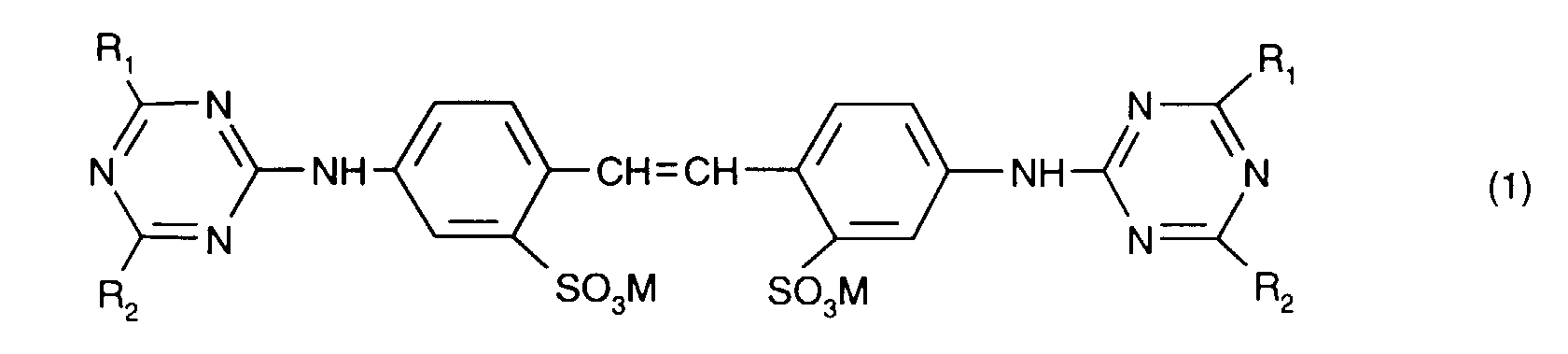
in which R1 and R2, independently, are phenyl, mono- or disulfonated phenyl, phenylamino, mono- or disulfonated phenylamino, morpholino, -N(CH2CH2OH)2, -N(CH3)(CH2CH2OH), -NH2, -N(C1-C4alkyl)2, -OCH3, -Cl, -NH-CH2CH2SO3H, CH2CH2OH or ethanolaminopropionic acid amide; and M is H, Na, Li, K, Ca, Mg, ammonium, or ammonium that is mono-, di-, tri- or tetra-substituted by C1-C4alkyl, C1-C4hydroxyalkyl or a mixture thereof.
in which R1 and R2, independently, are phenyl, mono- or disulfonated phenyl, phenylamino, mono- or disulfonated phenylamino, morpholino, -N(CH2CH2OH)2, -N(CH3)(CH2CH2OH), -NH2, -N(C1-C4alkyl)2, -OCH3, -Cl, -NH-CH2CH2SO3H, CH2CH2OH or ethanolaminopropionic acid amide; and M is H, Na, Li, K, Ca, Mg, ammonium, or ammonium that is mono-, di-, tri- or tetra-substituted by C1-C4alkyl, C1-C4hydroxyalkyl or a mixture thereof.
9. A process according to claim 8, wherein the fluorescent whitening agent is of the
formula (1) in which each R1 is 2,5-disulfophenyl and each R2 is morpholino, -N(C2H5)2, -N(CH2CH2OH)2 or ethanolaminopropionic acid amide; or each R1 is 3-sulfophenyl and each R2 is NH(CH2CH2OH) or N(CH2CH2OH)2; or each R1 is 4-sulfophenyl and each R2 is N(CH2CH2OH)2, N(CH2CHOHCH3)2, morpholino, or ethanolaminopropionic acid amide; or each R1 is phenylamino and each R2 is morpholino, NH(CH2CH2OH), N(CH2CH2OH)CH3, N(CH2CH2OH)2 or ethanolaminopropionic acid amide, and, in each case, the sulfo group is SO3M in which M is sodium.
10. A process according to claim 9, wherein the fluorescent whitening agent is of the
formula
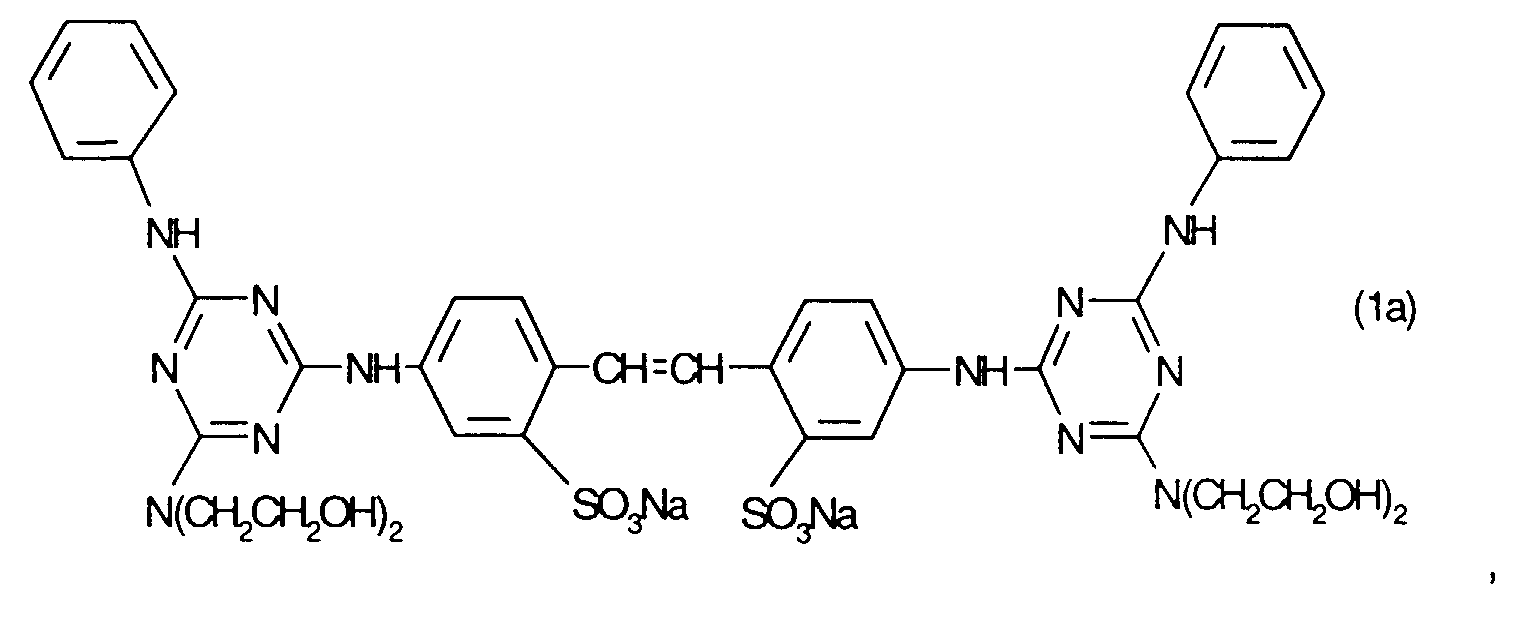

or
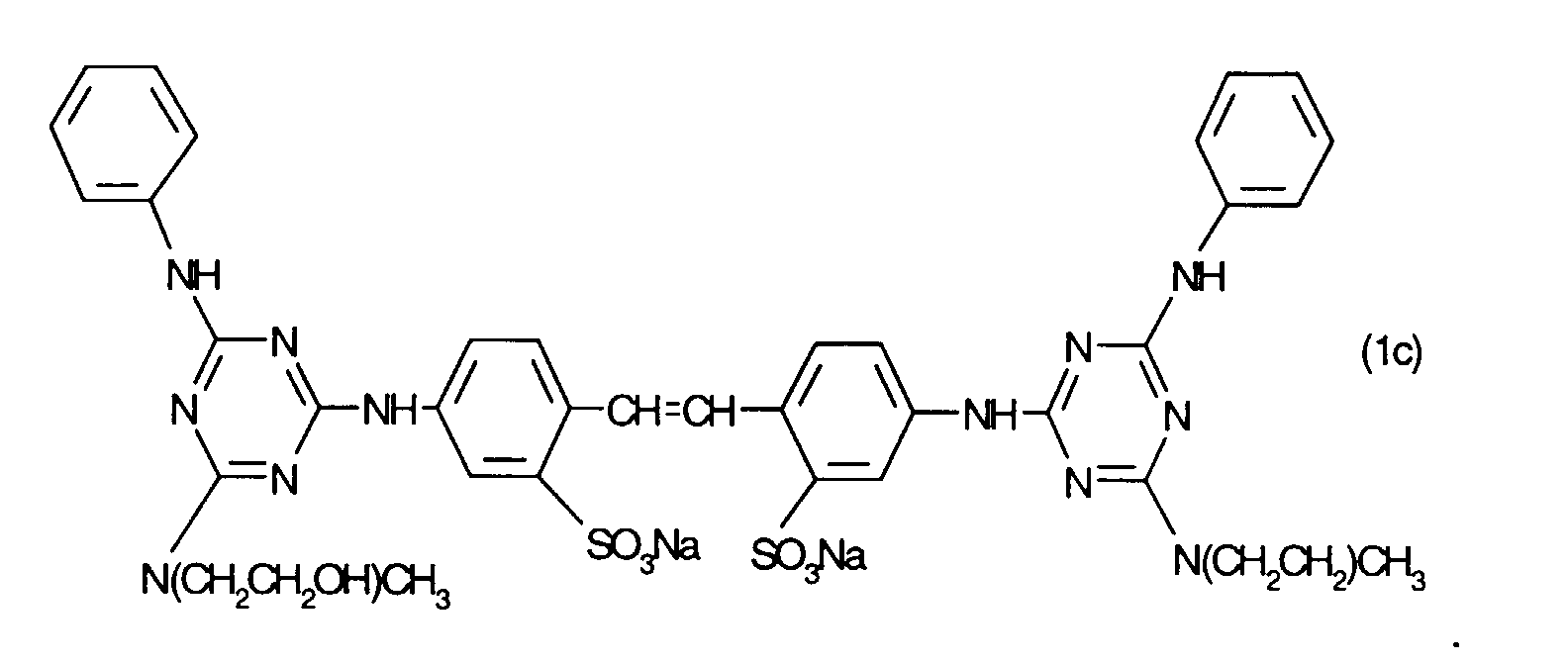
or
11. A process according to claim 7, wherein the 4,4'-bis-(triazol-2-yl)stilbene-2,2'-disulfonic
acid fluorescent whitening agent is of the formula:
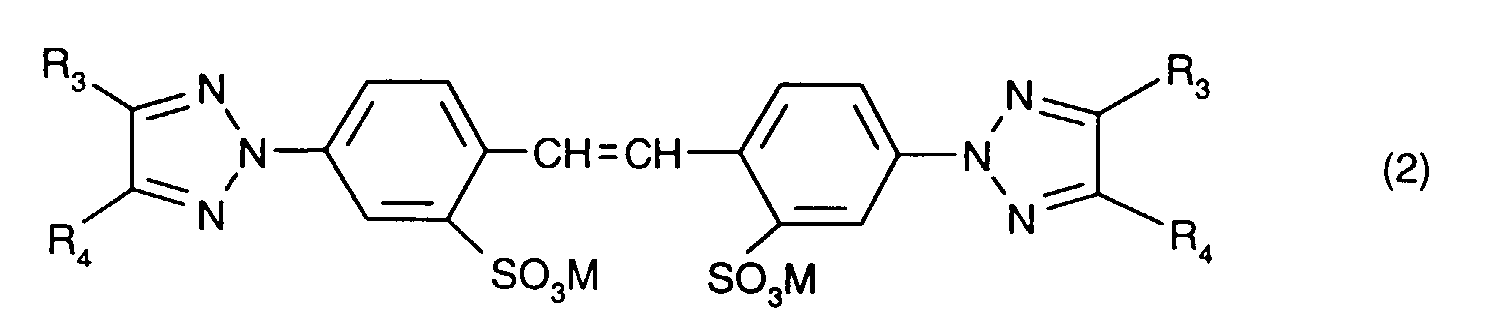
in which R3 and R4, independently, are H, C1-C4alkyl, phenyl or monosulfonated phenyl; and M is H, Na, Li, K, Ca, Mg, ammonium, or ammonium that is mono-, di-, tri- or tetra-substituted by C1-C4alkyl, C1-C4-hydroxyalkyl or a mixture thereof.
in which R3 and R4, independently, are H, C1-C4alkyl, phenyl or monosulfonated phenyl; and M is H, Na, Li, K, Ca, Mg, ammonium, or ammonium that is mono-, di-, tri- or tetra-substituted by C1-C4alkyl, C1-C4-hydroxyalkyl or a mixture thereof.
12. A process according to claim 11, wherein the fluorescent whitening agent is of the
formula (2) in which R3 is phenyl, R4 is H and M is sodium.
13. A process according to claim 7, wherein the 4,4'-dibenzofuranyl-biphenyl fluorescent
whitening agent is of the formula:
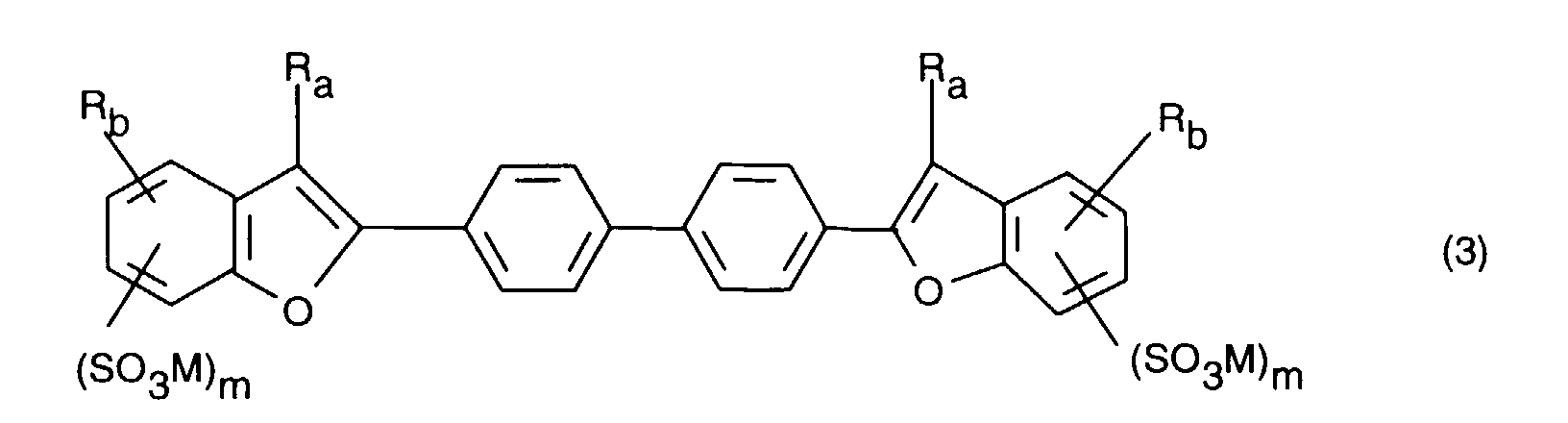
in which Ra and Rb, independently, are H or C1-C4alkyl, and M is H, Na, Li, K, Ca, Mg, ammonium, or ammonium that is mono-, di-, tri- or tetra-substituted by C1-C4alkyl, C1-C4-hydroxyalkyl or a mixture thereof.
in which Ra and Rb, independently, are H or C1-C4alkyl, and M is H, Na, Li, K, Ca, Mg, ammonium, or ammonium that is mono-, di-, tri- or tetra-substituted by C1-C4alkyl, C1-C4-hydroxyalkyl or a mixture thereof.
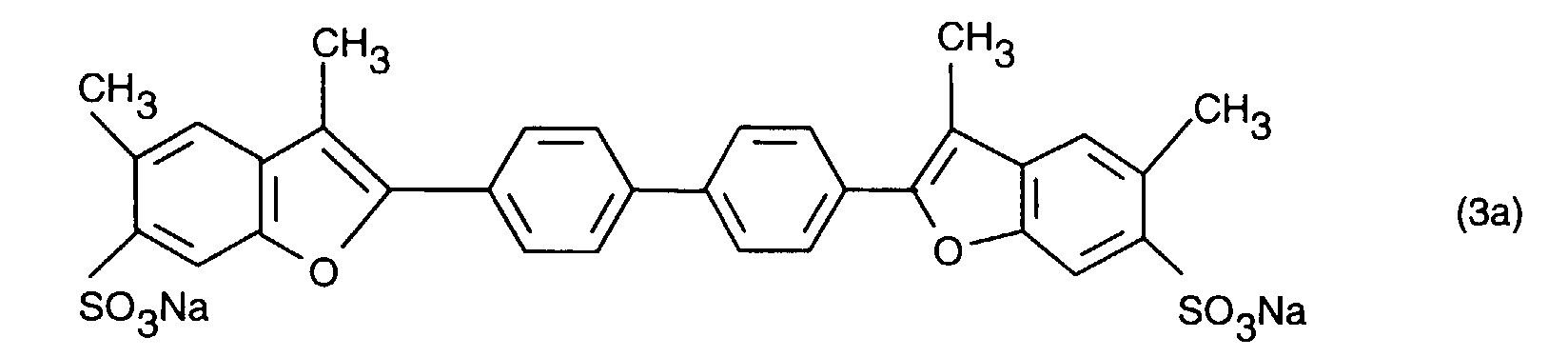
14. A process according to claim 13, wherein the fluorescent whitening agent is the compound
of the formula
15. A process according to claim 7, wherein the 4,4'-distyryl-biphenyl fluorescent whitening
agent is of the formula:

in which R5 and R6, independently, are H, SO3M, SO2N(C1-C4alkyl)2, O-(C1-C4alkyl), CN, Cl, COO(C1-C4alkyl), CON(C1-C4alkyl)2 or O(CH2)3N⊕(CH3)2 An-, in which M is H, Na, Li, K, Ca, Mg, ammonium, or ammonium that is mono-, di-, tri- or tetra-substituted by C1-C4alkyl, C1-C4-hydroxyalkyl or a mixture thereof, An- is an anion of an organic or inorganic acid or a mixture thereof, and n is 1.
in which R5 and R6, independently, are H, SO3M, SO2N(C1-C4alkyl)2, O-(C1-C4alkyl), CN, Cl, COO(C1-C4alkyl), CON(C1-C4alkyl)2 or O(CH2)3N⊕(CH3)2 An-, in which M is H, Na, Li, K, Ca, Mg, ammonium, or ammonium that is mono-, di-, tri- or tetra-substituted by C1-C4alkyl, C1-C4-hydroxyalkyl or a mixture thereof, An- is an anion of an organic or inorganic acid or a mixture thereof, and n is 1.
16. A process according to claim 15, wherein the fluorescent whitening agent is of the
formula (4) in which each R6 is H and each R5 is a 2-SO3M group in which M is sodium or each R5 is O(CH2)3N⊕(CH3)2 An-, in which An- is acetate.
17. A process according to claim 16, wherein the fluorescent whitening agent is of the
formula

18. A process according to claim 7, wherein the fluorescent whitening agent is a 4-phenyl-4'-benzoxazolyl-stilbene
of the formula:

in which R7 and R8, independently, are H, Cl, C1-C4alkyl or SO2-C1-C4alkyl, or is a stilbenyl-naphthotriazole of the formula:
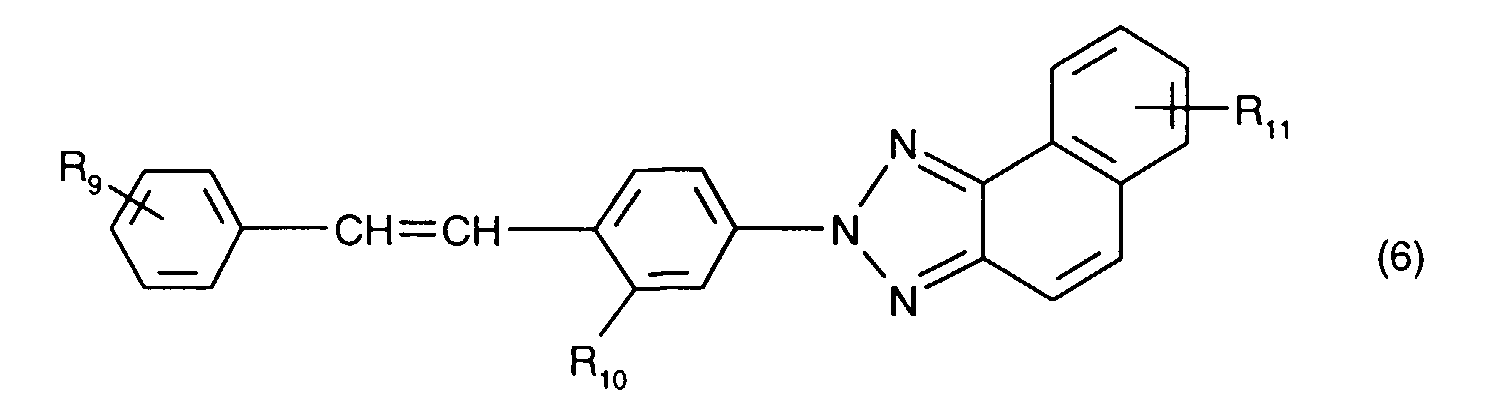
in which R9 is H or Cl; R10 is SO3M, SO2N(C1-C4alkyl)2, SO2O-phenyl or CN; R11 is H or SO3M; and M is H, Na, Li, K, Ca, Mg, ammonium, or ammonium that is mono-, di-, tri- or tetra-substituted by C1-C4alkyl, C1-C4hydroxyalkyl or a mixture thereof.
in which R7 and R8, independently, are H, Cl, C1-C4alkyl or SO2-C1-C4alkyl, or is a stilbenyl-naphthotriazole of the formula:
in which R9 is H or Cl; R10 is SO3M, SO2N(C1-C4alkyl)2, SO2O-phenyl or CN; R11 is H or SO3M; and M is H, Na, Li, K, Ca, Mg, ammonium, or ammonium that is mono-, di-, tri- or tetra-substituted by C1-C4alkyl, C1-C4hydroxyalkyl or a mixture thereof.
19. A process according to claim 7, wherein the fluorescent whitening agent is a 4-styrylstilbene
of the formula:

in which R12 and R13, independently, are H, SO3M, SO2N(C1-C4alkyl)2, O-(C1-C4alkyl), CN, Cl, COO(C1-C4alkyl), CON(C1-C4alkyl)2 or O(CH2)3N⊕(CH3)2 An- in which An- is an anion of an organic or inorganic acid or a mixture thereof and M is H, Na, Li, K, Ca, Mg, ammonium, or ammonium that is mono-, di-, tri- or tetra-substituted by C1-C4alkyl, C1-C4hydroxyalkyl or a mixture thereof.
in which R12 and R13, independently, are H, SO3M, SO2N(C1-C4alkyl)2, O-(C1-C4alkyl), CN, Cl, COO(C1-C4alkyl), CON(C1-C4alkyl)2 or O(CH2)3N⊕(CH3)2 An- in which An- is an anion of an organic or inorganic acid or a mixture thereof and M is H, Na, Li, K, Ca, Mg, ammonium, or ammonium that is mono-, di-, tri- or tetra-substituted by C1-C4alkyl, C1-C4hydroxyalkyl or a mixture thereof.
20. A process according to claim 7, wherein the fluorescent whitening agent is a bis-(benzoxazol-2-yl)
derivative of the formula:
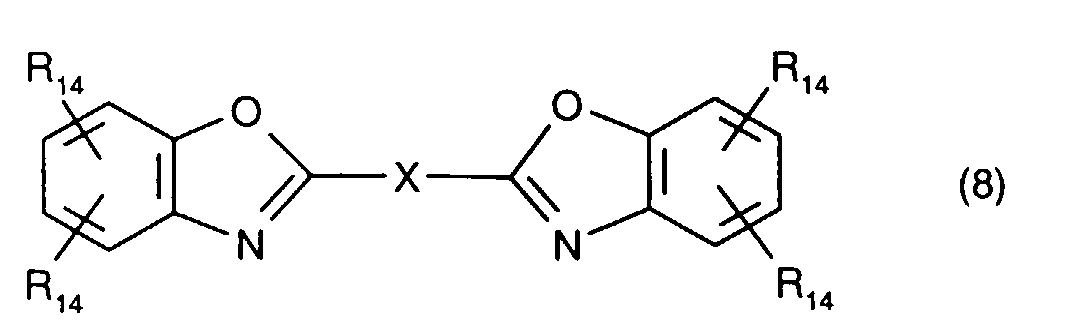
in which R14, independently, is H, C(CH3)3, C(CH3)2-phenyl, C1-C4alkyl or COO-C1-C4alkyl, and X is -CH=CH- or a group of the formula:

or
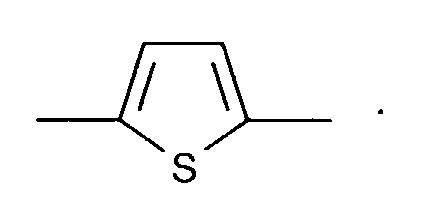
in which R14, independently, is H, C(CH3)3, C(CH3)2-phenyl, C1-C4alkyl or COO-C1-C4alkyl, and X is -CH=CH- or a group of the formula:
or
21. A process according to claim 7, wherein the fluorescent whitening agent is a bis-(benzimidazol-2-yl)
derivative of the formula:
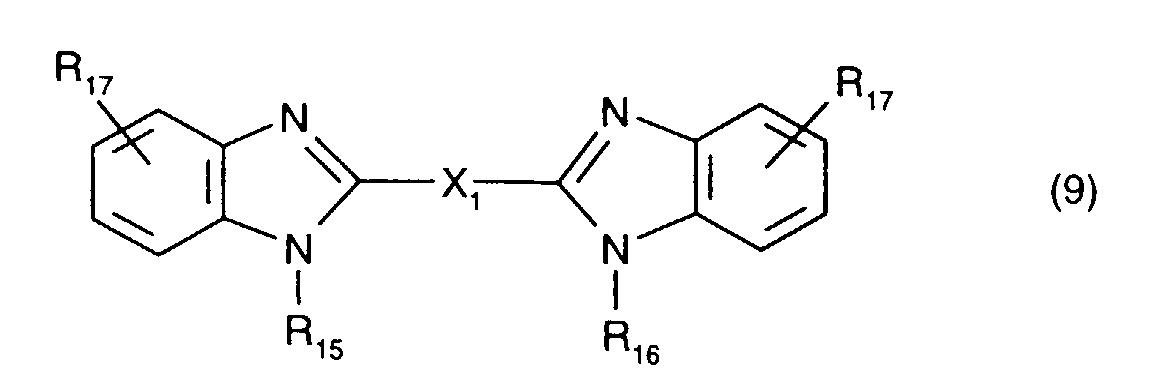
in which R15 and R16, independently, are H, C1-C4alkyl or CH2CH2OH; R17 is H or SO3M; X1 is -CH=CH- or a group of the formula

and M is H, Na, Li, K, Ca, Mg, ammonium, or ammonium that is mono-, di-, tri- or tetra-substituted by C1-C4alkyl, C1-C4hydroxyalkyl or a mixture thereof.
in which R15 and R16, independently, are H, C1-C4alkyl or CH2CH2OH; R17 is H or SO3M; X1 is -CH=CH- or a group of the formula
and M is H, Na, Li, K, Ca, Mg, ammonium, or ammonium that is mono-, di-, tri- or tetra-substituted by C1-C4alkyl, C1-C4hydroxyalkyl or a mixture thereof.
22. A process according to claim 7, wherein the fluorescent whitening agent is a coumarin
of the formula:
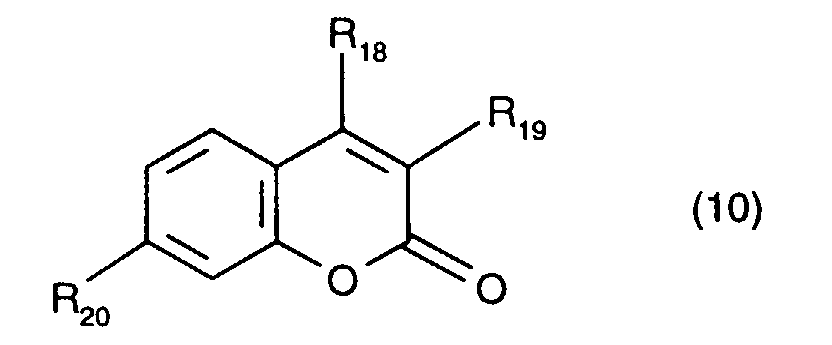
in which R18 is H, Cl or CH2COOH, R19 is H, phenyl, COO-C1-C4alkyl or a group of the formula:
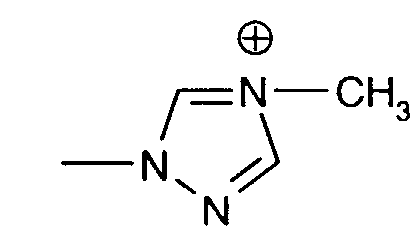
and R20 is O-C1-C4alkyl, N(C1-C4alkyl)2, NH-CO-C1-C4alkyl or a group of the formula:

in which R1 and R2, independently, are phenyl, mono- or disulfonated phenyl, phenylamino, mono- or disulfonated phenylamino, morpholino, -N(CH2CH2OH)2, -N(CH3)(CH2CH2OH), -NH2, -N(C1-C4alkyl)2, -OCH3, -Cl, -NH-CH2CH2SO3H or -NH-CH2CH2OH, R3 and R4, independently, are H, C1-C4alkyl, phenyl or monosulfonated phenyl and R21 is H, C1-C4alkyl or phenyl.
in which R18 is H, Cl or CH2COOH, R19 is H, phenyl, COO-C1-C4alkyl or a group of the formula:
and R20 is O-C1-C4alkyl, N(C1-C4alkyl)2, NH-CO-C1-C4alkyl or a group of the formula:
in which R1 and R2, independently, are phenyl, mono- or disulfonated phenyl, phenylamino, mono- or disulfonated phenylamino, morpholino, -N(CH2CH2OH)2, -N(CH3)(CH2CH2OH), -NH2, -N(C1-C4alkyl)2, -OCH3, -Cl, -NH-CH2CH2SO3H or -NH-CH2CH2OH, R3 and R4, independently, are H, C1-C4alkyl, phenyl or monosulfonated phenyl and R21 is H, C1-C4alkyl or phenyl.
23. A process according to claim 7, wherein the fluorescent whitening agent is a pyrazoline
of the formula:
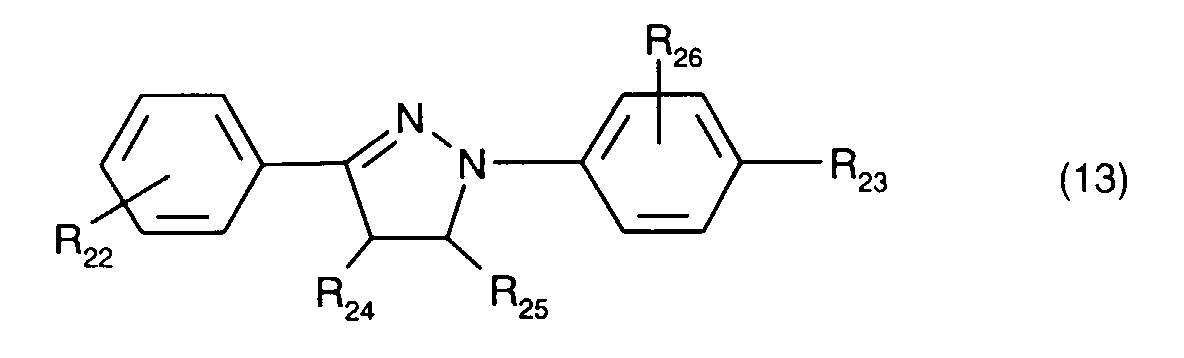
in which R22 is H, Cl or N(C1-C4alkyl)2, R23 is H, Cl, SO3M, SO2NH2, SO2NH-(C1-C4alkyl), COO-C1-C4alkyl, SO2-C1-C4alkyl, SO2NHCH2CH2CH2N⊕(CH3)3 or SO2CH2CH2N⊕H(C1-C4alkyl)2 An-, R24 and R25 are the same or different and each is H, C1-C4alkyl or phenyl, R26 is H or Cl, An- is an anion of an organic or inorganic acid, and M is H, Na, Li, K, Ca, Mg, ammonium, or ammonium that is mono-, di-, tri- or tetra-substituted by C1-C4alkyl, C1-C4hydroxyalkyl or a mixture thereof.
in which R22 is H, Cl or N(C1-C4alkyl)2, R23 is H, Cl, SO3M, SO2NH2, SO2NH-(C1-C4alkyl), COO-C1-C4alkyl, SO2-C1-C4alkyl, SO2NHCH2CH2CH2N⊕(CH3)3 or SO2CH2CH2N⊕H(C1-C4alkyl)2 An-, R24 and R25 are the same or different and each is H, C1-C4alkyl or phenyl, R26 is H or Cl, An- is an anion of an organic or inorganic acid, and M is H, Na, Li, K, Ca, Mg, ammonium, or ammonium that is mono-, di-, tri- or tetra-substituted by C1-C4alkyl, C1-C4hydroxyalkyl or a mixture thereof.
24. A process according to claim 7, wherein the fluorescent whitening agent is a naphthalimide
of the formula:

in which R27 is C1-C4alkyl or CH2CH2CH2N⊕(CH3)3 An- in which An- is an anion of an organic or inorganic acid, R28 and R29, independently, are O-C1-C4-alkyl, SO3M or NH-CO-C1-C4alkyl; and M is H, Na, Li, K, Ca, Mg, ammonium, or ammonium that is mono-, di-, tri- or tetra-substituted by C1-C4alkyl, C1-C4hydroxyalkyl or a mixture thereof.
in which R27 is C1-C4alkyl or CH2CH2CH2N⊕(CH3)3 An- in which An- is an anion of an organic or inorganic acid, R28 and R29, independently, are O-C1-C4-alkyl, SO3M or NH-CO-C1-C4alkyl; and M is H, Na, Li, K, Ca, Mg, ammonium, or ammonium that is mono-, di-, tri- or tetra-substituted by C1-C4alkyl, C1-C4hydroxyalkyl or a mixture thereof.
25. A process according to claim 7, wherein the fluorescent whitening agent is a 2-styrylbenzoxazole-
or -naphthoxazole derivative having the formula:
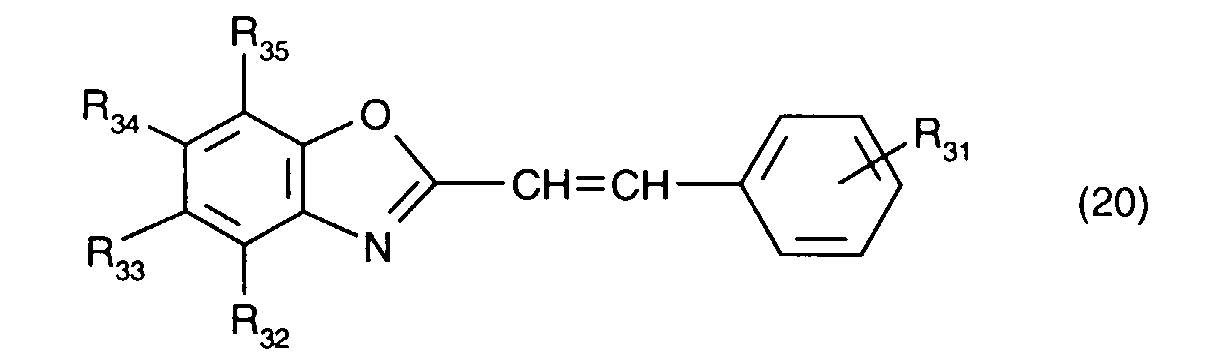
in which R31 is CN, Cl, COO-C1-C4alkyl or phenyl; R32 and R33 are the atoms required to form a fused benzene ring or R33 and R35, independently, are H or C1-C4alkyl; and R34 is H, C1-C4alkyl or phenyl.
in which R31 is CN, Cl, COO-C1-C4alkyl or phenyl; R32 and R33 are the atoms required to form a fused benzene ring or R33 and R35, independently, are H or C1-C4alkyl; and R34 is H, C1-C4alkyl or phenyl.
26. A process according to claim 7, wherein the fluorescent whitening agent is a benzimidazole-benzofuran
derivative having the formula:
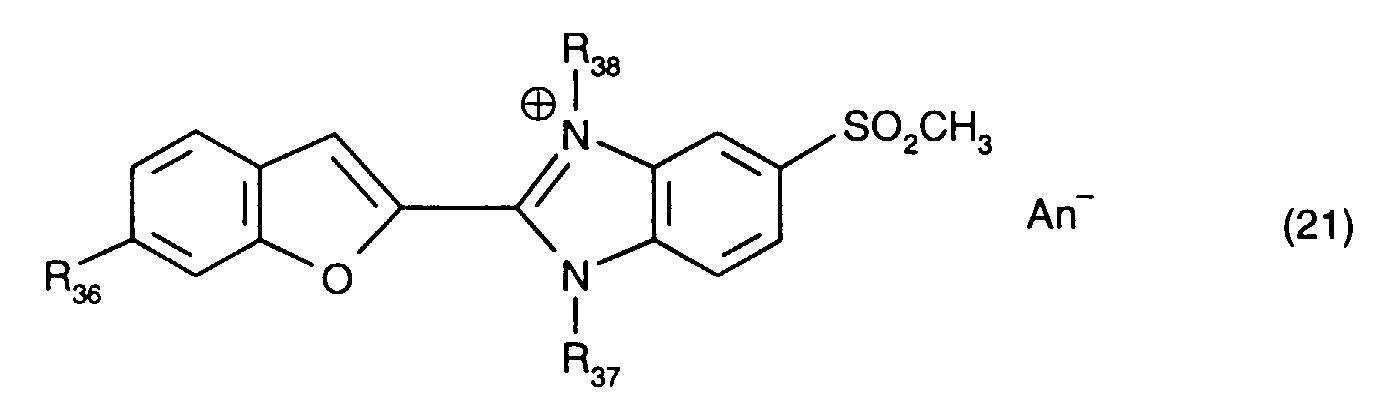
in which R36 is C1-C4alkoxy; R37 and R38, independently, are C1-C4alkyl; and An- is an anion of an organic or inorganic acid.
in which R36 is C1-C4alkoxy; R37 and R38, independently, are C1-C4alkyl; and An- is an anion of an organic or inorganic acid.
27. A process according to claim 7, wherein the fluorescent whitening agent is an oxanilide
derivative having the formula:

in which R39 is C1-C4alkoxy, R41 is C1-C4alkyl, C1-C4alkyl-SO3M or C1-C4alkoxy-SO3M in which M is H, Na, Li, K, Ca, Mg, ammonium, or ammonium that is mono-, di-, tri- or tetra-substituted by C1-C4alkyl, C1-C4hydroxyalkyl or a mixture thereof, preferably Na, Li or K, and R40 and R42 are the same and each is hydrogen, tert. butyl or SO3M, in which M is as defined for R41.
in which R39 is C1-C4alkoxy, R41 is C1-C4alkyl, C1-C4alkyl-SO3M or C1-C4alkoxy-SO3M in which M is H, Na, Li, K, Ca, Mg, ammonium, or ammonium that is mono-, di-, tri- or tetra-substituted by C1-C4alkyl, C1-C4hydroxyalkyl or a mixture thereof, preferably Na, Li or K, and R40 and R42 are the same and each is hydrogen, tert. butyl or SO3M, in which M is as defined for R41.
28. A process according to claim 1, wherein the fluorescent whitening agent is substituted
by 2 to 6 sulfonic acid groups.
29. A process according to claim 31, wherein the fluorescent whitening agent is substituted
by 2 sulfonic acid groups.
30. A process according to claim 1, wherein the fluorescent whitening agent comprises
a mixture of at least 2 different fluorescent whitening compounds.
31. A process according to claim 30, wherein the fluorescent whitening agent comprises
a mixture of fluorescent whitening agent which is substituted by 2 sulfonic acid groups
and a fluorescent whitening agent which is substituted by 4 or 6 sulfonic acid groups.
32. A process according to claim 31, wherein the fluorescent whitening agent comprises
a mixture of the compounds of the formulae
and
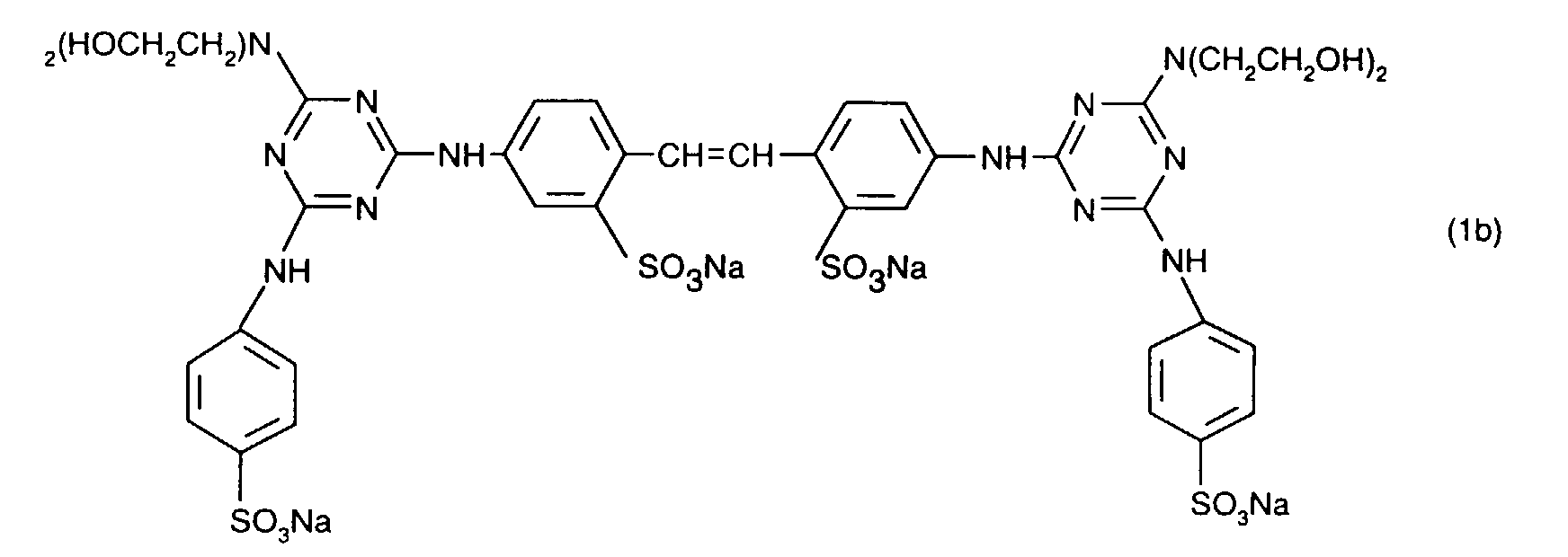
and
33. A process according to claim 30, wherein the fluorescent whitening agent comprises
a mixture of 5 to 95 parts by weight of a compound of the formula

and/or

with 95 to 5 parts by weight of the compound of the formula
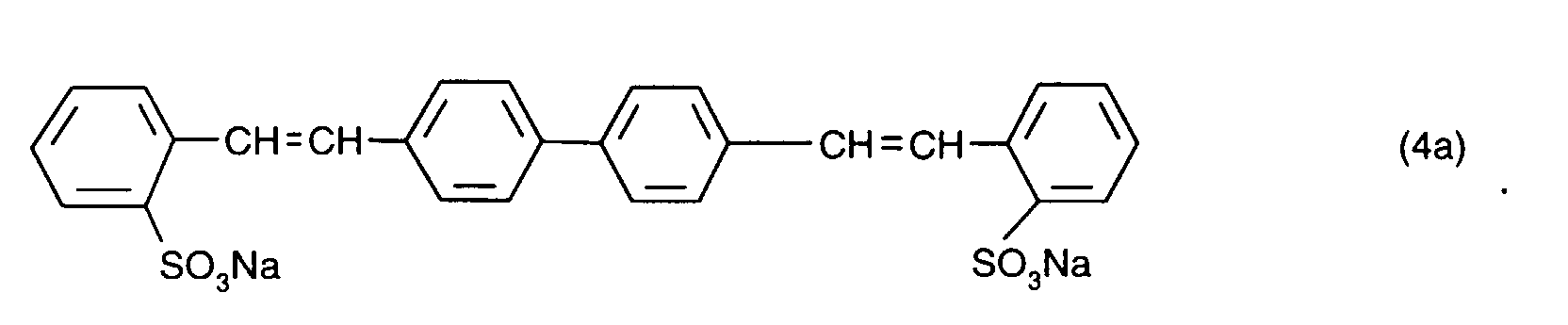
and/or
with 95 to 5 parts by weight of the compound of the formula
34. A process according to claim 1, wherein from 0.01 up to about 2% by weight, based
on the dry weight of the pulp, of the fluorescent whitening agent is employed.
35. A process according to claim 1, wherein the aqueous slurry comprising the lignin-containing
pulp has a solids content below 50%, based on the dry weight of the pulp.
36. A process according to claim 35, wherein the aqueous slurry comprising the lignin-containing
pulp has a pH of 4-10 and a solids content between 5 and 15%, based on the dry weight
of the pulp.
37. A process according to claim 1, which comprises additionally adding to the aqueous
slurry comprising a lignin-containing pulp and an effective amount of a fluorescent
whitening agent, an effective amount of an additive which is known to enhance the
effectiveness of a fluorescent whitening agent.
38. A process according to claim 37, wherein the additive is cationic starch, polyvinyl
alcohol or an enzyme.