|
(11) | EP 0 900 182 B1 |

| (12) | EUROPEAN PATENT SPECIFICATION |
|
|
| (54) |
METHODS FOR INHIBITING THE POLYMERIZATION OF ETHYLENICALLY UNSATURATED MONOMERS METHODE ZUR INHIBIERUNG DER POLYMERISATION VON ETHYLENISCHE UNGESATTIGTEN MONOMEREN PROCEDES DESTINES A EMPECHER LA POLYMERISATION DE MONOMERES ALCENIQUES |
|
|
|||||||||||||||||||||||||||||||
| Note: Within nine months from the publication of the mention of the grant of the European patent, any person may give notice to the European Patent Office of opposition to the European patent granted. Notice of opposition shall be filed in a written reasoned statement. It shall not be deemed to have been filed until the opposition fee has been paid. (Art. 99(1) European Patent Convention). |
[0001] This invention relates to methods for inhibiting polymerization of ethylenically unsaturated monomers. The methods are particularly effective at inhibiting polymerization of these monomers during storage conditions in the presence of oxygen.
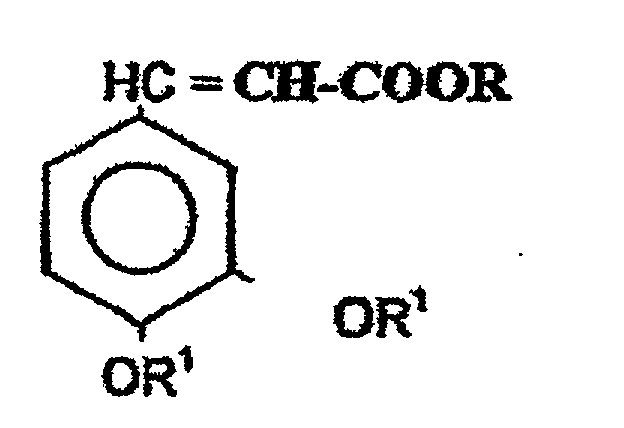
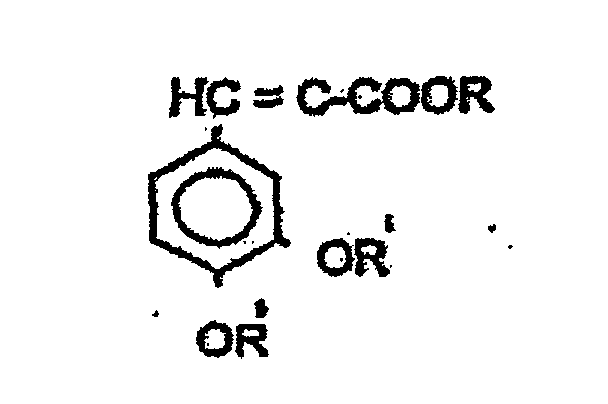
BACKGROUND ART
[0002] It is well known that ethylenically unsaturated monomers readily polymerize when heated and that the polymerization rate increases with increasing temperature. For this reason, the monomers are stabilized by the addition of substances which act as inhibitors or retarders of polymerization, or which block the initiation mechanism leading to the formation of radicals.
[0003] Certain ethylenically unsaturated (diolefin) monomers such as butadiene and isoprene polymerize when left in storage tanks and during transportation at temperatures as low as room temperature. This polymerization is initiated by reaction of the diolefin monomer with oxygen present in the monomer containing system. This reaction forms peroxides and free radical species which can further react with the diolefin monomer.
[0004] To prevent this polymerization from taking place, diolefin monomer manufacturers frequently add tert-butyl catechol (TBC) as a polymerization inhibitor. However, TBC is a toxic compound and can cause tissue damage when it contacts skin. These characteristics make it desirable to utilize an inhibitor compound that avoids these difficulties as well as being water and caustic extractable so that it could be easily removed from the finished product before use or additional processing.
[0005] The present inventor has discovered that dihydroxycinnamic acid and its derivatives effectively inhibit the polymerization of ethylenicatly unsaturated monomers during storage and transportation. These compounds prove particularly effective in the presence of oxygen and at temperatures up to 100°C.
[0006] EP 89-402156 discloses a cosmetic preparation containing an antioxidant system based on a stabilized ascorbic acid ester. The antioxidant system also contains tocopherol or mixtures of tocopherol, caffeic acid or its derivatives, a complexing agent and a non-thiol polypeptide.
[0007] JP Kokai JP 59015477 teaches a food antioxidant composition effective for oils and fats which comprises 3,4-dihydroxycinnamic acid esters and one or more of ascorbic acid-stearic acid ester, citric acid, malic acid, and ascorbic acid.
[0008] US-A-5221 498 disclose methods for inhibiting the polymerization of a vinyl monomer during elevated processing or during storage or shipment of the product by using a composition comprising a dihydroxy benzene compound selected from the group consisting of
wherein R is H, alkyl or aryl group having from 1 to 5 carbon atoms and an organic amine compound selected from the group consisting of polyoxypropylenediamine, and diethylenetriamine.
[0009] US-A-5396 005 discloses a method of inhibiting the polymerization of ethylenically unsaturated monomers using a composition comprising a methoxyphenol compound selected from the group consisting of eugenol and 2-tert-butyl-4-hydroxyanisole and a phenylenediamine compound.
[0010] US-A-3775493 discloses a method for inhibiting the polymerization of conjugated dienes in solution at temperatures ranging from 115 to 116°C which comprises adding, as polymerization inhibitor, a halogen-quinone derivative selected from the group consiting of chloroanile, bromoanile, iodanile,-2,5-dichlorobenzoquinone, 2,6-dichlorobenzoquinone, dichlorodicyanoquinone mixtures thereof and mixtures of the same with known inhibitors.
DISCLOSURE OF THE INVENTION
[0011] The present invention relates to a method for inhibiting the polymerization of isoprene comprising adding an effective polymerization inhibiting amount of a dihydroxycinnamic acid or derivate thereof.
[0012] The dihydroxycinnamic acid or derivatives thereof generally have the formula:
wherein R is H, CH3 or C2H5; R1 is H, CH3 or C2H5 with the proviso that at least one of R1 is H. The preferred compounds for use in the present invention are dihydroxycinnamic acid and dihydroxydihydrocinnamic acid.
[0013] The ethylenically unsaturated monomers are characterized as polymerizable ethylenically unsaturated hydrocarbons and include olephins such as alpha olephins containing 2 to 20 carbon atoms and preferably 2 to 8 carbon atoms, and conjugated di-olephins, preferably those containing 4 to 6 carbon atoms such as isoprene and butadiene.
[0014] For purposes of this invention, the term "effective amount" refers to the amount of dihydroxycinnamic acid or derivative thereof necessary to inhibit polymerization of ethylenically unsaturated monomers. This amount will vary according to the conditions under which the ethylenically unsaturated monomer is subjected during storage and/or handling thereof. At higher temperatures and higher monomer contamination, larger amounts of polymerization inhibiting compound are generally required.
[0015] Preferably the effective amount of dihydroxycinnamic acid or derivative added to the ethylenically unsaturated monomer ranges from 1 part to 1000 parts per million parts of monomer. More preferably, the amount of dihydroxycinnamic acid or derivative thereof added to the monomer ranges from 10 parts to 200 parts per million parts monomer.
[0016] The dihydroxycinnamic acid derivatives may be used in combination with the dihydroxycinnamic acid or as a mixture of the dihydroxycinnamic acid derivatives when utilized in the methods of the present invention.
[0017] The dihydroxycinnamic acid or derivative thereof may be added to the ethylenically unsaturated monomer as either a dispersion or as a solution using a suitable liquid carrier or solvent. Any solvent that is compatible with the dihydroxycinnamic acid or derivative thereof and the ethylenically unsaturated monomer may be employed.
MODES FOR CARRYING OUT THE INVENTION
[0018] The invention will now be described with reference to a number of specific examples which are to be regarded solely as illustrative, and not as restricting the scope of the invention.
EXAMPLES
[0019] Testing was performed to determine the effectiveness of the present invention at inhibiting the polymerization of ethylenically unsaturated monomers.
[0020] Tests were run in a stainless steel pressure vessel fitted with a glass sample container and cover, a stem, a pressure gauge with a continuous recorder, and the appropriate valves and fittings. A solution of 10 mL of isoprene in 40 mL of heptane and the designated treatment were placed in the glass sample container and inside the pressure vessel. The vessel was closed, filled with oxygen at 790.8 kPa (100 psig) and heated in a water bath at 100°C. The pressure was recorded continuously until a break point in the pressure-time curve (i.e., steepest slope of the curve) was reached. The induction time was calculated as the time elapsed between the placing of the vessel in the bath and the breaking point. The results of this testing are reported in Table I.
TABLE I
| Polymerization Inhibition Testing | ||
| Treatment | Dose (ppm) | Induction Time (min.) |
| Blank | ---- | 25 |
| TBC | 10 | 40 |
| BHT | 10 | 31 |
| 40 | 32 | |
| DHHCA | 10 | 85 |
| 25 | 144 | |
| Blank | ---- | 21 |
| TBC | 40 | 90 |
| DHHCA | 40 | 110 |
| DHCA | 40 | 54 |
| Blank | ---- | 25 |
| DHCA | 50 | 102 |
| 100 | 127 | |
| TBC is tert-butyl catechol | ||
| BHT is 2,6-di-t-butyl-4-methylphenol | ||
| DHCA is 3,5-dihydroxycinnamic acid | ||
| DHHCA is 3,4-dihydroxyhydrocinnamic acid | ||
[0021] These results demonstrate that the compounds of the present invention are effective at inhibiting the polymerization of ethylenically unsaturated monomers under conditions approximating storage. The commercially available inhibitors, TBC and BHT proved less effective than the inventive compounds.
INDUSTRIAL APPLICABILITY
[0022] The dihydroxycinnamic acid or derivatives thereof are effective at inhibiting the polymerization of ethylenically unsaturated monomers during their storage or under transportation conditions. These conditions are typically found to have oxygen atmospheres present and monomer temperatures up to 100°C. The present inventor anticipates that the methods of the present invention can inhibit the polymerization of ethylenically unsaturated monomers during the processing thereof. These processing conditions, such as purification and distillation processes, typically employ heat and will often cause fouling of the monomer.
1. A method for inhibiting the polymerization of isoprene comprising adding to the isoprene
an effective polymerization inhibiting amount of a dihydroxycinnamic acid or derivative
thereof having the formula
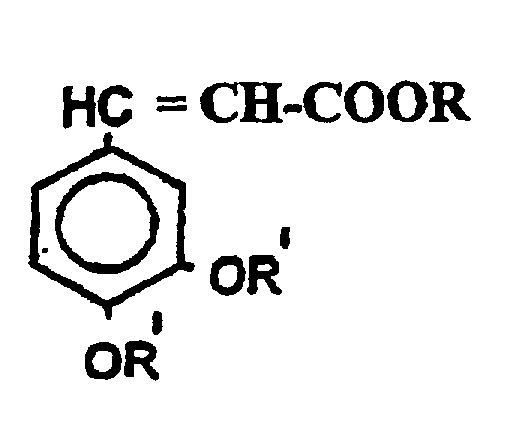
wherein R is H, CH3 or C2H5; R1 is H, CH3 or C2H5 with the proviso that at least one of R1 is H.
wherein R is H, CH3 or C2H5; R1 is H, CH3 or C2H5 with the proviso that at least one of R1 is H.
2. A method as claimed in daim 1, wherein said dihydroxycinnamic add or derivative thereof
is selected from the group consisting of dihydroxycinnamic acid and dihydroxydihydrocinnamic
acid.
3. A method as claimed in claim 1 or 2, wherein said dihydroxycinnamic acid or derivative
thereof is added to said isoprene in an amount ranging from 1 part to 1000 parts per
million parts of isoprene
4. A method as claimed in claim 1, 2 or 3, wherein said isoprene is exposed to oxygen
atmospheres.
5. A method as claimed in any one of the preceeding claims, wherein said isoprene has
a temperature ranging from ambient to 100°C.
6. A composition comprising isoprene and a dihydroxycinnamic acid or derivative thereof
having the formula
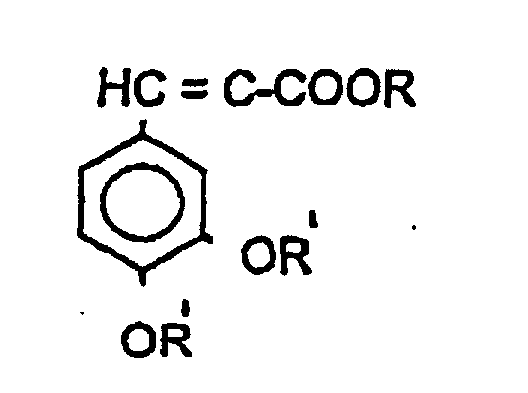
wherein R is H, CH3 or C2H5; R1 is H, CH3 or C2H5 with the proviso that at least one of R1 is H.
wherein R is H, CH3 or C2H5; R1 is H, CH3 or C2H5 with the proviso that at least one of R1 is H.
7. A composition as claimed in claim 6 wherein said dihydroxycinnamic add or derivative
thereof is selected from the group consisting of dihydroxycinnamic acid and dihydroxydihydrocinnamic
acid.
1. Verfahren zum Inhibieren der Polymerisation von Isopren, das das Zufügen zu dem Isopren
einer die Polymerisation inhibierenden wirksamen Menge einer Dihydroxyzimtsäure oder
eines Derivates davon mit der folgenden Formel umfasst:
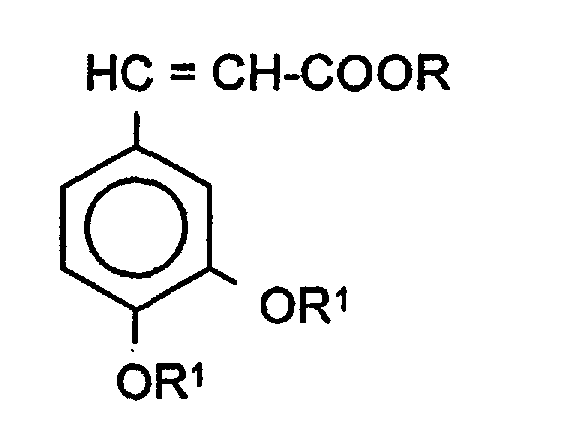
worin R H, CH3 oder CH2H5 ist; R1 H, CH3 oder C2H5 ist, unter dem Vorbehalt, dass mindestens eines von R1 H ist.
worin R H, CH3 oder CH2H5 ist; R1 H, CH3 oder C2H5 ist, unter dem Vorbehalt, dass mindestens eines von R1 H ist.
2. Verfahren nach Anspruch 1, worin genannte Dihydroxyzimtsäure oder genanntes Derivat
davon aus der Gruppe ausgewählt wird, die aus Dihydroxyzimtsäure und Dihydroxydihydrozimtsäure
besteht.
3. Verfahren nach Anspruch 1 oder 2, worin genannte Dihydroxyzimtsäure oder genanntes
Derivat davon genanntem Isopren in einer Menge zugefügt wird, die in dem Bereich von
1 Teil bis 1000 Teilen auf eine Million Teile Isopren liegt.
4. Verfahren nach Anspruch 1,2 oder 3, worin genanntes Isopren der Sauerstoffatmosphäre
ausgesetzt wird.
5. Verfahren nach einem der vorangehenden Ansprüche, worin genanntes Isopren eine Temperatur
in dem Bereich von Umgebungstemperatur bis 100 °C aufweist.
6. Zusammensetzung, die Isopren und eine Dihydroxyzimtsäure oder ein Derivat davon mit
der folgenden Formel umfasst:
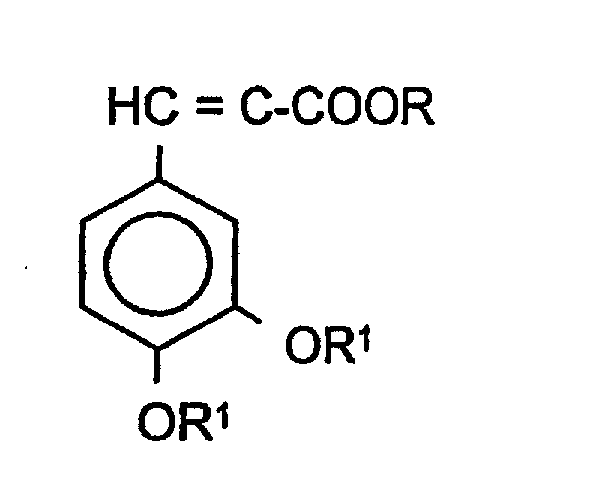
worin R H, CH3 oder C2H5 ist; R1 H, CH3 oder C2H5 ist, unter dem Vorbehalt, dass mindestens eines von R1 H ist.
worin R H, CH3 oder C2H5 ist; R1 H, CH3 oder C2H5 ist, unter dem Vorbehalt, dass mindestens eines von R1 H ist.
7. Zusammensetzung nach Anspruch 6, worin genannte Dihydroxyzimtsäure oder genanntes
Derivat davon aus der Gruppe ausgewählt wird, die aus Dihydroxyzimtäure und Dihydroxydihydrozimtsäure
besteht.
1. Méthode d'inhibition de la polymérisation de l'isoprène, comprenant l'addition à l'isoprène
d'une quantité, efficace pour l'inhibition de la polymérisation, d'un acide dihydroxycinnamique
ou d'un dérivé de celui-ci ayant la formule
dans laquelle R représente H, CH3 ou C2H5 ; R1 représente H, CH3 ou C2H5, avec la condition qu'au moins un parmi les R1 représente H.
dans laquelle R représente H, CH3 ou C2H5 ; R1 représente H, CH3 ou C2H5, avec la condition qu'au moins un parmi les R1 représente H.
2. Méthode selon la revendication 1, dans laquelle ledit acide dihydroxycinnamique ou
le dérivé de celui-ci est choisi parmi le groupe constitué par l'acide dihydroxycinnamique
et l'acide dihydroxydihydrocinnamique.
3. Méthode selon la revendication 1 ou 2, dans laquelle ledit acide dihydroxycinnamique
ou le dérivé de celui-ci est ajouté audit isoprène en une quantité dans la plage allant
de 1 partie à 1 000 parties par million de parties d'isoprène.
4. Méthode selon la revendication 1, 2 ou 3, dans laquelle ledit isoprène est exposé
à des atmosphères oxygénées.
5. Méthode selon l'une quelconque des revendications précédentes, dans laquelle ledit
isoprène a une température dans la plage allant de la température ambiante jusqu'à
100°C.
6. Composition comprenant de l'isoprène et de l'acide dihydroxycinnamique ou un dérivé
de celui-ci ayant la formule
dans laquelle R représente H, CH3 ou C2H5 ; R1 représente H, CH3 ou C2H5, avec la condition qu'au moins un parmi les R1 représente H.
dans laquelle R représente H, CH3 ou C2H5 ; R1 représente H, CH3 ou C2H5, avec la condition qu'au moins un parmi les R1 représente H.
7. Composition selon la revendication 6, dans laquelle ledit acide dihydroxycinnamique
ou le dérivé de celui-ci est choisi parmi le groupe constitué par l'acide dihydroxycinnamique
et l'acide dihydroxydihydrocinnamique.