|
(11) | EP 0 900 588 B1 |

| (12) | EUROPEAN PATENT SPECIFICATION |
|
|
| (54) |
Gas separation membranes based on regiospecific polyamide-imides Gastrennungsmembranen auf der Basis von regioselektiven Polyamidimiden Membranes de séparation de gaz à base de polyamides-imides régiospécifiques |
|
|
|||||||||||||||||||||||||||||||
| Note: Within nine months from the publication of the mention of the grant of the European patent, any person may give notice to the European Patent Office of opposition to the European patent granted. Notice of opposition shall be filed in a written reasoned statement. It shall not be deemed to have been filed until the opposition fee has been paid. (Art. 99(1) European Patent Convention). |
BACKGROUND OF THE INVENTION
[0001] The present invention relates to polymeric membranes, and more particularly membranes formed from polyamide-imides, which are useful for separating components of a gas mixture.
[0002] The commercial application for gas separation devices based on polymeric materials relies, in part, on maximizing the overall gas flux through the membrane. P. H. Kim, et al., J. Appl. Poly. Sci., 34 1767 (1987), reported that the gas flux for a membrane is relatable to the average space between the polymer chains. In addition, they indicated that the density of the polymer is also related to the overall gas flux. One challenge for commercial applications is to identify polymers which have both very high flux and good thermo-mechanical properties. It has generally been observed that to achieve high overall flux requires having a polymer with low chain-chain interactions. This can be exemplified by polymers such as poly(dimethylsiloxane) or poly(4-methyl-1-pentene). These materials have rather high gas flux values, but due to their low chain-chain interaction, they also have low glass transition temperatures (Tg). As a consequence, these materials require either special processing conditions to build-in chemical and physiochemical crosslinking or else they can only be used at low application temperatures. By contrast, polymers with strong chain-chain interactions have rather high Tg values but typically exhibit low gas flux.
[0003] Polyimides, which generally have strong chain-chain interactions and high Tg values, have been reported to have good gas flux values for certain specific structures. Specifically, U.S. Patent 3,822,202 (1974); Re 30,351 (1980) discloses a process for separating fluids using a semi-permeable membrane made from polyimides, polyesters or polyamides. The repeating units of the main polymer chain of these membranes are distinguished in that such repeating units have at least one rigid divalent subunit, wherein the two main chain single bonds extending from the subunit are not colinear, the subunit is sterically unable to rotate 360° around at least one of these bonds, and has 50% or more of its main chain atoms as members of aromatic rings.
[0004] S. Maiti and A. Ray, "Processable Heat-Resistant Polymers. VII. Synthesis and Characterization of Polyamideimide from N-(p-Carboxyphenyl)trimellitimide and p,p'-Di(aminocyclohexyl)methane", J. App. Poly. Sci., vol. 27, 4345-4356 (1982) discloses heat stable polyamideimides; and in "Processable Heat-Resistant Polymers. XIII. Structure-Property Relationship in Polyamideimides", J. App. Poly. Sci., vol. 28, 225-239 (1983) report the relationship between the structure and the properties of heat stable polyamideimides.
[0005] Yang, et al., "New Poly(amide-imide)s Synthesis", J. of Poly. Sci., Part A: Polymer Chemistry, vol. 30, 1855-1864 (1992), discloses the synthesis of aromatic poly(amide-imide)s having high inherent viscosities by direct polycondensation reaction of 2,5-bis(4-trimellitimidophenyl)-3,4-diphenylthiophene and aromatic diamines. Yang, et al., U.S. Patent 5,268,487, discloses the preparation of heat resistant poly(amide-ether-imide)s having improved strength and processability.
[0006] H. C. W. M. Buys, et al., "Aromatic Copolyimide Membranes for High Temperature Gas Separations: H2/CH4, H2/N2, and O2/N2", J. App. Poly. Sci., vol. 41, 1261-1270 (1990) discloses a study done to assess the effect of polymer molecular structure of aromatic copolyimide membranes on the permeability and permselectivity of gases.
[0007] X. Gao and F. Lu, J. appl. Poly. Sci., vol. 54, 1965-1970 (1994) reported a study on structure/permeability correlations for a family of aromatic polyamide-imides. It was reported that the introduction of bulky groups in the polymer chain tended to increase permeability without a corresponding decrease in permselectivity. The synthesis used was a solid state thermal imidization process using TMAC and a single diamine to form a non-regiospecific poly(amide-imide).
[0008] Yokelson, et al., U.S. Patent 5,124,428, discloses heat resistant fiber based on amide-imide resins. The resins were formed by reacting toluene diamine with trimellitic anhydride chloride to form a random polyamide-imide which is solution imidized to greater than 96%.
[0009] The work of Fritsch, et al., "Novel Highly Permselective 6F-poly(amide-imide)s as Membrane Heat for Nano-sized Catalysts", J. Memb. Sci., 99, 29-38 (1995), uses the regiospecific PAI materials for gas separation but employs the hexafluoro isopropyl group (either as 6FDA or 6EF44) to ensure solubility characteristics. This increases costs and falls out of the commercially important P/α ranges.
[0010] Similar disadvantages apply to the regiospecific polyamide-imide materials for gas separation described in DE 42 32 496 A. Said document discloses a polyamide-imide prepared from diaminomesitylene but employs a diimide dicarboxylic acid having the hexafluoro isopropyl group.
BRIEF SUMMARY OF THE INVENTION
[0011] The present invention is a class of gas separation membranes formed from regiospecific polyamide-imides. The polyamide-imides used in this invention are formed by reacting specific aromatic diimide dicarboxylic acids with selected aromatic diamines. By using carefully selected reactants, the resultant polyamide-imide has a predetermined polymeric structure which results in improved gas separation properties for membranes formed from these polymers compared to those formed from random copolymers.
[0012] The polyamide-imides can be cast to form any type of membrane structure, such as flat sheets, spiral wound, or hollow fibers. The resultant membranes are useful for a wide variety of gas separation applications, including separating O2/N2, He/N2, and CO2/CH4.
DETAILED DESCRIPTION OF THE INVENTION
[0013] This invention relates to the preparation of membranes based on regiospecific polyamide-imides. By using regiospecific polyamide-imides, the gas transport properties of the membranes can be tailored to meet the specific requirements of a particular gas separation application.
[0014] Table 1 below sets out the chemical names and structures for the acronyms used in this specification.
[0015] The regiospecific polyamide-imide membranes are prepared by reacting aromatic diimide dicarboxylic acids (DIDC) of the structural formula:
wherein Ar1 is selected from the group consisting of mPda, 2,6 TDA, TDA(IM), and NAPda, with an aromatic diamine represented by:
H2N―Ar2―NH2
wherein Ar2 is DAM or mixtures of aromatic diamines having Ar2 as DAM and NAPda.
[0016] In carrying out the polymerization, the above aromatic diimide dicarboxylic acids can be mixed with aromatic diimide dicarboxylic acids wherein Ar1 is DAM.
[0017] The resultant polyamide-imide which forms the gas separation membrane has the general structural formula:
wherein Ar1 and Ar2 are as set out above, and n is from 25-160 (corresponding to a molecular weight
n of about 15,000 to 100,000) and preferably from 40-80 (
n of about 25,000 to 50,000).
[0018] It should be noted that the DIDC monomer is a modified isophthalic acid wherein the diphthalimido structure is bridging the two phenylcarboxylic acid groups. These materials have surprisingly good solubility in aprotic solvents such as N-methylpyrrolidone (NMP) and dimethylacetamide (DMAc). This is contrasted to a variety of commercial polyamides such as Nomex® and Kevlar® which are soluble in only very aggressive solvent systems.
[0019] We have found that the gas transport properties for these regiospecific PAI materials can be controlled by the choice of aromatic groups placed in the imide (Ar1) and the amide (Ar2) sections of their regiospecific PAI material. Specifically, we have found that the imide linkage (Ar1) should be as small as possible to maximize selectivity, and that the amide linkage (Ar2) should be as large as DAM, but not DETDA, to maximize permeability and selectivity. These effects are illustrated by the data reported in Tables 3-7 below.
[0020] After the polymerization is carried out, the polymer is cast into a membrane using conventional technology. The membrane may be in the form of a flat sheet, spiral wound sheet, hollow fibers or any other structure which can be cast from polymers. The resultant membranes are useful for separating components of a feed gas mixture comprising at least two components which have different rates of permeability through the membrane by bringing the feed gas mixture into contact with the membrane and allowing one component to selectively permeate through the membrane thereby separating the permeating component from the feed gas mixture. Typical feed gas mixtures containing components which can be separated in this manner include, among others, mixtures containing O2/N2; He/N2; CO2/CH4; and the like.
[0021] Prior to being utilized in gas separation applications, membranes made from these regiospecific polyamide-imides may be coated; i.e. defect repaired, using conventional polymeric coating materials. Typical coating materials include polysiloxanes, polyphosphazenes, and the like.
[0022] The following examples are presented to better illustrate the present invention and are not meant to be limiting. Examples 7, 20, 25-28 and 32 are in accordance with the invention.
Example 1
Preparation of 2,6 TDA-DIDC
[0023] The aromatic diimide dicarboxylic acids used in the present invention can be prepared by the condensation of two moles of 1,2,4 benzene tricarboxylic anhydride with one mole of the selected aromatic diamine. The general procedure is detailed for 2,6 TDA-DIDC.
[0024] In a 500 ml 3-neck round bottom flask equipped with N2 purge, mechanical stirrer and dean-stark trap were placed the following components: TMA (25.0556 g 0.13 moles); DMF (75 ml). The mixture was heated to 60°C for 1 hour to dissolve the TMA. Then 2,6TDA (7.9411g; 0.065M), DMF (25 ml) and mXylene (20 ml) were added to the reaction mixture and the dean-stark trap was filled with mXylene. The temperature was raised to 190°C and water (2.5-3.0 ml) distilled off of the reaction mixture with 70 ml of mXylene/DMF solvent mixture over 3 hours. The 2,6TDA-DIDC was soluble in the reaction mixture at 190°C but dropped out of DMF solvent on cooling to room temperature. The solid was filtered, air dried for 24 hours then vacuum dried at 200°C for 48 hours. The dried monomer was sent for TGA/DSC to determine residual solvent and melting point. The 2,6 TDA/DIDC was used in the polymerization without further purification or analysis.
Examples 2 - 6
Preparation of other aromatic diimide dicarboxylic acids
[0025] The preparation of the other Ar1 DIDC noted in Table 2 were carried out using the same general procedure set out in Example 1, but with variations in the reaction solvent to account for solubility concerns of the product Ar1 DIDC monomer. For example: DAM and DETDA used a xylene/DMF (80/20) reaction mixture because of the solubility of the product material in all DMF. All of the other Ar1 DIDC materials were prepared from an all DMF reaction mixture.
[0026] As an exception to the general work-up procedure for these DIDC monomers we found that TDA (IM)-DIDC there was no precipitation of these monomers from the DMF/m-Xylene reaction solvent system after 24 hours. The phase separation of solid diimide dicarboxylic acid was accomplished by slurrying the organic solution with ten fold excess water/ice in a waring blender. The solid diimide dicarboxylic acid was filtered off of the liquid phase and then dried as above.
[0027] The specific structures and melting points for the aromatic diimide dicarboxylic acids prepared are set out in Table 2 below.
Example 7
Polymerization of 2,6 TDA-DIDC with DAM
[0028] The preparation of regiospecific PAI from Ar1DIDC and H2NAr2-NH2 was carried out using the Yamazaki reaction in the following manner. This procedure was employed by Yang and coworkers, New Poly(amide-imide)s Synthesis, J. Poly Sci: Part A: Polymer Chemistry, vol. 30, 1855-1864 (1992). The general procedure is detailed for 2,6 TDA-DIDC combined with DAM: In a 250 ml 3 neck round bottom flask equipped with mechanical stirrer and N2 purge were placed the following components: 2,6 TDA-DIDC (9.4076 gal, 0.02 m); DAM (3.0044 gm, 0.02 m); CaCl2 (10.1 gm); pyridine (20 ml .25 moles) and NMP (60 ml). The reaction mixture was heated to 100°C for 30 minutes. The reaction mixture was then cooled to 0°C with wet ice. Then TPP (13 ml .05 m) was added with NMP (20 ml) and the reaction mixture was heated to 100°C/3 hours with rapid stirring. After three hours the reaction mixture was cooled, diluted with 50 ml NMP and precipitated in H2O using a 1 gallon Waring® blender. The solid was washed with water/methanol mixtures as 2/1; 1/2; all methanol using the Waring blender for efficient extraction of inorganic salts and phosphate esters. The polymer was then air dried overnight and vacuum dried for 24 hrs/150°C. The materials were sent for molecular weight determination (weight average molecular weight [
w] by gel permeation chromatography [GPC]).
[0029] Polymer samples were converted into mechanically stable dense films using the following procedure: Polymer (∼10 grams) was dissolved in ∼70 grams of NMP to form an ∼12.5% dope solution. The dope solution was passed through a Zitex® PTFE "Coarse" grade pressure filter. After degassing, the dope solution was cast on 150 mm rings and dried to a free standing film after 8 hours at 100°C/200 mm pressure. This dense film was subsequently dried for 96 hours/.1 micron/295°C. TGA analysis indicated less than 0.4% residual solvent. The dried dense films were stored under N2 prior to testing. All gas transport measurements were performed in a microprocessor controlled manometric cell. The results are reported in Table 3 below.
Examples 8 - 31
[0030] Using the polymerization procedure noted in Example 7, regiospecific polyamide-imides were prepared, dried and converted into mechanically stable dense films. The structures and gas separation properties of these films are set out in Tables 3-6 below
Table 3
| Effects of Ar2 Unit on Polymer Characteristics of Regiospecific PAI Based on DAM-DIDC | ||||||||||
| Ex. | Ar2(1) | Permeability Coefficient | Selectivity | GPC(3) | ||||||
| O2 | N2 | He | CO2 | CH4 | O2/N2 | He/N2 | CO2/CH4 | w |
||
| 8 | mPda | 1.45 | .218 | 19.0 | 7.81 | -- | 6.67 | 87.2 | -- | 89.8 |
| 9 | 1,5 NAPda | 1.47 | .222 | 17.9 | 7.24 | -- | 6.62 | 80.6 | -- | |
| 10 | 2,6 TDA | 1.52 | .230 | 18.2 | 7.91 | -- | 6.61 | 79.1 | -- | 83.4 |
| 11 | 2,4 TDA | 2.01 | .308 | 21.7 | 10.4 | -- | 6.53 | 70.5 | -- | |
| 12 | TDA (IM)(2) | 1.85 | .281 | 20.3 | 9.93 | -- | 6.58 | 72.3 | -- | |
| 13 | DAM | 3.47 | .536 | 36.3 | 17.6 | .441 | 6.47 | 67.7 | 39.9 | 73.8 |
| 14 | DETDA (IM)(2) | 4.75 | .808 | 37.4 | 25.1 | -- | 5.88 | 46.3 | -- | 52.7 |
| 15 | 4HBAF | 5.93 | 1.10 | 35.8 | 34.1 | 1.06 | 5.39 | 32.5 | 32.2 | 104.4 |
| (1) Organic structures associated with these monomer acronyms are in Table 1. | ||||||||||
| (2) IM = Isomer Mix; typically 80% 2,4 and 20% 2,6. | ||||||||||
| (3) In NMP - LiCl (1%) 30°C. |
[0031] The above data show that α (O2/N2) remains relatively constant as the amide (Ar2) component increases in ring alkylation from mPDA to DAM. Simultaneously, the P(O2) increases by a factor of about 2.4. This observation indicates that the ring alkylation has no appreciable effect on α (O2/N2) but a substantial effect on P(O2). The higher alkylated structure DETDA or the bulkier structured 4HBAF exhibit increased P(O2), but with the expected decrease in α (O2/N2).
[0032] In a further study of a larger imide (Ar1) group on the same range of amide (Ar2) link, we prepared the materials set out in Table 4 below.
Table 4
| Effects of Ar2 Unit on Polymer Characteristics of Regiospecific PAI Based on DETDA-DIDC | ||||||||||
| Ex. | Ar2(1) | Permeability Coefficient | Selectivity | GPC(3) | ||||||
| O2 | N2 | He | CO2 | CH4 | O2/N2 | He/N2 | CO2/CH4 | w |
||
| 16 | mPda | 2.61 | .454 | 21.4 | 14.5 | .406 | 5.75 | 47.1 | 35.7 | 109.7 |
| 17 | DAM | 4.94 | .881 | 35.9 | 27.0 | .808 | 5.61 | 40.7 | 33.4 | 73.3 |
| 18 | DETDA (IM)(2) | 6.49 | 1.28 | 38.4 | 36.7 | 1.39 | 5.07 | 30.0 | 26.4 | 90.9 |
| 19 | 4HBAF | 6.88 | 1.37 | 34.8 | 42.5 | 1.66 | 5.02 | 25.4 | 25.6 | 102.1 |
| (1) Organic structures associated with these monomer acronyms are in Table 1. | ||||||||||
| (2) IM = Isomer Mix; typically 80% 2,4 and 20% 2,6. | ||||||||||
| (3) In NMP - LiCl (1%) 30°C. |
[0033] The results reported in Table 4 follow the same trend as illustrated in Table 3 for DAM-DIDC: for mPDA and DAM in the amide (Ar2) position, the α (O2/N2) is constant but with increasing P(O2). When the bulkier diamines, such as DETDA or 4HBAF, are used in the amide (Ar2) position, P(O2) increases while α (O2/N2) decrease.
[0034] The results reported in Table 3 and 4 above show that it is preferred to have DAM in the amide (Ar2) position of the polymer and, based on the comparison of DAMDIDC (Table 3) to DETDA-DIDC (Table 4), a smaller diamine in the imide (Ar1) position. This conclusion is further reinforced by the data presented in Table 5 below.
Table 5
| Effects of Ar1 Unit on Polymer Characteristics of Regiospecific PAI | |||||||||||
| Ex. | Ar1(1) | Ar2(1) | Permeability Coefficient | Selectivity | GPC(3) | ||||||
| O2 | N2 | He | CO2 | CH4 | O2/N2 | He/N2 | CO2/CH4 | w |
|||
| 20 | mPda(4) | DAM | .259 | .0285 | 7.61 | 1.21 | .018 | 9.09 | 267 | 89.6 | -- |
| 7 | 2,6 TDA | DAM | .747 | .0949 | 14.1 | 2.11 | -- | 7.87 | 149 | -- | 61.7 |
| 13 | DAM | DAM | 3.47 | .536 | 36.3 | 17.6 | .441 | 6.47 | 67.7 | 39.9 | 73.8 |
| 17 | DETDA(2) | DAM | 4.94 | .881 | 35.9 | 27.0 | .808 | 5.61 | 39.7 | 33.4 | 73.3 |
| 21 | mPda | DETDA(2) | .528 | .0781 | 9.63 | 1.94 | .0427 | 6.76 | 123 | 45.4 | 53.2 |
| 14 | DAM | DETDA(2) | 4.75 | .808 | 37.4 | 25.1 | -- | 5.88 | 46.3 | -- | 52.7 |
| 22 | 2,6 TDA | DETDA(2) | 1.24 | .191 | 17.4 | 8.02 | .108 | 6.56 | 92.6 | 75.0 | 48.8 |
| 18 | DETDA(2) | DETDA(2) | 6.49 | 1.28 | 38.4 | 36.7 | 1.39 | 5.07 | 30.0 | 26.4 | 90.9 |
| (1) Organic structures associated with these monomer acronyms are in Table 1. | |||||||||||
| (2) IM = Isomer Mix; typically 80% 2,4 and 20% 2,6. | |||||||||||
| (3) In NMP - LiCl (1%) 30°C. | |||||||||||
| (4) Polymer did not redissolve on casting. |
[0035] Polymers in Table 5 were prepared to test the effects of increasing the size of the imide (Ar1) group while keeping the amide (Ar2) group either DAM (Examples 20, 7, 13, 17) or DETDA (Examples 21, 22, 14, 18). As shown in the Table, P(O2), P(He), P(CO2) increased while α (O2/N2) and α (He/N2) decreased. Generally, the selectivity for O2/N2 and He/N2 are superior for the materials where DAM is in the amide (Ar2) position compared to DETDA in the amide (Ar2) position.
Table 6
| Symmetric Homopolymers | |||||||||||
| Ex. | Ar1(1) | Ar2(1) | Permeability Coefficient | Selectivity | GPC(3) | ||||||
| O2 | N2 | He | CO2 | CH4 | O2/ N2 | He/N2 | CO2 /CH4 | w |
|||
| 23 | mPda | mPda | .0607 | .00715 | 2.77 | .181 | -- | 8.49 | 380 | -- | 108 |
| 24 | TDA(IM)(2) | TDA(IM)(2) | .239 | .0280 | 6.78 | 1.12 | .0145 | 8.53 | 242 | 77.2 | 102 |
| (1) Organic structures associated with these monomer acronyms are in Table 1. | |||||||||||
| (2) IM = Isomer Mix; typically 80% 2,4 and 20% 2,6. | |||||||||||
| (3) In NMP - LiCl (1%) 30°C. |
[0036] As can be seen from the results reported in Table 6, the symmetric polymers, while soluble, have low permeability values.
[0037] The copolymers defined in Table 7 also demonstrate that there is an improvement by putting the smallest diamines in the imide (Ar1) position and DAM in the amide (Ar2) position. This is evidenced by a comparison of Example 25 vs. Example 29 and Example 26 vs. Example 31. Finally, in Table 8, we again compare the effects of mPda and DETDA (Example 20 vs. Example 8) and mPda and DETDA (Example 21 vs. Example 16). These also support the difference between DAM and DETDA.
Table 7
| Effects of Copolymerization in Ar1 and Ar2 on Polymer Characteristics of Regiospecific PAI | |||||||||||
| Ex. | Ar1(1) | Ar2(1) | Permeability Coefficient | Selectivity | GPC(2) | ||||||
| O2 | N2 | He | CO2 | CH4 | O2/N2 | He/N2 | CO2/CH4 | w |
|||
| 25 | 2,6 TDA (.5) DAM (.5) | DAM | 1.59 | .234 | 22.2 | -- | -- | 6.79 | 94.9 | -- | 68.5 |
| 26 | mPda (.25) DAM (.25) | DAM | 1.07 | .141 | 17.2 | 4.91 | .0704 | 7.59 | 122 | 69.7 | 109.7 |
| 27 | mPda (.3) DAM (.2) | DAM | .759 | .0920 | 14.2 | 3.61 | .0445 | 8.25 | 154 | 81.1 | 215 |
| 28 | mPda (.4) DAM | DAM | .447 | .0512 | 10.3 | 1.96 | -- | 8.73 | 201 | -- | |
| 29 | DAM | 2,6 TDA (.25) DAM (.25) | 2.31 | .352 | 28.3 | 11.3 | -- | 6.56 | 80.4 | -- | 71.8 |
| 30 | DAM | mPda .1 DAM .4 | 2.91 | .449 | 31.8 | 14.7 | -- | 6.48 | 70.8 | -- | 75.4 |
| 31 | DAM | mPda .25 DAM .25 | 2.19 | .331 | 25.2 | 11.0 | -- | 6.52 | 74.6 | -- | 74.9 |
| 32 | DAM (.25) NAPDA (.25) | DAM (.25) NAPDA (.25) | .810 | .100 | 13.7 | 4.36 | .055 | 8.10 | 137 | 79.2 | |
| (1) Organic structures associated with these monomer acronyms are in Table 1. | |||||||||||
| (2) In NMP - LiCl (1%) 30°C. |
Table 8
| Comparison of Placement Effects | ||||||
| Ex. | AR1 | Ar2(1) | Permeability Coefficient | Selectivity | ||
| O2 | He | O2/N2 | He/N2 | |||
| 20 | mPda | DAM | .259 | 7.61 | 9.09 | 267 |
| 8 | DAM | mPda | 1.45 | 19.0 | 6.67 | 87.2 |
| 21 | mPda | DETDA | .528 | 9.63 | 6.76 | 123 |
| 16 | DETDA | mPda | 2.61 | 21.4 | 5.75 | 47.1 |
| (1) Organic structures associated with these monomer acronyms are in Table 1. |
1. A semi-permeable membrane formed from a regiospecific polyamide-imide comprising units
having the structural formula:
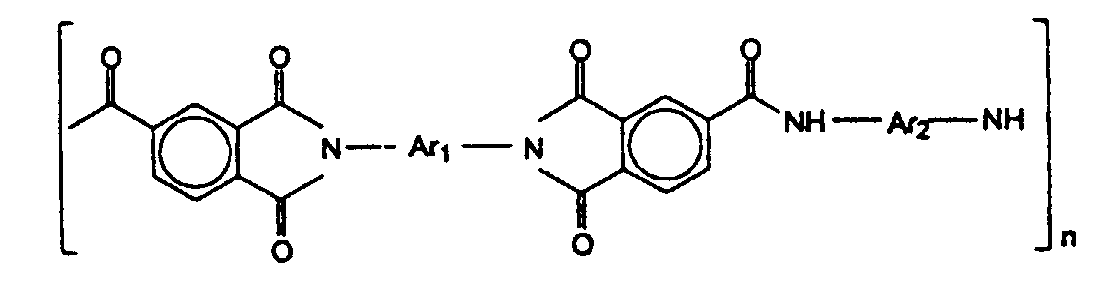
wherein each Ar1 is independently metaphenylene diamine, 2,6 toluene diamine, 2,4 toluene diamine, or naphthalene diamine; Ar2 is diaminomesitylene; and n is from 25 to 160.
wherein each Ar1 is independently metaphenylene diamine, 2,6 toluene diamine, 2,4 toluene diamine, or naphthalene diamine; Ar2 is diaminomesitylene; and n is from 25 to 160.
2. A semi-permeable membrane in accordance with Claim 1 wherein said regiospecific polyamide-imide
further comprises structural units wherein Ar1 is diaminomesitylene.
3. A semi-permeable membrane in accordance with Claim 1 wherein said regiospecific polyamide-imide
further comprises structural units wherein Ar2 is naphthalene diamine.
4. A membrane in accordance with Claim 1 wherein Ar1 is m-phenylene diamine.
5. A membrane in accordance with Claim 1 which has been coated with a thin polymeric
film.
6. A membrane in accordance with Claim 5 wherein said thin polymeric film is polysiloxane
or polyphosphazene.
7. A membrane in accordance with Claim 1 wherein n is from 40 to 80.
8. A process for separating a component from a gas mixture having at least two components,
said process comprising bringing said gas mixture into contact with a semi-permeable
membrane formed from a regiospecific polyamide-imide comprising units having the structural
formula:
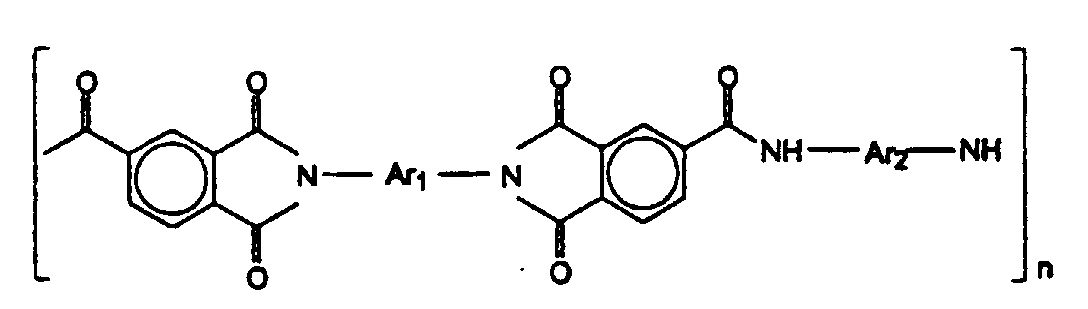
wherein each Ar1 is independently metaphenylene diamine, 2,6 toluene diamine, 2,4 toluene diamine, or naphthalene diamine; Ar2 is diaminomesitylene; and n is from 25 to 160 such that one component of said gas mixture selectively permeates the membrane, thereby separating that component from the gas mixture.
wherein each Ar1 is independently metaphenylene diamine, 2,6 toluene diamine, 2,4 toluene diamine, or naphthalene diamine; Ar2 is diaminomesitylene; and n is from 25 to 160 such that one component of said gas mixture selectively permeates the membrane, thereby separating that component from the gas mixture.
9. a process in accordance with Claim 8 wherein said gas mixture contains nitrogen and
oxygen.
10. A process in accordance with Claim 8 wherein said regiospecific polyamide-imide further
comprises structural units wherein Ar1 is diaminomesitylene.
11. A process in accordance with Claim 8 wherein said regiospecific polyamide-imide further
comprises structural units wherein Ar2 is naphthalene diamine.
1. Semipermeable Membran, die aus regiospezifischem Polyamidimid gebildet ist, umfassend
Einheiten der Strukturformel
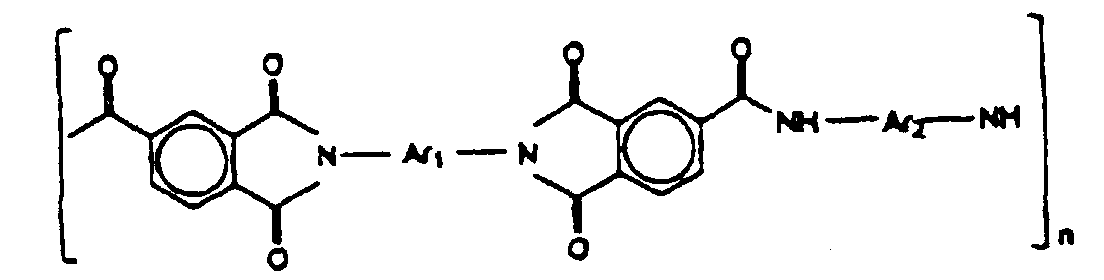
in der jedes Ar1 unabhängig meta-Phenylendiamin, 2,6-Toluoldiamin, 2,4-Toluoldiamin oder Naphthalindiamin ist, Ar2 Diaminosesitylen bedeutet und n 25 bis 160 ist.
in der jedes Ar1 unabhängig meta-Phenylendiamin, 2,6-Toluoldiamin, 2,4-Toluoldiamin oder Naphthalindiamin ist, Ar2 Diaminosesitylen bedeutet und n 25 bis 160 ist.
2. Semipermeable Membran nach Anspruch 1, in der das regiospezifische Polyamidimid außerdem
Struktureinheiten umfasst, in denen Ar1 Diaminomesitylen ist.
3. Semipermeable Membran nach Anspruch 1, in der das regiospezifische Polyamidimid außerdem
Struktureinheiten umfasst, in denen Ar2 Naphthalindiamin ist.
4. Membran nach Anspruch 1, in der Ar1 m-Phenylendiamin ist.
5. Membran nach Anspruch 1, die mit einem dünnen Polymerfilm beschichtet ist.
6. Membran nach Anspruch 5, in der der dünne Polymerfilm Polysiloxan oder Polyphosphazen
ist.
7. Membran nach Anspruch 1, in der n 40 bis 80 ist.
8. Verfahren zur Abtrennung einer Komponente aus einem Gasgemisch mit mindestens zwei
Komponenten, bei dem das Gasgemisch in Kontakt mit einer semipermeablen Membran gebracht
wird, die aus regiospezifischem Polyamidimid gebildet ist, umfassend Einheiten der
Strukturformel
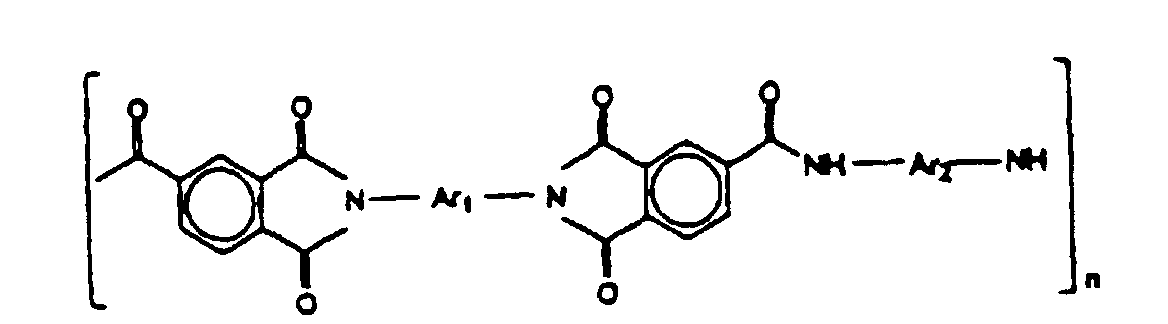
in der jedes Ar1 unabhängig meta-Phenylendiamin, 2,6-Toluoldiamin, 2,4-Toluoldiamin oder Naphthalindiamin ist, Ar2 Diaminomesitylen bedeutet und n 25 bis 160 ist, so dass eine Komponente des Gasgemischs die Membran selektiv permeiert und diese Komponente dadurch vom Gasgemisch abgetrennt wird.
in der jedes Ar1 unabhängig meta-Phenylendiamin, 2,6-Toluoldiamin, 2,4-Toluoldiamin oder Naphthalindiamin ist, Ar2 Diaminomesitylen bedeutet und n 25 bis 160 ist, so dass eine Komponente des Gasgemischs die Membran selektiv permeiert und diese Komponente dadurch vom Gasgemisch abgetrennt wird.
9. Verfahren nach Anspruch 8, bei dem das Gasgemisch Stickstoff und Sauerstoff enthält.
10. Verfahren nach Anspruch 8, bei dem das regiospezifische Polyamidimid außerdem Struktureinheiten
umfasst, in denen Ar1 Diaminomesitylen ist.
11. Verfahren nach Anspruch 8, bei dem das regiospezifische Polyamidimid außerdem Struktureinheiten
umfasst, in denen Ar2 Naphthalindiamin ist.
1. Membrane semi-perméable formée à partir d'un polyamide-imide régiospécifique comprenant
les unités ayant la forme structurelle :
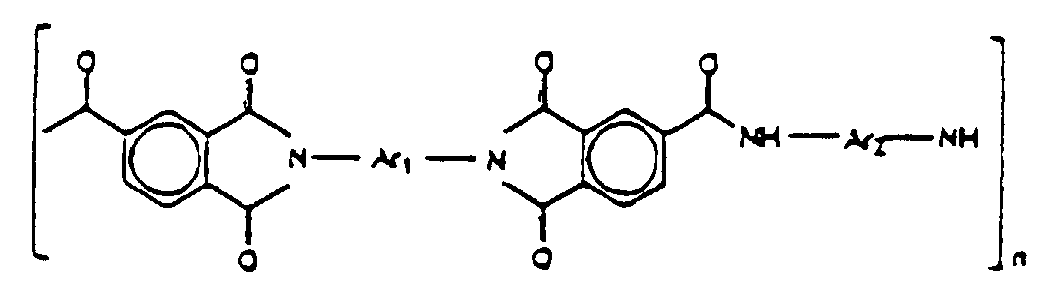
dans laquelle chaque Ar1 est indépendamment métaphénylène diamine, 2,6 toluène-diamine, 2,4 toluène diamine ou naphtalène diamine ; Ar2 est diaminomésitylène ; et n est de 25 à 160.
dans laquelle chaque Ar1 est indépendamment métaphénylène diamine, 2,6 toluène-diamine, 2,4 toluène diamine ou naphtalène diamine ; Ar2 est diaminomésitylène ; et n est de 25 à 160.
2. Membrane semi-perméable selon la revendication 1, dans laquelle le polyamide-imide
régiospécifique comprend de plus des unités structurelles dans lesquelles Ar1 est diaminomésitylène.
3. Membrane semi-perméable selon la revendication 1, dans laquelle le polyamide-imide
régiospécifique comprend de plus les unités structurelles dans lesquelles Ar2 est naphtalène-diamine.
4. Membrane selon la revendication 1, dans laquelle Ar1 est m-phénylène diamine.
5. Membrane selon la revendication 1, qui a été revêtue d'une pellicule polymère mince.
6. Membrane selon la revendication 5, dans laquelle la pellicule polymère mince est du
polysiloxane ou du polyphosphazène.
7. Membrane selon la revendication 1, dans laquelle n est de 40 à 80.
8. Procédé pour la séparation d'un composant à partir d'un mélange gazeux ayant au moins
deux composants, le procédé comprenant la mise en contact du mélange gazeux avec une
membrane semi-perméable formée à partir d'un polyamide-imide régiospécifique comprenant
des unités ayant la formule structurelle :
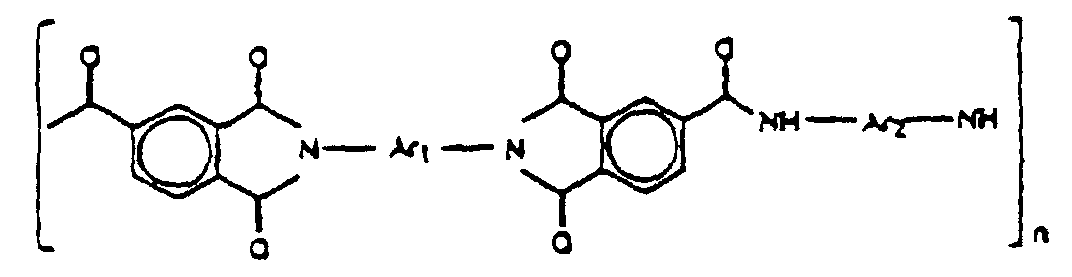
dans laquelle chaque Ar1 est indépendamment métaphénylènediamine, 2,6 toluène diamine, 2,4 toluène diamine, ou naphtalène-diamine ; Ar2 est diaminomésitylène ; et n est de 2 à 160 de telle sorte qu'un composant du mélange gazeux peut passer sélectivement à travers la membrane, séparant ainsi ce composant du mélange gazeux.
dans laquelle chaque Ar1 est indépendamment métaphénylènediamine, 2,6 toluène diamine, 2,4 toluène diamine, ou naphtalène-diamine ; Ar2 est diaminomésitylène ; et n est de 2 à 160 de telle sorte qu'un composant du mélange gazeux peut passer sélectivement à travers la membrane, séparant ainsi ce composant du mélange gazeux.
9. Procédé selon la revendication 8, dans lequel le mélange gazeux contient de l'azote
et de l'oxygène.
10. Procédé selon la revendication 8, dans lequel le polyamide-imide régiospécifique comprend
de plus des unités structurelles dans lesquelles Ar1 est diaminomésitylène.
11. Procédé selon la revendication 8, dans lequel le polyamide-imide régiospécifique comprend
de plus des unités structurelles dans lesquelles Ar2 est naphtalène-diamine.