|
(11) | EP 0 906 906 B1 |

| (12) | EUROPEAN PATENT SPECIFICATION |
|
|
| (54) |
PROCESS FOR PREPARING OPTICALLY ACTIVE 2-PIPERAZINECARBOXYLIC ACID DERIVATIVES VERFAHREN ZUR HERSTELLUNG VON OPTISCH AKTIVEN 2-PIPERAZINCARBONSÄURE DERIVATEN PROCEDE SERVANT A PREPARER DES DERIVES D'ACIDE 2-PIPERAZINECARBOXYLIQUE PRESENTANT UNE EFFICACITE OPTIQUE |
|
|
||||||||||||||||||||||||||||
| Note: Within nine months from the publication of the mention of the grant of the European patent, any person may give notice to the European Patent Office of opposition to the European patent granted. Notice of opposition shall be filed in a written reasoned statement. It shall not be deemed to have been filed until the opposition fee has been paid. (Art. 99(1) European Patent Convention). |
[0001] The present invention relates to an industrial method for producing optically-active 2-piperazinecarboxylic acid derivatives which are useful as intermediate materials for drugs.
[0002] For producing optically-active 2-piperazinecarboxylic acid derivatives, examples of known procedures are 1) a method of optical resolution using L-pyroglutamic acid as the resolving reagent (WO-A-95/21162), 2) a method of optical resolution using an optically-active α-hydroxy acid such as L-malic acid or the like as the resolving reagent (EP-A-0705824) and 3) a method of optical resolution using N-tosyl-L-phenylalanine as the resolving reagent (EP-A-0710652). However, as their solubility in water is high, the resolving reagents to be used in 1) and 2) are defective in that their recovery after use is low. On the other hand, as its solubility in acidic aqueous solutions is low, N-tolyl-L-phenylalanine to be used in 3) has the advantage of high recovery after use, but has the disadvantage of low production efficiency in that its ability to dissolve diastereomer salts is low and therefore the salt concentration in the resolving step using it could not be high, and that it requires expensive phenylalanine.
[0003] The present invention seeks to provide a method for producing optically-active 2-piperazinecarboxylic acid derivatives through diastereomer salt resolution, in which the recovery of the resolving reagent used is high and the production efficiency in obtaining the products is high.
[0004] We have assiduously conducted studies to obtain industrial methods for producing optically-active 2-plperazlnecarboxylic acid derivatives, and, as a result, have found that this can be attained using chemically-modified derivatives of inexpensive and easily-available, optically-active acidic amino acid derivatives as the resolving reagent for optically resolving 2-piperazinecarboxylic acid derivatives.
[0005] Specifically, the present invention provides a method for producing optically-active 2-piperazinecarboxylic acid derivatives, as defined below, which is characterized in that a 2-piperazinecarboxylic acid derivative, as defined below, is optically resolved with a resolving reagent, which is an optically-active N-sulfonylated acidic amino acid derivative, as defined below.
[0006] The resolving reagent, optically-active acidic amino acid derivative for use in the invention has 2 or more carboxyl groups and an amino group in the molecule, and includes an optically-active, N-sulfonylated acidic amino acid derivative. More specifically, it may be selected from N-sulfonylated derivatives of optically-active aspartic acid and optically-active glutamic acid, and any of the D-forms and L-forms of those derivatives may be used in a method in accordance with the invention.
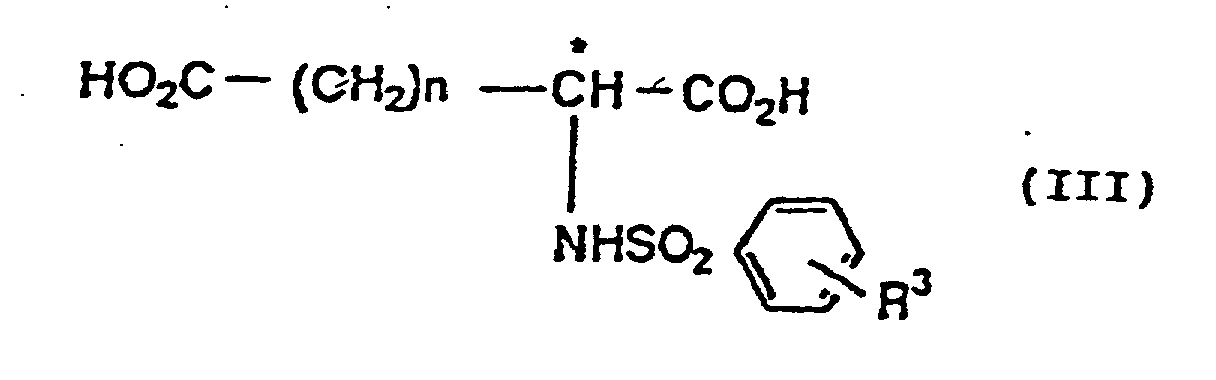
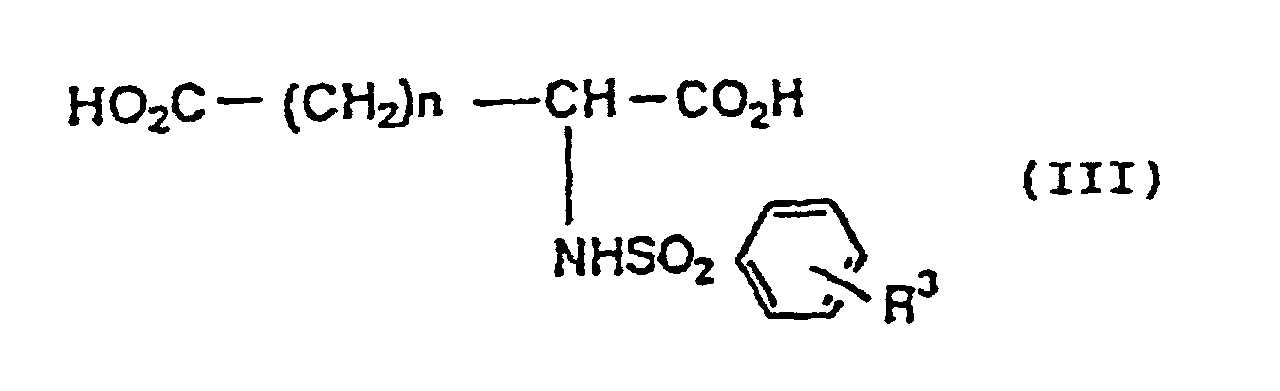
[0007] Optically-active N-sulfonated derivatives (ii) which may be used have the following general formula (III):
wherein R3 represents i) a hydrogen atom, ii) a linear or branched C1-4 alkyl group, iii) a nitro group, or iv) a halogen atom; and n represents 1 or 2.
[0008] Specific examples thereof which may be mentioned are
benzenesulfonylaspartic acid, benzenesulfonylglutamic acid, paratoluenesulfonylaspartic acid, paratoluenesulfonylglutamic acid, paranitrobenzenesulfonylaspartic acid, paranitrobenzenesulfonylglutamic acid, parachlorobenzenesulfonylaspartic acid and parachlorobenzenesulfonylglutamic acid.
[0009] These optically-active acidic amino acid derivatives can be easily produced from inexpensive aspartic acid and glutamic acid by any known method. After resolution, they decompose or racemize little under acidic or neutral conditions at a temperature from room temperature to 50°C.
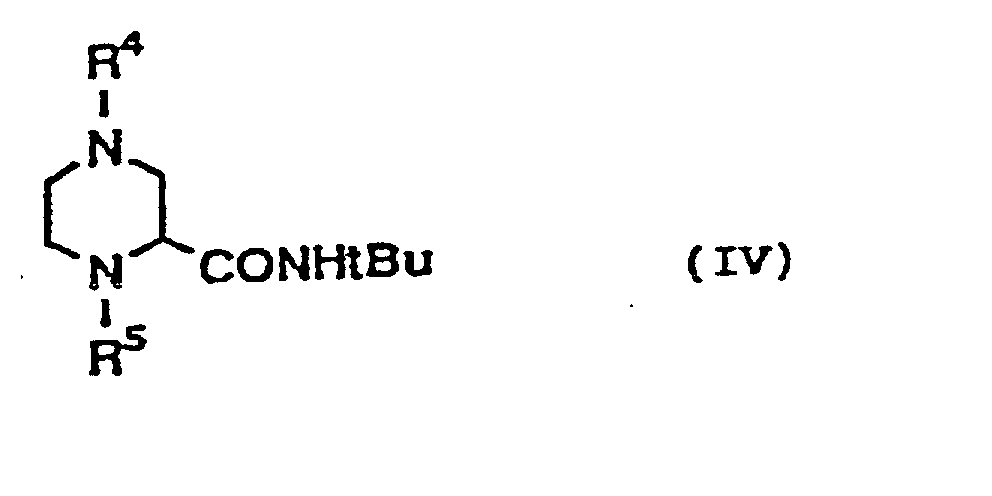
[0010] The 2-piperazinecarboxylic acid derivatives to be optically resolved in a method in accordance with the invention are those of the following general formula (iv):
wherein R4 and R5 may be the same as, or different from, one another, and each represents i) a hydrogen atom, ii) a C1-10 alkyl group, iii) an unsubstituted aryl group, or an aryl group substituted by a C1-10 alkyl group,
a C1-10 alkoxy group,
a nitro group or a halogen atom, or iv) an aralkyl group of which the aromatic ring moiety is unsubstituted or substituted by a C1-10 alkyl group, a C1-10 alkoxy group, a nitro group or a halogen atom; and tBu represents a tert-butyl group.
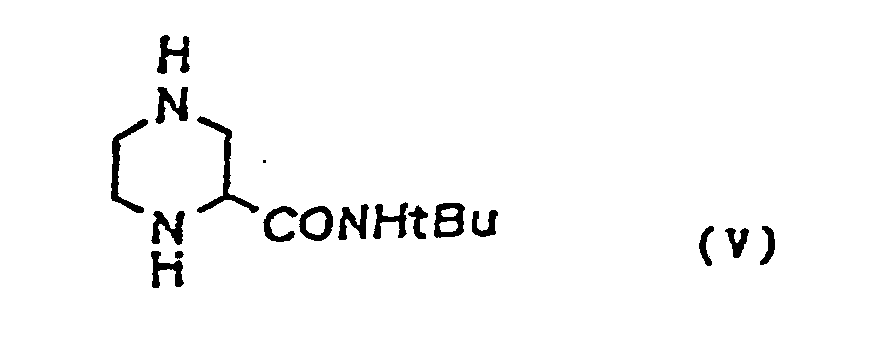
[0011] Especially preferred is N-tert-butyl-2-piperazinecarboxamide of the following formula (V)
wherein tBu represents a tert-butyl group.
[0012] 2-Piperazinecarboxylic acid derivatives which are used as the raw materials in the invention can be produced by any known method. For example, they can be produced by hydrogenation of pyrazinecarboxylic acid derivatives, or by condensation for cyclization of N,N-dialkylethylenediamines with 2,3-dihalopropionates followed by chemical modification of the resulting condensates.
[0013] The 2-piperazinecarboxylic acid derivatives to be used herein as the raw materials include not only racemic mixtures composed of the (+)-2-piperazinecarboxylic acid derivative and (-)-2-piperazinecarboxylic acid derivative in a ratio of 1/1, but also any other mixtures thereof where the amount of any one of the optical isomers is larger than that of the other.
[0014] Preferred procedures and conditions for optical resolution of 2-piperazinecarboxylic acid derivatives according to the invention are described below.
[0015] From 0.4 to 1.1 mols, but preferably from 0.5 to 1.0 mol of the resolving reagent selected from and optically-active, N-sulfonylated acidic amino acid derivatives is contacted with 1 mol of a 2-piperazinecarboxylic acid derivative in a solvent to form diastereomer salts. In this step, any mineral acid such as hydrochloric acid or sulfuric acid, or organic carboxylic acids such as formic acid or acetic acid may be added to the resolution system. Preferably, the amount of such additional mineral acid or organic carboxylic acid is, as combined with the resolving reagent used, from 0.5 to 1.1 mols, more preferably from 0.6 to 1.0 mols, relative to 1 mol of the 2-piperazinecarboxylic acid derivative.
[0016] The solvent to be used herein may be any one that brings about selective precipitation of one of the optically-active diastereomer salts formed therein without chemically modifying both the 2-piperazinecarboxylic acid derivative and the resolving reagent therein. Preferably, the solvent is so selected that the diastereomer salts formed are dissolved therein to have a salt concentration of not smaller than 25 % by weight. Specifically, examples of solvents which may be used in a method embodying the invention are water, alcohols such as methanol, ethanol, 1-propanol, 2-propanol, 1-butanol, 2-butanol and tert-butanol and mixed solvents of these.
[0017] The salt concentration referred to herein indicates the concentration of the salts as formed by the 2-piperazinecarboxylic acid derivative being resolved and the resolving reagent used. Where the additional mineral acid or organic carboxylic acid is added to the resolution system, the salt concentration shall correspond to the overall salt concentration as formed by the 2-piperazinecarboxylic acid derivative, the resolving reagent and the additional mineral acid or organic carboxylic acid. Specifically, the salt concentration is represented by [(2-piperazinecarboxylic acid derivative + resolving reagent + additional mineral acid or organic carboxylic acids)/total weight] x 100.
[0018] A higher salt concentration, if attained, is preferred in view of the economics of the resolution process, as the producibility per volume of the reactor used is higher.
[0019] Any means is employable for contacting the resolving reagent with a 2-piperazinecarboxylic acid derivative to be resolved therewith. For example, a 2-piperazinecarboxylic acid derivative and a resolving reagent may be added to the solvent all at a time, or may be added thereto separately. If desired, salts are previously formed from a 2-piperazinecarboxylic acid derivative and a resolving agent, and they may be added to the solvent. The additional salt of a mineral acid or organic carboxylic acid, if used, may be added to the solvent along with the 2-piperazinecarboxylic acid derivative and the resolving reagent all at a time, or may be added thereto separately. No special order is defined for the addition of those substances to the solvent.
[0020] The solution containing diastereomer salts thus formed is heated so as to dissolve the salts in the solvent, and thereafter cooled and/or concentrated, thereby to precipitate the sparingly-soluble diastereomer salt from the solution.
[0021] The temperature at which the sparingly-soluble diastereomer salt is precipitated from the solution may fall within the range between the solidifying point and the boiling point of the solvent used, and may be selected from within a range in accordance with the desired product, but, in general, it preferably falls between 0°C and 100°C.
[0022] Crystals of the sparingly-soluble diastereomer salt can be easily separated by conventional solid-liquid separation technique such as filtration or centrifugation. Recrystallization of the crystals thus separated gives the desired, high-purity diastereomer salt.
[0023] The thus-obtained diastereomer salt is de-salted in a suitable manner to decompose it into the (+)-2-piperazinecarboxylic acid derivative or (-)-2-piperazinecarboxylic acid derivative and the resolving reagent, which are separately collected.
[0024] Any conventional method may be employed for de-salting the diastereomer salt. For example, the salt may be processed with an acid or alkali in an aqueous solvent, or it may be processed with an ion-exchange resin. In one embodiment, the diastereomer salt is de-salted in water, to which is added an aqueous alkaline solution of, for example, sodium hydroxide, and then extracted with an organic solvent such as dichloromethane,
whereby the constituent, 2-piperazinecarboxylic acid derivative is extracted into the organic layer. The resulting extract is concentrated and crystallized to obtain the desired, optically-active 2-piperazinecarboxylic acid derivative. Next, a mineral acid such as hydrochloric acid or sulfuric acid is added to the extraction residue of the aqueous layer to provide a pH of from 1 to 2, and the resolving reagent used is taken out of the aqueous layer by filtration. Alternatively, the resolving reagent may be recovered by extraction of the aqueous layer with an organic solvent such as dichloromethane.
[0025] The resolving reagent used in a method embodying the present invention can be recovered at a high yield by any conventional de-salting method, and is racemated little during the recovering step. In other words, since it still retains its optical activity, the resolving reagent recovered can be re-used in an optical resolution method embodying the invention.
[0026] The optically-active 2-piperazinecarboxylic acid derivatives obtained by a method according to the invention are useful as intermediates for drugs.
EXAMPLES
[0027] Embodiments of the invention will now be described in more detail with reference to the following Examples.
[0028] The optical purity of the 2-piperazinecarboxamides constituting the diastereomer salts obtained in the following Examples was determined, for example, according to the method mentioned below. The diastereomer salt crystal formed was de-salted in 10 % aqueous ammonia of being 5 molar times the constituent, N-tert-butyl-2-piperazinecarboxamide, and then stirred with dichloromethane for 10 minutes. Next, this was subjected to liquid-liquid separation, then the resulting dichloromethane layer was dried with anhydrous magnesium sulfate, and thereafter dichloromethane was evaporated out to obtain a crude product, optically-active N-tert-butyl-2-piperazinecarboxamide. From 10 to 15 mg of this optically-active N-tert-butyl-2-piperazinecarboxamide was dissolved in 10 ml of acetonitrile. To 0.1 ml of the resulting solution, was added 1 ml of a solution of 400 mg of O,O'-di-p-toluoyl-L-tartaric anhydride dissolved in 100 ml of acetonitrile. While retaining the resulting solution for about 10 minutes, the N-tert-butyl-2-piperazinecarboxamide reacted with O,O'-di-p-toluoyl-L-tartaric anhydride. 1 ml of a solution of 0.2 g of 85 % phosphoric acid dissolved in 100 ml of water was added to the reaction mixture, and left as such for about 10 minutes, whereby the excess O,O'-di-p-toluoyl-L-tartaric anhydride was hydrolyzed. 5 µl of the resulting mixture was analyzed through HPLC, in which the column used was CAPCELL PAK C18 SG120 (of Shiseido) and the mobile phase was aqueous 0.04 % phosphoric acid / acetonitrile = 30/70 (v/v). The column temperature was 25°C; the flow rate was 0.7 ml/min; and the eluates were detected with UV (210 nm). The diastereomer resulting from the reaction of (+)-N-tert-butyl-2-piperazinecarboxamide and O,O'-di-p-toluoyl-L-tartaric anhydride was detected at a retention time of 7.3 minutes, and that from the reaction of (-)-N-tert-butyl-2-piperazinecarboxamide and O,O'-di-p-toluoyl-L-tartaric anhydride was detected at a retention time of 8.8 minutes. The optical purity of 2-piperazinecarboxamides of which the 1- and 4-positioned hydrogen atoms were substituted with benzyl groups or the like was determined through high-performance liquid chromatography using a CHIRALCEL OD column (manufactured by Daisel Chemical Industry).
Example 1:
[0029] 27.8 g (0.15 mole) of (±)-N-tert-butyl-2-piperazinecarboxamide (this is hereinafter referred to as "(±)-BPCA"), 45.2g (0.15 mole) of N-tosyl-D-glutamic acid, and 90 g of water were put into a 1-liter four-neck flask equipped with a thermometer, a condenser and a stirrer, and heated therein at 50°C. After having been stirred at 50°C for 1 hour, the reaction mixture was cooled to 30°C over a period of 4 hours. After having been further stirred at 30°C for 2 hours, this was filtered to collect 37.3 g of white crystals of the diastereomer salt thus formed.
The optical purity of (+)-BPCA in the crystals was 95.0 % e.e., and the yield thereof relative to (+)-BPCA having originally existed in the starting racemate was 70.2 %. The concentration of the diastereomer salt formed was 44.7 % by weight.
Example 2:
[0030] 27.8 g (0.15 mole) of (±)-BPCA, 43.1 g (0.15 mole) of N-benzenesulfonyl-L-glutamic acid, and 75 g of water were put into a 1-liter four-neck flask equipped with a thermometer, a condenser and a stirrer, and heated therein at 62°C. After having been stirred at 62°C for 1 hour, the reaction mixture was cooled to 30°C over a period of 5 hours. After having been further stirred at 30°C for 2 hours, this was filtered to collect 32.7 g of white crystals of the diastereomer salt formed. The optical purity of (-)-BPCA in the crystals was 72.1 % e.e., and the yield thereof relative to (-)-BPCA having originally existed in the starting racemate was 71.7%. The concentration of the diastereomer salt formed was 48.6 % by weight.
Example 3:
[0031] 18.5 g (0.10 mole) of (±)-BPCA, 13.7 g (0.05 mole) of N-benzenesulfonyl-L-aspartic acid, 1.8 g (0.05 mole) of hydrochloric acid and 60 g of 80 wt.% methanol were put into a 1-liter four-neck flask equipped with a thermometer, a condenser and a stirrer, and heated therein at 71°C. After having been stirred at 71°C for 1 hour, the reaction mixture was cooled to 30°C over a period of 3 hours. After having been further stirred at 30°C for 2 hours, this was filtered to collect 20.0 g of white crystal of the diastereomer salt formed. The optical purity of (-)-BPCA in the crystal was 96.3 % e.e., and the yield thereof relative to (-)-BPCA having originally existed in the starting racemate was 82.1 %. The concentration of the diastereomer salt formed was 36.3 % by weight.
Example 4:
[0032] 50.0 g (0.27 mole) of (±)-BPCA, 77.6 g (0.27 mole) of N-benzenesulfonyl-L-glutamic acid and 400 ml of water were put into a 1-liter four-neck flask equipped with a thermometer, a condenser and a stirrer, and heated therein at 60°C. After having been stirred at 60°C for 1 hour, the reaction mixture was cooled to 20°C over a period of 4 hours. After having been further stirred at 20°C for 2 hours, this was filtered to collect 22.0 g of white crystals of the diastereomer salt formed. The optical purity of (-)-BPCA in the crystals was 96.0 % e.e., and the yield thereof relative to (-)-BPCA having originally existed in the starting racemate was 33.8 %.
INDUSTRIAL APPLICABILITY
[0033] Optically resolving 2-piperazinecarboxylic acid derivatives, using as a resolving reagent, an optically-active acidic amino acid derivative produces optically-active 2-piperazinecarboxylic acid derivatives at high yields. In addition, by this method, the recovery of the resolving reagent used is high, and the concentration of the diastereomer salts formed is also high. The production efficiency of the method of the invention for producing optically-active 2-piperazinecarboxylic acid derivatives is also high.
1. A method for producing an optically-active 2-piperazinecarboxylic acid derivative
of the formula (IV):
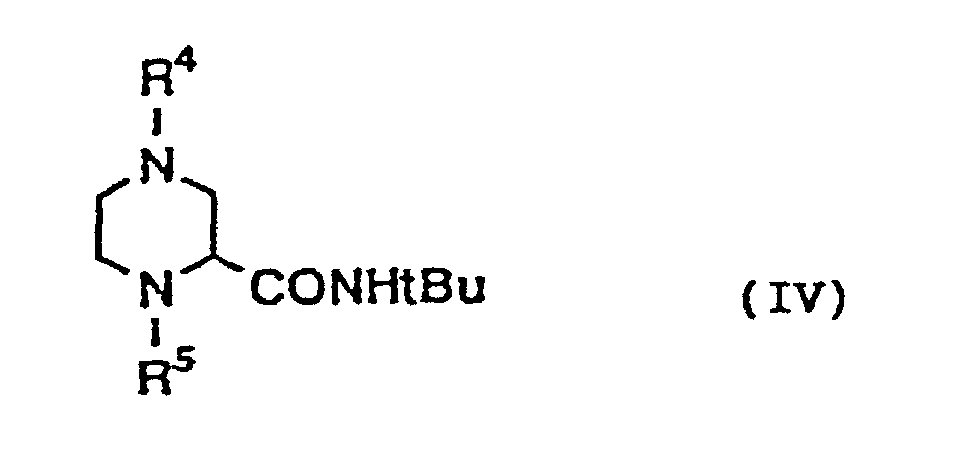
wherein R4 and R5 are the same as, or different from, one another, and each represents i) a hydrogen atom, ii) a C1-10 alkyl group, iii) an unsubstituted aryl group, or an aryl group substituted by a C1-10 alkyl group, a C1-10 alkoxy group, a nitro group or a halogen atom, or iv) an aralkyl group of which the aromatic ring moiety is unsubstituted or substituted by a C1-10 alkyl group, a C1-10 alkoxy group, a nitro group or a halogen atom; and tBu represents a tert-butyl group;
which method comprises optically resolving the 2-piperazinecarboxylic acid derivative with a resolving reagent characterized in that the resolving agent is an optically-active acidic amino acid derivative of the formula (III):
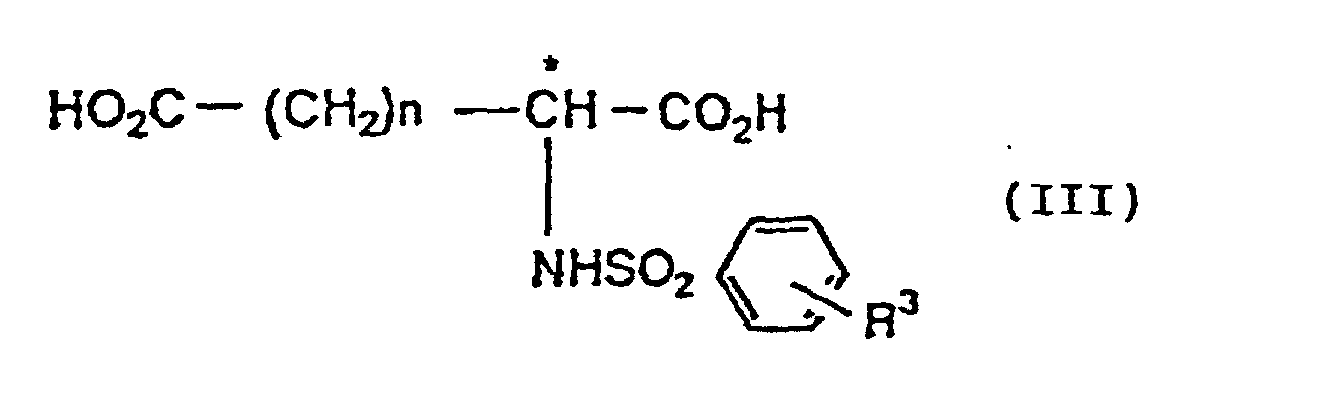
wherein R3 represents i) a hydrogen atom, ii) a linear or branched C1-4 alkyl group, iii) a nitro group, or iv) a halogen atom; and n represents 1 or 2.
wherein R4 and R5 are the same as, or different from, one another, and each represents i) a hydrogen atom, ii) a C1-10 alkyl group, iii) an unsubstituted aryl group, or an aryl group substituted by a C1-10 alkyl group, a C1-10 alkoxy group, a nitro group or a halogen atom, or iv) an aralkyl group of which the aromatic ring moiety is unsubstituted or substituted by a C1-10 alkyl group, a C1-10 alkoxy group, a nitro group or a halogen atom; and tBu represents a tert-butyl group;
which method comprises optically resolving the 2-piperazinecarboxylic acid derivative with a resolving reagent characterized in that the resolving agent is an optically-active acidic amino acid derivative of the formula (III):
wherein R3 represents i) a hydrogen atom, ii) a linear or branched C1-4 alkyl group, iii) a nitro group, or iv) a halogen atom; and n represents 1 or 2.
2. A method according to claim 1, wherein the 2-piperazinecarboxylic acid derivative
is a compound of the following formula (V):
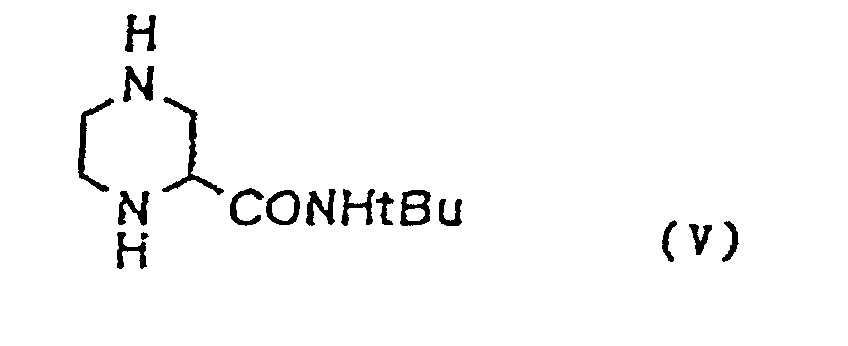
wherein tBu represents a tert-butyl group.
wherein tBu represents a tert-butyl group.
3. A method according to claim 1 or claim 2, which is carried out in the presence of
a resolution solvent.
4. A method according to claim 3, wherein the resolution solvent is water, or an alcohol,
or a mixed solvent of water and an alcohol.
5. A method according to any one of claims 1 to 4, wherein the molar ratio of the resolving
reagent to the 2-piperazinecarboxylic acid derivative is from 0.4/1 to 1.1/1.
1. Verfahren zur Herstellung eines optisch aktiven 2-Piperazincarbonsäurederivats der
Formel (IV):
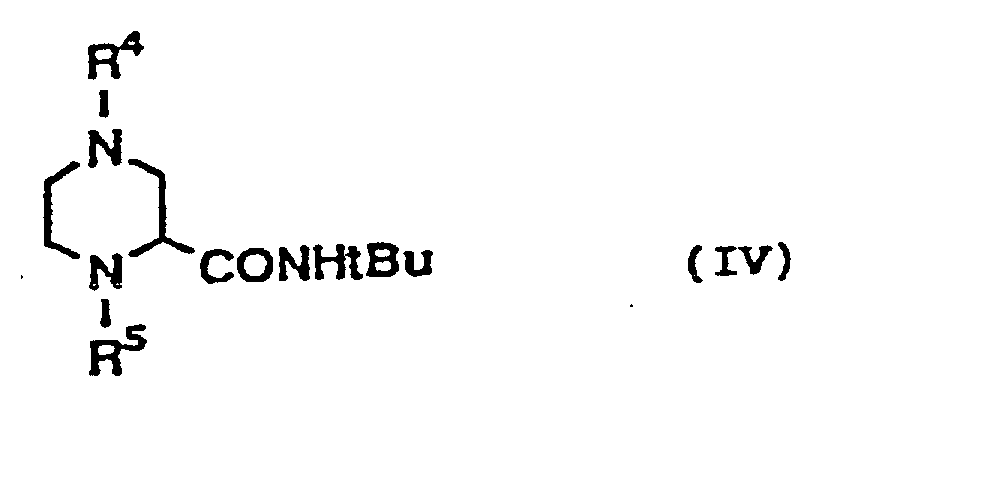
worin R4 und R5 gleich oder unterschiedlich sind und jeweils i) ein Wasserstoffatom, ii) eine C1-10-Alkylgruppe, iii) eine unsubstituierte Arylgruppe oder eine mit einer C1-10-Alkylgruppe, einer C1-10-Alkoxygruppe, einer Nitrogruppe oder einem Halogenatom substituierte Arylgruppe oder iv) eine Aralkylgruppe, deren aromatische Ringgruppierung unsubstituiert oder mit einer C1-10-Alkylgruppe, einer C1-10-Alkoxygruppe, einer Nitrogruppe oder einem Halogenatom substituiert ist, darstellen; und tBu eine tert-Butylgruppe ist;
wobei das Verfahren eine Antipodentrennung des 2-Piperazincarbonsäurederivats mit einem Trennmittel umfasst, dadurch charakterisiert, dass das Trennmittel ein optisch aktives, saures Aminosäurederivat der Formel (III) ist:
worin R3 für i) ein Wasserstoffatom, ii) eine lineare oder verzweigte C1-4-Alkylgruppe, iii) eine Nitrogruppe oder iv) ein Halogenatom steht; und n = 1 oder 2 ist.
worin R4 und R5 gleich oder unterschiedlich sind und jeweils i) ein Wasserstoffatom, ii) eine C1-10-Alkylgruppe, iii) eine unsubstituierte Arylgruppe oder eine mit einer C1-10-Alkylgruppe, einer C1-10-Alkoxygruppe, einer Nitrogruppe oder einem Halogenatom substituierte Arylgruppe oder iv) eine Aralkylgruppe, deren aromatische Ringgruppierung unsubstituiert oder mit einer C1-10-Alkylgruppe, einer C1-10-Alkoxygruppe, einer Nitrogruppe oder einem Halogenatom substituiert ist, darstellen; und tBu eine tert-Butylgruppe ist;
wobei das Verfahren eine Antipodentrennung des 2-Piperazincarbonsäurederivats mit einem Trennmittel umfasst, dadurch charakterisiert, dass das Trennmittel ein optisch aktives, saures Aminosäurederivat der Formel (III) ist:
worin R3 für i) ein Wasserstoffatom, ii) eine lineare oder verzweigte C1-4-Alkylgruppe, iii) eine Nitrogruppe oder iv) ein Halogenatom steht; und n = 1 oder 2 ist.
2. Verfahren nach Anspruch 1, worin das 2-Piperazincarbonsäurederivat eine Verbindung
der folgenden Formel (IV) ist:
worin tBu für eine tert-Butylgruppe steht.
worin tBu für eine tert-Butylgruppe steht.
3. Verfahren nach Anspruch 1 oder Anspruch 2, das in Gegenwart eines Trenn-Lösungsmittels
durchgeführt wird.
4. Verfahren nach Anspruch 3, worin das Trenn-Lösungsmittel Wasser, ein Alkohol oder
ein Gemisch aus Wasser une einem Alkohol ist.
5. Verfahren nach einem der Ansprüche 1 bis 4, worin das Molverhältnis zwischen dem Trennmittel
und dem 2-Piperazincarbonsäurederivat 0,4:1 bis 1,1:1 beträgt.
1. Méthode de production d'un dérivé d'acide 2-pipérazinecarboxylique optiquement actif
de la formule (IV):
où R4 et R5 sont identiques à ou différents l'un de l'autre, et chacun représente i) un atome d'hydrogène, ii) un groupe alkyle C1-10, iii) un groupe aryle non substitué ou un groupe aryle substitué par un groupe alkyle C1-10, un groupe alcoxy C1-10, un groupe nitro ou un atome d'halogène ou iv) un groupe aralkyle dont la fraction de cycle aromatique est non substituée ou substituée par un groupe alkyle C1-10, un groupe alcoxy C1-10, un groupe nitro ou un atome d'halogène; et tBu représente un groupe tert-butyle;
laquelle méthode comprend la résolution optique du dérivé d'acide 2-pipérazinecarboxylique avec un réactif résolvant, caractérisée en ce que l'agent résolvant est un dérivé d'acide aminé acide optiquement actif de la formule (III) :
où R3 représente i) un atome d'hydrogène, ii) un groupe alkyle C1-4 linéaire ou ramifié, iii) un groupe nitro ou iv) un atome d'halogène ; et n représente 1 ou 2.
où R4 et R5 sont identiques à ou différents l'un de l'autre, et chacun représente i) un atome d'hydrogène, ii) un groupe alkyle C1-10, iii) un groupe aryle non substitué ou un groupe aryle substitué par un groupe alkyle C1-10, un groupe alcoxy C1-10, un groupe nitro ou un atome d'halogène ou iv) un groupe aralkyle dont la fraction de cycle aromatique est non substituée ou substituée par un groupe alkyle C1-10, un groupe alcoxy C1-10, un groupe nitro ou un atome d'halogène; et tBu représente un groupe tert-butyle;
laquelle méthode comprend la résolution optique du dérivé d'acide 2-pipérazinecarboxylique avec un réactif résolvant, caractérisée en ce que l'agent résolvant est un dérivé d'acide aminé acide optiquement actif de la formule (III) :
où R3 représente i) un atome d'hydrogène, ii) un groupe alkyle C1-4 linéaire ou ramifié, iii) un groupe nitro ou iv) un atome d'halogène ; et n représente 1 ou 2.
2. Méthode selon la revendication 1, où le dérivé d'acide 2-pipérazinecarboxylique est
un composé de la formule (V) qui suit :
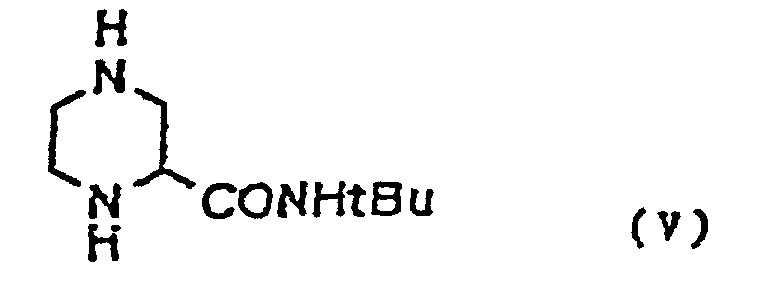
où tBu représente un groupe tert-butyle.
où tBu représente un groupe tert-butyle.
3. Méthode selon la revendication 1 ou la revendication 2, qui est effectuée en présence
d'un solvant de résolution.
4. Méthode selon la revendication 3, où le solvant de résolution est de l'eau, ou un
alcool, ou un solvant mélangé d'eau et d'un alcool.
5. Méthode selon l'une quelconque des revendications 1 à 4, où le rapport molaire de
réactif résolvant au dérivé d'acide 2-pipérazinecarboxylique est de 0,4/1 à 1,1/1.