|
(11) | EP 0 908 511 B1 |

| (12) | EUROPEAN PATENT SPECIFICATION |
|
|
| (54) |
Liquid multipurpose-cleaning compositions with effective foam control Flüssige Mehrzweckreinigungszusammensetzungen mit wirksamer Schaumkontrolle Compositions de nettoyage à usage multiples ayant un contrôle de mousse efficace |
|
|
||||||||||||||||||||||||||||
|
|||||||||||||||||||||||||||||
| Note: Within nine months from the publication of the mention of the grant of the European patent, any person may give notice to the European Patent Office of opposition to the European patent granted. Notice of opposition shall be filed in a written reasoned statement. It shall not be deemed to have been filed until the opposition fee has been paid. (Art. 99(1) European Patent Convention). |
Technical field
[0001] The present invention relates to the cleaning of different surfaces such as hard-surfaces, fabrics, clothes and the like. More particularly, the present invention refers to liquid multipurpose cleaning compositions suitable for use in various laundry and household bleaching applications both in their neat and diluted form while having easy rinsing properties.
Background of the invention
[0002] Bleaching components especially peroxygen bleaches are known in the art to serve as a strong oxidiser which assists in the chemical degradation, break-up and removal of stains and soils and also as an effective disinfectant. This dual role of peroxygen bleaches has contributed to the increased use of these components in the formulation of cleaning compositions.
[0003] Peroxygen bleaches compatible surfactants, such as nonionic surfactants and/or zwitterionic surfactants, are also known to contribute to the cleaning performance of such peroxygen bleach-containing compositions. Indeed, EP-A-0 856 876 (claiming the priority of European application number 97870013.6) discloses such liquid peroxygen bleach-containing compositions comprising an ethoxylated nonionic surfactant and a zwitterionic betaine surfactant that deliver effective stain removal performance and bleaching performance on various surfaces. However, a problem encountered with the use of such surfactants in peroxygen bleach-containing compositions is the foaming property of the surfactants which renders the rinsing step more difficult.
[0004] Accordingly, the formulator of cleaning compositions is faced with the challenge of formulating a cleaning composition which exhibits low-foaming properties. More particularly, it is an object of the present invention to provide a multipurpose liquid composition providing effective bleaching performance and effective stain removal performance when used in any laundry and/or any household applications while exhibiting low-foaming properties.
[0005] It has now been found that these objects can be efficiently met by formulating a liquid composition having a pH below 7 and comprising a peroxygen bleach, a surfactant and a foam reducing system comprising a fatty acid together with a capped nonionic alkoxylated surfactant and/or a silicone. Such foam reducing system provides a reduction of the foaming due to the surfactants present in the compositions of the present invention. The use of this foam reducing system in the compositions of the present invention reduces the foaming of these compositions both in the strength and the consistency of the suds. Actually, it has surprisingly been found that there is a synergistic effect associated to the use of a fatty acid together with a capped alkoxylated nonionic surfactant and/or a silicone in terms of foam reduction across various usage conditions including both neat and diluted conditions.
[0006] An advantage of the compositions of the present invention is that they exhibit a great flexibility in the soils they may clean. Indeed, the compositions of the present invention provide excellent stain removal performance on a broad range of stains and soils and excellent bleaching performance when used in any laundry application, e.g., as a laundry detergent or a laundry additive, and especially when used as a laundry pretreater, or even in other household applications like in hard surface cleaning applications.
[0007] Advantageously, the compositions of the present invention exhibit effective stain removal performance on stains like kitchen soils comprising mainly edible oils, bathroom soils comprising mainly sebum and/or soap scum, floor soils comprising mainly particulate soils and more generally on any greasy stain (e.g., olive oil, mayonnaise, vegetal oil, make up), enzymatic stains (grass, blood) as well as bleachable stains (e.g., tea, coffee).
[0008] A further advantage is that the compositions herein are physically and chemically stable upon prolonged periods of storage. Also they are clear compositions in a broad range of temperatures, e.g. up to 45°C.
[0009] Yet another advantage of the compositions according to the present invention is that they are able to perform in a variety of conditions, i.e., in hard and soft water as well as when used neat or diluted. Advantageously, they also provide satisfactory shine performance and surface safety when used as hard surface cleaners and satisfactory fabric and color safety when used as laundry cleaners.
Background art
[0010] EP-A-709 450 discloses compositions with branched alkyl capped nonionic surfactants with low sudsing properties. Fatty acids are also disclosed at levels of 3% to 50% and bleaching agents like peroxygen bleaches at levels of 1% to 30%. The pH of the compositions exemplified is 7.8.
[0011] EP-A-621456 discloses detergent compositions consisting essentially of nonionic surfactants and suds depressing capped nonionic surfactants. Optional ingredients may be added like fatty acids or bleaches. When the compositions are liquids, the pH is raised to a value of at least 7.
[0012] EP-A-724 011 discloses aqueous cleaning compositions comprising a bleach (e.g. peroxygen bleach), a surfactant and an alkylene glycol diether. The pH of the composition is preferably above 7. Fatty acids are mentioned as optional ingredients.
[0013] None of these above prior art documents recognises the synergistic effect associated to the combination of fatty acid together with a capped alkoxylated nonionic surfactant and/or silicone, in a peroxygen bleach-containing composition comprising a surfactant, in term of foam reduction.
Summary of the invention
[0014] The present invention encompasses a liquid composition having a pH below 7, and comprising a peroxygen bleach, a surfactant and a foam reducing system comprising a fatty acid together with a capped alkoxylated nonionic surfactant according to the formula:
R1(O-CH2-CH2)n-(OR2)m-O-R3
wherein R1 is a C8-C24 linear or branched alkyl or alkenyl group, aryl group, alkaryl group, R2 is a C1-C10 linear or branched alkyl group, R3 is a C1-C10 alkyl or alkenyl group and n and m are integers independently ranging in the range of from 1 to 20 and/or a silicone.
[0015] The present invention further encompasses processes of cleaning a surface, e.g. a fabric or a hard-surface, starting from a liquid composition as defined herein. For example, the processes of cleaning fabrics include the steps of contacting said fabrics with the liquid compositions herein neat or diluted, and subsequently rinsing said fabrics. The processes of treating a hard-surface herein include the steps of applying the composition herein to the hard-surface and optionally rinsing the hard-surface.
Detailed description of the invention
The liquid cleaning composition
[0016] The compositions according to the present invention are liquid compositions as opposed to a solid or a gas. As used herein "liquid" includes "pasty" compositions. The liquid compositions herein are preferably aqueous compositions. The liquid compositions according to the present invention have a pH below 7, preferably from 1 to 6.5, more preferably from 2 to 6 and most preferably from 2.5 to 5.5. Formulating the compositions according to the present invention in the acidic pH range contributes to the chemical stability of the compositions and to the stain removal performance of the compositions. The pH of the compositions may be adjusted by any acidifying agent known to those skilled in the art. Examples of acidifying agents are organic acids such as citric acid and inorganic acids such as sulphuric acid.
The Peroxygen bleach:
[0017] As a first essential element, the compositions according to the present invention comprise a peroxygen bleach or a mixture thereof. Indeed, the presence of peroxygen bleach contributes to the excellent bleaching benefits of said compositions. Suitable peroxygen bleaches for use herein are hydrogen peroxide, water soluble sources thereof, or mixtures thereof. As used herein, a hydrogen peroxide source refers to any compound which produces perhydroxyl ions when said compound is in contact with water.
[0018] Suitable water-soluble sources of hydrogen peroxide for use herein include percarbonates, persilicates, persulphates such as monopersulfate, perborates, peroxyacids such as diperoxydodecandioic acid (DPDA), magnesium perphtalic acid, perlauric acid, perbenzoic and alkylperbenzoic acids, hydroperoxides, aliphatic and aromatic diacyl peroxides, and mixtures thereof. Preferred peroxygen bleaches herein are hydrogen peroxide, hydroperoxide and/or diacyl peroxide. Hydrogen peroxide is the most preferred peroxygen bleach herein.
[0019] Suitable hydroperoxides for use herein are tert-butyl hydroperoxide, cumyl hydroperoxide, 2,4,4-trimethylpentyl-2-hydroperoxide, di-isopropylbenzene-monohydroperoxide, tert-amyl hydroperoxide and 2,5-dimethyl-hexane-2,5-dihydroperoxide. Such hydroperoxides have the advantage to be particularly safe to fabrics and color while delivering excellent bleaching performance when used in any laundry application.
[0020] Suitable aliphatic diacyl peroxides for use herein are dilauroyl peroxide, didecanoyl peroxide, dimyristoyl peroxide, or mixtures thereof. Suitable aromatic diacyl peroxide for use herein is for example benzoyl peroxide. Such diacyl peroxides have the advantage to be particularly safe to fabrics and color while delivering excellent bleaching performance when used in any laundry application.
[0021] Typically, the compositions herein comprise from 0.01% to 20% by weight of the total composition of said peroxygen bleach or mixtures thereof, preferably from 1% to 15% and more preferably from 2% to 10%.
The surfactant:
[0022] As a second essential element, the compositions according to the present invention comprise a surfactant or a mixture thereof. Naturally, for the purpose of the present invention the surfactants are stable to the peroxygen bleach.
[0023] Typically, the compositions of the present invention comprise from 0.01% to 60% by weight of the total composition of a surfactant or a mixture thereof, preferably from 0.1% to 30%, more preferably from 0.5% to 15% and most preferably from 1% to 10%.
[0024] Suitable surfactants for use herein include any nonionic, anionic, zwitterionic, cationic and/or amphoteric surfactants.
[0025] Particularly suitable surfactants for use herein are nonionic surfactants such as alkoxylated nonionic surfactants and/or polyhydroxy fatty acid amide surfactants and/or amine oxides and/or zwitterionic surfactants like the zwitterionic betaine surfactants described herein after.
[0026] Suitable alkoxylated nonionic surfactants for use herein are ethoxylated nonionic surfactants according to the formula RO-(C2H4O)nH, wherein R is a C6 to C22 alkyl chain or a C6 to C28 alkyl benzene chain, and wherein n is from 0 to 20, preferably from 1 to 15 and, more preferably from 2 to 15 and most preferably from 2 to 12. The preferred R chains for use herein are the C8 to C22 alkyl chains. Propoxylated nonionic surfactants and ethoxy/propoxylated ones may also be used herein instead of the ethoxylated nonionic surfactants as defined herein above or together with said surfactants.
[0027] Preferred ethoxylated nonionic surfactants are according to the formula above and have an HLB (hydrophilic-lipophilic balance) below 16, preferably below 15, and more preferably below 14. Those ethoxylated nonionic surfactants have been found to provide good grease cutting properties.
[0028] Accordingly suitable ethoxylated nonionic surfactants for use herein are Dobanol® 91-2.5 (HLB= 8.1; R is a mixture of C9 and C11 alkyl chains, n is 2.5), or Lutensol® TO3 (HLB=8; R is a C13 alkyl chains, n is 3), or Lutensol® AO3 (HLB=8; R is a mixture of C13 and C15 alkyl chains, n is 3), or Tergitol® 25L3 (HLB= 7.7; R is in the range of C12 to C15 alkyl chain length, n is 3), or Dobanol® 23-3 (HLB=8.1; R is a mixture of C12 and C13 alkyl chains, n is 3), or Dobanol® 23-2 (HLB=6.2; R is a mixture of C12 and C13 alkyl chains, n is 2), or Dobanol® 45-7 (HLB=11.6; R is a mixture of C14 and C15 alkyl chains, n is 7) Dobanol® 23-6.5 (HLB=11.9; R is a mixture of C12 and C13 alkyl chains, n is 6.5), or Dobanol® 25-7 (HLB=12; R is a mixture of C12 and C15 alkyl chains, n is 7), or Dobanol® 91-5 (HLB=11.6; R is a mixture of C9 and C11 alkyl chains, n is 5), or Dobanol® 91-6 (HLB=12.5 ; R is a mixture of C9 and C11 alkyl chains, n is 6), or Dobanol® 91-8 (HLB=13.7 ; R is a mixture of C9 and C11 alkyl chains, n is 8), Dobanol® 91-10 (HLB=14.2 ; R is a mixture of C9 to C11 alkyl chains, n is 10), or mixtures thereof. Preferred herein are Dobanol® 91-2.5 , or Lutensol® TO3, or Lutensol® AO3, or Tergitol® 25L3, or Dobanol® 23-3, or Dobanol® 23-2, or mixtures thereof. These Dobanol® surfactants are commercially available from SHELL. These Lutensol® surfactants are commercially available from BASF and these Tergitol® surfactants are commercially available from UNION CARBIDE.
[0029] Suitable chemical processes for preparing the alkoxylated nonionic surfactants for use herein include condensation of corresponding alcohols with alkylene oxide, in the desired proportions. Such processes are well-known to the man skilled in the art and have been extensively described in the art.
[0030] The compositions herein may desirably comprise one of those ethoxylated nonionic surfactants or a mixture of those ethoxylated nonionic surfactants having different HLBs (hydrophilic-lipophilic balance). In a preferred embodiment, the compositions herein comprise an ethoxylated nonionic surfactant according to the above formula and having an HLB up to 10 (i.e., a so called hydrophobic ethoxylated nonionic surfactant), preferably below 10, more preferably below 9, and an ethoxylated nonionic surfactant according to the above formula and having an HLB above 10 to 16 (i.e., a so called hydrophilic ethoxylated nonionic surfactant), preferably from 11 to 14. Indeed, in this preferred embodiment the compositions of the present invention typically comprise from 0.01% to 15% by weight of the total composition of said hydrophobic ethoxylated nonionic surfactant, preferably from 0.5% to 10% and from 0.01% to 15% by weight of said hydrophilic ethoxylated nonionic surfactant, preferably from 0.5% to 10%. Such mixtures of ethoxylated nonionic surfactants with different HLBs may be desired as they allow optimum grease cleaning removal performance on a broader range of greasy soils having different hydrophobic/hydrophilic characters.
[0031] Other particularly suitable nonionic surfactants for use herein include polyhydroxy fatty acid amide surfactants, or mixtures thereof, according to the formula:
R2 - C(O) - N(R1) - Z,
wherein R1 is H, or C1-C4 alkyl, C1-C4 hydrocarbyl, 2-hydroxy ethyl, 2-hydroxy propyl or a mixture thereof, R2 is C5-C31 hydrocarbyl, and Z is a polyhydroxyhydrocarbyl having a linear hydrocarbyl chain with at least 3 hydroxyls directly connected to the chain, or an alkoxylated derivative thereof.
[0032] Preferably, R1 is C1-C4 alkyl, more preferably C1 or C2 alkyl and most preferably methyl, R2 is a straight chain C7-C19 alkyl or alkenyl, preferably a straight chain C9-C18 alkyl or alkenyl, more preferably a straight chain C11-C18 alkyl or alkenyl, and most preferably a straight chain C11-C14 alkyl or alkenyl, or mixtures thereof. Z preferably will be derived from a reducing sugar in a reductive amination reaction; more preferably Z is a glycityl. Suitable reducing sugars include glucose, fructose, maltose, lactose, galactose, mannose and xylose. As raw materials, high dextrose corn syrup, high fructose corn syrup, and high maltose corn syrup can be utilised as well as the individual sugars listed above. These corn syrups may yield a mix of sugar components for Z. It should be understood that it is by no means intended to exclude other suitable raw materials. Z preferably will be selected from the group consisting of -CH2-(CHOH)n-CH2OH, -CH(CH2OH)-(CHOH)n-1-CH2OH, -CH2-(CHOH)2-(CHOR')(CHOH)-CH2OH, where n is an integer from 3 to 5, inclusive, and R' is H or a cyclic or aliphatic monosaccharide, and alkoxylated derivatives thereof. Most preferred are glycityls wherein n is 4, particularly CH2-(CHOH)4-CH2OH.
[0033] In formula R2 - C(O) - N(R1) - Z, R1 can be, for example, N-methyl, N-ethyl, N-propyl, N-isopropyl, N-butyl, N-2-hydroxy ethyl, or N-2-hydroxy propyl. R2 - C(O) - N< can be, for example, cocamide, stearamide, oleamide, lauramide, myristamide, capricamide, palmitamide, tallowamide and the like. Z can be 1-deoxyglucityl, 2-deoxyfructityl, 1-deoxymaltityl, 1-deoxylactityl, 1-deoxygalactityl, 1-deoxymannityl, 1-deoxymaltotriotityl and the like.
[0034] Suitable polyhydroxy fatty acid amide surfactants to be used herein may be commercially available under the trade name HOE® from Hoechst.
[0035] Methods for making polyhydroxy fatty acid amide surfactants are known in the art. In general, they can be made by reacting an alkyl amine with a reducing sugar in a reductive amination reaction to form a corresponding N-alkyl polyhydroxyamine, and then reacting the N-alkyl polyhydroxyamine with a fatty aliphatic ester or triglyceride in a condensation/amidation step to form the N-alkyl, N-polyhydroxy fatty acid amide product. Processes for making compositions containing polyhydroxy fatty acid amides are disclosed for example in GB patent specification 809,060, published February 18, 1959, by Thomas Hedley & Co., Ltd., US patent 2,965,576, issued December 20, 1960 to E.R. Wilson, US patent 2,703,798, Anthony M. Schwartz, issued March 8, 1955, US patent 1,985,424, issued December 25, 1934 to Piggott and WO92/06070.
[0036] Other suitable nonionic surfactants for use herein include amine oxides having the following formula R1R2R3NO wherein each of R1, R2 and R3 is independently a saturated substituted or unsubstituted, linear or branched hydrocarbon chains of from 1 to 30 carbon atoms. Preferred amine oxide surfactants to be used according to the present invention are amine oxides having the following formula R1R2R3NO wherein R1 is an hydrocarbon chain comprising from 1 to 30 carbon atoms, preferably from 6 to 20, more preferably from 8 to 16, most preferably from 8 to 12, and wherein R2 and R3 are independently substituted or unsubstituted, linear or branched hydrocarbon chains comprising from 1 to 4 carbon atoms, preferably from 1 to 3 carbon atoms, and more preferably are methyl groups. R1 may be a saturated substituted or unsubstituted linear or branched hydrocarbon chain. Suitable amine oxides for use herein are for instance natural blend C8-C10 amine oxides as well as C12-C16 amine oxides commercially available from Hoechst.
[0037] Another class of surfactants particularly suitable for use herein include zwitterionic betaine surfactants containing both a cationic hydrophilic group, i.e., a quaternary ammonium group, and anionic hydrophilic group on the same molecule at a relatively wide range of pH's. The typical anionic hydrophilic groups are carboxylates and sulfonates, although other groups like sulfates, phosphonates, and the like can be used. A generic formula for the zwitterionic betaine surfactants for use herein is :
R1-N+(R2)(R3)R4X-
wherein R1 is a hydrophobic group; R2 is hydrogen, C1-C6 alkyl, hydroxy alkyl or other substituted C1-C6 alkyl group; R3 is C1-C6 alkyl, hydroxy alkyl or other substituted C1-C6 alkyl group which can also be joined to R2 to form ring structures with the N, or a C1-C6 carboxylic acid group or a C1-C6 sulfonate group; R4 is a moiety joining the cationic nitrogen atom to the hydrophilic group and is typically an alkylene, hydroxy alkylene, or polyalkoxy group containing from 1 to 10 carbon atoms; and X is the hydrophilic group which is a carboxylate or sulfonate group.
[0038] Preferred hydrophobic groups R1 are aliphatic or aromatic, saturated or unsaturated, substituted or unsubstituted hydrocarbon chains that can contain linking groups such as amido groups, ester groups. More preferred R1 is an alkyl group containing from 1 to 24 carbon atoms, preferably from 8 to 18, and more preferably from 10 to 16. These simple alkyl groups are preferred for cost and stability reasons. However, the hydrophobic group R1 can also be an amido radical of the formula Ra-C(O)-NH-(C(Rb)2)m, wherein Ra is an aliphatic or aromatic, saturated or unsaturated, substituted or unsubstituted hydrocarbon chain, preferably an alkyl group containing from 8 up to 20 carbon atoms, preferably up to 18, more preferably up to 16, Rb is selected from the group consisting of hydrogen and hydroxy groups, and m is from 1 to 4, preferably from 2 to 3, more preferably 3, with no more than one hydroxy group in any (C(Rb)2) moiety.
[0039] Preferred R2 is hydrogen, or a C1-C3 alkyl and more preferably methyl. Preferred R3 is a C1-C4 carboxylic acid group or C1-C4 sulfonate group, or a C1-C3 alkyl and more preferably methyl. Preferred R4 is (CH2)n wherein n is an integer from 1 to 10, preferably from 1 to 6, more preferably is from 1 to 3.
[0040] Some common examples of betaine/sulphobetaine are described in U.S. Pat. Nos. 2,082,275, 2,702,279 and 2,255,082.
[0041] Examples of particularly suitable alkyldimethyl betaines include coconut-dimethyl betaine, lauryl dimethyl betaine, decyl dimethyl betaine, 2-(N-decyl-N, N-dimethyl-ammonia)acetate, 2-(N-coco N, N-dimethylammonio) acetate, myristyl dimethyl betaine, palmityl dimethyl betaine, cetyl dimethyl betaine, stearyl dimethyl betaine. For example Coconut dimethyl betaine is commercially available from Seppic under the trade name of Amonyl 265®. Lauryl betaine is commercially available from Albright & Wilson under the trade name Empigen BB/L®.
[0042] Examples of amidobetaines include cocoamidoethylbetaine, cocoamidopropyl betaine or C10-C14 fatty acylamidopropylene(hydropropylene)sulfobetaine. For example C10-C14 fatty acylamidopropylene(hydropropylene)sulfobetaine is commercially available from Sherex Company under the trade name "Varion CAS® sulfobetaine".
[0043] A further example of betaine is Lauryl-immino-dipropionate commercially available from Rhone-Poulenc under the trade name Mirataine H2C-HA ®.
[0044] Particularly preferred zwitterionic betaine surfactants for use herein are salt free, i.e. that the zwitterionic betaine surfactant raw material contains less than 5% by weight of salts, preferably less than 2%, more preferably less than 1% and most preferably from 0.01% to 0.5%.
[0045] By "salts" is meant herein any material having as base unit, a couple of positive ion (or positive molecular ion) and negative ion (or negative molecular ion) containing one or more halogen atoms. Such salts include Sodium Chloride, Potassium Chloride, Sodium Bromide and the like.
[0046] Such salts free zwitterionic betaine surfactants are obtainable by conventional manufacturing processes like inverse osmosis or fractionated precipitation. For example inverse osmosis is based on the principle of contacting the zwitterionic betaine surfactant raw material (commercially available ) with a polar solvent (it is to be understood that such a solvent is free of salts) separated by a semipermeable membrane for example acetate-cellulose. An adequate pressure is applied on the system to allow the salts to migrate from the surfactant raw material to the polar solvent phase. This way the zwitterionic betaine surfactant raw material is purified, i.e. the salts is subtracted from the raw material.
[0047] Advantageously, it has now been surprisingly found that the use of such salt free zwitterionic betaine surfactants deliver improved fabric safety and/or color safety when bleaching fabrics with a peroxygen bleach-containing composition comprising the same, as compared to the use of the same zwitterionic betaine surfactants with higher amount of salts. Thus, in its broadest aspect, the present invention also encompasses the use of a composition comprising a salt free zwitterionic betaine surfactant and a peroxygen bleach for bleaching fabrics whereby color safety is improved (i.e. color damage/decoloration is reduced) and/or fabric safety is improved.
[0048] In a preferred embodiment herein the surfactants present in the compositions of the present invention are a mixture of ethoxylated nonionic surfactants and betaine zwitterionic surfactants. Indeed, such betaine zwitterionic surfactants have the ability to further boost the stain removal performance delivered by the ethoxylated nonionic surfactants on greasy stains (e.g., lipstick, olive oil, mayonnaise, vegetal oil, sebum, make-up), while providing improved bleaching performance to the liquid peroxygen bleach-containing compositions of the present invention comprising them.
[0049] Indeed, a significant co-operation has been observed between these ingredients to get optimum stain removal performance on a variety of soils, from particulate to non-particulate soils from hydrophobic to hydrophilic soils under any household application and especially laundry application on both hydrophilic and hydrophobic fabrics.
[0050] Optimum stain removal performance and bleaching performance are obtained when the ethoxylated nonionic surfactant and the zwitterionic betaine surfactant are present in the compositions of the present invention comprising a peroxygen bleach (pH below 7), at weight ratio of the ethoxylated nonionic surfactant to the zwitterionic betaine surfactant of from 0.01 to 20, preferably from 0.1 to 15, more preferably from 0.5 to 5 and most preferably from 0.6 to 3.
[0051] Importantly, the improved stain removal benefit and bleaching benefit are delivered with a liquid composition which is a water-like, clear and transparent composition. The appearance of a composition can be evaluated via turbidimetric analysis. For example, the transparency of a composition can be evaluated by measuring its absorbency via a spectrophotometer at 800 nm wave length.
[0052] Although less desirable than the surfactants mentioned above for their stain removal properties, other surfactants may be used in the compositions herein. Suitable anionic surfactants for use in the compositions herein include water-soluble salts or acids of the formula ROSO3M wherein R preferably is a C10-C24 hydrocarbyl, preferably an alkyl or hydroxyalkyl having a C10-C20 alkyl component, more preferably a C12-C18 alkyl or hydroxyalkyl, and M is H or a cation, e.g., an alkali metal cation (e.g., sodium, potassium, lithium), or ammonium or substituted ammonium (e.g., methyl-, dimethyl-, and trimethyl ammonium cations and quaternary ammonium cations, such as tetramethyl-ammonium and dimethyl piperdinium cations and quaternary ammonium cations derived from alkylamines such as ethylamine, diethylamine, triethylamine, and mixtures thereof, and the like). Typically, alkyl chains of C12-16 are preferred for lower wash temperatures (e.g., below 50°C) and C16-18 alkyl chains are preferred for higher wash temperatures (e.g., above 50°C).
[0053] Other suitable anionic surfactants for use herein are water-soluble salts or acids of the formula RO(A)mSO3M wherein R is an unsubstituted C10-C24 alkyl or hydroxyalkyl group having a C10-C24 alkyl component, preferably a C12-C20 alkyl or hydroxyalkyl, more preferably C12-C18 alkyl or hydroxyalkyl, A is an ethoxy or propoxy unit, m is greater than zero, typically between 0.5 and 6, more preferably between 0.5 and 3, and M is H or a cation which can be, for example, a metal cation (e.g., sodium, potassium, lithium, calcium, magnesium, etc.), ammonium or substituted-ammonium cation. Alkyl ethoxylated sulfates as well as alkyl propoxylated sulfates are contemplated herein. Specific examples of substituted ammonium cations include methyl-, dimethyl-, trimethyl-ammonium and quaternary ammonium cations, such as tetramethyl-ammonium, dimethyl piperdinium and cations derived from alkanolamines such as ethylamine, diethylamine, triethylamine, mixtures thereof, and the like. Exemplary surfactants are C12-C18 alkyl polyethoxylate (1.0) sulfate, C12-C18E(1.0)M, C12-C18 alkyl polyethoxylate (2.25) sulfate, C12-C18E(2.25)M), C12-C18 alkyl polyethoxylate (3.0) sulfate, C12-C15 alkyl ethoxylate (3) sulphate, C12-C18 alkyl polyethoxylate (4.0) sulfate, C12-C18E(4.0)M, wherein M is conveniently selected from sodium and potassium.
[0054] Other anionic surfactants useful for detersive purposes can also be used herein. These can include salts (including, for example, sodium, potassium, ammonium, and substituted ammonium salts such as mono-, di- and triethanolamine salts) of soap, C9-C20 linear alkylbenzenesulfonates, C8-C22 primary or secondary alkanesulfonates, C8-C24 olefinsulfonates, sulfonated polycarboxylic acids prepared by sulfonation of the pyrolyzed product of alkaline earth metal citrates, e.g., as described in British patent specification No. 1,082,179, C8-C24 alkylpolyglycolethersulfates (containing up to 10 moles of ethylene oxide); alkyl ester sulfonates such as C14-16 methyl ester sulfonates; acyl glycerol sulfonates, fatty oleyl glycerol sulfates, alkyl phenol ethylene oxide ether sulfates, paraffin sulfonates, alkyl phosphates, isethionates such as the acyl isethionates, N-acyl taurates, alkyl succinamates and sulfosuccinates, monoesters of sulfosuccinate (especially saturated and unsaturated C12-C18 monoesters) diesters of sulfosuccinate (especially saturated and unsaturated C6-C14 diesters), sulfates of alkylpolysaccharides such as the sulfates of alkylpolyglucoside (the nonionic nonsulfated compounds being described below), branched primary alkyl sulfates, alkyl polyethoxy carboxylates such as those of the formula RO(CH2CH2O)kCH2COO-M+ wherein R is a C8-C22 alkyl, k is an integer from 0 to 10, and M is a soluble salt-forming cation. Resin acids and hydrogenated resin acids are also suitable, such as rosin, hydrogenated rosin, and resin acids and hydrogenated resin acids present in or derived from tall oil. Further examples are given in "Surface Active Agents and Detergents" (Vol. I and II by Schwartz, Perry and Berch). A variety of such surfactants are also generally disclosed in U.S. Patent 3,929,678, issued December 30, 1975, to Laughlin, et al. at Column 23, line 58 through Column 29, line 23.
[0055] Other suitable anionic surfactants for use herein also include acyl sarcosinate or mixtures thereof, in its acid and/or salt form, preferably long chain acyl sarcosinates having the following formula:
wherein M is hydrogen or a cationic moiety and wherein R is an alkyl group of from 11 to 15 carbon atoms, preferably of from 11 to 13 carbon atoms. Preferred M are hydrogen and alkali metal salts, especially sodium and potassium. Said acyl sarcosinate surfactants are derived from natural fatty acids and the aminoacid sarcosine (N-methyl glycine). They are suitable to be used as aqueous solution of their salt or in their acidic form as powder. Being derivatives of natural fatty acids, said acyl sarcosinates are rapidly and completely biodegradable and have good skin compatibility.
[0056] Accordingly, suitable long chain acyl sarcosinates for use herein include C12 acyl sarcosinate (i.e., an acyl sarcosinate according to the above formula wherein M is hydrogen and R is an alkyl group of 11 carbon atoms) and C14 acyl sarcosinate (i.e., an acyl sarcosinate according to the above formula wherein M is hydrogen and R is an alkyl group of 13 carbon atoms). C12 acyl sarcosinate is commercially available, for example, as Hamposyl L-30® supplied by Hampshire. C14 acyl sarcosinate is commercially available, for example, as Hamposyl M-30® supplied by Hampshire.
The foam reducing system:
[0057] As a third essential element, the compositions according to the present invention comprise a foam reducing system comprising a fatty acid together with a capped alkoxylated nonionic surfactant as defined herein after and/or silicone.
[0058] Typically, the compositions herein comprise from 1·10-4 % to 10% by weight of the total composition of a fatty acid or a mixture thereof, preferably from 1·10-3% to 5% and more preferably from 1·10-2% to 5%.
[0059] Typically, the compositions herein comprise from 1·10-3% to 20% by weight of the total composition of a capped alkoxylated nonionic surfactant as defined herein or a mixture thereof, preferably from 1·10-2% to 10% and more preferably from 5·10-2 % to 5%.
[0060] Typically, the compositions herein comprise from 1·10-5 % to 5% by weight of the total composition of a silicone or a mixture thereof, preferably from 1·10-5% to 1% and more preferably from 1·10-4% to 0.5%.
[0061] Suitable fatty acids for use herein are the alkali salts of a C8-C24 fatty acid. Such alkali salts include the metal fully saturated salts like sodium, potassium and/or lithium salts as well as the ammonium and/or alkylammonium salts of fatty acids, preferably the sodium salt. Preferred fatty acids for use herein contain from 8 to 22 carbon atoms, preferably from 8 to 20 and more preferably from 8 to 18.
[0062] Suitable fatty acids may be selected from caprylic acid, capric acid, lauric acid, myristic acid, palmitic acid, stearic acid and mixtures of fatty acids suitably hardened, derived from natural sources such as plant or animal esters (e.g., palm oil, coconut oil, soybean oil, castor oil, tallow, ground oil, whale and fish oils and/or babassu oil.
[0063] For example Coconut Fatty Acid is commercially available from UNICHEMA under the name PRIFAC 5900®.
[0064] Suitable capped alkoxylated nonionic surfactants for use herein are according to the formula:
R1(O-CH2-CH2)n-(OR2)m-O-R3
wherein R1 is a C8-C24 linear or branched alkyl or alkenyl group, aryl group, alkaryl group, preferably R1 is a C8-C18 alkyl or alkenyl group, more preferably a C10-C15 alkyl or alkenyl group, even more preferably a C10-C15 alkyl group;
wherein R2 is a C1-C10 linear or branched alkyl group, preferably a C2-C10 linear or branched alkyl group, preferably a C3 group;
wherein R3 is a C1-C10 alkyl or alkenyl group, preferably a C1-C5 alkyl group, more preferably methyl;
and wherein n and m are integers independently ranging in the range of from 1 to 20, preferably from 1 to 10, more preferably from 1 to 5; or mixtures thereof.
[0065] These surfactants are commercially available from BASF under the trade name Plurafac®, from HOECHST under the trade name Genapol® or from ICI under the trade name Symperonic®. Preferred capped nonionic alkoxylated surfactants of the above formula are those commercially available under the tradename Genapol® L 2.5 NR from Hoechst, and Plurafac® from BASF.
[0066] Suitable silicones for use herein include any silicone and silica-silicone mixtures. Silicones can be generally represented by alkylated polysiloxane materials while silica is normally used in finely divided forms exemplified by silica aerogels and xerogels and hydrophobic silicas of various types. These materials can be incorporated as particulates in which the silicone is advantageously releasably incorporated in a water-soluble or water-dispersible, substantially non-surface-active detergent impermeable carrier. Alternatively, the silicone can be dissolved or dispersed in a liquid carrier and applied by spraying on to one or more of the other components.
[0067] Actually in industrial practice, the term "silicone" has become a generic term which encompasses a variety of relatively high-molecular-weight polymers containing siloxane units and hydrocarbyl groups of various types. Indeed, silicone compounds have been extensively described in the art, see for instance US 4 076 648, US 4 021 365, US 4 749 740, US 4 983 316, EP 150 872, EP 217 501 and EP 499 364. The silicone compounds disclosed therein are suitable in the context of the present invention. Generally, the silicone compounds can be described as siloxanes having the general structure :
wherein n is from 20 to 2000, and where each R independently can be an alkyl or an aryl radical. Examples of such substituents are methyl, ethyl, propyl, isobutyl, and phenyl. Preferred polydiorganosiloxanes are polydimethylsiloxanes having trimethylsilyl end blocking units and having a viscosity at 25°C of from 5 x 10⁻⁵ m2/s to 0.1 m2/s, i.e. a value of n in the range 40 to 1500. These are preferred because of their ready availability and their relatively low cost.
[0068] A preferred type of silicone compounds useful in the compositions herein comprises a mixture of an alkylated siloxane of the type hereinabove disclosed and solid silica.
[0069] The solid silica can be a fumed silica, a precipitated silica or a silica made by the gel formation technique. The silica particles can be rendered hydrophobic by treating them with diakylsilyl groups and/or trialkylsilane groups either bonded directly onto the silica or by means of silicone resin. A preferred silicone compound comprises a hydrophobic silanated, most preferably trimethylsilanated silica having a particle size in the range from 10 mm to 20 mm and a specific surface area above 50 m2/g. Silicone compounds employed in the compositions according to the present invention suitably have an amount of silica in the range of 1 to 30% (more preferably 2.0 to 15%) by weight of the total weight of the silicone compounds resulting in silicone compounds having an average viscosity in the range of from 2 x 10⁻⁴m2/s to 1m2/s. Preferred silicone compounds may have a viscosity in the range of from 5 x 10⁻³m2/s to 0.1m2/s. Particularly suitable are silicone compounds with a viscosity of 2 x 10⁻²m2/s or 4.5 x 10⁻²m2/s.
[0070] Suitable silicone compounds for use herein are commercially available from various companies including Rhone Poulenc, Fueller and Dow Corning.
[0071] Examples of silicone compounds for use herein are Silicone DB® 100 and Silicone Emulsion 2-3597® both commercially available from Dow Corning.
[0072] Another silicone compound is disclosed in Bartollota et al. U.S. Patent 3 933 672. Other particularly useful silicone compounds are the self-emulsifying silicone compounds, described in German Patent Application DE-OS-2 646 126 published April 28, 1977. An example of such a compound is DC-544®, commercially available from Dow Corning, which is a siloxane-glycol copolymer.
[0073] Typically preferred silicone compounds are described in European Patent application EP-A-573699. Said compositions can comprise a silicone/silica mixture in combination with fumed nonporous silica such as AerosilR.
[0074] The present invention is based on the finding that fatty acids act synergistically with such a capped alkoxylated nonionic surfactant and/or silicone when added in a liquid composition comprising a peroxygen bleach and a surfactant to exhibit a reduced generation of foam of said composition, when used both in neat and diluted conditions, as compared to the same composition, but comprising only one of said foam reducing agents. Indeed, the reduction of foam height when measured in neat and diluted conditions (typically at a dilution level of 12.5 : 1000 (composition :water)) is faster and more important with a given peroxygen bleach-containing composition comprising a surfactant (e.g. nonionic and/or zwitteionic surfactant) and a foam reducing system according to the present invention (i.e. fatty acid together with capped alkoxylated nonionic surfactant and/or silicone), as compared to the reduction of foam height observed with the same composition but with only one of said foam reducing agent (either only fatty acid or only the capped alkoxylated nonionic surfactant or silicone) at the same total level of foam reducing agent.
[0075] More particularly, it has been found that the combination of a fatty acid with the capped alkoxylated nonionic surfactant according to the present invention performs dual functions when it is incorporated in the compositions herein, said functions being not only to have a low foaming property but also to reduce the foaming of the surfactants herein both when the compositions herein are used in neat and diluted conditions.
[0076] Indeed, the combinations of foam reducing agents according to the present invention increase the collapse rate of the foam generated by the surfactants. As a result, when incorporated in the compositions of the invention, a reduction of the generation of foam as well as an increase in the collapse rate is observed.
[0077] Optimum defoaming properties (consistency and strenght of the suds) are obtained with the compositions according to the present invention comprising the fatty acid and the capped alkoxylated surfactant at a weight ratio of the fatty acid to the capped nonionic surfactant of 0.01 to 10, preferably from 0.1 to 5 and more preferably from 0.1 to 1. Also when the combination fatty acid and silicone is used as the foam reducing system herein, optimum defoaming properties (consistency and strenght of the suds) are obtained with the compositions according to the present invention comprising the fatty acid and the silicone at a weight ratio of the fatty acid to the silicone of 1·104 to 1·10-1, preferably from 1· 104 to 1 and more preferably from 1·103 to 1·101,
[0078] In another preferred embodiment of the present invention, the three foam reducing agents described herein are used together to get optimum defoaming properties to the compositions of the present invention and are typically present at a weight ratio of fatty acid:capped nonionic surfactant: silicone of 1:1·103: 1·10-5 to 10:1:1 and preferably from 1: 1·102:1·10-4 to 1:1:1.
[0079] Foaming (foam height) can be measured by using a Foam-meter, a machine composed by 5 cylinders rotating around a horizontal axe, which can be filled with the product under evaluation.
[0080] Usually, the user sets the speed at 45 round per minute and the rotation time at 900 seconds. The test method may consists of 2 different steps related to different product concentrations:
Foaming of neat product :
[0081] The Foam Meter cylinder is filled with the product under test until the first sign on the cylinder (about 500 grams of product) and the rotation is started.
Foaming of diluted product :
[0082] Another cylinder is filled with tap water until the first sign on the cylinder (about 500 grams of tap water) and the appropriate quantity of test product depending on the dilution level under test is added before starting the rotation.
[0083] As soon as the instrument stops, the foam height can be read on the scale outside each cylinder and recorded as the foam height at time 0. Then, the foam height for each cylinder can be recorded upon time, typically after 1, 2, 3, 4, 5, 10, 15, 20, 25, 30 minutes.
[0084] Another advantage of the present invention is that such capped nonionic surfactants, fatty acids and/or silicones are stable in presence of a peroxygen bleaching component.
[0085] A further advantage of the compositions of the present invention is that they are physically and chemically stable upon prolonged periods of storage.
[0086] Chemical stability of the compositions herein may be evaluated by measuring the concentration of available oxygen (often abbreviated to AvO2) at given storage time after having manufactured the compositions. The concentration of available oxygen can be measured by chemical titration methods known in the art, such as the iodometric method, thiosulphatimetric method, the permanganometric method and the cerimetric method. Said methods and the criteria for the choice of the appropriate method are described for example in "Hydrogen Peroxide", W. C. Schumb, C. N. Satterfield and R. L. Wentworth, Reinhold Publishing Corporation, New York, 1955 and "Organic Peroxides", Daniel Swern, Editor Wiley Int. Science, 1970.
[0087] By "physically stable", it is meant herein that no phase separation occurs in the compositions for a period of 7 days at 50°C.
Optional ingredients
[0088] The compositions herein may further comprise a variety of other optional ingredients such as chelating agents, radical scavengers, antioxidants, builders, stabilisers, bleach activators, soil suspenders, soil suspending polyamine polymers, polymeric soil release agents, catalysts, dye transfer agents, solvents, brighteners, perfumes, pigments and dyes.
Chelating agents:
[0089] Accordingly, the compositions of the present invention may comprise a chelating agent as a preferred optional ingredient. Suitable chelating agents may be any of those known to those skilled in the art such as the ones selected from the group comprising phosphonate chelating agents, amino carboxylate chelating agents, other carboxylate chelating agents, polyfunctionally-substituted aromatic chelating agents, ethylenediamine N,N'- disuccinic acids, or mixtures thereof.
[0090] A chelating agent may be desired in the compositions of the present invention as it may contribute to reduce tensile strength loss of fabrics and/or color damage, especially in a laundry pretreatment application. Indeed, the chelating agents inactivate the metal ions present on the surface of the fabrics and/or in the cleaning compositions (neat or diluted) that otherwise would contribute to the radical decomposition of the peroxygen bleach.
[0091] Suitable phosphonate chelating agents for use herein may include alkali metal ethane 1-hydroxy diphosphonates (HEDP), alkylene poly (alkylene phosphonate), as well as amino phosphonate compounds, including amino aminotri(methylene phosphonic acid) (ATMP), nitrilo trimethylene phosphonates (NTP), ethylene diamine tetra methylene phosphonates, and diethylene triamine penta methylene phosphonates (DTPMP). The phosphonate compounds may be present either in their acid form or as salts of different cations on some or all of their acid functionalities. Preferred phosphonate chelating agents to be used herein are diethylene triamine penta methylene phosphonate (DTPMP) and ethane 1-hydroxy diphosphonate (HEDP). Such phosphonate chelating agents are commercially available from Monsanto under the trade name DEQUEST®
[0092] Polyfunctionally-substituted aromatic chelating agents may also be useful in the compositions herein. See U.S. patent 3,812,044, issued May 21, 1974, to Connor et al. Preferred compounds of this type in acid form are dihydroxydisulfobenzenes such as 1,2-dihydroxy -3,5-disulfobenzene.
[0093] A preferred biodegradable chelating agent for use herein is ethylene diamine N,N'- disuccinic acid, or alkali metal, or alkaline earth, ammonium or substitutes ammonium salts thereof or mixtures thereof. Ethylenediamine N,N'- disuccinic acids, especially the (S,S) isomer have been extensively described in US patent 4, 704, 233, November 3, 1987, to Hartman and Perkins. Ethylenediamine N,N'- disuccinic acids is, for instance, commercially available under the tradename ssEDDS® from Palmer Research Laboratories.
[0094] Suitable amino carboxylates for use herein include ethylene diamine tetra acetates, diethylene triamine pentaacetates, diethylene triamine pentaacetate (DTPA),N- hydroxyethylethylenediamine triacetates, nitrilotri-acetates, ethylenediamine tetrapropionates, triethylenetetraaminehexa-acetates, ethanol-diglycines, propylene diamine tetracetic acid (PDTA) and methyl glycine di-acetic acid (MGDA), both in their acid form, or in their alkali metal, ammonium, and substituted ammonium salt forms. Particularly suitable amino carboxylates to be used herein are diethylene triamine penta acetic acid, propylene diamine tetracetic acid (PDTA) which is, for instance, commercially available from BASF under the trade name Trilon FS® and methyl glycine di-acetic acid (MGDA).
[0095] Further carboxylate chelating agents for use herein include salicylic acid, aspartic acid, glutamic acid, glycine, malonic acid or mixtures thereof.
[0096] Another chelating agent for use herein is of the formula:
wherein R1, R2, R3, and R4 are independently selected from the group consisting of -H, alkyl, alkoxy, aryl, aryloxy, -Cl, -Br, -NO2, -C(O)R', and -SO2R''; wherein R' is selected from the group consisting of -H, -OH, alkyl, alkoxy, aryl, and aryloxy; R'' is selected from the group consisting of alkyl, alkoxy, aryl, and aryloxy; and R5, R6, R7, and R8 are independently selected from the group consisting of -H and alkyl.
[0097] Particularly preferred chelating agents for use herein are amino aminotri(methylene phosphonic acid), di-ethylene-triamino-pentaacetic acid, diethylene triamine penta methylene phosphonate, 1-hydroxy ethane diphosphonate, ethylenediamine N, N'-disuccinic acid, and mixtures thereof.
[0098] Typically, the compositions according to the present invention may comprise up to 5% by weight of the total composition of a chelating agent, or a mixture thereof, preferably from 0.01% to 1.5% by weight and more preferably from 0.01% to 0.5%.
Radical scavengers:
[0099] The compositions of the present invention may comprise a radical scavenger or a mixture thereof. Suitable radical scavengers for use herein include the well-known substituted mono and dihydroxy benzenes and their analogs, alkyl and aryl carboxylates and mixtures thereof. Preferred such radical scavengers for use herein include di-tert-butyl hydroxy toluene (BHT), hydroquinone, di-tert-butyl hydroquinone, mono-tert-butyl hydroquinone, tert-butyl-hydroxy anysole, benzoic acid, toluic acid, catechol, t-butyt catechol, benzylamine, 1,1,3-tris(2-methyl-4-hydroxy-5-t-butylphenyl) butane, n-propyl-gallate or mixtures thereof and highly preferred is di-tert-butyl hydroxy toluene. Such radical scavengers like N-propyl-gallate may be commercially available from Nipa Laboratories under the trade name Nipanox S1 ®. Radical scavengers when used, are typically present herein in amounts ranging from up to 10% by weight of the total composition, preferably from 0.001% to 2% and more preferably from 0.001% to 0.5% by weight.
[0100] The presence of radical scavengers may contribute to reduce tensile strength loss of fabrics and/or color damage when the compositions of the present invention are used in any laundry application, especially in a laundry pretreatment application.
Antioxidants:
[0101] The compositions according to the present invention may further comprise an antioxidant or mixtures thereof. Typically, the compositions herein may comprise up to 10% by weight of the total composition of an antioxidant or mixtures thereof, preferably from 0.002% to 5%, more preferably from 0.005% to 2%, and most preferably from 0.01% to 1%.
[0102] Suitable antioxidants for use herein include organic acids like citric acid, ascorbic acid, tartaric acid, adipic acid and sorbic acid, or amines like lecithin, or aminoacids like glutamine, methionine and cysteine, or esters like ascorbil palmitate, ascorbil stearate and triethylcitrate, or mixtures thereof. Preferred antioxidants for use herein are citric acid, ascorbic acid, ascorbil palmitate, lecithin or mixtures thereof.
Bleach activators:
[0103] As an optional ingredient, the compositions of the present invention may comprise a bleach activator or mixtures thereof. By "bleach activator", it is meant herein a compound which reacts with hydrogen peroxide to form a peracid. The peracid thus formed constitutes the activated bleach. Suitable bleach activators to be used herein include those belonging to the class of esters, amides, imides, or anhydrides. Examples of suitable compounds of this type are disclosed in British Patent GB 1 586 769 and GB 2 143 231 and a method for their formation into a prilled form is described in European Published Patent Application EP-A-62 523. Suitable examples of such compounds to be used herein are tetracetyl ethylene diamine (TAED), sodium 3,5,5 trimethyl hexanoyloxybenzene sulphonate, diperoxy dodecanoic acid as described for instance in US 4 818 425 and nonylamide of peroxyadipic acid as described for instance in US 4 259 201 and n-nonanoyloxybenzenesulphonate (NOBS). Also suitable are N-acyl caprolactams selected from the group consisting of substituted or unsubstituted benzoyl caprolactam, octanoyl caprolactam, nonanoyl caprolactam, hexanoyl caprolactam, decanoyl caprolactam, undecenoyl caprolactam, formyl caprolactam, acetyl caprolactam, propanoyl caprolactam, butanoyl caprolactam pentanoyl caprolactam or mixtures thereof. A particular family of bleach activators of interest was disclosed in EP 624 154, and particularly preferred in that family is acetyl triethyl citrate (ATC). Acetyl triethyl citrate has the advantage that it is environmental-friendly as it eventually degrades into citric acid and alcohol. Furthermore, acetyl triethyl citrate has a good hydrolytical stability in the product upon storage and it is an efficient bleach activator. Finally, it provides good building capacity to the composition. The compositions according to the present invention may comprise from 0.01% to 20% by weight of the total composition of said bleach activator, or mixtures thereof, preferably from 1% to 10%, and more preferably from 3% to 7%
Cleaning processes
[0104] In the present invention, the liquid cleaning composition of the present invention needs to be contacted with the surface to clean.
[0105] By "surfaces", it is meant herein any inanimate surface. These inanimate surfaces include, but are not limited to, hard-surfaces typically found in houses like kitchens, bathrooms, or in car interiors, e.g., tiles, walls, floors, chrome, glass, smooth vinyl, any plastic, plastified wood, table top, sinks, cooker tops, dishes, sanitary fittings such as sinks, showers, shower curtains, wash basins, WCs and the like, as well as fabrics including clothes, curtains, drapes, bed linens, bath linens, table cloths, sleeping bags, tents, upholstered furniture and the like, and carpets. Inanimate surfaces also include household appliances including, but not limited to, refrigerators, freezers, washing machines, automatic dryers, ovens, microwave ovens, dishwashers and so on.
[0106] Thus, the present invention also encompasses a process of cleaning a fabric, as the inanimate surface. In such a process a composition, as defined herein, is contacted with the fabrics to be cleaned. This can be done either in a so-called "pretreatment mode", where a composition, as defined herein, is applied neat onto said fabrics before the fabrics are rinsed, or washed then rinsed, or in a "soaking mode" where a composition, as defined herein, is first diluted in an aqueous bath and the fabrics are immersed and soaked in the bath, before they are rinsed, or in a "through the wash mode", where a composition, as defined herein, is added on top of a wash liquor formed by dissolution or dispersion of a typical laundry detergent. It is also essential in both cases, that the fabrics be rinsed after they have been contacted with said composition, before said composition has completely dried off.
[0107] Indeed, it has been found that water evaporation contributes to increase the concentration of free radicals onto the surface of the fabrics and, consequently, the rate of chain reaction. It is also speculated that an auto-oxidation reaction occurs upon evaporation of water when the liquid compositions are left to dry onto the fabrics. Said reaction of auto-oxidation generates peroxy-radicals which may contribute to the degradation of cellulose. Thus, not leaving the liquid compositions, as described herein, to dry onto the fabrics, in a process of pretreating soiled fabrics, contributes to reduce the tensile strength loss and/or color damage when pretreating fabrics with liquid peroxygen bleach-containing compositions.
[0108] In the pretreatment mode, the process comprises the steps of applying said liquid composition in its neat form onto said fabrics, or at least soiled portions thereof, and subsequently rinsing, or washing then rinsing said fabrics. In this mode, the neat compositions can optionally be left to act onto said fabrics for a period of time ranging from 1 min. to 1 hour, before the fabrics are rinsed, or washed then rinsed, provided that the composition is not left to dry onto said fabrics. For particularly though stains, it may be appropriate to further rub or brush said fabrics by means of a sponge or a brush, or by rubbing two pieces of fabrics against each other.
[0109] In another mode, generally referred to as "soaking", the process comprises the steps of diluting said liquid composition in its neat form in an aqueous bath so as to form a diluted composition. The dilution level of the liquid composition in an aqueous bath is typically up to 1:85, preferably up to 1:50 and more preferably about 1:25 (composition:water). The fabrics are then contacted with the aqueous bath comprising the liquid composition, and the fabrics are finally rinsed, or washed then rinsed. Preferably in that embodiment, the fabrics are immersed in the aqueous bath comprising the liquid composition, and also preferably, the fabrics are left to soak therein for a period of time ranging from 1 minute to 48 hours, preferably from 1 hour to 24 hours.
[0110] In yet another mode which can be considered as a sub-embodiment of "soaking", generally referred to as "bleaching through the wash", the liquid composition is used as a so-called laundry additive. And in that embodiment the aqueous bath is formed by dissolving or dispersing a conventional laundry detergent in water. The liquid composition in its neat form is contacted with the aqueous bath, and the fabrics are then contacted with the aqueous bath containing the liquid composition. Finally, the fabrics are rinsed.
[0111] In another embodiment the present invention also encompasses a process of cleaning a hard-surface, as the inanimate surface. In such a process a composition, as defined herein, is contacted with the hard-surfaces to be cleaned. Thus, the present invention also encompasses a process of cleaning a hard-surface with a composition, as defined herein, wherein said process comprises the step of applying said composition to said hard-surface, preferably only soiled portions thereof, and optionally rinsing said hard-surface.
[0112] In the process of cleaning hard-surfaces according to the present invention the composition, as defined herein, may be applied to the surface to be cleaned in its neat form or in its diluted form typically up to 200 times their weight of water, preferably into 80 to 2 times their weight of water, and more preferably 60 to 2 times.
[0113] When used as hard surfaces cleaners the compositions of the present invention are easy to rinse and provide good shine characteristics on the cleaned surfaces.
[0114] Depending on the end-use envisioned, the compositions herein can be packaged in a variety of containers including conventional bottles, bottles equipped with roll-on, sponge, brusher or sprayers.
Test methods:
[0115] The stain removal performance may be evaluated by the following test methods on various type of stains.
[0116] A suitable test method for evaluating the stain removal performance on a soiled fabric for example under pretreatment condition is the following: A composition according to the present invention is applied neat to a fabric preferably to the soiled portion of the fabric, left to act from 1 to 10 minutes, and said pretreated fabric is then washed according to common washing conditions, at a temperature of from 30° to 70°C for from 10 to 100 minutes. The stain removal is then evaluated by comparing side by side the soiled fabric pretreated with the composition of the present invention with those pretreated with the reference. A visual grading may be used to assign difference in panel units (psu) in a range from 0 to 4.
[0117] A suitable test method for evaluating cleaning performance on a hard-surface is the following: synthetic soil representative of typical hard surface household kitchen dirt soil can be used. The test-soil is applied on an enamel-coated metal plate (cleaned with a detergent and then with alcohol) with a paint roller, and the plates are baked at 130° C for 30 minutes. After 24 hours they can be used for the test. This test is evaluated in a Gardner straight-line scrub machine. The results are given in number of strokes a given composition needs to clean a standard soiled plate. The lower the number of strokes needed the more efficient in terms of satin removal is the composition used to clean the dirt from the test plates.
[0118] The bleaching performance may be evaluated as for the stain removal performance but the stains used are bleachable stains like coffee, tea and the like.
Examples
[0120] Following compositions were made by mixing the listed ingredients in the listed proportions (weight % unless otherwise specified).
| Compositions (% weight) |
I | II | III | IV* | V | VI | VII | VIII |
| Dobanal® 91-10 | - | - | - | 1.6 | 0.8 | - | 1.6 | - |
| Dobanol® 45-7 | 1.6 | 2.0 | 2.6 | - | 0.8 | 1.6 | - | 2.0 |
| Dobanol® 23-3 | 2.0 | - | 1.0 | 2.0 | 2.0 | 2.0 | 2.0 | - |
| Lauryl Betaine | - | - | 2.4 | 2.4 | 2.4 | 5.0 | 5.0 | 5.0 |
| Mirataine H2C-HA® | 5.0 | 2.4 | - | - | - | - | - | - |
| Coconut fatty acid | 0.5 | 0.20 | 0.25 | 0.25 | 0.25 | 0.25 | 0.25 | 0.1 |
| Capped alcohol* | 0.5 | 0.20 | 0.25 | - | 0.25 | - | 0.25 | 0.4 |
| Silicane DB® 100 | - | - | 0.004 - | - | 0.004 | 0.004 | 0.004 | |
| H2O2 | 7.0 | 7.0 | 6.0 | 7.0 | 7.0 | 7.0 | 7.0 | 7.0 |
| HEDP | 0.16 | - | 0.16 | 0.16 | - | 0.16 | 0.16 | 0.16 |
| DTPMP | - | 0.18 | - | - | 0.18 | - | - | - |
| BHT | 0.1 | 0.1 | 0.1 | 0.1 | 0.3 | 0.1 | 0.1 | 0.1 |
| Citric acid | 0.05 | 0.05 | 0.50 | 0.05 | 0.05 | 0.05 | 0.05 | 0.05 |
| Water and minors | up to 100% | |||||||
| pH (neat product) | 4 | 4 | 5 | 6 | 4 | 5 | 4 | 6 |
| * not the scope of the invention |
[0121] HEDP is 1-hydroxy-ethane diphosphonate.
DTPMP is diethylene triamine penta methylene phosphonate.
Mirataine H2C-HA® is Lauryl-immino-dipropionate
Silicone DB® 100 is a silicone compound commercially available from Dow Corning.
Silicone emulsion 2-3597® is a silicone compound commercially available from Dow Corning.
Capped alcohol* is Plufarac LF 231® commercially available from BASF.
Glucose amine* is HOE®, a polyhydroxy fatty acid amide surfactant commercially available from Hoechst.
Dobanol® 23-3 is a C12-C13 EO3 nonionic surfactant commercially available from SHELL.
Dobanol® 91-10 is a C9-C11 EO10 nonionic surfactant commercially available from SHELL.
Dobanol® 45-7 is a C14-C15 EO7 nonionic surfactant commercially available from SHELL.
C25-AE3-S is C12-C15 alkyl-ethoxy (3EO)-sulphate.
BHT is di-tert-butyl hydroxy toluene.
[0122] Compositions I to XXIII when used to clean soiled colored fabrics exhibit excellent overall stain removal performance, especially on greasy stains like lipstick, make-up, olive oil, mayonnaise, sebum and the like, and excellent bleaching performance.
[0123] When used in a pretreatment mode, any of the compositions I to XXIII is applied neat on the stained portion of a fabric and left to act thereon for 5 minutes. Then the fabric is washed with a conventional detergent and rinsed.
[0124] When used in a bleaching-through-the-wash mode, any of the compositions I to XXIII is contacted with an aqueous bath formed by dissolution of a conventional detergent in water. Fabrics are then contacted with the aqueous bath comprising the liquid detergent, and the fabrics are rinsed. They can also be used in a soaking mode, where 100 ml of the liquid compositions are diluted in 10 litres of water. The fabrics are then contacted with this aqueous bath containing the composition, and left to soak therein for a period of time of 24 hours. The fabrics are eventually rinsed.
1. A liquid composition having a pH below 7, and comprising a peroxygen bleach, a surfactant
and a foam reducing system comprising a fatty acid together with a capped alkoxylated
nonionic surfactant of formula:
R1(O-CH2-CH2)n-(OR2)m-O-R3
wherein R1 is a C8-C24 linear or branched alkyl or alkenyl group, aryl group, alkaryl group, R2 is a C1-C10 linear or branched alkyl group, R3 is a C1-C10 alkyl or alkenyl group and n and m are integers independently ranging in the range of from 1 to 20, and/or together with a silicone.
R1(O-CH2-CH2)n-(OR2)m-O-R3
wherein R1 is a C8-C24 linear or branched alkyl or alkenyl group, aryl group, alkaryl group, R2 is a C1-C10 linear or branched alkyl group, R3 is a C1-C10 alkyl or alkenyl group and n and m are integers independently ranging in the range of from 1 to 20, and/or together with a silicone.
2. A composition according to claim 1 wherein said peroxygen bleach is hydrogen peroxide
or a water soluble source thereof, typically selected from the group consisting of
percarbonate, persilicate, persulphate, perborate, peroxyacid, hydroperoxide, aromatic
and aliphatic diacyl peroxides and mixtures thereof, preferably is hydrogen peroxide,
tert-butyl hydroperoxide, cumyl hydroperoxide, 2,4,4-trimethylpentyl-2-hydroperoxide,
di-isopropylbenzenemonohydroperoxide, tert-amyl hydroperoxide, 2,5-dimethyl-hexane-2,5-dihydroperoxide,
dilauroyl peroxide, didecanoyl peroxide, dimyristoyl peroxide, benzoyl peroxide or
a mixture thereof, and more preferably is hydrogen peroxide.
3. A composition according to any of the preceding claims which comprises from 0.01%
to 20% by weight of the total composition of said peroxygen bleach or mixtures thereof,
preferably from 1% to 15% and more preferably from 2% to 10%.
4. A composition according to any of the preceding claims wherein said composition comprises
from 0.01% to 60% by weight of the total composition of a surfactant or mixture thereof,
more preferably from 0.1% to 30% and most preferably from 0.5% to 15%.
5. A composition according to any of the preceding claims wherein said surfactant is
a nonionic surfactant and/or a zwitterionic surfactant, preferably a mixture of an
alkoxylated nonionic surfactant and a zwitterionic betaine surfactant.
6. A composition according to any of the preceding claims wherein said nonionic surfactant
is an ethoxylated nonionic surfactant according to the formula RO-(C2H4O)nH, wherein R is a C6 to C22 alkyl chain or a C6 to C28 alkyl benzene chain, and wherein n is an integer from 0 to 20, preferably from 1
to 15, more preferably from 2 to 15 and most preferably from 2 to 12, and/or an amine
oxide surfactant and/or a polyhydroxy fatty acid amide surfactant.
7. A composition according to any of the preceding claims wherein said zwitterionic betaine
surfactant is according to the formula:
R1-N+(R2)(R3)R4X-
wherein R1 is an aliphatic or aromatic, saturated or unsaturated, substituted or unsubstituted hydrocarbon chain that can contain linking groups such as amido groups, ester groups, preferably an alkyl group containing from 1 to 24 carbon atoms, preferably from 8 to 18, and more preferably from 10 to 16, or an amido radical of the formula Ra-C(O)-NH-(C(Rb)2)m, wherein Ra is an aliphatic or aromatic, saturated or unsaturated, substituted or unsubstituted hydrocarbon chain, preferably an alkyl group containing from 8 up to 20 carbon atoms, preferably up to 18, more preferably up to 16, Rb is selected from the group consisting of hydrogen and hydroxy groups, and m is from 1 to 4, preferably from 2 to 3, more preferably 3, with no more than one hydroxy group in any (C(Rb)2) moiety;
R2 is hydrogen, C1-C6 alkyl, hydroxy alkyl or other substituted C1-C6 alkyl group;
R3 is C1-C6 alkyl, hydroxy alkyl or other substituted C1-C6 alkyl group which can also be joined to R2 to form ring structures with the N, or a C1-C6 carboxylic acid group or a C1-C6 sulfonate group;
R4 is a moiety joining the cationic nitrogen atom to the hydrophilic group and is typically an alkylene, hydroxy alkylene, or polyalkoxy group containing from 1 to 10 carbon atoms;
and X is a carboxylate or sulfonate group; or a mixture thereof.
R1-N+(R2)(R3)R4X-
wherein R1 is an aliphatic or aromatic, saturated or unsaturated, substituted or unsubstituted hydrocarbon chain that can contain linking groups such as amido groups, ester groups, preferably an alkyl group containing from 1 to 24 carbon atoms, preferably from 8 to 18, and more preferably from 10 to 16, or an amido radical of the formula Ra-C(O)-NH-(C(Rb)2)m, wherein Ra is an aliphatic or aromatic, saturated or unsaturated, substituted or unsubstituted hydrocarbon chain, preferably an alkyl group containing from 8 up to 20 carbon atoms, preferably up to 18, more preferably up to 16, Rb is selected from the group consisting of hydrogen and hydroxy groups, and m is from 1 to 4, preferably from 2 to 3, more preferably 3, with no more than one hydroxy group in any (C(Rb)2) moiety;
R2 is hydrogen, C1-C6 alkyl, hydroxy alkyl or other substituted C1-C6 alkyl group;
R3 is C1-C6 alkyl, hydroxy alkyl or other substituted C1-C6 alkyl group which can also be joined to R2 to form ring structures with the N, or a C1-C6 carboxylic acid group or a C1-C6 sulfonate group;
R4 is a moiety joining the cationic nitrogen atom to the hydrophilic group and is typically an alkylene, hydroxy alkylene, or polyalkoxy group containing from 1 to 10 carbon atoms;
and X is a carboxylate or sulfonate group; or a mixture thereof.
8. A composition according to any of the preceding claims wherein said fatty acid is
an alkali salt of a C8-C24 fatty acid, preferably a fatty acid containing from 8 to 22 carbon atoms, and more
preferably from 8 to 18 carbon atoms.
9. A composition according to any of the preceding claims wherein said silicone can be
described as a siloxane having the general structure :
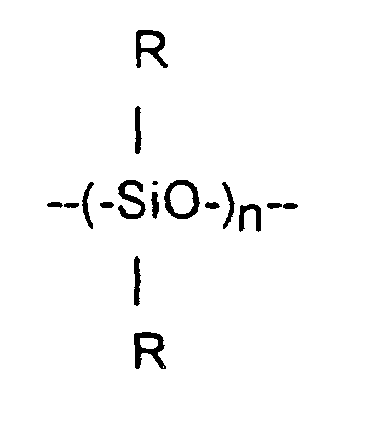
wherein n is from 20 to 2000, and wherein each R independently can be an alkyl or an aryl radical, and preferably is a polydimethylsiloxane having trimethylsilyl end blocking units and n is in the range of 40 to 1500.
wherein n is from 20 to 2000, and wherein each R independently can be an alkyl or an aryl radical, and preferably is a polydimethylsiloxane having trimethylsilyl end blocking units and n is in the range of 40 to 1500.
10. A composition according to any of the preceding claims wherein said foam reducing
system comprises fatty acid together with the capped alkoxylated nonionic surfactant
at a weight ratio of the fatty acid to the capped nonionic surfactant of 0.01 to 10,
and preferably from 0.1 to 5.
11. A composition according to any of the preceding claims wherein said foam reducing
system comprises fatty acid together with the silicone at a weight ratio of the fatty
acid to the silicone of 1·104 to 1·10-1, and preferably from 1·104 to 1.
12. A composition according to any of the preceding claims wherein said foam reducing
system comprises fatty acid together with both the capped alkoxylated nonionic surfactant
and the silicone at a weight ratio of fatty acid: capped nonionic surfactant:silicone
of 1:1·103:1·10-5 to 10:1:1 and preferably of 1: 1·102:1·10-4 to 1:1:1.
13. A composition according to any of the preceding claims wherein said composition further
comprises a chelating agent or a mixture thereof typically up to 5% by weight of the
total composition, and preferably from 0.01% to 1.5%.
14. A composition according to claim 13 wherein said chelating agent is a phosphonate
chelating agent, an amino carboxylate chelating agent, another carboxylate chelating
agent, a polyfunctionally-substituted aromatic chelating agent, ethylenediamine N,
N'-disuccinic acid or mixtures thereof, and more preferably amino aminotri(methylene
phosphonic acid), di-ethyiene-triamino-pentaacetic acid, diethylene triamine penta
methylene phosphonate, 1-hydroxy ethane diphosphonate, ethylenediamine N, N'-disuccinic
acid or mixtures thereof.
15. A composition according to any of the preceding claims wherein said composition further
comprises at least an optional ingredient selected from the group consisting of builders,
stabilisers, bleach activators, soil suspenders, soil suspending polyamine polymers,
polymeric soil release agents, radical scavengers, catalysts, dye transfer agents,
solvents, brighteners, perfumes, dyes, pigments and mixtures thereof.
16. A process of cleaning fabrics which includes the steps of diluting in an aqueous bath
a liquid composition according to any of the preceding claims, in its neat form, contacting
said fabrics with said aqueous bath comprising said liquid composition, and subsequently
rinsing, or washing then rinsing said fabrics.
17. A process according to claim 16, wherein the fabrics are left to soak in said aqueous
bath comprising said liquid composition for a period of time ranging from 1 minute
to 48 hours, preferably from 1 hour to 24 hours.
18. A process according to claim 16, wherein said aqueous oath is formed by dissolving
or dispersing a conventional laundry detergent in water.
19. A process of pretreating fabrics which comprises the steps of applying a liquid composition
according to any of the claims 1 to 15, in its neat form, onto said fabrics, preferably
only soiled portions thereof, before rinsing said fabrics, or washing then rinsing
said fabrics.
20. A process of cleaning a hard-surface with a composition according to any of the claims
1 to 15, wherein said process comprises the step of applying said composition to said
hard-surface and optionally rinsing said hard-surface.
1. Flüssige Zusammensetzung mit einem pH von unter 7 und umfassend ein Persauerstoffbleichmittel,
ein Tensid und ein schaumminderndes System, umfassend eine Fettsäure zusammen mit
einem verkappten, alkoxylierten nichtionischen Tensid mit der Formel:
R1(O-CH2-CH2)n-(OR2)m-O-R3
worin R1 eine lineare oder verzweigte C8-C24-Alkyl- oder -Alkenylgruppe, Arylgruppe, Alkarylgruppe ist, R2 eine lineare oder verzweigte C1-C10-Alkylgruppe ist, R3 eine C1-C10-Alkyl- oder -Alkenylgruppe ist und n und m ganze Zahlen sind, die unabhängig im Bereich von 1 bis 20 liegen, und/oder zusammen mit einem Silikon.
R1(O-CH2-CH2)n-(OR2)m-O-R3
worin R1 eine lineare oder verzweigte C8-C24-Alkyl- oder -Alkenylgruppe, Arylgruppe, Alkarylgruppe ist, R2 eine lineare oder verzweigte C1-C10-Alkylgruppe ist, R3 eine C1-C10-Alkyl- oder -Alkenylgruppe ist und n und m ganze Zahlen sind, die unabhängig im Bereich von 1 bis 20 liegen, und/oder zusammen mit einem Silikon.
2. Zusammensetzung nach Anspruch 1, wobei das Persauerstoffbleichmittel Wasserstoffperoxid
oder eine wasserlösliche Quelle davon ist, üblicherweise ausgewählt aus der Gruppe
bestehend aus Percarbonat, Persilikat, Persulfat, Perborat, Peroxysäure, Hydroperoxid,
aromatischen und aliphatischen Diacylperoxiden und Mischungen davon, und vorzugsweise
Wasserstoffperoxid, tert.-Butylhydroperoxid, Cumylhydroperoxid, 2,4,4-Trimethylpentyl-2-hydroperoxid,
Düsopropylbenzolmonohydroperoxid, tert.-Amylhydroperoxid, 2,5-Dimethylhexan-2,5-dihydroperoxid,
Dilauroylperoxid, Didecanoylperoxid, Dimyristoylperoxid, Benzoylperoxid oder eine
Mischung davon und mehr bevorzugt Wasserstoffperoxid ist.
3. Zusammensetzung nach einem der vorstehenden Ansprüche, wobei sie das Persauerstoffbleichmittel
oder Mischungen davon zu von 0,01 Gew.-% bis 20 Gew.-% der Gesamtzusammensetzung,
vorzugsweise von 1 % bis 15 % und mehr bevorzugt von 2 % bis 10 %, umfasst.
4. Zusammensetzung nach einem der vorstehenden Ansprüche, wobei die Zusammensetzung zu
von 0,01 Gew.-% bis 60 Gew.-% der Gesamtzusammensetzung ein Tensid oder eine Mischung
davon umfasst, mehr bevorzugt von 0,1 % bis 30 % und am meisten bevorzugt von 0,5
% bis 15 %.
5. Zusammensetzung nach einem der vorstehenden Ansprüche, wobei das Tensid ein nichtionisches
Tensid und/oder ein zwitterionisches Tensid ist, vorzugsweise eine Mischung aus einem
alkoxylierten nichtionischen Tensid und einem zwitterionischen Betaintensid.
6. Zusammensetzung nach einem der vorstehenden Ansprüche, wobei das nichtionische Tensid
ein ethoxyliertes nichtionisches Tensid gemäß der Formel RO-(C2H4O)nH ist, worin R eine C6- bis C22-Alkylkette oder eine C6- bis C28-Alkylbenzolkette ist und worin n eine ganze Zahl von 0 bis 20 ist, vorzugsweise von
1 bis 15, mehr bevorzugt von 2 bis 15 und am meisten bevorzugt von 2 bis 12, und/oder
ein Aminoxidtensid und/oder ein Polyhydroxyfettsäureamid-Tensid.
7. Zusammensetzung nach einem der vorstehenden Ansprüche, wobei das zwitterionische Betaintensid
folgende Formel aufweist:
R1-N+(R2)(R3)R4X-
worin R1 eine aliphatische oder aromatische, gesättigte oder ungesättigte, substituierte oder nicht substituierte Kohlenwasserstoffkette ist, die verbundene Gruppen, wie Amidogruppen, Estergruppen, vorzugsweise eine Alkylgruppe mit 1 bis 24 Kohlenstoffatomen, vorzugsweise 8 bis 18 und mehr bevorzugt 10 bis 16, oder einen Amidorest mit der Formel Ra-C(O)-NH-(C(Rb)2)m enthalten kann, worin Ra eine aliphatische oder aromatische, gesättigte oder ungesättigte, substituierte oder nicht substituierte Kohlenwasserstoffkette, vorzugsweise eine Alkylgruppe mit 8 bis zu 20 Kohlenstoffatomen, vorzugsweise bis zu 18, mehr bevorzugt bis zu 16 ist, Rb ausgewählt ist aus der Gruppe bestehend aus Wasserstoff und Hydroxygruppen, und m 1 bis 4 ist, vorzugsweise 2 bis 3, mehr bevorzugt 3, und nicht mehr als einer Hydroxygruppe an jeder (C(Rb)2)-Einheit;
R2 Wasserstoff, C1-C6-Alkyl, Hydroxyalkyl oder eine andere substituierte C1-C6-Alkylgruppe ist;
R3 C1-C6-Alkyl, Hydroxyalkyl oder eine andere substituierte C1-C6-Alkylgruppe, die mit R2 unter Ausbildung von Ringstrukturen mit N verbunden sein kann, oder eine C1-C6-Carboxylsäuregruppe oder eine C1-C6-Sulfonatgruppe ist;
R4 eine Einheit ist, die das kationische Stickstoffatom mit der hydrophilen Gruppe verbindet und üblicherweise eine Alkylen-, Hydroxyalkylen- oder Polyalkoxygruppe mit 1 bis 10 Kohlenstoffatomen ist;
und X eine Carboxylat- oder Sulfonatgruppe oder eine Mischung davon ist.
R1-N+(R2)(R3)R4X-
worin R1 eine aliphatische oder aromatische, gesättigte oder ungesättigte, substituierte oder nicht substituierte Kohlenwasserstoffkette ist, die verbundene Gruppen, wie Amidogruppen, Estergruppen, vorzugsweise eine Alkylgruppe mit 1 bis 24 Kohlenstoffatomen, vorzugsweise 8 bis 18 und mehr bevorzugt 10 bis 16, oder einen Amidorest mit der Formel Ra-C(O)-NH-(C(Rb)2)m enthalten kann, worin Ra eine aliphatische oder aromatische, gesättigte oder ungesättigte, substituierte oder nicht substituierte Kohlenwasserstoffkette, vorzugsweise eine Alkylgruppe mit 8 bis zu 20 Kohlenstoffatomen, vorzugsweise bis zu 18, mehr bevorzugt bis zu 16 ist, Rb ausgewählt ist aus der Gruppe bestehend aus Wasserstoff und Hydroxygruppen, und m 1 bis 4 ist, vorzugsweise 2 bis 3, mehr bevorzugt 3, und nicht mehr als einer Hydroxygruppe an jeder (C(Rb)2)-Einheit;
R2 Wasserstoff, C1-C6-Alkyl, Hydroxyalkyl oder eine andere substituierte C1-C6-Alkylgruppe ist;
R3 C1-C6-Alkyl, Hydroxyalkyl oder eine andere substituierte C1-C6-Alkylgruppe, die mit R2 unter Ausbildung von Ringstrukturen mit N verbunden sein kann, oder eine C1-C6-Carboxylsäuregruppe oder eine C1-C6-Sulfonatgruppe ist;
R4 eine Einheit ist, die das kationische Stickstoffatom mit der hydrophilen Gruppe verbindet und üblicherweise eine Alkylen-, Hydroxyalkylen- oder Polyalkoxygruppe mit 1 bis 10 Kohlenstoffatomen ist;
und X eine Carboxylat- oder Sulfonatgruppe oder eine Mischung davon ist.
8. Zusammensetzung nach einem der vorstehenden Ansprüche, wobei die Fettsäure ein Alkalisalz
einer C8-C28-Fettsäure ist, vorzugsweise eine Fettsäure mit 8 bis 22 Kohlenstoffatomen und mehr
bevorzugt 8 bis 18 Kohlenstoffatomen.
9. Zusammensetzung nach einem der vorstehenden Ansprüche, wobei das Silikon als Siloxan
mit der folgenden allgemeinen Struktur beschrieben werden kann:
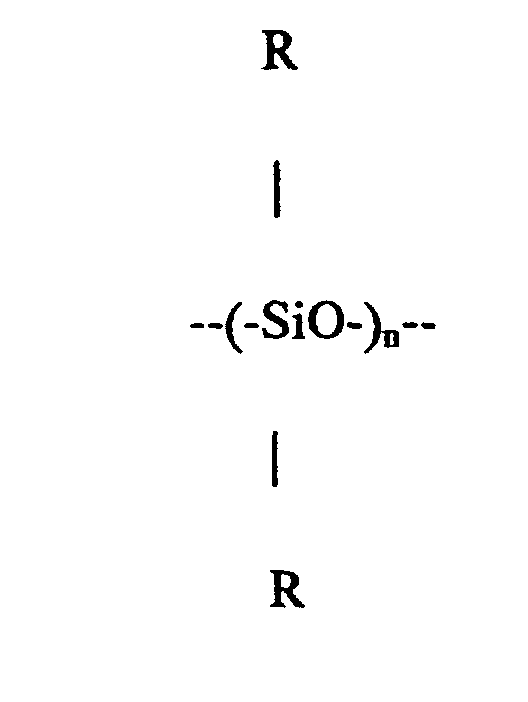
worin n 20 bis 2000 ist und worin jedes R unabhängig ein Alkyl- oder ein Arylrest sein kann, und vorzugsweise ein Polydimethylsiloxan mit Trimethylsilyl-Endblockierungseinheiten ist und n im Bereich von 40 bis 1500 liegt.
worin n 20 bis 2000 ist und worin jedes R unabhängig ein Alkyl- oder ein Arylrest sein kann, und vorzugsweise ein Polydimethylsiloxan mit Trimethylsilyl-Endblockierungseinheiten ist und n im Bereich von 40 bis 1500 liegt.
10. Zusammensetzung nach einem der vorstehenden Ansprüche, wobei das schaummindemde System
die Fettsäure zusammen mit dem verkappten, alkoxylierten nichtionischen Tensid in
einem Gewichtsverhältnis von Fettsäure zu verkapptem nichtionischem Tensid von 0,01
zu 10 und vorzugsweise von 0,1 zu 5 umfasst.
11. Zusammensetzung nach einem der vorstehenden Ansprüche, wobei das schaummindernde System
die Fettsäure zusammen mit dem Silikon in einem Gewichtsverhältnis von Fettsäure zu
Silikon von 1·104 zu 1·10-1 und vorzugsweise von 1·104 zu 1 umfasst.
12. Zusammensetzung nach einem der vorstehenden Ansprüche, wobei das schaummindernde System
die Fettsäure zusammen mit sowohl dem verkappten, alkoxylierten nichtionischen Tensid
als auch dem Silikon in einem Gewichtsverhältnis von Fettsäure:verkapptem nichtionischem
Tensid:Silikon von 1:1·103:1·10-5 bis 10:1:1 und vorzugsweise von 1:1·102:1·10-4 bis 1:1:1 umfasst.
13. Zusammensetzung nach einem der vorstehenden Ansprüche, wobei die Zusammensetzung weiterhin
einen Chelatbildner oder eine Mischung davon, üblicherweise bis zu 5 Gew.-% der Gesamtzusammensetzung
und vorzugsweise 0,01 % bis 1,5 %, umfasst.
14. Zusammensetzung nach Anspruch 13, wobei der Chelatbildner ein Phosphonat-Chelatbildner,
ein Aminocarboxylat-Chelatbildner, ein anderer Carboxylat-Chelatbildner, ein polyfunktionell
substituierter aromatischer Chelatbildner, Ethylendiamin-N,N'-disuccinsäure oder Mischungen
davon und mehr bevorzugt Amino-Aminotri(methylenphosphonsäure), Diethylentriaminpentaessigsäure,
Diethylentriaminpentamethylenphosphonat, 1-Hydroxyethandiphosphonat, Ethylendiamin-N,N'-disuccinsäure
oder Mischungen davon ist.
15. Zusammensetzung nach einem der vorstehenden Ansprüche, worin die Zusammensetzung weiterhin
wenigstens einen fakultativen Bestandteil ausgewählt aus der Gruppe bestehend aus
Buildem, Stabilisatoren, Bleichaktivatoren, Schmutzsuspendiermitteln, schmutzsuspendierenden
Polyaminpolymeren, polymeren Schmutzabweisungsmitteln, Radikalfängern, Katalysatoren,
Farbstoffübertragungsmitteln, Lösungsmitteln, Aufhellern, Duftstoffen, Farbstoffen,
Pigmenten und Mischungen davon umfasst.
16. Verfahren zum Reinigen von Gewebe, das die Schritte des Verdünnens einer flüssigen
Zusammensetzung nach einem der vorstehenden Ansprüche in ihrer unverdünnten Form in
einem Wasserbad, des Kontaktierens des Gewebes mit dem Wasserbad umfassend die flüssige
Zusammensetzung und des anschließenden Spülens oder Waschens mit nachfolgendem Spülen
des Gewebes umfasst.
17. Verfahren nach Anspruch 16, wobei das Gewebe im Wasserbad mit der flüssigen Zusammensetzung
für einen Zeitraum im Bereich von 1 Minute bis 48 Stunden, vorzugsweise von 1 Stunde
bis 24 Stunden, eingeweicht wird.
18. Verfahren nach Anspruch 16, wobei das Wasserbad durch Lösen oder Dispergieren eines
herkömmlichen Wäschewaschmittels in Wasser ausgebildet wird.
19. Verfahren zur Vorbehandlung von Gewebe, das die Schritte des Auftragens einer flüssigen
Zusammensetzung nach einem der vorstehenden Ansprüche 1 bis 15 in ihrer unverdünnten
Form auf das Gewebe, vorzugsweise nur auf die verschmutzten Abschnitte davon, vor
dem Spülen oder Waschen mit nachfolgendem Spülen des Gewebes umfasst.
20. Verfahren zum Reinigen einer harten Oberfläche mit einer Zusammensetzung nach einem
der vorstehenden Ansprüche 1 bis 15, wobei das Verfahren die Schritte des Auftragens
der Zusammensetzung auf die harte Oberfläche und wahlweise des Spülens der harten
Oberfläche umfasst.
1. Composition liquide ayant un pH inférieur à 7, et comprenant un agent de blanchiment
peroxygéné, un agent tensioactif et un système de réduction de la mousse comprenant
un acide gras en mélange avec un agent tensioactif non ionique alcoxylé coiffé de
formule:
R1(O-CH2-CH2)n-(OR2)m-O-R3
dans laquelle R1 est un groupe alkyle ou alcényle linéaire ou ramifié, aryle, alkaryle wen C8 à C24, R2 est un groupe alkyle linéaire ou ramifié en C1 à C10, R3 est un groupe alkyle ou alcényle en C1 à C10 et n et m sont des entiers compris, indépendamment, dans l'intervalle allant de 1 à 20 et/ou en mélange avec une silicone.
R1(O-CH2-CH2)n-(OR2)m-O-R3
dans laquelle R1 est un groupe alkyle ou alcényle linéaire ou ramifié, aryle, alkaryle wen C8 à C24, R2 est un groupe alkyle linéaire ou ramifié en C1 à C10, R3 est un groupe alkyle ou alcényle en C1 à C10 et n et m sont des entiers compris, indépendamment, dans l'intervalle allant de 1 à 20 et/ou en mélange avec une silicone.
2. Composition selon la revendication 1, dans laquelle ledit agent de blanchiment peroxygéné
est le peroxyde d'hydrogène ou une source hydrosoluble de celui-ci, typiquement choisie
dans le groupe constitué par le percarbonate, le persilicate, le persulfate, le perborate,
le peroxyacide, l'hydroperoxyde, les peroxydes aliphatiques et aromatiques de diacyle
et leurs mélanges, de préférence le peroxyde d'hydrogène, l'hydroperoxyde de tert-butyle,
l'hydroperoxyde de cumyle, le 2,4,4-triméthylpentyl-2-hydroperoxyde, le di-isopropylbenzène-monohydroperoxyde,
l'hydroperoxyde de tert-amyle, le 2,5-diméthyl-hexane-2,5-dihydroperoxyde, le peroxyde
de dilauroyle, le peroxyde de didécanoyle, le peroxyde de dimyristoyle, le peroxyde
de benzoyle ou un de leurs mélanges, et plus préférablement le peroxyde d'hydrogène.
3. Composition selon l'une quelconque des revendications précédentes, qui comprend de
0,01 % à 20 %, en poids de la composition totale, dudit agent de blanchiment peroxygéné
ou de leurs mélanges, de préférence de 1 % à 15 % et plus préférablement de 2 % à
10 %.
4. Composition selon l'une quelconque des revendications précédentes, ladite composition
comprenant de 0,01 % à 60 %, en poids de la composition totale, d'un agent tensioactif
ou de leur mélange, plus préférablement de 0,1 % à 30 % et le plus préférablement
de 0,5 % à 15 %.
5. Composition selon l'une quelconque des revendications précédentes dans laquelle ledit
agent tensioactif est un agent tensioactif non ionique et/ou un agent tensioactif
zwittérionique, de préférence un mélange d'un agent tensioactif non ionique alcoxylé
et d'un agent tensioactif zwittérionique à base de bétaïne.
6. Composition selon l'une quelconque des revendications précédentes dans laquelle ledit
agent tensioactif non ionique est un agent tensioactif éthoxylé non ionique selon
la formule RO-(C2H4O)nH, dans laquelle R est une chaîne alkyle en C6 à C22 ou une chaîne alkylbenzène en C6 à C28, et dans laquelle n est un entier de 0 à 20, de préférence de 1 à 15, plus préférablement
de 2 à 15 et le plus préférablement de 2 à 12, et/ou un agent tensioactif à base d'oxyde
d'amine et/ou un agent tensioactif à base d'amide d'acide gras polyhydroxylé.
7. Composition selon l'une quelconque des revendications précédentes dans laquelle ledit
agent tensioactif zwittérionique à base de bétaïne a la formule:
R1-N+(R2)(R3)R4X-
dans laquelle R1 est une chaîne hydrocarbonée aliphatique ou aromatique, saturée ou non saturée, substituée ou non substituée qui peut contenir des groupes de liaison comme des groupes amide, des groupes ester, de préférence un groupe alkyle contenant de 1 à 24 atomes de carbone, de préférence de 8 à 18, et plus préférablement de 10 à 16, ou un radical amide de formule Ra-C(O)-NH-(C(Rb)2)m, dans laquelle Ra est une chaîne hydrocarbonée aliphatique ou aromatique, saturée ou non saturée, substituée ou non substituée, de préférence un groupe alkyle contenant de 8 jusqu'à 20 atomes de carbone, de préférence jusqu'à 18, plus préférablement jusqu'à 16, Rb est choisi dans le groupe constitué de l'hydrogène et du groupe hydroxy, et m va de 1 à 4, de préférence de 2 à 3, plus préférablement 3, avec au plus un groupe hydroxy dans n'importe lequel des fragments (C(Rb)2);
R2 est l'hydrogène, un groupe alkyle, hydroxyalkyle en C1 à C6 ou un autre groupe alkyle en C1 à C6 substitué;
R3 est un groupe alkyle, hydroxyalkyle en C1 à C6 ou un autre groupe alkyle en C1 à C6 substitué qui peut aussi être lié à R2 pour former des structures cycliques avec le N, ou un groupe acide carboxylique en C1 à C6 ou un groupe sulfonate en C1 à C6; R4 est un fragment liant l'atome d'azote cationique au groupe hydrophile et est typiquement un alkylène, un hydroxyalkylène, ou groupe polyalcoxy contenant de 1 à 10 atomes de carbone;
et X est un groupe carboxylate ou sulfonate; ou un mélange de ceux-ci.
R1-N+(R2)(R3)R4X-
dans laquelle R1 est une chaîne hydrocarbonée aliphatique ou aromatique, saturée ou non saturée, substituée ou non substituée qui peut contenir des groupes de liaison comme des groupes amide, des groupes ester, de préférence un groupe alkyle contenant de 1 à 24 atomes de carbone, de préférence de 8 à 18, et plus préférablement de 10 à 16, ou un radical amide de formule Ra-C(O)-NH-(C(Rb)2)m, dans laquelle Ra est une chaîne hydrocarbonée aliphatique ou aromatique, saturée ou non saturée, substituée ou non substituée, de préférence un groupe alkyle contenant de 8 jusqu'à 20 atomes de carbone, de préférence jusqu'à 18, plus préférablement jusqu'à 16, Rb est choisi dans le groupe constitué de l'hydrogène et du groupe hydroxy, et m va de 1 à 4, de préférence de 2 à 3, plus préférablement 3, avec au plus un groupe hydroxy dans n'importe lequel des fragments (C(Rb)2);
R2 est l'hydrogène, un groupe alkyle, hydroxyalkyle en C1 à C6 ou un autre groupe alkyle en C1 à C6 substitué;
R3 est un groupe alkyle, hydroxyalkyle en C1 à C6 ou un autre groupe alkyle en C1 à C6 substitué qui peut aussi être lié à R2 pour former des structures cycliques avec le N, ou un groupe acide carboxylique en C1 à C6 ou un groupe sulfonate en C1 à C6; R4 est un fragment liant l'atome d'azote cationique au groupe hydrophile et est typiquement un alkylène, un hydroxyalkylène, ou groupe polyalcoxy contenant de 1 à 10 atomes de carbone;
et X est un groupe carboxylate ou sulfonate; ou un mélange de ceux-ci.
8. Composition selon l'une quelconque des revendications précédentes, dans laquelle ledit
acide gras est un sel alcalin d'un acide gras en C8 à C24, de préférence d'un acide gras contenant de 8 à 22 atomes de carbone, et plus préférablement
de 8 à 18 atomes de carbone.
9. Composition selon l'une quelconque des revendications précédentes, dans laquelle ladite
silicone peut être décrite comme un siloxane de structure générale:
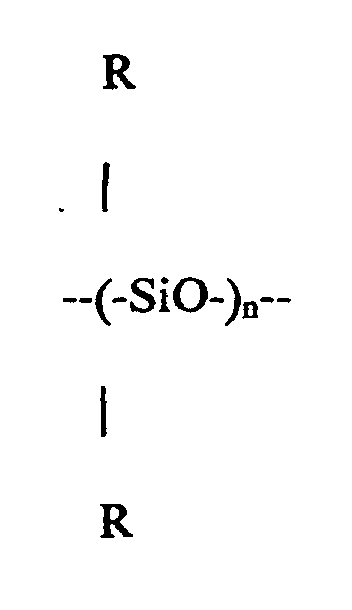
dans laquelle n vaut de 20 à 2000, et dans laquelle chaque R indépendamment peut être un radical alkyle ou aryle, et de préférence est un polydiméthylsiloxane ayant des motifs triméthylsilyle bloqueurs d'extrémités et n est compris dans l'intervalle allant de 40 à 1500.
dans laquelle n vaut de 20 à 2000, et dans laquelle chaque R indépendamment peut être un radical alkyle ou aryle, et de préférence est un polydiméthylsiloxane ayant des motifs triméthylsilyle bloqueurs d'extrémités et n est compris dans l'intervalle allant de 40 à 1500.
10. Composition selon l'une quelconque des revendications précédentes, dans laquelle ledit
système de réduction de la mousse comprend un acide gras en mélange avec l'agent tensioactif
non ionique alcoxylé coiffé selon un rapport pondéral de l'acide gras sur l'agent
tensioactif non ionique coiffé de 0,01 à 10, et de préférence de 0,1 to 5.
11. Composition selon l'une quelconque des revendications précédentes, dans laquelle ledit
système de réduction de la mousse comprend un acide gras en mélange avec la silicone
selon un rapport pondéral de l'acide gras sur la silicone de 1x10⁴ à 1x10⁻¹, et de préférence de 1x10⁴ à 1.
12. Composition selon l'une quelconque des revendications précédentes, dans laquelle ledit
système de réduction de la mousse comprend un acide gras en mélange à la fois avec
l'agent tensioactif non ionique alcoxylé coiffé et avec la silicone selon un rapport
pondéral d'acide gras: agent tensioactif non ionique coiffé:silicone de 1/1x103/1x10-5 à 10/1/1 et de préférence allant de 1/1x102/1x10-4 à 1/1/1.
13. Composition selon l'une quelconque des revendications précédentes ladite composition
comprenant en outre un agent chélatant ou un de ses mélanges typiquement jusqu'à 5
% en poids de la composition totale, et de préférence de 0,01 % à 1,5 %.
14. Composition selon la revendication 13, dans laquelle ledit agent chélatant est un
agent chélatant à base de phosphonate, un agent chélatant à base d'aminocarboxylate,
un autre agent chélatant à base de carboxylate, un agent chélatant aromatique à substitution
polyfonctionnelle, l'acide éthylènediamine-N, N'-disuccinique ou leurs mélanges, et
plus préférablement l'acide amino-tri(méthylène phosphonique), l'acide diéthylène
triamino pentaacétique, le phosphonate de diéthylènetriaminepentaméthylène, le diphosphonate
de 1-hydroxyéthane, l'acide éthylènediamine-N, N'-disuccinique ou leurs mélanges.
15. Composition selon l'une quelconque des revendications précédentes, ladite composition
comprenant en outre au moins un ingrédient facultatif choisi dans le groupe constitué
par les adjuvants, les stabilisants, les activateurs de blanchiment, les agents de
suspension des salissures, les agents de suspension des salissures à base de polymères
de polyamine, les agents polymères de libération des salissures, les piégeurs de radicaux
libres, les catalyseurs, les agents de transfert de teinture, les solvants, les azureurs,
les parfums, les teintures, les pigments et leurs mélanges.
16. Procédé de nettoyage des tissus qui inclut les étapes de dilution, dans un bain aqueux,
d'une composition liquide pure selon l'une quelconque des revendications précédentes,
de mise en contact desdits tissus avec ledit bain aqueux comprenant ladite composition
liquide, et ensuite de rinçage, ou de lavage puis de rinçage desdits tissus.
17. Procédé selon la revendication 16, dans lequel on laisse les tissus tremper dans ledit
bain aqueux contenant ladite composition liquide pendant une durée allant de 1 minute
à 48 heures, de préférence de 1 heure à 24 heures.
18. Procédé selon la revendication 16, dans lequel ledit bain aqueux est formé en dissolvant
ou dispersant un détergent à lessive classique dans de l'eau.
19. Procédé de prétraitement des tissus qui comprend les étapes d'application d'une composition
liquide sous sa forme pure selon l'une quelconque des revendications 1 à 15, sur lesdits
tissus, de préférence uniquement sur les parties souillées de ces tissus, avant le
rinçage desdits tissus, ou le lavage puis le rinçage desdits tissus.
20. Procédé de nettoyage d'une surface dure avec une composition selon l'une quelconque
des revendications 1 à 15, ledit procédé comprenant l'étape d'application de ladite
composition sur ladite surface dure et facultativement le rinçage de ladite surface
dure.