|
(11) | EP 0 912 098 B2 |

| (12) | NEW EUROPEAN PATENT SPECIFICATION |
| After opposition procedure |
|
|
| (54) |
USE OF A COMBINATION OF SURFACTANTS, CHELATING AGENTS AND ESSENTIAL OILS FOR EFFECTIVE DISINFECTION VERWENDUNG EINER MISCHUNG ENTHALTEND EMULGATOREN, KOMPLEXBILDER UND ETHERISCHE ÖLE ALS DESINFEKTIONSMITTEL UTILISATION D'UNE COMBINAISON DE TENSIOACTIFS, D'AGENTS CHELATEURS ET D'HUILES ESSENTIELLES POUR UNE DESINFECTION EFFICACE |
|
|
||||||||||||||||||||||||||||
|
|||||||||||||||||||||||||||||
Technical field
[0001] The present invention relates to antimicrobial compositions which can be used to disinfect and clean various surfaces including hard surfaces or in laundry applications.
Background
[0002] Antimicrobial compositions include materials which have the ability to disinfect. It is generally recognised that a disinfecting material greatly reduces or even eliminates the microorganisms existing on a surface. Antimicrobial compositions have been described in the art which include strong disinfecting materials which are not fully satisfactory from an environmental and/or human safety point of view. For example, typical disinfecting materials used in antimicrobial compositions include quaternary ammonium.
[0003] Also, a drawback associated with antimicrobial compositions based on strong disinfecting materials like peracids and/or halogen-releasing compounds, e.g., hypochlorite, is that they may damage surfaces onto which they are contacted to perform their disinfecting action. Indeed, such antimicrobial compositions based on peracids and/or hypochlorite are perceived by the consumers as being not safe to various surfaces including hard-surfaces and fabrics, especially delicate fabrics like silk, wool and the like.
[0004] It is therefore an object of the present invention to provide effective disinfection using ingredients which are perceived to have a limited detrimental impact on surfaces and/or to be environmental friendly.
[0005] This object can be met by combining in a composition an amphoteric surfactant, a chelating agent and an antimicrobial essential oil, or an active thereof selected from the lists described in claim 1. Indeed, it has been found that the incorporation, in a composition, of the combination of an amphoteric surfactant, a chelating agent and a selected antimicrobial essential oil, or an active thereof, provides disinfecting properties to said composition. Actually, a composition comprising said combination provides excellent disinfection on a surface, even at high dilution levels, i.e., up to dilution levels of from 1:100 (composition:water).
[0006] By combining a chelating agent, an amphoteric surfactant and an essential oil or an active thereof selected from the lists described in claim 1, disinfection may be provided on all types of surfaces including hard-surfaces as well as in laundry applications, or even in human application.
[0007] An advantage of the present invention is that excellent disinfection is provided on a broad range of bacterial pure strains including Gram positive and Gram negative bacterial strains and more resistant micro-organisms like fungi.
[0008] Another advantage of the present invention is that beside the disinfection properties delivered, good cleaning is also provided.
[0009] Representative of the prior art is for example EP-B-288 689 which discloses a liquid for hard-surfaces comprising antimicrobial effective amounts of pine oil and at least one oil soluble organic acid. EP 467 618 discloses a liquid cleaner for hand surfaces comprising fine oil and a chelating agent.
[0010] US-5,403,587 discloses aqueous antimicrobial compositions which can be used to sanitise, disinfect, and clean hard-surfaces. More particularly, US-5,403,587 discloses aqueous compositions (pH 1 to 12) comprising essential oils (0.02% to 5%), which exhibit antimicrobial properties efficacy such as thyme oil, eucalyptus oil, clove oil and the like, and a solubilizing or dispersing agent sufficient to form an aqueous solution or dispersion of said essential oils in a water carrier.
[0011] EP 252 278 relates to a liquid disinfectand cleaner for skin and means membranes, comprising an alcohol, hydrogen peroxide, a carboxylic acid, a nitrogen-containing organic compound, and a phenolic compound which anti-microbial compounds.
[0012] Co-pending European patent application number 96870017.9 discloses disinfecting compositions comprising hydrogen peroxide, an antimicrobial essential oil, optionally surfactants and chelating agents.
[0013] None of these prior art documents discloses that by combining a chelating agent, an amphoteric surfactant and a selected antimicrobial essential oil or an active thereof as defined in claim 1 excellent disinfecting properties are delivered to a surface, even under diluted conditions.
Summary of the invention
[0014] The present invention encompasses the use, in a composition of a combination of a chelating agent, an amphoteric surfactant and an antimicrobial essential oil or an active thereof selected from the lists described in claim 1, to provide disinfecting properties to said composition.
Detailed description of the invention
[0015] A first essential ingredient of the present invention is a chelating agent selected from the list described in claim 1. It has now been found that a chelating agent in combination with a surfactant when added on top of an antimicrobial essential oil and/or an active thereof, in a composition, improves the disinfecting properties of said composition.
[0016] Phosphonate chelating agents are etidronic acid (1-hydroxyethylidene-bisphosphonic acid or HEDP) as well as amino phosphonate compounds, including alkali metal ethane 1-hydroxy diphosphonates, nitrilo trimethylene phosphonates, ethylene diamine tetra methylene phosphonates, and diethylene triamine penta methylene phosphonates. The phosphonate compounds may be present either in their acid form or as salts of different cations on some or all of their acid functionalities. Preferred phosphonate chelating agents to be used herein are diethylene triamine penta methylene phosphonates. Such phosphonate chelating agents are commercially available from Monsanto under the trade name DEQUEST®.
[0017] Polyfunctionally-substituted aromatic chelating agents may also be useful in the compositions herein. See U.S. patent 3,812,044, issued May 21, 1974, to Connor et al. Preferred compounds of this type in acid form are dihydroxydisulfobenzenes such as 1,2-dihydroxy -3,5-disulfobenzene.
[0018] A preferred biodegradable chelating agent for use herein is ethylene diamine N,N'- disuccinic acid, or alkali metal, or alkaline earth, ammonium or substitutes ammonium salts thereof or mixtures thereof. Ethylenediamine N,N'- disuccinic acids, especially the (S,S) isomer have been extensively described in US patent 4, 704, 233, November 3, 1987 to Hartman and Perkins. Ethylenediamine N,N'- disuccinic acid is, for instance, commercially available under the tradename ssEDDS® from Palmer Research Laboratories.
[0019] Suitable amino carboxylate chelating agents useful herein are ethylene diamine tetra acetate, diethylene triamine pentaacetate, diethylene triamine pentacetate (DTPA), N-hydroxyethylethylenediamine triacetate, nitrilotri-acetate, ethylenediamine tetraproprionate, triethylenetetraaminehexa-acetate, ethanoldiglycine, propylene diamine tetracetic acid (PDTA) and methyl glycine di-acetic acid (MGDA), both in their acid form, or in their alkali metal, ammonium, and substituted ammonium salt forms. Particularly suitable to be used herein are diethylene triamine penta acetic acid (DTPA), propylene diamine tetracetic acid (PDTA) which is, for instance, commercially available from BASF under the trade name Trilon FS® and methyl glycine di-acetic acid (MGDA).
[0020] Further carboxylate chelating agents to be used herein are malonic acid, salicylic acid, glycine, aspartic acid, glutamic acid, dipicolinic acid and derivatives thereof, or mixtures thereof.
[0021] Typically, the chelating agent, or a mixture thereof, is present in the composition at a level of from 0.001% to 5% by weight, preferably from 0.002% to 3% by weight and more preferably from 0.002% to 1.5%.
[0022] A second essential ingredient of the present invention is an amphoteric surfactant or a mixture thereof.
[0023] Suitable amphoteric surfactants to be used herein are betaine and sulphobetaine surfactants, derivatives thereof or mixtures thereof as defined in claim 1. Said betaine or sulphobetaine surfactants are preferred herein as, they help disinfection by increasing the permeability of the bacterial cell wall, thus allowing other active ingredients to enter the cell.
[0024] Furthermore, due to the mild action profile of said betaine or sulphobetaine surfactants, they are particularly suitable for the cleaning of delicate surfaces, e.g. delicate laundry or surfaces in contact with food and/or babies. Betaine and sulphobetaine surfactants are also extremely mild to the skin and/or surfaces to be treated.
[0025] The betaine and sulphobetaine surfactants herein are according to the formula
wherein R1 is an alkyl radical containing from 1 to 24 carbon atoms, preferably from 8 to 18, and more preferably from 12 to 14, wherein R2 and R3 contain from 1 to 3 carbon atoms, and preferably 1 carbon atom, wherein n is an integer from 1 to 10, preferably from 1 to 6 and more preferably is 1, Y is selected from the group consisting of carboxyl and sulfonyl radicals and wherein the sum of R1, R2 and R3 radicals is from 14 to 24 carbon atoms, or mixtures thereof.
[0026] Examples of particularly suitable betaine surfactants include C12-C18 alkyl dimethyl betaine such as coconut-betaine and C10-C16 alkyl dimethyl betaine such as laurylbetaine. Coconutbetaine is commercially available from Seppic under the trade name of Amonyl 265®. Laurylbetaine is commercially available from Albright & Wilson under the trade name Empigen BB/L®.
[0027] Other suitable amphoteric surfactants to be used herein are amine oxides having the following formula R1R2R3NO wherein each of R1, R2 and R3 is independently a saturated substituted or unsubstituted, linear or branched alkyl group of from 1 to 30 carbon atoms, preferably of from 6 to 30 carbon atoms, more preferably of from 10 to 20 carbon atoms, and most preferably of from 8 to 18 carbon atoms. Preferred amine oxides for use herein are for instance natural blend C8-C10 amine oxides as well as C12-C16 amine oxides commercially available from Hoechst. Suitable short chain amine oxides to be used according to the present invention are amine oxides having the following formula R1R2R3NO wherein R1 is a C6 to C10 alkyl group, preferably a C8 to C10 alkyl group and wherein R2 and R3 are independently substituted or unsubstituted, linear or branched alkyl groups of from 1 to 4 carbon atoms, preferably of from 1 to 3 carbon atoms, and more preferably are methyl groups. R1 may be a saturated linear or branched alkyl group. Preferred short chain amine oxides for use herein are for instance natural blend C8-C10 amine oxides available from Hoechst.
[0028] In a preferred embodiment of the present invention, the surfactant is a surfactant system comprising an amine oxide and a betaine or sulphobetaine surfactant as defined in claim 1, preferably in a weight ratio of amine oxide to betaine or sulphobetaine of 2:1 to 100:1, more preferably of 6:1 to 100:1. Using such a surfactant system together with a chelating agent and an antimicrobial essential oil or active thereof, in a composition, provides not only effective disinfecting properties and effective cleaning performance to said composition but also provides the cleaned surfaces with a shiny effect, i.e., the amount of filming/streaking left on the cleaned surface that has been treated with said composition is minimal.
[0029] Typically, the surfactant or mixtures thereof is present in the composition at a level of from 0.01% to 50% by weight of the total composition, preferably from 0.01% to 30% and more preferably from 0.1 % to 10%.
[0030] A third essential ingredient of the present invention is a selected antimicrobial essential oil or an active thereof, or a mixture thereof as defined in claim 1.
[0031] The selected antimicrobial essential oils to be used herein are thyme oil, clove oil, cinnamon oil, geranium oil, eucalyptus oil, peppermint oil, mint oil or mixtures thereof, and thymol (present for example in thyme), eugenol (present for example in cinnamon and clove), menthol (present for example in mint), geraniol (present for example in geranium and rose), verbenone (present for example in vervain), eucalyptol and pinocarvone (present in eucalyptus), cedrol (present for example in cedar), anethol (present for example in anise), carvacrol, hinokitiol, berberine, ferulic acid, cinnamic acid, methyl salycilic acid, methyl salycilate, terpineol and mixtures thereof. Preferred actives of essential oils to be used herein are thymol, eugenol, verbenone, eucalyptol, terpineol, cinnamic acid, methyl salycilic acid and/or geraniol.
[0032] Thymol may be commercially available for example from Aldrich, eugenol may be commercially available for example from Sigma, Systems - Bioindustries (SBI) - Manheimer Inc.
[0033] Typically, the selected antimicrobial essential oil or actives thereof or mixture thereof is present in the composition at a level of at least 0.003% by weight of the total composition, preferably from 0.006% to 10%, more preferably from 0.1% to 4% and most preferably of from 0.03% to 2%.
[0034] It has now been found that by combining an amphoteric surfactant, a chelating agent and a selected antimicrobial essential oil or active thereof, in a composition as defined in claim 1, that improved disinfecting properties are delivered, even when used under highly diluted conditions. By "improved disinfecting properties" it is meant herein that the disinfection delivered by combining a surfactant, a chelating agent and a selected antimicrobial essential oil and/or an active thereof, in a composition, is improved as compared to the disinfection delivered by using only one or two of said ingredients, in said composition.
[0035] Excellent disinfection is obtained by combining an amphoteric surfactant, a chelating agent and a selected antimicrobial essential oil or active thereof as defined in claim 1 on a variety of microorganisms including Gram positive bacteria like Staphylococcus aureus, and Gram negative bacteria like Pseudomonas aeroginosa as well as on fungi like Candida albicans present on surfaces, even if used in highly diluted conditions.
[0036] Disinfection properties of a composition may be measured by the bactericidal activity of said composition. A test method suitable to evaluate the bactericidal activity of a composition is described in European Standard, prEN 1040, CEN/TC 216 N 78, dated November 1995 issued by the European committee for standardisation, Brussels. European Standard, prEN 1040, CEN/TC 216 N 78, specifies a test method and requirements for the minimum bactericidal activity of a disinfecting composition. The test is passed if the bacterical colonies forming units (cfu) are reduced from a 107 cfu (initial level) to a 102 cfu (final level after contact with the disinfecting product), i.e. a 105 reduction of the viability is necessary. A composition comprising an amphoteric surfactant, a chelating agent and a selected antimicrobial essential oil or an active thereof passes this test, even if used in highly diluted conditions.
[0037] The combination of ingredients according to the present invention may be formulated in a composition being either in a solid, pasty or liquid form. In the case where the compositions according to the present invention are formulated as solids, they will be mixed with an appropriate solvent, typically water, before use. In liquid form, the compositions are preferably but not necessarily formulated as aqueous compositions. Liquid compositions are preferred herein for convenience of use.
[0038] In the embodiment, where the compositions according to the present invention are aqueous liquid cleaning compositions, they preferably have a pH as is of not more than 12.0, more preferably from 1 to 10, and most preferably from 2 to 9. The pH of the compositions can be adjusted by using organic or inorganic acids, or alkalinising agents.
[0039] As effective disinfection is provided with the combination of ingredients of the present invention the compositions comprising said combination do not require the addition of other antimicrobial compounds. However, if desired in one embodiment of the present invention said compositions may further comprise, as optional ingredients, other antimicrobial compounds like a peroxygen bleach, or mixtures thereof. Preferred peroxygen bleach is hydrogen peroxide, or a water soluble source thereof, or mixtures thereof.
[0040] It is believed that the presence of peroxygen bleach especially hydrogen peroxide, persulfate and the like, further contributes to the disinfecting properties of the compositions according to the present invention. Indeed, peroxygen bleach may attack the vital function of the micro-organism cells, for example it may inhibit the assembling of ribosomes units within the cytoplasm of the micro-organism cells. Also peroxygen bleach like hydrogen peroxide, is a strong oxidizer that generates hydroxyl free radicals which attack proteins and nucleic acids. Furthermore, the presence of peroxygen bleach, especially hydrogen peroxide, provides strong stain removal benefits which are particularly noticeable for example in laundry and hard surfaces applications.
[0041] As used herein a hydrogen peroxide source refers to any compound which produces hydrogen peroxide when said compound is in contact with water. Suitable water-soluble sources of hydrogen peroxide for use herein include percarbonates, persilicate, persulphate such as monopersulfate, perborates and peroxyacids such as diperoxydodecandioic acid (DPDA), magnesium perphthalic acid and mixtures thereof.
[0042] In addition, other classes of peroxides can be used as an alternative to hydrogen peroxide and sources thereof or in combination with hydrogen peroxide and sources thereof. Suitable classes include dialkylperoxides, diacylperoxides, preformed percarboxylic acids, organic and inorganic peroxides and/or hydroperoxides.
[0043] The compositions herein may comprise up to 15% by weight of the total composition of a peroxygen bleach or a mixture thereof, preferably from 0.5% to 10%, and more preferably from 1% to 8%.
[0044] The compositions according to the present invention may comprise other antimicrobial ingredients that further contribute to the antimicrobial activity of the compositions according to the present invention. Such antimicrobial ingredients include parabens like ethyl paraben, propyl paraben, methyl paraben, glutaraldehyde or mixtures thereof.
[0045] The compositions herein may further comprise a variety of other optional ingredients such as solvents, builders, stabilisers, bleach activators, soil suspenders, dye transfer agents, brighteners, perfumes, anti dusting agents, enzymes, dispersant, dye transfer inhibitors, pigments, perfumes, radical scavengers and dyes.
[0046] The compositions herein may be packaged in a variety of suitable detergent packaging known to those skilled in the art. The liquid compositions herein may desirably be packaged in manually operated spray dispensing containers, which are usually made of synthetic organic polymeric plastic materials. Indeed, said spray-type dispensers allow to uniformly apply to a relatively large area of a surface to be disinfected the liquid disinfecting compositions suitable to be used according to the present invention, thereby contributing to disinfection properties of said compositions. Such spray-type dispensers are particularly suitable to disinfect vertical surfaces.
[0047] Suitable spray-type dispensers to be used according to the present invention include manually operated foam trigger-type dispensers sold for example by Specialty Packaging Products, Inc. or Continental Sprayers, Inc. These types of dispensers are disclosed, for instance, in US-4,701,311 to Dunnining et al. and US-4,646,973 and US-4,538,745 both to Focarracci. Particularly preferred to be used herein are spray-type dispensers such as T 8500® commercially available from Continental Spray International or T 8100® commercially available from Canyon, Northern Ireland. In such a dispenser the liquid composition is divided in fine liquid droplets resulting in a spray that is directed onto the surface to be treated. Indeed, in such a spray-type dispenser the composition contained in the body of said dispenser is directed through the spray-type dispenser head via energy communicated to a pumping mechanism by the user as said user activates said pumping mechanism. More particularly, in said spray-type dispenser head the composition is forced against an obstacle, e.g. a grid or a cone or the like, thereby providing shocks to help atomise the liquid composition, i.e. to help the formation of liquid droplets.
[0048] The compositions of the present invention may also be executed in the form of wipes. By "wipes" it is meant herein disposable towels, e.g., paper towels where a composition according to the present invention is incorporated. In a preferred execution said wipes incorporate a liquid composition. Preferably said wipes are packaged in a plastic box. The advantage of this execution is a faster usage of a disinfecting composition by the user, this even outside the house, i.e. there is no need to pour the liquid compositions according to the present invention on the surfaces to be treated/disinfect and to dry it out with a cloth. In other words, wipes allow disinfection of surfaces in one step.
[0049] The compositions according to the present invention may be applied onto any surfaces for disinfection purpose. By "surface" it is meant herein any surface including hard-surfaces like bathroom, kitchen, table tops, refrigerators, and the like as well as fabrics, clothes, carpets and the like. Said compositions according to the present invention may be applied to the surface to be disinfected in its neat form or in its diluted form.
[0050] By "diluted form" it is meant herein that the compositions to be used being either in a liquid or solid form may be diluted by the user typically up to 100 times their weight of water, preferably into 80 to 30 times their weight of water, and more preferably 60 to 40 times.
Examples
[0052] The following compositions were made by mixing the listed ingredients in the listed proportions (weight % unless otherwise specified).
| Compositions % by weight |
I | II | III | IV |
| Hydrogen peroxide | 7.0 | -- | 2 | -- |
| Thyme oil | -- | 0.4 | -- | -- |
| Clove oil | 0.5 | -- | 0.2 | 0.1 |
| Geranium oil | -- | 0.2 | -- | -- |
| Eucalyptus oil | 0.2 | -- | 0.2 | 0.2 |
| geraniol | -- | -- | -- | 0.1 |
| Betaine | 1.5 | 0.05 | 0.05 | 0.05 |
| Amine oxide | 3 | 0.9 | 1 | 0.9 |
| Alkyl sulphate | -- | -- | -- | -- |
| DTPA | 0.1 | -- | 0.1 | -- |
| DETPMP | -- | 0.15 | -- | 0.21 |
| Water and minors H2SO4 up to pH 4 |
------------------------------up to 100%------------------------ | |||
[0053] DETPMP is diethylene triamine penta methylene phosphonate
DTPA is diethylene triamine pentacetate
Alkyl sulfate is a C10 alkyl sulphate
Betaine is coco alkyldimethyl betaine available from Albright & Wilson under the trade name of Empigen BB/L®.
Amine oxide is N-decyldimethyl amine oxide
[0054] The compositions of the examples above are according to the present invention, they may be used neat or diluted, e.g., composition I may be used at a dilution level of 1:50, to provide effective disinfecting performance on the surface treated. Indeed, these compositions pass the prEN 1040 test of the European committee of standardisation.
1. The use, in a composition, of a combination of a chelating agent, an amphoteric surfactant
and an antimicrobial essential oil or an active thereof, to provide disinfecting properties
to said composition, wherein the essential oil or active thereof is selected from
the group consisting of thyme oil, clove oil, cinnamon oil, geranium oil, eucalyptus
oil, peppermint oil, mint oil or mixtures thereof, and thymol, eugenol, menthol, carvacrol,
verbenone, eucalyptol, cedrol, anethol, pinocarvone, geraniol, hinokitiol, berberine,
ferulic acid, cinnamic acid, methyl salicylic acid, methyl salicylate, terpineol and
mixtures thereof, and preferably is thymol, eugenol, verbenone, eucalyptol, terpineol,
cinnamic acid, methyl salicylic acid and/or geraniol, wherein said chelating agent
is etidronic acid, an alkali metal ethane 1-hydroxy diphosphonate, nitrilo trimethylene
phosphonate, ethylene diamine tetra methylene phosphonate, diethylene triamine penta
methylene phosphonate, dihydroxydisulfobenzene, ethylenediamine N,N'- disuccinic acid,
ethylene diamine tetra acetate, diethylene triamine pentaacetate, N-hydroxyethylethylenediamine
triacetate, nitrilotri-acetate, ethylenediamine tetraproprionate, triethylenetetraminehexa-acetate,
ethanoldiglycine, propylene diamine tetracetic acid, methyl glycine di-acetic acid,
malonic acid, salicylic acid, glycine, aspartic acid, glutamic acid, dipicolinic acid
or a mixture thereof and wherein said amphoteric surfactant or mixtures thereof, is
a betaine or sulphobetaine surfactant, or derivatives thereof, or mixtures thereof
according to the following formula:
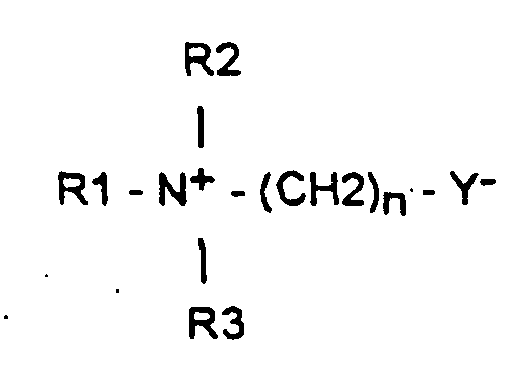
wherein R1 is an alkyl radical containing from 1 to 24 carbon atoms, preferably from 8 to 18, and more preferably from 12 to 14, wherein R2 and R3 contain from 1 to 3 carbon atoms, and preferably 1 carbon atom, wherein n is an integer from 1 to 10, preferably from 1 to 6 and more preferably is 1, Y is selected from the group consisting of carboxyl and sulfonyl radicals and wherein the sum of R1, R2 and R3 radicals is from 14 to 24 carbon atoms and/or an amine oxide or mixtures thereof according to the formula R1R2R3NO wherein each of R1, R2 and R3 is independently a saturated substituted or unsubstituted, linear or branched alkyl group of from 1 to 30 carbon atoms, preferably of from 6 to 30 carbon atoms, more preferably of from 10 to 20 carbon atoms, and most preferably of from 8 to 18 carbon atoms.
wherein R1 is an alkyl radical containing from 1 to 24 carbon atoms, preferably from 8 to 18, and more preferably from 12 to 14, wherein R2 and R3 contain from 1 to 3 carbon atoms, and preferably 1 carbon atom, wherein n is an integer from 1 to 10, preferably from 1 to 6 and more preferably is 1, Y is selected from the group consisting of carboxyl and sulfonyl radicals and wherein the sum of R1, R2 and R3 radicals is from 14 to 24 carbon atoms and/or an amine oxide or mixtures thereof according to the formula R1R2R3NO wherein each of R1, R2 and R3 is independently a saturated substituted or unsubstituted, linear or branched alkyl group of from 1 to 30 carbon atoms, preferably of from 6 to 30 carbon atoms, more preferably of from 10 to 20 carbon atoms, and most preferably of from 8 to 18 carbon atoms.
2. The use according to claim 1 wherein said chelating agent or mixtures thereof is present
in said composition at a level of from 0.001% to 5% by weight of the total composition,
preferably at a level of from 0.002% to 3% and more preferably from 0.002% to 1.5%.
3. The use according to any of the preceding claims wherein said surfactant or mixtures
thereof is present in said composition at a level of from 0.01% to 50% by weight of
the total composition, preferably at a level of from 0.01% to 30% and more preferably
from 0.1% to 10%.
4. The use according to any of the preceding claims wherein said antimicrobial essential
oil or an active thereof or mixtures thereof is present in said composition at a level
of at least 0.003% by weight of the total composition, preferably from 0.006% to 10%,
more preferably from 0.1% to 4% and most preferably from 0.03% to 2%.
5. The use according to any of the preceding claims wherein said composition further
comprises at least another antimicrobial ingredient selected from the group consisting
of peroxygen bleach, glutaraldehyde, ethyl paraben, propyl paraben, methyl paraben
and mixtures thereof.
1. Verwendung, in einer Zusammensetzung, einer Kombination aus einem Komplexbildner,
einem amphotären Tensid und einem antimikrobiellen etherischen Öl oder einem Wirkstoff
hiervon, um der Zusammensetzung desinfizierende Eigenschaften zu verleihen, wobei
das etherische Öl oder der Wirkstoff hiervon aus der Gruppe gewählt ist, bestehend
aus Thymianöl, Nelkenöl, Zimtöl, Geraniumöl, Eukalyptusöl, Pfefferminzöl, Minzöl oder
Mischungen hiervon, und Thymol, Eugenol, Menthol, Carvacrol, Verbenon, Eucalyptol,
Cedrol, Anethol, Pinocarvon, Geraniol, Hinokitiol, Berberin, Ferulasäure, Zimtsäure,
Methylsalicylsäure, Methylsalicylat, Terpineol und Mischungen hiervon, und vorzugsweise
Thymol, Eugenol, Verbenon, Eucalyptol, Terpineol, Zimtsäure, Methylsalicylsäure und/oder
Geraniol ist, wobei der Komplexbildner Etidronsäure, ein Alkalimetall-Ethan-1-hydroxydiphosphonat,
Nitrilotrimethylenphosphonat, Ethylendiamintetramethylenphosphonat, Diethylentriaminpentamethylenphosphonat,
Dihydroxydisulfobenzol, Ethylendiamin-N,N'-dibernsteinsäure, Diethylentriaminpentaacetat,
N-Hydroxyethylethylendiamintriacetat, Nitrilotriacetat, Ethylendiamintetrapropionat,
Triethylentetraaminhexaacetat, Ethanoldiglycin, Propylendiamintetraessigsäure, Methylglycindiessigsäure,
Malonsäure, Salicylsäure, Glycin, Asparaginsäure, Glutaminsäure, Dipicolinsäure oder
eine Mischung hiervon ist, und wobei das amphotäre Tensid oder Mischungen hiervon
ein Betain- oder Sulfobetain-Tensid oder Derivate hiervon oder Mischungen hiervon
gemäß der folgenden Formel ist:
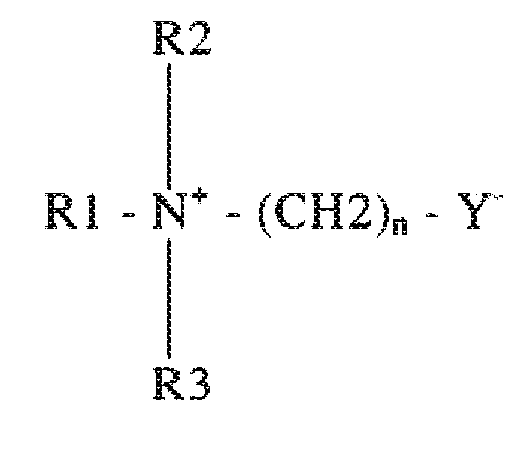
worin R1 ein Alkylrest mit 1 bis 24, vorzugsweise 8 bis 18, und weiter vorzugsweise 12 bis 14 Kohlenstoffatomen ist, worin R2 und R3 1 bis 3 Kohlenstoffatome enthalten und vorzugsweise 1 Kohlenstoffatom, wobei n eine ganze Zahl von 1 bis 10 ist, vorzugsweise 1 bis 6 und weiter vorzugsweise 1, Y aus der Gruppe gewählt ist, bestehend aus Carboxyl- und Sulfonylresten, und wobei die Summe aus R1-, R2- und R3-Resten 14 bis 24 Kohlenstoffatome enthält und/oder ein Aminoxid oder Mischungen hiervon gemäß der Formel R1R2R3NO, worin jedes von R1, R2 und R3 unabhängig eine gesättigte substituierte oder unsubstituierte, lineare oder verzweigte Alkylgruppe mit 1 bis 30 Kohlenstoffatomen, vorzugsweise 6 bis 30 Kohlenstoffatomen, weiter vorzugsweise 10 bis 20 Kohlenstoffatomen, und am meisten bevorzugt 8 bis 18 Kohlenstoffatomen, ist.
worin R1 ein Alkylrest mit 1 bis 24, vorzugsweise 8 bis 18, und weiter vorzugsweise 12 bis 14 Kohlenstoffatomen ist, worin R2 und R3 1 bis 3 Kohlenstoffatome enthalten und vorzugsweise 1 Kohlenstoffatom, wobei n eine ganze Zahl von 1 bis 10 ist, vorzugsweise 1 bis 6 und weiter vorzugsweise 1, Y aus der Gruppe gewählt ist, bestehend aus Carboxyl- und Sulfonylresten, und wobei die Summe aus R1-, R2- und R3-Resten 14 bis 24 Kohlenstoffatome enthält und/oder ein Aminoxid oder Mischungen hiervon gemäß der Formel R1R2R3NO, worin jedes von R1, R2 und R3 unabhängig eine gesättigte substituierte oder unsubstituierte, lineare oder verzweigte Alkylgruppe mit 1 bis 30 Kohlenstoffatomen, vorzugsweise 6 bis 30 Kohlenstoffatomen, weiter vorzugsweise 10 bis 20 Kohlenstoffatomen, und am meisten bevorzugt 8 bis 18 Kohlenstoffatomen, ist.
2. Verwendung nach Anspruch 1, wobei der Komplexbildner oder Mischungen hiervon in der
Zusammensetzung in einem Anteil von 0,001 bis 5 Gew.-% der Gesamtzusammensetzung vorliegt,
vorzugsweise in einem Anteil von 0,002% bis 3%, und weiter vorzugsweise von 0.002%
bis 1,5%.
3. Verwendung nach mindestens einem der vorangehenden Ansprüche, wobei das Tensid oder
Mischungen hiervon in der Zusammensetzung in einem Anteil von 0,01 bis 50 Gew.-% der
Gesamtzusammensetzung vorliegt, vorzugsweise in einem Anteil von 0,01% bis 30%, und
weiter vorzugsweise von 0,1% bis 10%.
4. Verwendung nach mindestens einem der vorangehenden Ansprüche, wobei das antimikrobielle
etherische Öl oder ein Wirkstoff hiervon oder Mischungen hiervon in der Zusammensetzung
in einem Anteil von mindestens 0,003 Gew.-% der Gesamtzusammensetzung vorliegt, vorzugsweise
0,006% bis 10%, weiter vorzugsweise 0,1% bis 4%, am meisten bevorzugt 0,03% bis 2%.
5. Verwendung nach mindestens einem der vorangehenden Ansprüche, wobei die Zusammensetzung
weiterhin mindestens einen anderen antimikrobiellen Bestandteil umfaßt, gewählt aus
der Gruppe, bestehend aus Persauerstoff-Bleichmittel, Glutaraldehyd, Ethylparaben,
Propylparaben, Methylparaben und Mischungen hiervon.
1. Utilisation, dans une composition, d'une combinaison d'un agent chélatant, d'un agent
tensioactif amphotère et d'une huile essentielle antimicrobienne ou d'un ingrédient
actif de celle-ci, pour conférer des propriétés désinfectantes à ladite composition,
dans laquelle l'huile essentielle ou l'ingrédient actif de celle-ci est choisi(e)
dans le groupe constitué par l'essence de thym, l'essence de clou de girofle, l'essence
de cannelle, l'essence de géranium, l'essence d'eucalyptus, l'essence de menthe poivrée,
l'essence de menthe, ou leurs mélanges, et le thymol, l'eugénol, le menthol, le carvacrol,
la verbénone, l'eucalyptol, le cédrol, l'anéthol, la pinocarvone, le géraniol, l'hinokitiol,
la berbérine, l'acide férulique, l'acide cinnamique, l'acide méthylsalicylique, le
salicylate de méthyle, le terpinéol, et leurs mélanges, et de préférence le thymol,
l'eugénol, la verbénone, l'eucalyptol, le terpinéol, l'acide cinnamique, l'acide méthylsalicylique
et/ou le géraniol, dans laquelle ledit agent chélatant est l'acide étidronique, un
éthane-1-hydroxy-diphosphonate de métal alcalin, le nitrilotriméthylènephosphonate,
l'éthylènediaminetétraméthylènephosphonate, le diéthylènetriaminepentaméthylènephosphonate,
le dihydroxydisulfobenzène, l'acide éthylènediamine-N,N'-disuccinique, le diéthylènetriaminepentaacétate,
le N-hydroxyéthyléthylène-diaminetriacétate, le nitrilotriacétate, l'éthylènediaminetétrapropionate,
le triéthylènetétraminehexa-acétate, l'éthanoldiglycine, l'acide propylènediaminetétraacétique,
l'acide méthylglycinediacétique, l'acide malonique, l'acide salicylique, la glycine,
l'acide aspartique, l'acide glutamique, l'acide dipicolinique, ou leurs mélanges,
et dans laquelle ledit agent tensioactif amphotère ou ses mélanges est ou sont un
agent tensioactif bétaïne ou sulfobétaïne, ou leurs dérivés, ou leurs mélanges répondant
à la formule suivante :
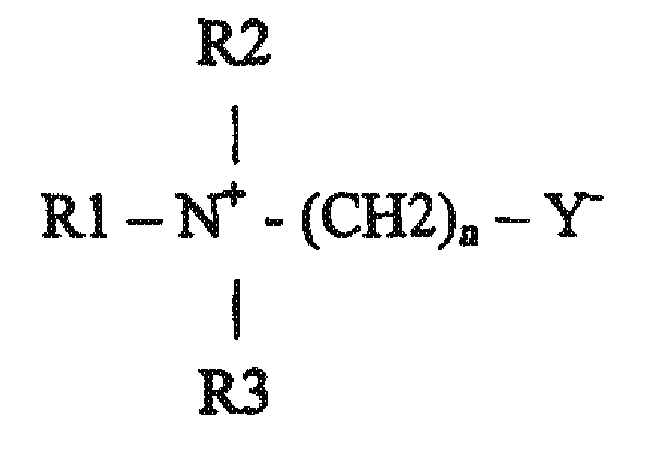
dans laquelle R1 est un radical alkyle contenant 1 à 24 atomes de carbone, de préférence 8 à 18, et plus préférablement 12 à 14, dans laquelle R2 et R3 contiennent 1 à 3 atomes de carbone, et de préférence 1 atome de carbone, dans laquelle n est un nombre entier de 1 à 10, de préférence de 1 à 6, et plus préférablement n vaut 1, Y est choisi dans le groupe constitué par des radicaux carboxyle et sulfonyle, et dans laquelle la somme des radicaux R1, R2 et R3 est de 14 à 24 atomes de carbone, et/ou un oxyde d'amine, ou leurs mélanges, conformément à la formule R1R2R3NO, dans laquelle chacun des radicaux R1, R2 et R3 représente indépendamment un groupe alkyle saturé, substitué ou non substitué, linéaire ou ramifié ayant 1 à 30 atomes de carbone, de préférence 6 à 30 atomes de carbone, plus préférablement 10 à 20 atomes de carbone, et plus préférablement encore 8 à 18 atomes de carbone.
dans laquelle R1 est un radical alkyle contenant 1 à 24 atomes de carbone, de préférence 8 à 18, et plus préférablement 12 à 14, dans laquelle R2 et R3 contiennent 1 à 3 atomes de carbone, et de préférence 1 atome de carbone, dans laquelle n est un nombre entier de 1 à 10, de préférence de 1 à 6, et plus préférablement n vaut 1, Y est choisi dans le groupe constitué par des radicaux carboxyle et sulfonyle, et dans laquelle la somme des radicaux R1, R2 et R3 est de 14 à 24 atomes de carbone, et/ou un oxyde d'amine, ou leurs mélanges, conformément à la formule R1R2R3NO, dans laquelle chacun des radicaux R1, R2 et R3 représente indépendamment un groupe alkyle saturé, substitué ou non substitué, linéaire ou ramifié ayant 1 à 30 atomes de carbone, de préférence 6 à 30 atomes de carbone, plus préférablement 10 à 20 atomes de carbone, et plus préférablement encore 8 à 18 atomes de carbone.
2. Utilisation selon la revendication 1, dans laquelle ledit agent chélatant ou ses mélanges
est ou sont présent(s) dans ladite composition à raison de 0,001 % à 5 % en poids
de la composition totale, de préférence à raison de 0,002 % à 3 %, et plus préférablement
de 0,002 % à 1,5%.
3. Utilisation selon l'une quelconque des revendications précédentes, dans laquelle ledit
agent tensioactif ou ses mélanges est ou sont présent(s) dans ladite composition à
raison de 0,01 % à 50 % en poids de la composition totale, de préférence à raison
de 0,01 % à 30 %, et plus préférablement de 0,1 % à 10 %.
4. Utilisation selon l'une quelconque des revendications précédentes, dans laquelle ladite
huile essentielle antimicrobienne ou ledit ingrédient actif de celle-ci est présent(e)
dans ladite composition à raison d'au moins 0,003 % en poids de la composition totale,
de préférence à raison de 0,006 % à 10 %, plus préférablement de 0,1 % à 4 %, et plus
préférablement encore de 0,03 % à 2 %.
5. Utilisation selon l'une quelconque des revendications précédentes, dans laquelle ladite
composition comprend en outre au moins un autre ingrédient antimicrobien choisi dans
le groupe constitué par un agent de blanchiment peroxygéné, le glutaraldéhyde, l'éthylparabène,
le propylparabène, le méthylparabène et leurs mélanges.
REFERENCES CITED IN THE DESCRIPTION
This list of references cited by the applicant is for the reader's convenience only. It does not form part of the European patent document. Even though great care has been taken in compiling the references, errors or omissions cannot be excluded and the EPO disclaims all liability in this regard.
Patent documents cited in the description
- EP288689B [0009]
- EP467618A [0009]
- US5403587A [0010] [0010]
- EP252278A [0011]
- EP96870017A [0012]
- US3812044A [0017]
- US4704233A [0018]
- US4701311A [0047]
- US4646973A [0047]
- US4538745A [0047]