|
(11) | EP 0 915 148 B1 |

| (12) | EUROPEAN PATENT SPECIFICATION |
|
|
| (54) |
Alkylated anisole lubricant and method for his preparation Alkyliertes Anisolschmiermittel und Verfahren zur Herstellung davon Lubrifiant à base d'anisole alkylée et sa méthode de préparation |
|
|
||||||||||||||||||||||||||||
| Note: Within nine months from the publication of the mention of the grant of the European patent, any person may give notice to the European Patent Office of opposition to the European patent granted. Notice of opposition shall be filed in a written reasoned statement. It shall not be deemed to have been filed until the opposition fee has been paid. (Art. 99(1) European Patent Convention). |
[0001] This invention relates to alkylated anisole compositions useful as lubricant basestock and to their means of preparation. More particularly, the invention relates to alkylated anisole lubricant compositions that are hydrolytically stable and exhibit superior wear resistant properties, thermal stability and oxidative stability.
[0002] Efforts to improve upon the performance of natural mineral oil based lubricants by the synthesis of oligomeric hydrocarbon fluids have been the subject of important research and development in the petroleum industry for at least fifty years and have led to the relatively recent market introduction of a number of superior polyalphaolefin (PAO) synthetic lubricants, primarily based on the oligomerization of alpha-olefins or 1-alkenes. In terms of lubricant property improvement, the thrust of the industrial research effort on synthetic lubricants has been toward fluids exhibiting useful viscosities over a wide range of temperature, i.e., improved viscosity index, while also showing lubricity, thermal and oxidative stability and pour point equal to or better than mineral oil. These new synthetic lubricants lower friction and hence increase mechanical efficiency across the full spectrum of mechanical loads from worm gears to traction drives and do so over a wider range of operating conditions than mineral oil lubricants.
[0003] Notwithstanding their generally superior properties, PAO lubricants are often formulated with additives to enhance those properties for specific applications. The more commonly used additives include oxidation inhibitors, rust inhibitors, metal passivators, antiwear agents, extreme pressure additives, pour point depressants, detergent-dispersants, viscosity index (VI) improvers, foam inhibitors and the like. This aspect of the lubricant arts is specifically described in Kirk-Othmer "Encyclopedia of Chemical Technology", 3rd edition, Vol. 14, pp477-526. Esters such as adipic acid esters and pentaerythritol esters are commonly used additives but such esters are generally hydrolytically unstable.
[0004] Improvements in lubricant technology flow from both new additive development addressed to deficiencies in lubricant basestocks and new basestock development for inherently better properties. Alkylated aromatics, particularly alkylated naphthalene, are known in the prior art as lubricant additives for their antiwear properties, thermal and oxidative stability as disclosed in U.S. Patents 4,211,665, 4,238,343, 4,604,491 and 4,714,7944.
[0005] Esters form another important class of basestocks used in lubricants, for example, esters prepared from pentaerythritol. These esters enhance the solvency, seal swell and homogeneity of the final lube product, among other utilities. Although they supplement and reinforce lubricant properties esters are vulnerable to hydrolytic instability - a problem which compromises their usefulness as additives. Indeed, the search for hydrolytically stable additives or basestock that can improve upon wear properties, thermal and oxidative stability, dispersancy, lubricity and other critical lubricants functions continues.
[0006] Certain compositions of alkylated anisoles in olefin mixture and the hydrogenated product are known in the art as useful lube basestock. US patent 5,202,040 discloses anisole alkylation with olefin oligomers for the purpose of increasing viscosity of PAO type synthetic lubricant base stocks. The disclosure is directed toward compositions produced by alkylation of anisole with linear olefins concomitant with the oligomerization of the linear olefins to produce a mixture of olefin oligomers and alkylanisole. Alkylated anisole is the minor component of the mixture. The product mixture is useful as lubricant after hydrotreating to saturate olefin oligomers. However, the hydrotreating step also saturates the anisole ring which a positive effect on oxidative and on thermal stability.
[0007] US patent 5,171,915 teaches a process of alkylating anisole with mixtures of olefin dimers. The olefin dimers employed as alkylating agent are a unique class of branched internal monoolefin dimers and vinylidenyl olefin prepared by dimerization of C10+ alpha olefins in contact with reduced chromium oxide catalyst. The product of this process is a complicated mixture and no specific structure of alkylanisole is identified.
[0008] US patent 4,463,207 provides an example of anisole alkylation with 1-dodecene under a supported tantalum chloride/oxide catalyst. The product contains 98% of the monoalkylate and is not useful as a lubricant base stock.
[0009] A. A. Durrani and co-workers [J.C.S., Perkin I, 1979, 2079] describes the synthesis of 3- and 4-n-alkylanisoles where the alkyl groups are primary. These compounds were synthesized by reacting 1-alkyllithium with fluoroanisole. They are not useful as lubricants because of their high volatility.
[0010] The objective of the present invention is to provide a unique lubricant basestock that is hydrolytically stable while exhibiting superior thermal and oxidative stability and antiwear properties. Another objective of the invention is to provide a process to produce the foregoing unique lubricant basestock by aromatics alkylation with olefins without producing a significant amount of olefin oligomers.
Summary of the Invention
[0011] The present invention relates to lubricant bases produced by the alkylation of anisole (methoxybenzene) with long chain alpha olefins or internal olefins to form mixtures of alkylanisoles. The alkylation, which may be carried out with conventional Lewis acid alkylation catalysts, with solid catalysts such as super acid metal oxides, acid clays, zeolites or ion-exchange resin catalyst, produces the alkylated anisole while minimizing the formation of olefin oligomers. The alkyl anisole products exhibit superior antiwear properties as well as improved thermal and oxidative stability over polyalphaolefin (PAO) type lubricants. The products also provide additive solvency and dispersancy functions to lubricant formulations. When compared to ester basestock, the hydrolytic stability of the alkylated anisoles is markedly superior.
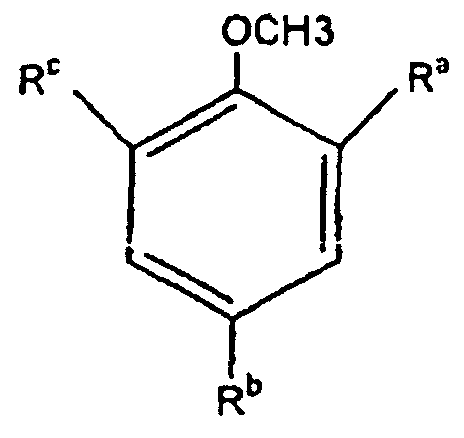
[0012] A new lubricant according to the invention consisting of a base oil made up exclusively (apart from incidental impurities) of a mixture of mono, di and trialkylated anisole having the following structure:
where Ra, Rb and Rc are hydrogen with at least one of Ra, Rb and Rc comprising a secondary alkyl radical containing 8 to 24 carbon atoms which is essentially free of olefin monomers and has a pour point below -20°C, the lubricant optionally further comprising lubricant additives selected from dispersants, detergents, viscosity index improvers, extreme pressure/antiwear additives, antioxidants, pour depressants, emulsifiers, demulsifiers, corrosion inhibitors, antirust inhibitors, antistaining additives and friction modifiers.
[0013] Preferably, Ra, Rb and Rc, alike or different, are CHR1R2 where R1 is methyl and R2 is alkyl containing 6 to 22 carbon atoms. Also, when Ra, Rb and Rc, alike or different, are CHR1R2, R1 can be alkyl containing 2 to 21 carbon atoms and R2 can be alkyl containing up to 21 carbon atoms where the combination of R1 and R2 contains 7 to 23 carbon atoms. The mixture is essentially free of olefin oligomers in the freshly synthesized condition and, as a result, has a usefully low bromine number, indicating a low degree of unsaturation, so that no hydrogenation may be necessary prior to blending.
[0014] The lubricant base oil may further contain lubricant additives such as dispersants, detergents, viscosity index improvers, extreme pressure/antiwear additives, antioxidants, pour point depressants, emulsifiers, demulsifiers, corrosion inhibitors, antirust inhibitors, antistaining additives and friction modifiers.
[0015] The alkylated anisole product is produced by contacting anisole and an olefinic alkylating agent feedstream comprising C8-C24 monoolefins in an alkylation zone with an acidic alkylation catalyst under alkylation conditions so that the desired alkylated anisole (mixture of mono, di and trialkylated anisole having the structure above) is produced without any significant production of olefin oligomers which are the components leading to the presence of unsaturation in the product. This is achieved by minimizing the proportion of olefin which is present relative to the anisole during the alkylation step. Desirably, the olefin is added progressively to a larger amount of the anisole if batch processing is being used. If the process is operated continuously, incremental feed of the olefin can be used to minimize excess olefin present at any stage of the reaction to minimize olefin oligomerization.
Detailed Description
[0016] Anisole (methoxybenzene) can be alkylated with long chain alpha or internal olefins to form the mixtures of alkylanisole useful as lubricant basestock. The process provides a product that has better thermal and oxidative stability than PAO type lubricants. In comparison with ester base oils, alkylated anisole provides additive solvency and dispersancy functions required in modern lubricant formulations. However, the product is superior to esters, especially since it is hydrolytically stable.
[0017] Olefins useful as alkylating agents for the anisole include C8-C24 alpha olefins or internal olefins although the alpha olefins are preferred since the products are then more linear in the substituent alkyl groups. The preferred olefins include 1-octene, 1-decene, 1-dodecene and 1-tetradecene. Individual olefins may be used as alkylating agent or the alkylating agent may comprise a mixture of C8-C24 alpha olefins or internal olefins. The viscometric properties, especially viscosity and VI, of the alkylated anisole depend on the length of olefin used and the extent of multiple alkylation. The viscosity of the product can be readily varied from ((3-6)x10-6m2s-1) (3 cS to 6cS), or extended to (10-5m2s-1) (10 cS) (KV at 100°C) or even higher values to produce products which may be used as additives e.g. VI improvers for other fluids. The viscosity at 40°C may be greater than (3x10⁻⁵m2s-1) (30cS).
[0018] The alkylation reaction can be carried out with solid catalysts such as WOx/ZrO2, acid clay, zeolites and ion-exchange resin catalysts. The olefin feed is slowly added to a mixture of anisole and catalyst in a batch type operation to minimize the formation of olefin oligomers.
[0019] The alkylated anisole product consists of mono-, di- and tri secondary alkylanisoles. The exact ratio of monoalkylation to dialkylation and trialkylation depends on the olefin to anisole mole ratio used in the alkylation reaction. For the monoalkylanisole fraction produced by the process of the invention, detailed analysis with GC-MASS revealed many side chain isomers such as 2-arylalkane and 3-arylalkene. The positions of alkylation on the anisole ring are at the ortho- and para positions. Higher viscosity products may be produced by using longer chain alkylating groups or by introducing more alkyl groups into the molecule, for example, by going to dialkylated and trialkylated products. For additive applications, products containing at least 50 weight percent dialkylated or trialkylated materials are preferred.
[0020] The alkylation process of the invention employs alkylation catalyst which may be a Lewis acid such as HF, H2SO4, AlCl3, BF3, FeCl3, TiCl4, ZnCl2 and P2O5. Also effective are acidic clays, acidic natural or synthetic zeolites and mixed metal oxide super acids. Mixed metal oxide super acids are described in M. Hino and K. Arata, J. Chem. Soc. Chem. Commun., 1987, 1259; and K. Arata and M. Hino, Proc. 9th Int. Cong. on Catal., 1988, 4, 1727 and U. S. patent 5,453,556. Mixed metal oxide super acids, especially WOx/ZO2, are the preferred catalysts.
[0021] The mixed metal oxide superacids comprise an oxide of a Group IVB metal, preferably zirconia or titania, modified with an oxyanion of a Group VIB metal, such as an oxyanion of tungsten, such as tungstate. The modification of the Group IVB metal oxide with the oxyanion of the Group VIB metal imparts acid functionality to the material. The combination of Group IVB metal oxide with an oxyanion of a Group VIB metal is believed to enter into an actual chemical interaction which, in any event, provides a composition with more acidity than a simple mixture of separately formed Group IVB metal oxide mixed with a separately formed Group VIB metal oxide or oxyanion.
[0022] Zeolites, especially the large pore size zeolites such as zeolite Y and USY, are also effective alkylation catalysts for the process of the invention. Zeolite catalysts include ZSM-5, ZSM-11, ZSM-12, ZSM-48, ZSM-50, Zeolite Beta, MCM-56, MCM-22, MCM-36, MCM-49, ultrastable zeolite Y (USY), zeolite X, TMA Offretite, TEA Mordenite, Mordenite, rare earth-exchanged zeolite Y (REY), and Dealuminized Y. Other catalysts which may be used include acidified clays and amorphous silica-alumina although these provide less selectivity to the desired products than other catalysts.
[0023] MCM-56 is also a useful zeolite type catalyst for the alkylation process of the present invention. MCM-56 is a member of the MCM-22 group useful in the invention which includes MCM-22, MCM-36, MCM-49 and MCM-56. MCM-22 is described in U. S. patent 4,954,325. MCM-36 is described in U. S. patent 5,250,277 and MCM-36 (bound) is described in U. S. patent 5,292,698. MCM-49 is described in U. S. patent 5,236,575 and MCM-56 is described in U. S. patent 5,362,697.
[0024] The alkylation of anisole with olefins can suitably be carried out at a temperature between 10 and 260°C, and a pressure between atmospheric and 7,000 kPa. Preferably, the alkylation reaction is carried out by slowly adding olefin to a mixture of anisole and alkylation catalyst at at or near atmospheric pressure. For WOx/ZrO2, a temperature of 10 to 150°C is preferred. For conventional Friedel Crafts catalyst, zeolites or acid clay type catalysts a temperature between 10 and 345°C can be employed. Under these conditions a preponderance of the alkylation product comprises dialkylated anisole where the alkyl substituents groups are secondary alkyl groups.
[0025] The alkylated anisole products are notable for having a low degree of unsaturation resulting from the essential absence of olefin oligomers. Bromine numbers below 10, especially below 5 or even 3, e.g. 1 or 2, can be attained, so that there is no need to carry out a hydrogenation treatment to remove residual unsaturation before the product is ready for use. In addition, the products are marked by excellent low pour points (ASTM D 97), below -20°C and in favorable cases, below -40°C. VI values in excess of 100 e.g. 100 or 120 or higher are attainable.
Example 1
[0027] This example illustrates the use of WOx/ZrO2 catalyst for anisole alkylation. To a 2000-ml flask charged with anisole (216 g, 2.00 mole) and WOx/ZrO2 catalyst (32 g, 3.2%) at 40C was added 1-dodecene (758 g, 4.50 mole) over a 2 hour period. The reaction temperature quickly rose to 95C and was maintained between 95-100C by heating or cooling as needed. Heating was continued for 2 more hours after the addition was finished. After removal of spent catalyst the crude product was distilled to remove any unconverted olefins to give a 94% yield of colorless oil. The conditions used and the results of the product evaluation are shown in Table 2 below.
[0028] GC chromatographic analysis of the alkylated anisole product was carried out. The detailed GC analysis on the mono-alkylated anisole products as shown in Table 1 below. Higher boiling di- and tri-alkylated anisoles have too complicated isomer distribution and are not easy to resolve in GC. Their structure is based on comparative analysis from the mono-alkylated anisole and NMR spectra of the whole mixture. An infra-red (IR) spectra of the alkylated anisole mixture was also prepared. The absence of any OH absorption in IR spectra indicates that there is no phenol derivative formed during the alkylation reaction.
Examples 2-6
[0029] Examples 2-6 were carried out similarly to that of Example 1 except that different catalysts or different temperatures were used. The conditions and results are shown in Table 2.
Examples 7-8
[0030] Example 7-8 were run with all starting materials charged into the reactor at the beginning. After certain periods at the specified reaction temperature the catalyst was removed by filtration and the unconverted olefin was removed by distillation. The results are also included in Table 2 below.
Table 1
| Isomer distribution of mono-AA fraction of Ex.1 | |||||
| Isomer | p-2 | p-3 | p-5 | p-4 | p-6 |
| R1 | CH3 | C2H5 | C3H7 | C4H9 | C5H11 |
| R2 | C10H21 | C9H19 | C8H17 | C7H15 | C6H13 |
| % | 35.3 | 16.9 | 6.9 | 4.7 | 3.6 |
| Isomer | o-2 | o-3 | o-5 | o-4 | o-6 |
| R1 | CH3 | C2H5 | C3H7 | C4H9 | C5H11 |
| R2 | C10H21 | C9H19 | C8H17 | C7H15 | C6H13 |
| % | 11.3 | 12.2 | 3.9 | 3.3 | 2.1 |
Product Evaluation
[0031] The viscometric properties and composition of the product of Examples 1-8 are shown in Table 2.
Example 9
[0032] Example 9 presents the results of tests carried out to determine the thermal and oxidative stability of alkylated anisole versus polyalphaolefin (PAO) and adipic ester lubricant base stocks. The results are presented in Tables 3 (Thermal Stability) and Table 4 (Oxidative Stability) below.
[0033] The thermal stability test was carried out under nitrogen for specified time and temperature. The test sample (10 g in glass flasks) was degassed before testing. Data in the 2nd and 3rd columns of Table 3 clearly shows that alkylated anisole has higher thermal stability than adipic ester and pentaerithritol esters or polyol esters.
[0034] The B-10 test for oxidative stability is an test method for evaluating oxidative stability of lubricants (mineral oil or synthetic) either with or without additives. The evaluation is based on the resistance of the lubricant to oxidation by air under specified conditions as measured by the formation of sludge, the corrosion of a lead specimen, and changes in neutralization number and viscosity. In this method, the sample is placed in a glass oxidation cell together with iron, copper and aluminum catalysts and a weighed lead corrosion specimen. The cell and its contents are placed in a bath maintained at a specified temperature and a measured volume of dried air is bubbled through the sample for the duration of the test. The cell is removed from the bath and the catalyst assembly is removed from the cell. The oil is examined for the presence of sludge and the Neutralization Number (ASTM D664) and Kinematic Viscosity at 100° C. (ASTM D445) are determined. The lead specimen is cleaned and weighed to determine the loss in weight.
[0035] The RBOT is an ASTM standard method (D2272). The oxidatiove stability data in Table 4 demonstrate that alkylated anisole has better oxidative stability than PAO and is comparable to that of esters.
Table 3
| Thermal Stability of Alkylated Anisole (AA),Esters and PAO | |||
| 274°C 72hr | 302°C 72hr | 310°C 72hr | |
| AA | |||
| Δwt: | - | - | -5% |
| ΔKv/100 C | - | - | -11% |
| ΔKv/40 C | - | - | -17% |
| AA/C12= | |||
| Δwt: | - | -4.9% | -6.2% |
| ΔKV/100 C | - | -0.6% | -7.5% |
| ΔKv/40 C | - | 1.5% | -12% |
| AA/C12= | |||
| Δwt: | - | -2.3% | -6.6% |
| ΔKv/100C | - | -2.3% | 2.8% |
| ΔKv/40C | - | -9.7% | -6.5% |
| Adipic Ester, | |||
| Δwt: | -11.2% | - | - |
| ΔKv/40C | -27% | - | - |
| TMP ester | |||
| Δwt: | - | -2.7% | - |
| ΔKv/40 C | - | -12% | - |
| 5 10-6m2s-1 (cS) PAO | |||
| Δwt: | - | -1.8% | - |
| ΔKv/40 C | - | -19% | - |
Table 4
| Oxidative stability of Alkylated Anisole (AA), Esters, PAO | ||||
| B-10 | B-10 | B-10 | ROBT min | |
| Temp, °C | 127 | 157 | 190 | |
| Duration, hr. | 40 | 40 | 24 | |
| AA | 65 | |||
| ΔKV/100 C | - | - | 287% | |
| AA/C12= | 55 | |||
| ΔKv/100 C | 35% | 172% | - | 55 |
| Adipic Ester | 75 | |||
| PE Ester | - | 139% | - | 482 |
| 5 cS PAO | ||||
| Δwt: | 82.4% | - | - | 25 |
| ΔKv/40C, % | -19% | - | - | |
Example 10
[0036] This example demonstrates that a homogeneous catalyst such as BF3 can be used to catalyze alkyl anisole synthesis. In this example, 200 grams of anisole (2 moles) was charged into a three liter reaction flask. 1-Decene, 518 grams (4 moles) containing 7.2 grams of propanol was charged into a feed flask. BF3 gas was bubbled through the reaction flask and the feed flask. The 1-decene solution was pumped into the reaction flask in 4 hours. When an exotherm occurred the reaction flask was cooled with brine water to room temperature. After six hours of reaction time the reaction was discontinued by purging with N2 followed by quenching with NaOH. The organic layer was separated and distilled to remove any unreacted starting material. The residual oil has the following properties: KV @ 100 C = 5.05 5.05x10⁻⁶m2s-1 (cS). KV @ 40 C = 30.9 3.09x10⁻⁵m2s-1 (cS), viscosity index (VI) = 84. The oil had excellent thermal and oxidative stability.
Example 11
[0037] This example was carried out similarly to that of Example 10 except that 108 grams of anisole, 224 grams of 1-hexadecene and 5 grams of propanol were used at the start of the reaction. The product had the following properties: KV @ 100 C = 5.78 (5.78x10⁻⁶m2s-1) (cS), KV @ 40 C = 33.4 (33.4x10⁻⁵m2s-1) (cS), VI = 115. The oil had excellent thermal and oxidative stability.
Example 12
[0038] This example was carried out similarly to that of Example 11. The olefin use was a mixture of 1-hexadecene and 1-octadecene. The product had the following properties: KV @ 100 C = 9.20 (9.20x10⁻⁶m2s-1 (cS), KV @ 40 C = 62.5 (6.25x10⁻⁵m2s-1) (cS), VI = 125. The oil had excellent thermal and oxidative stability.
[0039] The alkylated anisole lubricant base stock can be easily synthesized with a variety of catalysts and demonstrates better thermal and oxidative stability than PAO and adipic ester. Because alkylated anisole is hydrolytically stable, representing a significant improvement over ester base stock.
1. A lubricant consisting of a base oil made up exclusively of a mixture of mono, di
and tri alkylated anisoles each having the following structure:
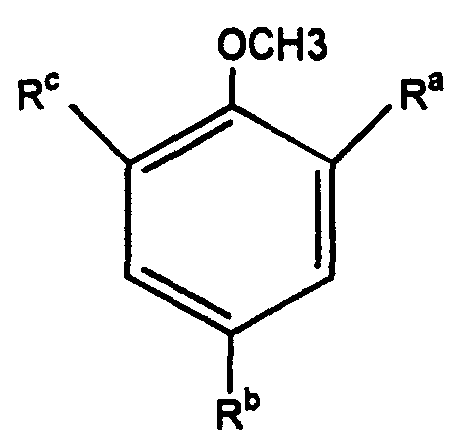
where Ra, Rb and Rc are hydrogen with at least one of said Ra, Rb and Rc of at least one of said anisoles comprising a secondary alkyl radical containing 8 to 24 carbon atoms, which is essentially free of olefin oligomers, and has a pour point less than -20°C, the lubricant optionally further comprising lubricant additives selected from dispersants, detergents, viscosity index improvers, extreme pressure/antiwear additives, antioxidants, pour depressants, emulsifiers, demulsifiers, corrosion inhibitors, antirust inhibitors, antistaining additives and friction modifiers.
where Ra, Rb and Rc are hydrogen with at least one of said Ra, Rb and Rc of at least one of said anisoles comprising a secondary alkyl radical containing 8 to 24 carbon atoms, which is essentially free of olefin oligomers, and has a pour point less than -20°C, the lubricant optionally further comprising lubricant additives selected from dispersants, detergents, viscosity index improvers, extreme pressure/antiwear additives, antioxidants, pour depressants, emulsifiers, demulsifiers, corrosion inhibitors, antirust inhibitors, antistaining additives and friction modifiers.
2. The lubricant of claim 1 where Ra, Rb and Rc, alike or different, include groups CHR1R2 where R1 is methyl and R2 is alkyl containing 6 to 22 carbon atoms.
3. The lubricant of claim 1 or claim 2 wherein Ra, Rb and Rc, alike or different, include groups CHR1R2 where R1 is alkyl containing 2 to 21 carbon atoms and R2 is alkyl containing up to 21 carbon atoms wherein the combination of R1 and R2 contains 7 to 23 carbon atoms.
4. The lubricant of any preceding claim in which the mixture has a Bromine number less
than 10, preferably less than 5.
5. The lubricant of any preceding claim in which said mixture comprises at least 50 weight
percent anisole having two secondary alkyl substituents.
6. A lubricant according to any preceding claim having a viscosity at 40°C greater than
(3x10⁻⁵m2s-1) (30 cS).
7. The lubricant of claim 1 in which said mixture has viscosity index above 100 and pour
point below below -40°C.
8. A method of producing a mixture consisting exclusively of mono, di and tri alkylated
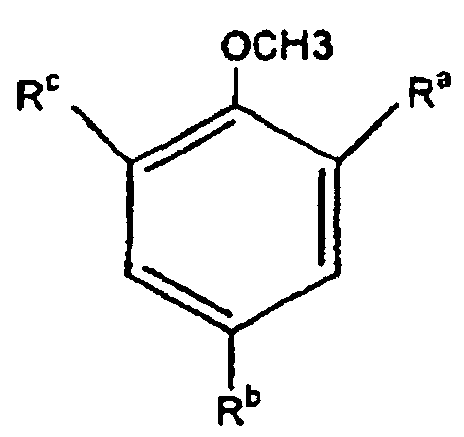
anisoles each having the following structure:
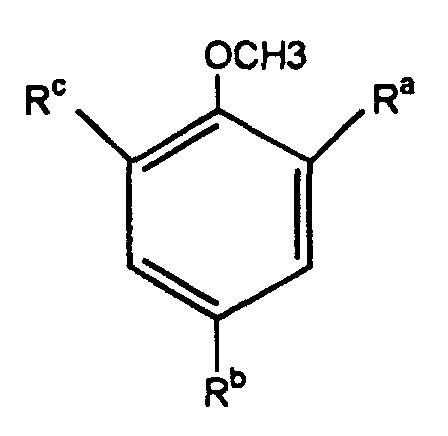
where Ra, Rb and Rc are hydrogen with at least one of said Ra, Rb and Rc of at least one of said anisoles comprising a secondary alkyl radical containing 8 to 24 carbon atoms by contacting anisole in the presence of an acidic alkylation catalyst with C8-24-monoolefin, wherein the proportion of olefin relative to anisole during the alkylation is minimised and the product is essentially free of olefin oligomers.
where Ra, Rb and Rc are hydrogen with at least one of said Ra, Rb and Rc of at least one of said anisoles comprising a secondary alkyl radical containing 8 to 24 carbon atoms by contacting anisole in the presence of an acidic alkylation catalyst with C8-24-monoolefin, wherein the proportion of olefin relative to anisole during the alkylation is minimised and the product is essentially free of olefin oligomers.
9. A method according to claim 8 in which the monoolefin includes a C8-24-alphaolefin, optionally including a C8-24internal olefin.
10. A method according to claim 8 or claim 9 in which the catalyst is a mixed metal oxide
super acid, preferably WOx/ZO where Z is zirconium or titanium, or is a Zeolite, preferably USY or MCM-22, MCM-36,
MCM-49 or MCM-56.
11. A method according to any of claims 8 to 10 in which the product of the alkylation
comprising at least 50% by weight dialkylated anisole.
12. A method according to any of claims 8 to 11 in which the product mixture of the alkylation
reaction has a Bromine number less than 10 more preferably less than 5.
1. Schmiermittel, das aus einem Grundöl besteht, das ausschließlich aus einem Gemisch
von mono-, di- und trialkylierten Anisolen hergestellt ist, die jeweils folgende Struktur
haben:
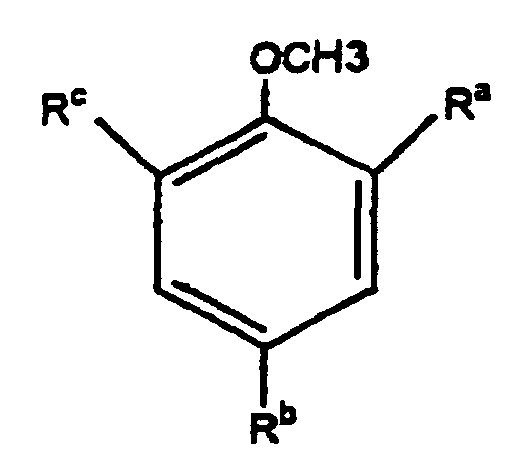
worin Ra, Rb und Rc Wasserstoff sind, wobei mindestens einer der Reste Ra, Rb und Rc von mindestens einem der Anisole einen sekundären Alkylrest von 8 bis 24 Kohlenstoffatomen umfaßt, das im wesentlichen frei von Olefin-Oligomeren ist und einen Fließpunkt von weniger als -20°C aufweist, wobei das Schmiermittel ferner gegebenenfalls Schmiermittel-Additive umfaßt, die aus Dispersionsmitteln, Detergenzien, Viskositätsverbesserern, EP/Verschleißschutz-Additiven, Antioxidantien, Fließpunkt-Erniedrigern, Emulgatoren, Demulgatoren, Korrosionsinhibitoren, Rostinhibitoren, Verfärbungsschutz-Additiven und Reibwertverbesserern ausgewählt sind.
worin Ra, Rb und Rc Wasserstoff sind, wobei mindestens einer der Reste Ra, Rb und Rc von mindestens einem der Anisole einen sekundären Alkylrest von 8 bis 24 Kohlenstoffatomen umfaßt, das im wesentlichen frei von Olefin-Oligomeren ist und einen Fließpunkt von weniger als -20°C aufweist, wobei das Schmiermittel ferner gegebenenfalls Schmiermittel-Additive umfaßt, die aus Dispersionsmitteln, Detergenzien, Viskositätsverbesserern, EP/Verschleißschutz-Additiven, Antioxidantien, Fließpunkt-Erniedrigern, Emulgatoren, Demulgatoren, Korrosionsinhibitoren, Rostinhibitoren, Verfärbungsschutz-Additiven und Reibwertverbesserern ausgewählt sind.
2. Schmiermittel nach Anspruch 1, wobei Ra, Rb und Rc, die gleich oder verschieden sind, die Reste CHR1R2 einschließen, wobei R1 eine Methylgruppe ist und R2 eine Alkylgruppe mit 6 bis 22 Kohlenstoffatomen ist.
3. Schmiermittel nach Anspruch 1 oder Anspruch 2, wobei Ra, Rb und Rc, die gleich oder verschieden sind, die Gruppen CHR1R2 einschließen, wobei R1 eine Alkylgruppe mit 2 bis 21 Kohlenstoffatomen ist und R2 eine Alkylgruppe mit bis zu 21 Kohlenstoffatomen ist, wobei die Kombination aus R1 und R2 7 bis 23 Kohlenstoffatome enthält.
4. Schmiermittel nach einem der vorstehenden Ansprüche, wobei das Gemisch eine Bromzahl
von weniger als 10, vorzugsweise weniger als 5 aufweist.
5. Schmiermittel nach einem der vorstehenden Ansprüche, wobei das Gemisch mindestens
50 Gew.-% Anisol mit 2 sekundären Alkylsubstituenten umfaßt.
6. Schmiermittel nach einem der vorstehenden Ansprüche mit einer Viskosität bei 40°C
von mehr als 3 x 10⁻⁵ m2·s-1 (30 cS).
7. Schmiermittel nach Anspruch 1, wobei das Gemisch einen Viskositätsindex von mehr als
100 und einen Fließpunkt von weniger als -40°C aufweist.
8. Verfahren zur Herstellung eines Gemischs, das ausschließlich aus mono-, di- und trialkylierten
Anisolen besteht, die jeweils folgende Struktur haben:
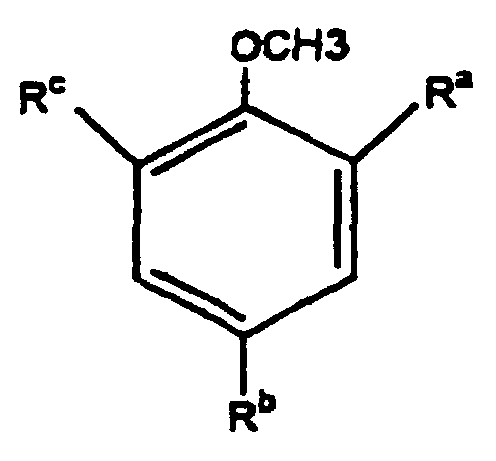
worin Ra, Rb und Rc Wasserstoff sind, wobei mindestens einer der Reste Ra, Rb und Rc von mindestens einem der Anisole einen sekundären Alkylrest mit 8 bis 24 Kohlenstoffatomen umfaßt, durch den Kontakt von Anisol mit einem C8-24-Monoolefin in Gegenwart eines sauren Alkylierungskatalysators, wobei der Anteil des Olefins im Verhältnis zum Anisol bei der Alkylierung minimiert ist und das Produkt im wesentlichen frei von Olefin-Oligomeren ist.
worin Ra, Rb und Rc Wasserstoff sind, wobei mindestens einer der Reste Ra, Rb und Rc von mindestens einem der Anisole einen sekundären Alkylrest mit 8 bis 24 Kohlenstoffatomen umfaßt, durch den Kontakt von Anisol mit einem C8-24-Monoolefin in Gegenwart eines sauren Alkylierungskatalysators, wobei der Anteil des Olefins im Verhältnis zum Anisol bei der Alkylierung minimiert ist und das Produkt im wesentlichen frei von Olefin-Oligomeren ist.
9. Verfahren nach Anspruch 8, wobei das Monoolefin ein C8-24-α-Olefin einschließt, das gegebenenfalls ein internes C8-24-Olefin einschließt.
10. Verfahren nach Anspruch 8 oder Anspruch 9, wobei der Katalysator eine gemischte Metalloxid-Supersäure,
vorzugsweise WOx/ZO, wobei Z Zirconium oder Titan ist, oder ein Zeolith, vorzugsweise USY oder MCM-22,
MCM-36, MCM-49 oder MCM-56, ist.
11. Verfahren nach einem der Ansprüche 8 bis 10, wobei das Produkt der Alkylierung mindestens
50 Gew.-% dialkyliertes Anisol umfaßt.
12. Verfahren nach einem der Ansprüche 8 bis 11, wobei das Produktgemisch der Alkylierungsreaktion
eine Bromzahl von weniger als 10, stärker bevorzugt weniger als 5 aufweist.
1. Lubrifiant composé d'une huile de base constituée exclusivement d'un mélange d'anisoles
mono, di et trialkylés, chacun présentant la structure suivante :
où Ra, Rb et Rc représentent un atome d'hydrogène, au moins un desdits Ra, Rb et Rc d'au moins un desdits anisoles comprenant un radical alkyle secondaire contenant de 8 à 24 atomes de carbone, lequel est essentiellement exempt d'oligomères d'oléfines et a un point d'écoulement inférieur à -20 °C, le lubrifiant comprenant éventuellement en outre des additifs de lubrification choisis parmi les dispersants, les détergents, les améliorants d'indice de viscosité, les additifs extrême pression/anti-usure, les antioxydants, les produits diminuant la coulabilité, les émulsifiants, les désémulsifiants, les inhibiteurs de corrosion, les inhibiteurs antirouille, les additifs antitaches et les modificateurs de friction.
où Ra, Rb et Rc représentent un atome d'hydrogène, au moins un desdits Ra, Rb et Rc d'au moins un desdits anisoles comprenant un radical alkyle secondaire contenant de 8 à 24 atomes de carbone, lequel est essentiellement exempt d'oligomères d'oléfines et a un point d'écoulement inférieur à -20 °C, le lubrifiant comprenant éventuellement en outre des additifs de lubrification choisis parmi les dispersants, les détergents, les améliorants d'indice de viscosité, les additifs extrême pression/anti-usure, les antioxydants, les produits diminuant la coulabilité, les émulsifiants, les désémulsifiants, les inhibiteurs de corrosion, les inhibiteurs antirouille, les additifs antitaches et les modificateurs de friction.
2. Lubrifiant selon la revendication 1, dans lequel Ra, Rb et Rc, identiques ou différents, comprennent des groupes CHR1R2 où R1 représente un groupe méthyle et R2 représente un groupe alkyle contenant de 6 à 22 atomes de carbone.
3. Lubrifiant selon la revendication 1 ou la revendication 2, dans lequel Ra, Rb et Rc, identiques ou différents, comprennent des groupes CHR1R2 où R1 représente un groupe alkyle contenant de 2 à 21 atomes de carbone et R2 représente un groupe alkyle contenant jusqu'à 21 atomes de carbone dans lequel la
combinaison de R1 et de R2 contient de 7 à 23 atomes de carbone.
4. Lubrifiant selon l'une quelconque des revendications précédentes, dans lequel le mélange
a un indice de brome inférieur à 10, de préférence inférieur à 5.
5. Lubrifiant selon l'une quelconque des revendications précédentes, dans lequel ledit
mélange comprend au moins 50 pour cent en poids d'anisole ayant deux substituants
alkyles secondaires.
6. Lubrifiant selon l'une quelconque des revendications précédentes, ayant une viscosité
à 40 °C supérieure à 3 x 10⁻⁵m2s-1 (30 cs).
7. Lubrifiant selon la revendication 1, dans lequel ledit mélange a un indice de viscosité
supérieur à 100 et un point d'écoulement inférieur à -40 °C.
8. Procédé de production d'un mélange constitué exclusivement d'anisoles mono, di et
trialkylés, chacun présentant la structure suivante :
où Ra, Rb et Rc représentent un atome d'hydrogène, au moins un desdits Ra, Rb et Rc d'au moins un desdits anisoles comprenant un radical alkyle secondaire contenant de 8 à 24 atomes de carbone en mettant en contact l'anisole en présence d'un catalyseur d'alkylation acide avec une mono-oléfine en C8 à C24, dans lequel la proportion d'oléfine par rapport à l'anisole durant l'alkylation est minimisée et le produit est essentiellement exempt d'oligomères d'oléfines.
où Ra, Rb et Rc représentent un atome d'hydrogène, au moins un desdits Ra, Rb et Rc d'au moins un desdits anisoles comprenant un radical alkyle secondaire contenant de 8 à 24 atomes de carbone en mettant en contact l'anisole en présence d'un catalyseur d'alkylation acide avec une mono-oléfine en C8 à C24, dans lequel la proportion d'oléfine par rapport à l'anisole durant l'alkylation est minimisée et le produit est essentiellement exempt d'oligomères d'oléfines.
9. Procédé selon la revendication 8, dans lequel la mono-oléfine comprend une alpha-oléfine
en C8 à C24, comprenant éventuellement une oléfine interne en C8 à C24.
10. Procédé selon la revendication 8 ou la revendication 9, dans lequel le catalyseur
est un mélange oxyde métallique/super acide, de préférence WOx/ZO, où Z représente un atome de zirconium ou un atome de titane, ou représente une
zéolite, de préférence USY ou MCM-22, MCM-36, MCM-49 ou MCM-56.
11. Procédé selon l'une quelconque des revendications 8 à 10, dans lequel le produit de
l'alkylation comprend au moins 50 % en poids d'anisole dialkylé.
12. Procédé selon l'une quelconque des revendications 8 à 11, dans lequel le mélange du
produit de l'alkylation a un indice de brome inférieur à 10, plus préférablement inférieur
à 5.