| (19) |
 |
|
(11) |
EP 0 916 298 A1 |
| (12) |
EUROPEAN PATENT APPLICATION |
| (43) |
Date of publication: |
|
19.05.1999 Bulletin 1999/20 |
| (22) |
Date of filing: 02.11.1998 |
|
| (51) |
International Patent Classification (IPC)6: A47J 27/09 |
|
| (84) |
Designated Contracting States: |
|
AT BE CH CY DE DK ES FI FR GB GR IE IT LI LU MC NL PT SE |
|
Designated Extension States: |
|
AL LT LV MK RO SI |
| (30) |
Priority: |
07.11.1997 PT 10207697
|
| (71) |
Applicant: Cruzinox,
Industria Metalurgica, Lda. |
|
3720 Carregosa (PT) |
|
| (72) |
Inventor: |
|
- Mendonca Santos, Fernando Jorge
3720 Carregosa (PT)
|
| (74) |
Representative: Pereira da Cruz, Joao
J. Pereira da Cruz, S.A. |
|
Rua Vitor Cordon, 14
1249-103 Lisbon
1249-103 Lisbon (PT) |
|
| |
|
| (54) |
Opening and closing safety device for a pressure cooker |
(57) Opening/closing safety device to be mounted on a bayonet pan, consisting of a body
(1) to which a side handle is attached (11), and a lid (2) to which an upper body
is attached (3), which consists of a lever (4) which, when it is in its initial position,
guarantees that there is no pressure inside the pan and which, when it is locked (pressure
cooker), prevents the pan from opening.
|

|
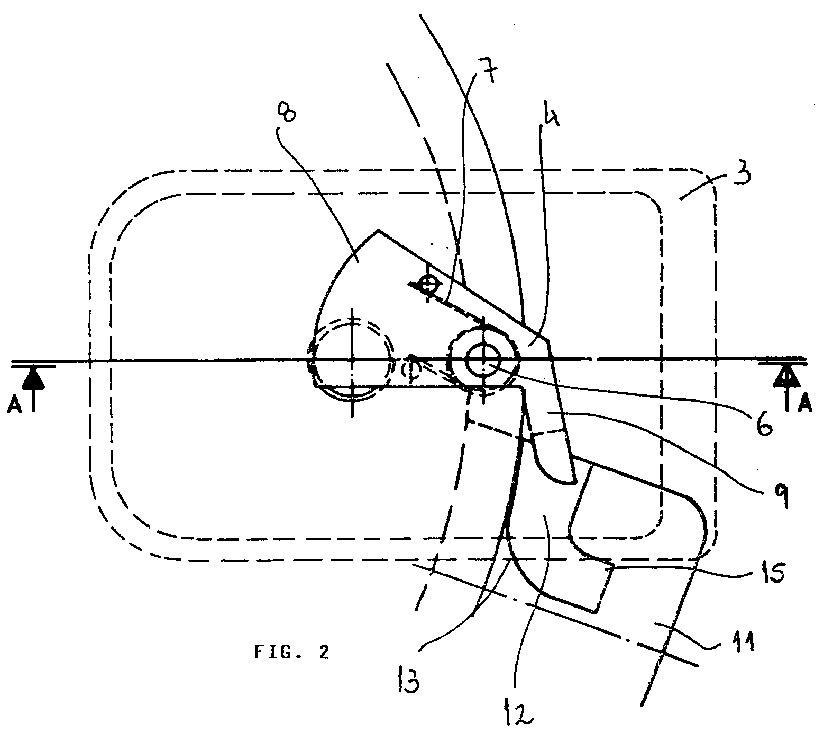
[0001] The invention consists of a device to be mounted on a bayonet pressure cooker and
it has two different functions. Firstly, it guarantees that there is no pressure inside
the pan when it is not correctly closed (safety closing) and secondly it guarantees
that the user can only open the pan when there is no pressure inside it (safety opening).
[0002] The aforementioned device is intended to be mounted on a pressure cooker consisting
of a body (1) and a lid (2), which are mounted by means of a bayonet system. The device
is mounted on the lid (2) and consists of an upper body (3) to which a lever is attached
(4), held in place by a screw (5). The lever turns on its central axis (6) and is
kept in a rest position by means of a spring (7) which compresses it (this axis is
parallel to the generator of the cylinder of the body).
[0003] The lever (4) has a wide surface (8) at one end perpendicular to the central axis
in the shape of a section of a circumference, and at the other end it has a foot (9)
parallel to the axis with a rounded cross-section. A valve (10) is also mounted on
the lid which goes up whenever there is any pressure, thus remaining in a closed position
(guaranteeing that the pan is sealed).
[0004] On the body there is a side handle (11) which allows the pan to be handled and which
has a cavity (12), where there is a projection (13) which allows the foot (9) of the
lever to slide when the pan is closed.
[0005] As mentioned above, this device has two different functions. The first one is to
prevent any pressure when the pan is not completely closed. When the pan is turned
only slightly (fig. 3 and fig. 4) and is not completely closed, the foot (9) of the
lever starts to slide above the projection (13) of the handle and the spring (7) relaxes,
allowing the lever (4) to turn on its axis. When steam starts to form inside the pan,
the valve (10) goes up immediately and bumps against the wider end (8) opposite the
foot of the lever. In this way, the valve (10) is prevented from rising completely
to the top, to the closed position, allowing the steam to escape through the escape
orifice (16), thus guaranteeing that there is no pressure inside the pan. Only when
the pan is completely closed (fig. 5 and fig. 6) will the lever (4) allow the valve
(10) to move to its upper position, preventing the steam from escaping through the
valve (10) and thereby allowing the pressure to increase inside the pan.
[0006] The second function is to guarantee safety when the pan is opened. In order to guarantee
that the pan is not inadvertently opened by the user when there is still pressure
inside, thus running the risk of causing an accident, this device prevents the pan
from being opened whenever there is any pressure inside. If there is pressure inside
the pan, the valve (10) is closed in its upper position. If the user tries to turn
the lid (2) in order to open the pan, the valve (10) will bump against the side of
the lever (4), thus preventing it from turning on its axis. When this happens, the
lower part (14) of the foot of the lever bumps against the projection (15) of the
side handle, thereby preventing the lid (2) from turning on the body (1). Only when
the pressure lowers inside the pan will the valve (10) move to the lower position,
thus allowing the lever (4) to turn and the pan to be opened completely safely.
[0007] There are a few systems, for example the ones described in EP 0 614 63 A1, EP 0 547
668 A1 and WO 85/02851, which describe safety mechanisms for opening and closing.
As regards the patents EP 0 614 639 A1 and EP 0 547 668 A1, the advantage of the mechanism
described in relation to these patents is that as well as guaranteeing safety when
opening the pan (as in the case of the abovementioned patents), it also guarantees
safety when the pan is closed, which does not happen with the mechanisms described
in the other patents. Furthermore, as regards the patent WO 85/03851, in order to
close the pan, the mechanism described therein requires the user to press a button
as well as turning the lid on top of the body, so that the pan is closed in such a
way as to permit the presence of steam inside the pan. It is therefore necessary to
carry out two different operations in order to operate the pan. This does not happen
with the mechanism described, making it easier for the user to operate the pan.
[0008] This mechanism guarantees complete safety for the user of the pressure cooker and
it ensures that a single device provides total safety if the pan is not handled properly
by the user.
[0009] The following figures are attached hereto and make up the opening and closing safety
device.
- Figure 1 -
- Side view seen in cross-section of the mechanism mounted in the rest position;
- Figure 2 -
- View from above seen in cross-section of the mechanism mounted in the rest position;
- Figure 3 -
- Side view seen in cross-section of the mechanism mounted in a not fully closed position;
- Figure 4 -
- View from above seen in cross-section of the mechanism mounted in a not fully closed
position;
- Figure 5 -
- Side view seen in cross-section of the mechanism mounted in the closed position;
- Figure 6 -
- View from above seen in cross-section of the mechanism mounted in the closed position.
1. Opening/closing safety device to be mounted on a pressure cooker with a bayonet lock,
consisting of a body (1) to which a side handle is attached (11), and a lid (2) to
which an upper body is attached (3), characterised in that it consists of a lever
(4) which turns on a central axis (6) perpendicular to the flat part of the lid (2)
and which has one end in the shape of the section of a circumference with a sharp
angle (8), and which has a foot (9) at the other end parallel to the axis of rotation
with a rounded edge in order to allow it to slide, with the opposite side forming
a corner that acts as a stopper, which when the pan is closed, bumps against the projection
(15) of an L-shaped cavity (12) situated on the side handle (11) of the pan.
2. Device according to claim 1, characterised in that the lever has a hole in the centre
and fits into the axis in the upper body (3), which is secured by means of a screw
(5) and has a spring (7) fitted between the upper body (3) and the lever (4), forcing
it to rest in its initial position.
3. Device according to claims 1 and 2, characterised in that the lower handle (11) has
an L-shaped projection with a rounded elbow-bend (13) in order to allow the foot (9)
of the lever (4) to slide, and in that it has on the other side a projection (15)
for blocking the lever (4) when the pan is closed.