|
(11) | EP 0 916 637 B1 |

| (12) | EUROPEAN PATENT SPECIFICATION |
|
|
| (54) |
PROCESS FOR PREPARATING OPTICALLY ACTIVE COMPOUNDS VERFAHREN ZUR HERSTELLUNG OPTISCHE AKTIVE VERBINDUNGEN PROCEDE DE PREPARATION DE COMPOSES OPTIQUEMENT ACTIFS |
|
|
|||||||||||||||||||||||||||||||||||
| Note: Within nine months from the publication of the mention of the grant of the European patent, any person may give notice to the European Patent Office of opposition to the European patent granted. Notice of opposition shall be filed in a written reasoned statement. It shall not be deemed to have been filed until the opposition fee has been paid. (Art. 99(1) European Patent Convention). |
[0001] The present invention relates to a method for producing optically active amines. More specifically, the present invention relates to a novel, highly practical method for producing optically active amines useful for various utilities such as intermediates for synthesizing pharmaceutical chemicals, liquid crystal materials and agents for optical resolution.
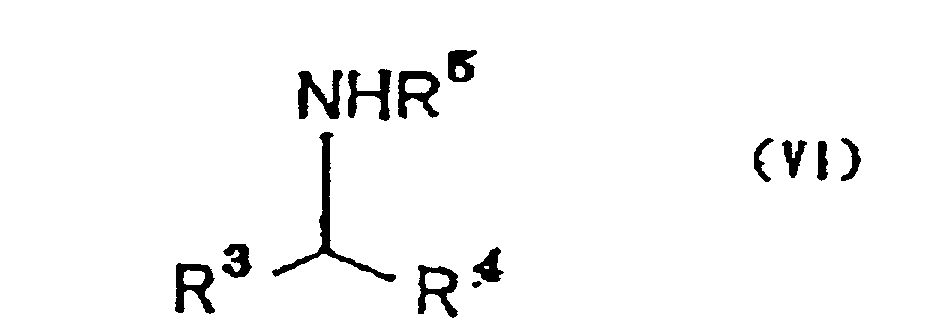
[0003] As for a method for synthetically producing optically active amine compounds, a process of optically resolving once produced racemic compounds by using optically active acids and a process using asymmetric synthetic reaction have been known. By the optical resolution process, however, optically active acids should be used at an equal amount or more to amine compounds disadvantageously and complex procedures such as crystallization, separation and purification are required so as to recover optically active amine compounds. As the method using asymmetric synthesis, alternatively, the following processes have been known; (1) an enzymatic process; (2) a process using metal hydride compounds; and (3) a process of asymmetric hydrogenation by using metal complex catalysts. As to the process using metal hydride compounds as described above in (2), a great number of reports have been issued about a process of asymmetrically reducing carbon-nitrogen multiple bonds by using metal hydrides with chiral modifiers. As a general process thereof, for example, it has been known a stoichiometric reduction process of imine compounds and oxime compounds by using a metal hydrides with an optically active ligand, as described in Comprehensive Organic Synthesis, EdS. B.M. Trost and I. Flemming, Vol.8, p.25 (1991) , Organic Preparation and Procedures Inc. O. Zhu, R. O. Hutchins, and M. K. Huchins, Vol. 26 (2) , pp.193-235 (1994) and Japanese Patent Laid-open No. 2-311446. The process includes a number of processes with excellent reaction selectivity, but these processes are disadvantageous because these processes require the use of a reaction agent at an equivalent weight or more to a reaction substrate, along with neutralization treatment after the reaction and additionally in that these processes require laborious purification procedures to recover optically active substances. As the process of asymmetric hydrogenation of carbon-nitrogen multiple bonds by using metal complex catalysts as the method (3) , it has been known an asymmetric hydrogenation process of imine compounds with functional groups, by means of optically active metal complex catalysts, as described in Asymmetric Catalysis in Organic Synthesis, pp.82-85 (1994), Ed. R. Noyori. But the process has a drawback in terms of reaction velocity and selectivity.
[0004] By using enzymes as in method (1), amines at a relatively high optical purity can be recovered, but the reaction substrates are limited and the resulting amines have only specific absolute configurations. Furthermore, using a process of asymmetric hydrogenation by means of complex catalysts of transition metals using hydrogen gas, optically active amines have not yet been recovered at a high selectivity or pressure-resistant reactors are essentially required because hydrogen gas is used as the hydrogen source. Hence, such a process is disadvantageous because of technically difficult operation and safety problems.
[0005] Accordingly, it has been demanded that a novel method for synthesizing an optically active amine by using a very common, highly active and highly selective catalyst be realized.
[0006] Alternatively, a great number of transition metal complexes have been used conventionally as catalysts for organic metal reactions; particularly because rare metal complexes are highly active and stable with the resultant ready handleability despite high costs, synthetic reactions using the complexes have been developed. The progress of such asymmetric synthetic reactions using chiral complex catalysts is innovative, and a great number of reports have been issued, reporting that highly efficient organic synthetic reactions have been realized.
[0007] Among them, a great number of asymmetric reactions using chiral complexes catalysts with optically active phosphine ligands as the catalysts have already been developed, and some of them have been applied industrially (Asymmetric Catalysis in Organic Synthesis, Ed. R. Noyori).
[0008] As complexes of optically active nitrogen compounds coordinated with transition metals such as ruthenium, rhodium and iridium, a great number of such complexes additionally having excellent properties as catalysts for asymmetric synthetic action have been known. So as to enhance the properties of these catalysts, a great number of propositions concerning the use of optically active nitrogen compounds of specific structures have been done (Chem. Rev. , Vol.92, pp.1051-1069 (1992)).
[0009] For example, reports have been issued about (1) optically active 1,2-diphenylethylenediamines and rhodium-diamine complexes with ligands of cyclohexanediamines, as described in Tetrahedron Asymmetry, Vol.6, pp.705-718 (1995); (2) ruthenium-imide complex with ligands of optically active bisaryliminocyclohexanes, as described in Tetrahedron, Vol.50, pp.4347-4354 (1994); (3) iridium-pyridine complex with ligands of pyridines, as described in Japanese Patent Laid-open Nos. 62-281861 and 63-119465; (4) optically active 1,2-diphenylethylenediamines or iridium-diamine complex with ligands of cyclohexanediamines, as described in Japanese Patent Laid-open No.62-273990; (5) ruthenium-diamine complex of RuCl[p-TsNCH(C6H5)CH(C6H5)NH2] (arene) (chloro-(N-p-toluenesulfonyl-1,2-diphenylethylenediamine) (arene) ruthenium) (arene represents benzene which may or may not have a substituent) , which is produced by coordinating ruthenium with optically active N-p-toluenesulfonyl-1,2-diphenylethylenediamine [referred to as "p-TsNHCH(C6H5)CH(C6H5)NH2" hereinabove and below], as described in J. Am. Chem. Soc., Vol.117, pp.7562-7563(1995); J. Am. Chem. So.c., Vol.118, pp.2521-2522 (1996) and J. Am. Chem. Soc., Vol.118, pp.4916-4917 (1996).
[0010] Even if these complexes are used, however, problems currently remain to be overcome for practical use, including insufficient catalyst activities, sustainability and optical purities; depending on the subjective reactions and reaction substrates.
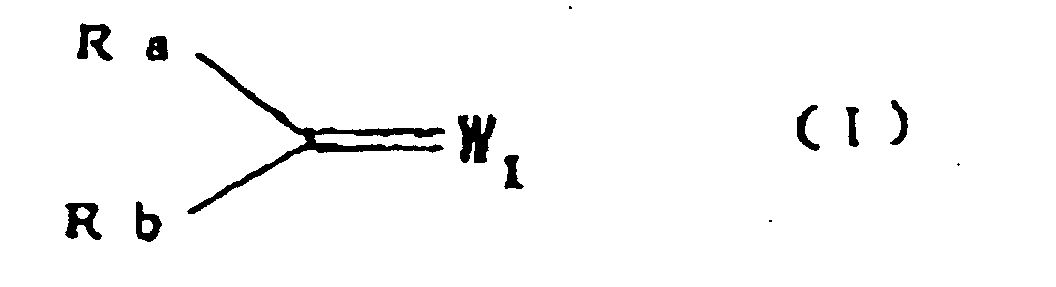
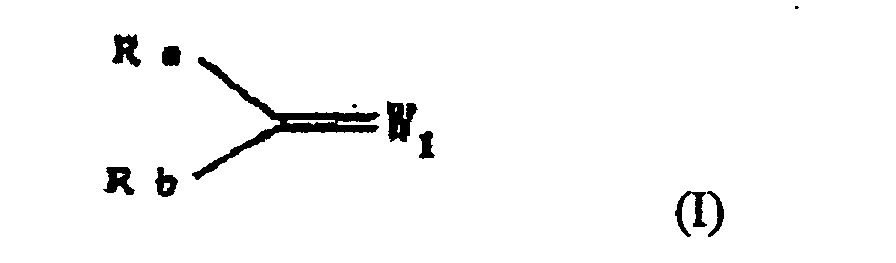
[0011] So as to overcome the aforementioned problems, the present invention provides a method for producing optically active compounds, comprising subjecting a compound represented by the following formula (I);
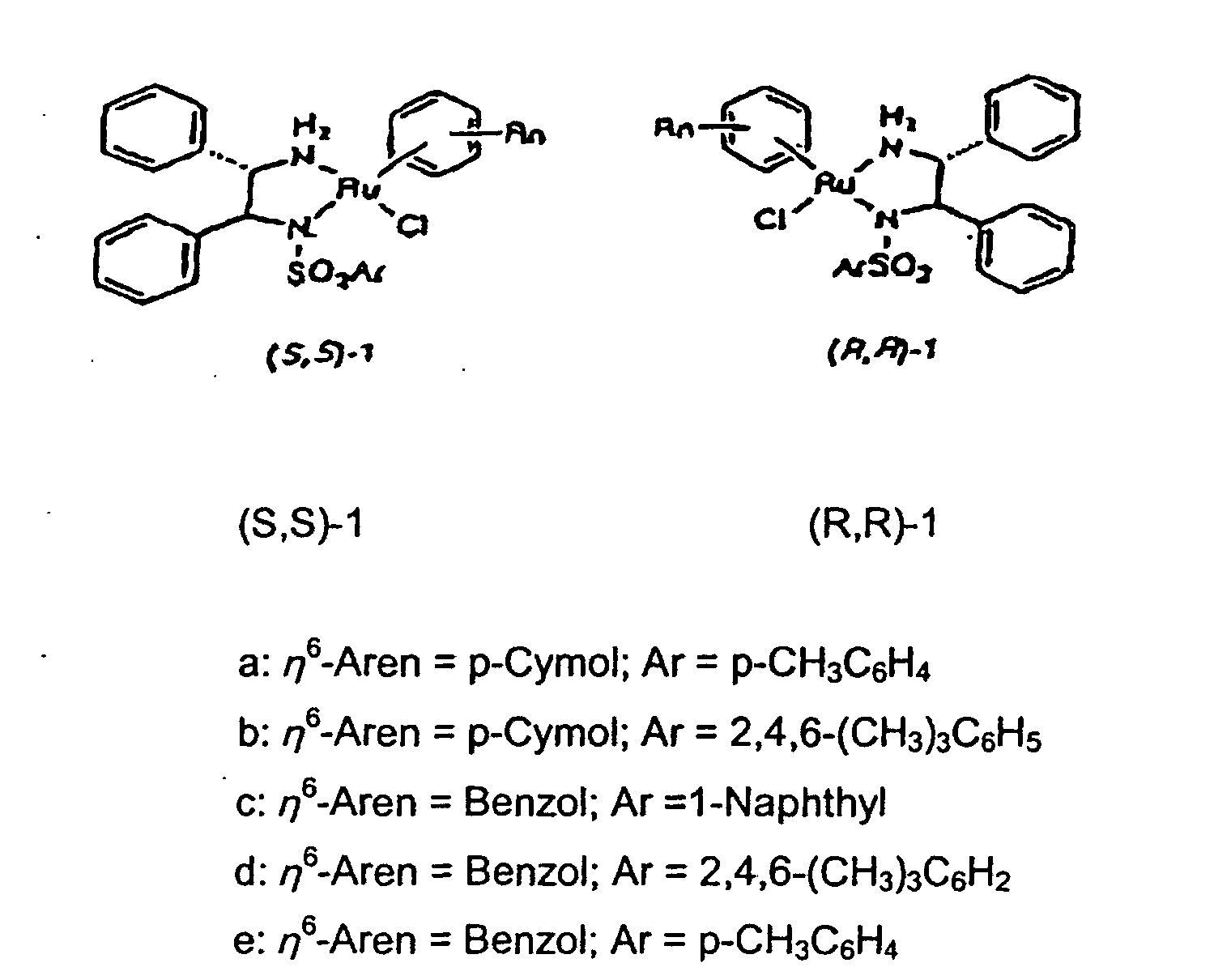
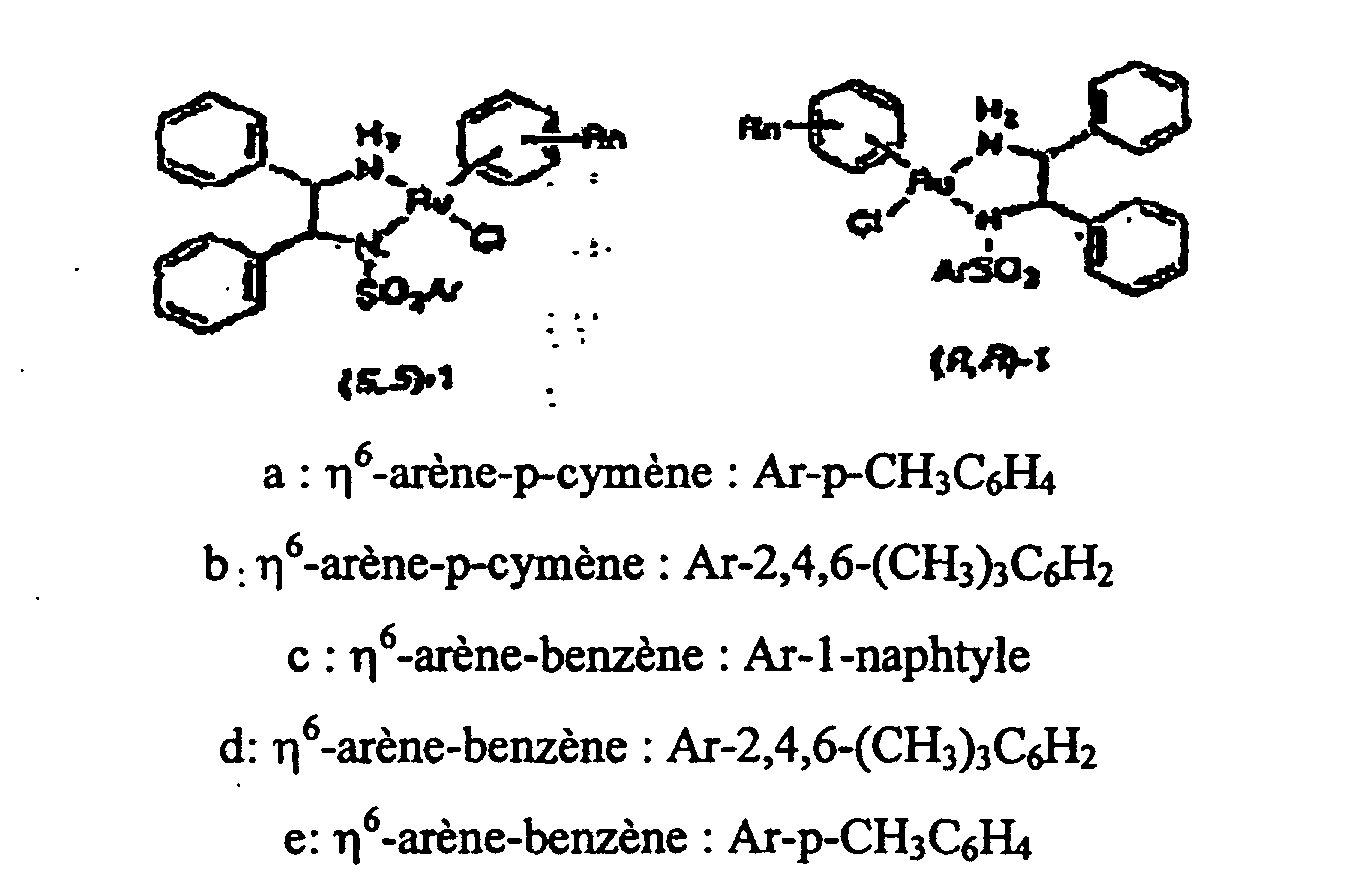
wherein Ra and Rb independently represent a linear or cyclic hydrocarbon group or heterocyclic group, which may or may not have a substituent; W1 represents N-H or N-Rc; and Rc represents a linear or cyclic hydrocarbon group or heterocyclic group, which may or may not have a substituent; or Ra and Rb, Ra and Rc or Rb and Rc may optionally be bonded together to form a saturated or unsaturated cyclic imine; to transfer-type asymmetric reduction in the presence of a ruthenium metal complex of the following formulae:
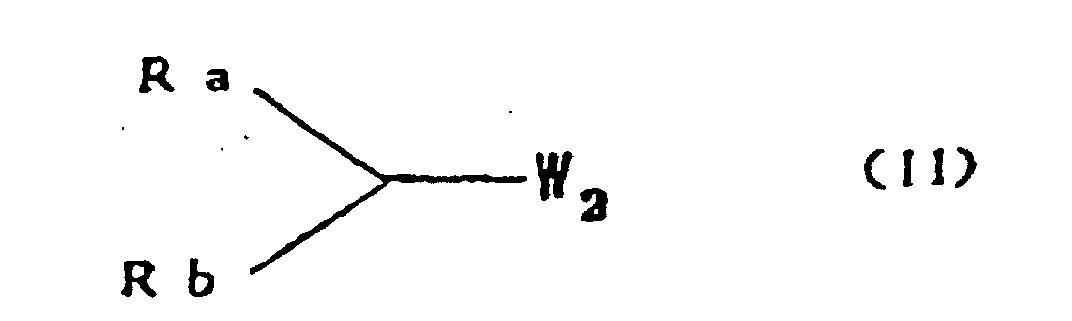
along with formic acid and triethylamine, to produce an optically active compound represented by the following formula (II) ;
wherein Ra and Rb and Rc represent the same as those described above; and W2 represents NH2 or NH-Rc.
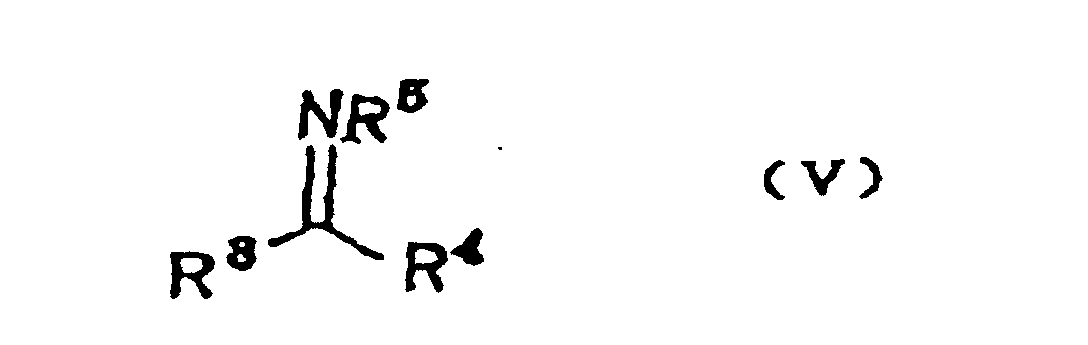
[0012] Furthermore, the present invention is to provide a method for producing an optically active amine, comprising asymmetrically reducing an imine compound represented by the following formula (V) ;
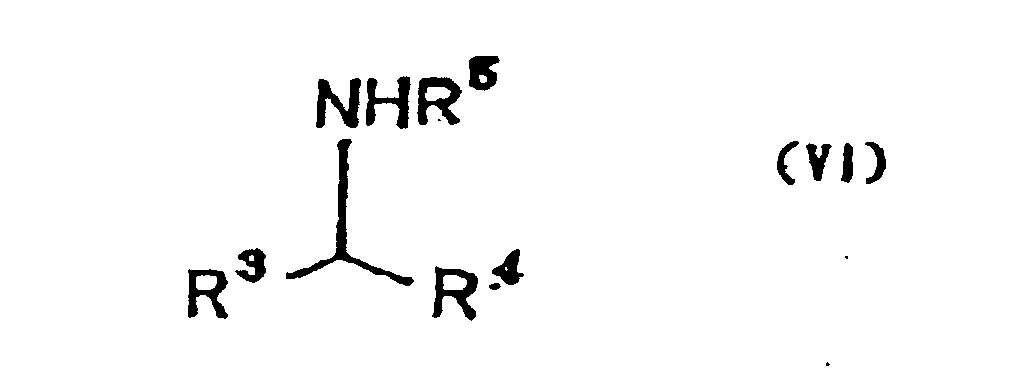
wherein R3 represents an aromatic hydrocarbon group, a saturated or unsaturated aliphatic hydrocarbon group or cyclic aliphatic hydrocarbon group, which may or may not have a substituent, or a heterocyclic group which may or may not have a substituent and contains hetero atoms selected from the group consisting of nitrogen, oxygen and sulfur as atoms composing the ring; R4 represents a saturated or unsaturated aliphatic hydrocarbon group or cyclic aliphatic hydrocarbon group which may or may not have a substituent, or an aromatic hydrocarbon group, or the same heterocyclic group as described above; R5 represents hydrogen atom, or a saturated or unsaturated aliphatic hydrocarbon group or cyclic aliphatic hydrocarbon group, which may or may not have a substituent, or an aromatic hydrocarbon group, or the same heterocyclic group as described above, or the hydrocarbon group or heterocyclic group bonded together via hydroxyl group or oxygen atom; and R3 and R4, R3 and R5 or R4 and R5, are bonded together to form a ring, to produce optically active amines represented by the following formula (VI);
wherein R3, R4 and R5 are the same as described above.
[0013] In accordance with the present invention, the characteristic methods for producing optically active compounds as described above are provided. The detail is described below.
[0014] More specifically, for example, the present invention is to provide a method for producing an optically active amine compound of the following formula (VI) , comprising asymmetric reduction of an imine compound of the following formula (V).
[0015] For example, R3 is an aromatic monocyclic or polycyclic hydrocarbon group, unsubstituted or substituted, a saturated or unsaturated aliphatic hydrocarbon group or cyclic hydrocarbon group, unsubstituted or substituted, or a hetero monocyclic or polycyclic group containing hetero atoms selected from the group consisting of nitrogen, oxygen and sulfur ; more specifically, R3 includes aromatic monocyclic or polycyclic hydrocarbon groups such as phenyl group, 2-methyphenyl, 2-ethylphenyl, 2-isopropylphenyl, 2-tert-butylphenyl, 2-methoxyphenyl, 2-chlorophenyl, 2-vinylphenyl, 3-methylphenyl, 3-ethylphenyl, 3-isopropylphenyl, 3-methoxyphenyl, 3-chlorophenyl, 3-vinylphenyl, 4-methyphenyl, 4-ethylphenyl, 4-isopropylphenyl, 4-tert-butylphenyl, 4-vinylphenyl, cumenyl, mesityl, xylyl, 1-naphthyl, 2-naphthyl, anthryl, phenanthryl, and indenyl groups; hetero monocyclic or polycyclic groups such as thienyl, furyl, pyranyl, xanthenyl, pyridyl, pyrrolyl, imidazolyl, indolyl, carbazoyl, and phenanthronylyl; and ferrocenyl group. Like these examples, R' may contain any of various substituents, which may satisfactorily be hydrocarbon groups such as alkyl, alkenyl, cycloalkyl, and cycloalkenyl; halogen atom; oxygen-containing groups such as alkoxy group, carboxyl group and ester group; nitro group and cyano group.
[0016] Furthermore, R4 represents hydrogen atom, a saturated or unsaturated hydrocarbon group, aryl group, hetero atom-containing functional groups, including for example alkyl groups such as methyl, ethyl, propyl, butyl, pentyl, hexyl, and heptyl; cycloalkyl groups such as cyclopropyl, cyclobutyl, cyclopentyl, and cyclohexyl; unsaturated hydrocarbons such as vinyl and allyl; and the same as those for R1. Additionally, R5 represents hydrogen atom, a saturated and unsaturated hydrocarbon group, aryl group, a hetero atom-containing heterocyclic group, or the hydrocarbon group or heterocyclic group bonded together via hydroxyl group or oxygen atom, including for example alkyl groups such as methyl, ethyl, propyl, butyl, pentyl, hexyl and heptyl; cycloalkyl groups such as cyclopropyl, cyclobutyl, cyclopentyl, and cyelohexyl; unsaturated hydrocarbon groups such as benzyl, vinyl and allyl; hydroxyl group; alkyl ether groups and aryl ether groups. Furthermore, a saturated or unsaturated cyclic imine compound formed by bonding together R3 and R4, R3 and R5 or R4 and R5, is illustrated.
[0017] Non-cyclic imine compounds can be synthesized readily from the corresponding ketones and amines. In this case, the syn-form and anti-form or a mixture enriched with either one of these syn- and anti-forms may be used satisfactorily, but a purified product of the mixture may be used singly or a mixture thereof with another imine compound may also be used.
[0018] In the method for producing optically active amine compounds, use is made of an asymmetric reduction catalyst composed of a transition metal complex and an optically active nitrogen-containing compound.
[0019] The transition metal catalysts are used at an amount variable, depending on the size, mode and economy of the reactor, but the catalysts may satisfactorily be used within a molar ratio range of approximately 1/100 to 1/100,000, preferably 1/200 to 1/5,000 to the reaction substrate imine compound.
[0020] The transition metal catalyst to be used as the catalyst as described above is an essential component to progress the asymmetric reduction in a smooth manner thereby attaining a higher asymmetric yield, and amine compounds at a higher optical purity cannot be recovered at a sufficiently high reaction activity, if the catalyst is eliminated.
[0021] For the method for producing optically active amines through hydrogen transfer-type asymmetric reduction in accordance with the present invention, the presence of formic acid is indispensable. Formic acid is capable of donating hydrogen through thermal action or catalytic action.
[0022] The amount of formic acid to be used as a hydrogen source is determined, depending on the solubility and economy of the reaction substrate. Generally, the substrate is used at a concentration of approximately 0.1 to 30 % by weight, depending on the type of the substrate to be used, and is preferably at a concentration of 0.1 to 10 % by weight. When using formic acid and a combination of formic acid with amine as a hydrogen source, no solvent is necessarily used, but use may satisfactorily be made of aromatic compounds such as toluene and xylene; halogen compounds such as dichloromethane, or organic compounds such as DMSO, DMF or acetonitrile, if it intended to use any solvent.
[0023] Hydrogen pressure is not required, but depending on the reaction conditions, hydrogen pressure may satisfactorily be loaded. Even if hydrogen pressure is loaded, the pressure may satisfactorily be (1 atm to 50 atm) 1,01·105 Pa to 5,07·106 Pa.
[0024] The reaction temperature is about -20 °C to 100 °C from the economical standpoint. More practically, the reaction can be carried out around room temperature of 25 to 40 °C. The reaction time varies, depending on the reaction conditions such as the concentration of a reaction substrate, temperature and pressure, but the reaction is on completion from several minutes to 100 hours.
[0025] The metal complex to be used in accordance with the present invention may be preliminarily synthesized by the following method, and the resulting complex may be used.
[0026] More specifically, for example, a method is illustrated, comprising suspending a ruthenium-arene complex, an optically active amine compound and triethylamine in 2-propanol, heating the resulting mixture in argon or nitrogen gas stream under agitation, and cooling then the resulting reaction mixture, from which the solvent is then removed, and re-crystallizing the resulting mixture in an alcohol solvent to prepare an asymmetric complex.
[0027] The catalyst system to be used for the hydrogen transfer-type asymmetric reduction in accordance with the present invention is very characteristic and has never been known up to now.
[0028] The ruthenium-diamine complex employed in the present invention may be isolated and used, but while generating the complex in a reaction solution, the resulting complex is used as a catalyst for asymmetric synthesis. Depending on the selection, an objective compound of the desired absolute configuration can be produced. Such ruthenium-diamine complex can be used at 1/10,000 to 1/10 fold in mole, preferably 1/2,000 to 1/200. fold in mole to the substrate compound.
[0029] In accordance with the present invention, the reaction may be carried out in a batchwise manner or a continuous manner.
[0030] The resulting product can be purified by known processes such as silica gel column chromatography.
Examples
Example B
<Production of optically active amines>
[0031] Production examples of optically active amines are shown below and the present inventive method will be described in detail. Tables 6 and 7 show reaction substrates and asymmetric metal catalysts to be possibly used as typical examples.
[0032] The instrumental analysis was done by using the following individual systems.
NMR: JEOL GSX-400/Varian Gemini-200 (1H-NMR sample: TMS, 31P-NMR standard sample: phosphoric acid)
GLC: SHIMADZU GC-17A(column: chiral CP-Cyclodextrin-b-236-M19)
HPLC: JASCO GULLIVER (column: CHIRALCEL OJ, OB-H, OB, OD)
[0033] The absolute configurations of the resulting optically active amine compounds were determined on the basis of optical rotation and by HPLC and X-ray structural analysis. Blanks are not definitely shown.
Example 42
[0034] 6,7-Dimethoxy-1-methyl-3,4-dihydroxyisoquinoline (Table 6-2a) (1.03 g, 5 mmol) and a ruthenium catalyst (Table 7) (R, R)-1a (16 mg, 0.025 mmol) were dissolved in acetonitrile (10 ml), followed by addition of a mixture of formic acid-triethylamine (5 : 2) , for agitation at 28 °C for 3 hours. To the reaction mixture was added an aqueous sodium carbonate solution to extract the product in ethyl acetate. After evaporation of the solvent, 1H-NMR(CDCl3) of the resulting product was measured to calculate the conversion. Then, the product was purified by silica gel chromatography, to determine the optical purity and absolute configuration of the resulting optically active amine by HPLC or GLC. As collectively shown in Table 8, (S)-6,7-dimethoxy-1-methyl-1,2,3,4-tetrahydroisoquinoline (1.02 g, yield of 99 %, 96 % ee) was obtained.
Examples 43 to 69
[0035] By using the same reactor as in Example 42 but using different reaction substrates, catalysts, reaction solvents and ratios of reaction substrates/catalysts, the same experimental procedures as in Example 42 were carried out. The results are collectively shown in Table 8.
Example 70
[0036] Using the same reactor as in Example 42, the enamine compound was used for the same experimental procedures as in Example 42, so that the reaction progressed in a smooth manner, to recover the corresponding optically active amine compound. The results are collectively shown in Table 8.
Comparative Example 1
[0037] Under the same conditions as in Example 42, ruthenium-arene catalysts with no optically active amine ligands were used as catalysts, so that the reaction was facilitated, to recover a racemic amine compound quantitatively.
Comparative Example 2
[0038] Under the same conditions as in Example 51, ruthenium-arene catalysts with no optically active amine ligands were used as catalysts, so that no reaction was never facilitated.
[0039] As has been described above in detail, in accordance with the present invention, optically active amines can be produced at a high yield and an excellent optical purity.
Table 8
[In the table, s/c means the molar ratio of substrate/ruthenium-optically active
diamine complex.]| Amines | ||||||||
| Examples | Imines | Catalysts | S /C | Solvents | Time h | yield % | ee, % | absolute configuration |
| 42 | 2a | (R, R)-1a | 200 | CH3CN | 3 | 99 | 96 | S |
| 43 | 2a | (R, R)-1a | 200 | CH2Cl2 | 3 | 99 | 94 | S |
| 44 | 2a | (S, S)-1a | 200 | CH2Cl2 | 3 | 99 | 93 | R |
| 45 | 2a | (R, R)-1a | 200 | Acetone | 3 | 99 | 95 | S |
| 46 | 2a | (R, R)-1a | 200 | DMF | 3 | 99 | 95 | S |
| 47 | 2a | (R, R)-1a | 200 | DMSO | 3 | 99 | 95 | S |
| 48 | 2a | (R, R)-1a | 1000 | CH2Cl2 | 98 | 99 | 90 | S |
| 49 | 2b | (S, S)-1a | 200 | CH2Cl2 | 8 | 81 | 87 | R |
| 50 | 2c | (S, S)-1b | 200 | CH2Cl2 | 16 | 99 | 92 | R |
| 51 | 2d | (S, S)-1c | 200 | CH2Cl2 | 8 | 99 | 84 | R |
| 52 | 2e | (S, S)-1c | 100 | CH2Cl2 | 12 | 96 | 84 | R |
| 53 | 2f | (R, R)-1e | 200 | CH2Cl2 | 18 | 68 | 82 | |
| 54 | 2g | (R, R)-1e | 200 | CH2Cl2 | 14 | 94 | 98 | |
| 55 | 3 | (S, S)-1a | 200 | CH2Cl2 | 16 | 99 | 84 | |
| 56 | 4a | (S, S)-1a | 200 | DMF | 5' | 86 | 97 | R |
| 57 | 4b | (S, S)-1a | 200 | DMF | 5 | 83 | 96 | R |
| 58 | 5 | (R, R)-1e | 200 | CH2Cl2 | 48 | 59 | 78 | |
| 59 | 6 | (S, S)-1c | 200 | CH2Cl2 | 39 | 22 | 47 | S |
| 60 | 7 | (S, S)-1c | 200 | CH2Cl2 | 40 | 100 | 34 | |
| 61 | 8 | (S, S)-1c | 100 | CH2Cl2 | 6 | 90 | 89 | S |
| 62 | 9 | (S, S)-1c | 100 | CH2Cl2 | 12 | 64 | 88 | S |
| 63 | 10 | (S, S)-1d | 200 | CH2Cl2 | 36 | 72 | 77 | S |
| 64 | 11 | (R, R)-1e | 200 | CH2Cl2 | 15 | 13 | 36 | |
| 65 | 12a | (R, R)-1e | 200 | CH2Cl2 | 37 | 43 | 46 | |
| 66 | 12b | (R, R)-1e | 200 | CH2Cl2 | 109 | 35 | 36 | |
| 67 | 12c | (R, R)-1e | 200 | CH2Cl2 | 65 | 67 | 25 | |
| 68 | 13 | (S, S)-1c | 200 | CH2Cl2 | 16 | 82 | 64 | |
| 69 | 14 | (S, S)-1e | 200 | CH2Cl2 | 67 | 71 | 12 | R |
| 70 | 15 | (S, S)-1e | 200 | CH2Cl2 | 12 | 69 | 43 | |
Reference Example 1
[0040] Synthesis of RuCl [(S,S)-p-TsNCH (C6H5)CH(C6H5)NH2](η6-p-cymene) (chloro((S,S)-N-p-toluenesulfonyl-1, 2-diphenylethylenediamine) (η 6-p-cymene) ruthenium
[0041] [RuCl2(η 6-p-cymene)] 2(tetrachlorobis (η 6-p-cymene ) diruthenium) (1.53 g; 2.5 mmol) and (S,S)-p-TsNCH (C6H5)CH (C6H5)NH2( (S, S) -N-p-toluenesulfonyl-1, 2-diphenylethylenediamine) (1.83 g; 5.0 mmol) and triethylamine (1.4 ml; 10 mmol) are dissolved in 2-propanol (50 ml) in a Schlenk's reactor which is preliminarily dried in vacuum and of which the inside is then substituted with argon. The reaction solution was agitated at 80 °C for 1 hour and is then condensed, to recover crystal, which was then filtered and rinsed with a small amount of water, followed by drying under reduced pressure to recover orange crystal (2.99 g). The yield is 94 %.
m.p.> 100 °C (decomposed)
- IR(KBr) [cm-1] :
- 3272, 3219, 3142, 3063
3030, 2963, 2874
1.32 (d, 3H) , 1.34 (d, 3H) , 2.19 (s. 3 H) , 2. 28 (s, 3H) . 3.07 (m. 1H) . 3.26 (m. 1H) . 3.54(m, 1H) . 3.66 (d, 1H) . 5.68 (d, 1H) . 5.70 (d, 1H) . 5.72 Cd. 1H) . 5.86 (d. 1H) . 6.61 (m. 1H) , 6.2 9 - 7.20 (m. 14H)
| Elemental analysis (C31H35ClN2O2Rus) |
|||||
| C | H | N | Cl | Ru | |
| Theoretical values (%) | 58.53 | 5.54 | 4.40 | 5.57 | 15.89 |
| Elemental values (%) | 58.37 | 5.44 | 4.36 | 5.75 | 18.83 |
[0042] The present catalyst was tested by X-ray crystallography. It was indicated that the complex was of a structure satisfying the analysis results.
1. A method for producing optically active compounds, comprising subjecting a compound
represented by the following formula (I);
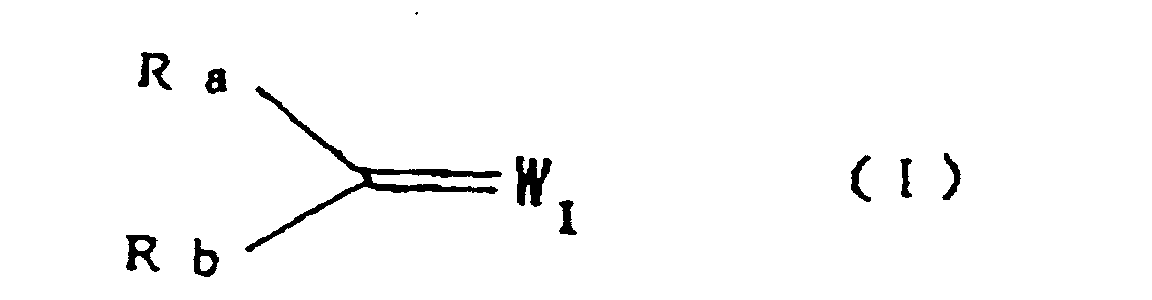
wherein Ra and Rb independently represent a linear or cyclic hydrocarbon group or heterocyclic group, which may or may not have a substituent; W1 represents N-H or N-Rc; and Rc represents a linear or cyclic hydrocarbon group or heterocyclic group, which may or may not have a substituent; or Ra and Rb, Ra and Rc or Rb and Rc may optionally be bonded together to form a saturated or unsaturated cyclic imine; to transfer-type asymmetric reduction in the presence of a ruthenium metal complex of the following formulae:
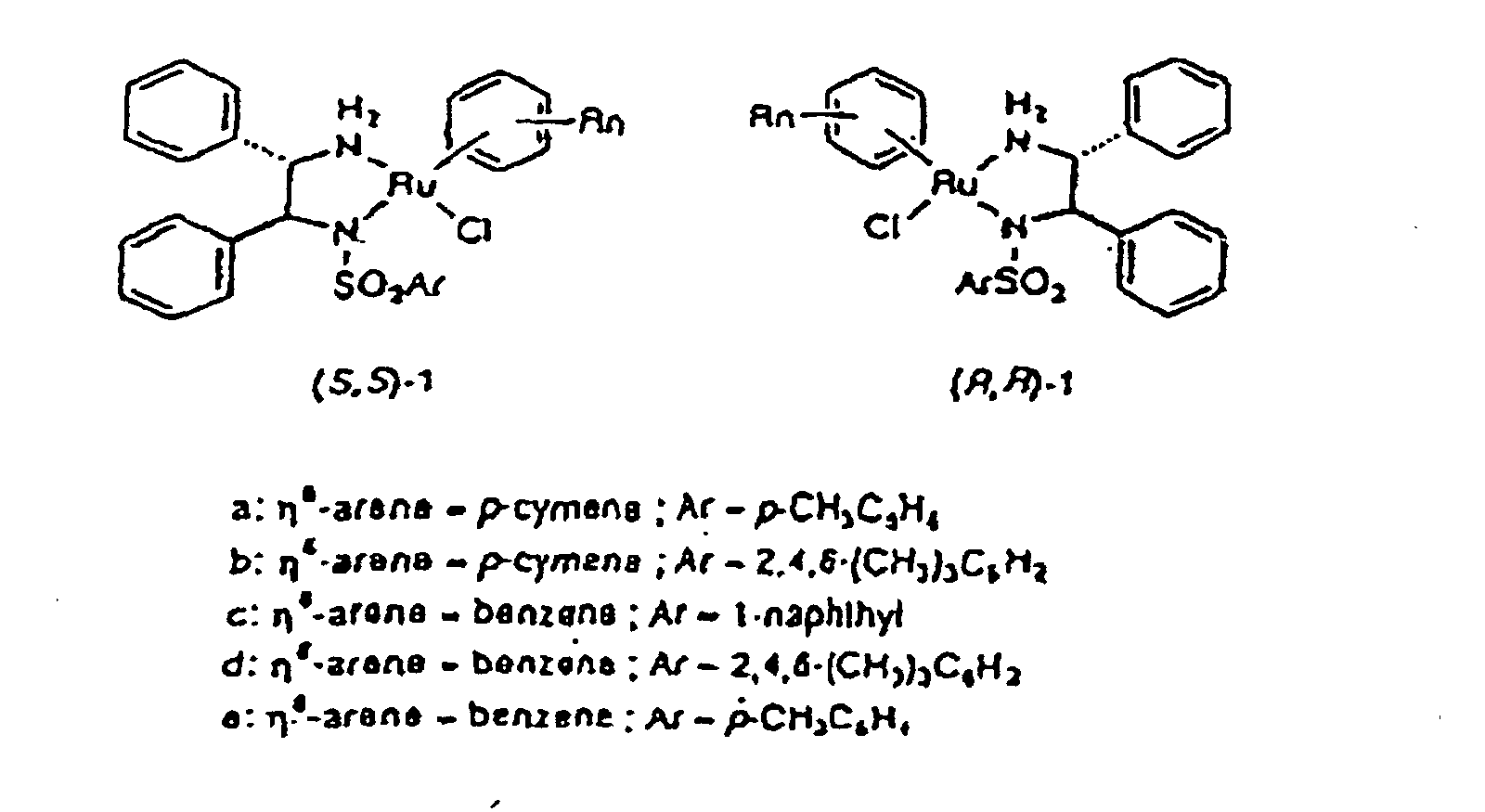
along with formic acid and triethylamine, to produce an optically active compound represented by the following formula (II);
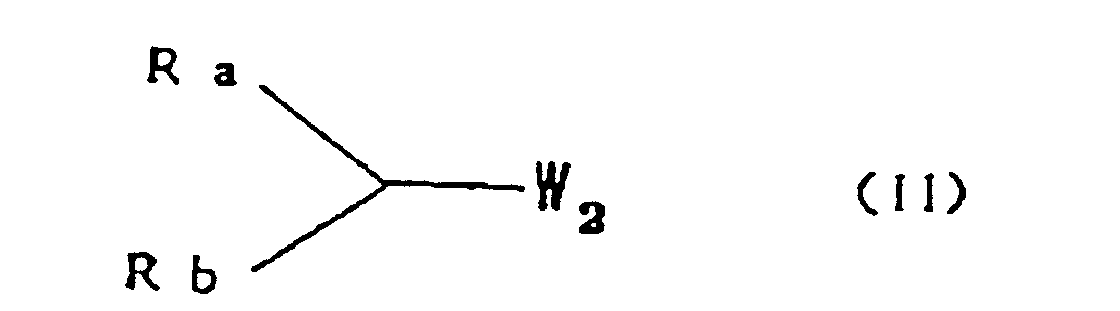
wherein Ra and Rb and Rc represent the same as those described above; and W2 represents NH2 or NH-Rc.
wherein Ra and Rb independently represent a linear or cyclic hydrocarbon group or heterocyclic group, which may or may not have a substituent; W1 represents N-H or N-Rc; and Rc represents a linear or cyclic hydrocarbon group or heterocyclic group, which may or may not have a substituent; or Ra and Rb, Ra and Rc or Rb and Rc may optionally be bonded together to form a saturated or unsaturated cyclic imine; to transfer-type asymmetric reduction in the presence of a ruthenium metal complex of the following formulae:
along with formic acid and triethylamine, to produce an optically active compound represented by the following formula (II);
wherein Ra and Rb and Rc represent the same as those described above; and W2 represents NH2 or NH-Rc.
2. A method for producing optically active amines according to claim 1, comprising asymmetrically
reducing an imine compound represented by the following formula (V);
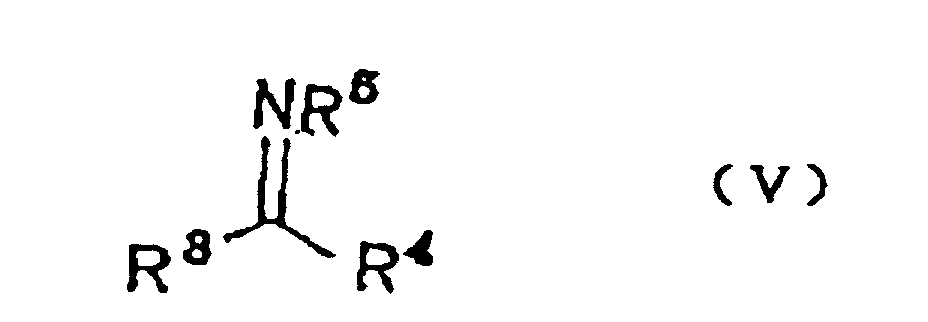
wherein R3 represents an aromatic hydrocarbon groups a saturated or unsaturated aliphatic hydrocarbon group or cyclic aliphatic hydrocarbon group, which may or may not have a substituent, or a heterocyclic group which may or may not have a substituent and contains hetero atoms selected from the list consisting of nitrogen, oxygen and sulfur as atoms composing the ring; R4 represents a saturated or unsaturated aliphatic hydrocarbon group or cyclic aliphatic hydrocarbon group which may or may not have a substituent, or an aromatic hydrocarbon group, or the same heterocyclic group as described above; R5 represents hydrogen atom, or a saturated or unsaturated aliphatic hydrocarbon group or cyclic aliphatic hydrocarbon group, which may or may not have a substituent, or an aromatic hydrocarbon group, or the same heterocyclic group as described above, or the hydrocarbon group or heterocyclic group bonded together via hydroxyl group or oxygen atom; and R3 and R4, R3 and R5 or R4 and R5, are bonded together to form a ring, to produce optically active amines represented by the following formula (VI);
wherein R3, R4 and R5 are the same as described above.
wherein R3 represents an aromatic hydrocarbon groups a saturated or unsaturated aliphatic hydrocarbon group or cyclic aliphatic hydrocarbon group, which may or may not have a substituent, or a heterocyclic group which may or may not have a substituent and contains hetero atoms selected from the list consisting of nitrogen, oxygen and sulfur as atoms composing the ring; R4 represents a saturated or unsaturated aliphatic hydrocarbon group or cyclic aliphatic hydrocarbon group which may or may not have a substituent, or an aromatic hydrocarbon group, or the same heterocyclic group as described above; R5 represents hydrogen atom, or a saturated or unsaturated aliphatic hydrocarbon group or cyclic aliphatic hydrocarbon group, which may or may not have a substituent, or an aromatic hydrocarbon group, or the same heterocyclic group as described above, or the hydrocarbon group or heterocyclic group bonded together via hydroxyl group or oxygen atom; and R3 and R4, R3 and R5 or R4 and R5, are bonded together to form a ring, to produce optically active amines represented by the following formula (VI);
wherein R3, R4 and R5 are the same as described above.
1. Verfahren zur Herstellung optisch aktiver Verbindungen, bei dem man eine Verbindung
der folgenden Formel (I)
worin Ra und Rb unabhängig für eine lineare oder cyclische Kohlenwasserstoffgruppe oder eine heterocyclische Gruppe stehen, die gegebenenfalls einen Substituenten trägt; W1 für N-H oder N-Rc steht; und Rc für eine lineare oder cyclische Kohlenwasserstoffgruppe oder eine heterocyclische Gruppe steht, die gegebenenfalls einen Substituenten trägt; oder Ra und Rb, Ra und Rc oder Rb und Rc gegebenenfalls unter Ausbildung eines gesättigten oder ungesättigten cyclischen Imins miteinander verbunden sind; in Gegenwart eines Rutheniummetallkomplexes der folgenden Formeln:
zusammen mit Ameisensäure und Triethylamin einer asymmetrischen Transfer-Reduktion unterzieht, wobei man eine optisch aktive Verbindung der folgenden Formel (II) erhält
worin Ra und Rb und Rc die oben angegebenen Bedeutungen haben; und W2 für NH2 oder NH-Rc steht.
worin Ra und Rb unabhängig für eine lineare oder cyclische Kohlenwasserstoffgruppe oder eine heterocyclische Gruppe stehen, die gegebenenfalls einen Substituenten trägt; W1 für N-H oder N-Rc steht; und Rc für eine lineare oder cyclische Kohlenwasserstoffgruppe oder eine heterocyclische Gruppe steht, die gegebenenfalls einen Substituenten trägt; oder Ra und Rb, Ra und Rc oder Rb und Rc gegebenenfalls unter Ausbildung eines gesättigten oder ungesättigten cyclischen Imins miteinander verbunden sind; in Gegenwart eines Rutheniummetallkomplexes der folgenden Formeln:
zusammen mit Ameisensäure und Triethylamin einer asymmetrischen Transfer-Reduktion unterzieht, wobei man eine optisch aktive Verbindung der folgenden Formel (II) erhält
worin Ra und Rb und Rc die oben angegebenen Bedeutungen haben; und W2 für NH2 oder NH-Rc steht.
2. Verfahren zur Herstellung optisch aktiver Amine nach Anspruch 1, bei dem man eine
Iminverbindung der folgenden Formel (V) asymmetrisch reduziert
worin R3 für eine aromatische Kohlenwasserstoffgruppe, eine gesättigte oder ungesättigte aliphatische Kohlenwasserstoffgruppe oder eine cyclische aliphatische Kohlenwasserstoffgruppe, die gegebenenfalls einen Substituenten trägt, oder eine heterocyclische Gruppe, die gegebenenfalls einen Substituenten trägt und unter Stickstoff, Sauerstoff und Schwefel ausgewählte Heteroatome als den Ring aufbauende Atome enthält, steht; R4 für eine gesättigte oder ungesättigte aliphatische Kohlenwasserstoffgruppe oder eine cyclische aliphatische Kohlenwasserstoffgruppe, die gegebenenfalls einen Substituenten trägt, eine aromatische Kohlenwasserstoffgruppe oder eine vorstehend beschriebene heterocyclische Gruppe steht; R5 für ein Wasserstoffatom, eine gesättigte oder ungesättigte aliphatische Kohlenwasserstoffgruppe oder cyclische aliphatische Kohlenwasserstoffgruppe, die gegebenenfalls einen Substituenten trägt, eine aromatische Kohlenwasserstoffgruppe oder eine vorstehend beschriebene heterocyclische Gruppe oder eine über eine Hydroxylgruppe oder ein Sauerstoffatom gebundene Kohlenwasserstoffgruppe oder heterocyclische Gruppe steht; und R3 und R4, R3 und R5 oder R4 und R5 unter Bildung eines Rings miteinander verbunden sind, wobei man optisch aktive Amine der folgenden Formel (VI) erhält
worin R3, R4 und R5 die oben angegebenen Bedeutungen haben.
worin R3 für eine aromatische Kohlenwasserstoffgruppe, eine gesättigte oder ungesättigte aliphatische Kohlenwasserstoffgruppe oder eine cyclische aliphatische Kohlenwasserstoffgruppe, die gegebenenfalls einen Substituenten trägt, oder eine heterocyclische Gruppe, die gegebenenfalls einen Substituenten trägt und unter Stickstoff, Sauerstoff und Schwefel ausgewählte Heteroatome als den Ring aufbauende Atome enthält, steht; R4 für eine gesättigte oder ungesättigte aliphatische Kohlenwasserstoffgruppe oder eine cyclische aliphatische Kohlenwasserstoffgruppe, die gegebenenfalls einen Substituenten trägt, eine aromatische Kohlenwasserstoffgruppe oder eine vorstehend beschriebene heterocyclische Gruppe steht; R5 für ein Wasserstoffatom, eine gesättigte oder ungesättigte aliphatische Kohlenwasserstoffgruppe oder cyclische aliphatische Kohlenwasserstoffgruppe, die gegebenenfalls einen Substituenten trägt, eine aromatische Kohlenwasserstoffgruppe oder eine vorstehend beschriebene heterocyclische Gruppe oder eine über eine Hydroxylgruppe oder ein Sauerstoffatom gebundene Kohlenwasserstoffgruppe oder heterocyclische Gruppe steht; und R3 und R4, R3 und R5 oder R4 und R5 unter Bildung eines Rings miteinander verbunden sind, wobei man optisch aktive Amine der folgenden Formel (VI) erhält
worin R3, R4 und R5 die oben angegebenen Bedeutungen haben.
1. Procédé de production de composés optiquement actifs, comprenant la soumission d'un
composé représenté par la formule (I) suivante :
dans laquelle Ra et Rb représentent indépendamment un groupe hydrocarbure linéaire ou cyclique ou un groupe hétérocyclique, lequel groupe peut être substitué ou non substitué ; W1 représente N-H ou N-Rc ; et Rc représente un groupe hydrocarbure linéaire ou cyclique ou un groupe hétérocyclique, lequel groupe peut être substitué ou non substitué ; ou Ra et Rb, Ra et Rc ou Rb et Rc peuvent être éventuellement liés pour former une imine cyclique saturée ou insaturée ;
à une réduction asymétrique de type transfert en présence d'un complexe métallique de ruthénium des formules suivantes :
avec de l'acide formique et de la triéthylamine, pour produire un composé optiquement actif représenté par la formule (II) suivante:
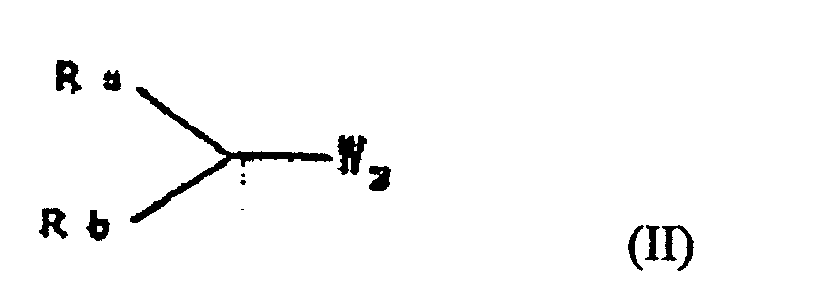
dans laquelle Ra et Rb et Rc sont tels que définis ci-dessus ; et W2 représente NH2 ou NH-Rc.
dans laquelle Ra et Rb représentent indépendamment un groupe hydrocarbure linéaire ou cyclique ou un groupe hétérocyclique, lequel groupe peut être substitué ou non substitué ; W1 représente N-H ou N-Rc ; et Rc représente un groupe hydrocarbure linéaire ou cyclique ou un groupe hétérocyclique, lequel groupe peut être substitué ou non substitué ; ou Ra et Rb, Ra et Rc ou Rb et Rc peuvent être éventuellement liés pour former une imine cyclique saturée ou insaturée ;
à une réduction asymétrique de type transfert en présence d'un complexe métallique de ruthénium des formules suivantes :
avec de l'acide formique et de la triéthylamine, pour produire un composé optiquement actif représenté par la formule (II) suivante:
dans laquelle Ra et Rb et Rc sont tels que définis ci-dessus ; et W2 représente NH2 ou NH-Rc.
2. Procédé de production d'amines optiquement actives selon la revendication 1, comprenant
une réduction asymétrique d'un composé imine représenté par la formule (V) suivante
:
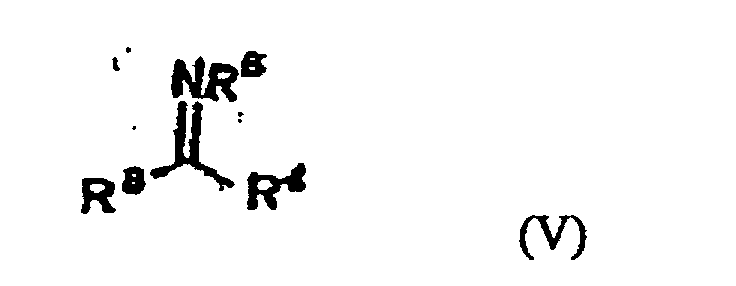
dans laquelle R3 représente un groupe hydrocarbure aromatique, un groupe hydrocarbure aliphatique saturé ou insaturé ou un groupe hydrocarbure aliphatique cyclique, lequel groupe peut être substitué ou non substitué, ou un groupe hétérocyclique, lequel groupe peut être substitué ou non substitué et comprendre des hétéroatomes choisis dans le groupe consistant en les atomes d'azote, les atomes d'oxygène et les atomes de soufre comme atomes composant le cycle ; R4 représente un groupe hydrocarbure aliphatique saturé ou insaturé ou un groupe hydrocarbure aliphatique cyclique, lequel groupe peut être substitué ou non substitué, ou un groupe hydrocarbure aromatique, ou le même groupe hétérocyclique que celui décrit ci-dessus ; R5 représente un atome d'hydrogène ou un groupe hydrocarbure aliphatique saturé ou insaturé ou un groupe hydrocarbure aliphatique cyclique, lequel groupe peut être substitué ou non substitué, ou un groupe hydrocarbure aromatique, ou le même groupe hétérocyclique que celui décrit ci-dessus, ou le groupe hydrocarbure ou le groupe hétérocyclique lié ensemble par un groupe hydroxyle ou un atome d'oxygène ; et R3 et R4, R3 et R5 ou R4 et R5 sont liés ensemble pour former un cycle, pour produire des amines optiquement actives représentées par la formule (VI) suivante :
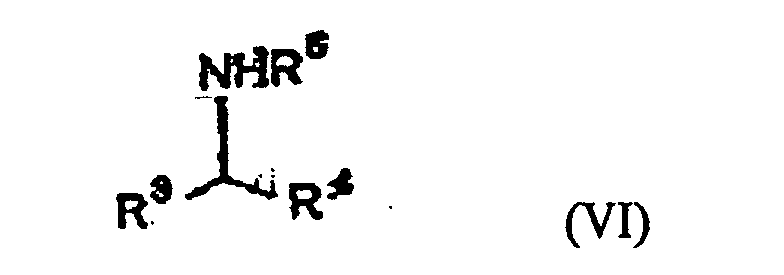
dans laquelle R3, R4 et R5 sont tels que définis ci-dessus.
dans laquelle R3 représente un groupe hydrocarbure aromatique, un groupe hydrocarbure aliphatique saturé ou insaturé ou un groupe hydrocarbure aliphatique cyclique, lequel groupe peut être substitué ou non substitué, ou un groupe hétérocyclique, lequel groupe peut être substitué ou non substitué et comprendre des hétéroatomes choisis dans le groupe consistant en les atomes d'azote, les atomes d'oxygène et les atomes de soufre comme atomes composant le cycle ; R4 représente un groupe hydrocarbure aliphatique saturé ou insaturé ou un groupe hydrocarbure aliphatique cyclique, lequel groupe peut être substitué ou non substitué, ou un groupe hydrocarbure aromatique, ou le même groupe hétérocyclique que celui décrit ci-dessus ; R5 représente un atome d'hydrogène ou un groupe hydrocarbure aliphatique saturé ou insaturé ou un groupe hydrocarbure aliphatique cyclique, lequel groupe peut être substitué ou non substitué, ou un groupe hydrocarbure aromatique, ou le même groupe hétérocyclique que celui décrit ci-dessus, ou le groupe hydrocarbure ou le groupe hétérocyclique lié ensemble par un groupe hydroxyle ou un atome d'oxygène ; et R3 et R4, R3 et R5 ou R4 et R5 sont liés ensemble pour former un cycle, pour produire des amines optiquement actives représentées par la formule (VI) suivante :
dans laquelle R3, R4 et R5 sont tels que définis ci-dessus.