| (19) |
 |
|
(11) |
EP 0 922 309 B1 |
| (12) |
EUROPEAN PATENT SPECIFICATION |
| (45) |
Mention of the grant of the patent: |
|
21.03.2001 Bulletin 2001/12 |
| (22) |
Date of filing: 11.04.1997 |
|
| (86) |
International application number: |
|
PCT/EP9701/825 |
| (87) |
International publication number: |
|
WO 9741/609 (06.11.1997 Gazette 1997/47) |
|
| (54) |
A METHOD AND A DEVICE TO OBTAIN THE AGITATION OF ELECTROLYTE INSIDE A LEAD-ACID STORAGE
BATTERY
VERFAHREN UND VORRICHTUNG ZUM RÜHREN DES ELEKTROLYTEN IN EINER BLEI-SÄURE SPEICHERBATTERIE
PROCEDE ET DISPOSITIF D'AGITATION D'UN ELECTROLYTE A L'INTERIEUR D'UNE BATTERIE D'ACCUMULATEURS
AU PLOMB
|
| (84) |
Designated Contracting States: |
|
AT BE DE DK ES FR GB IE IT LU NL PT SE |
| (30) |
Priority: |
26.04.1996 IT VI960069
|
| (43) |
Date of publication of application: |
|
16.06.1999 Bulletin 1999/24 |
| (73) |
Proprietor: Stocchiero, Olimpio |
|
36050 Montorso Vicentino (IT) |
|
| (72) |
Inventor: |
|
- Stocchiero, Olimpio
36050 Montorso Vicentino (IT)
|
| (74) |
Representative: Bonini, Ercole |
|
c/o STUDIO ING. E. BONINI SRL
Corso Fogazzaro 8
36100 Vicenza
36100 Vicenza (IT) |
| (56) |
References cited: :
FR-A- 877 555
US-A- 4 288 501
|
US-A- 4 269 906
|
|
| |
|
|
- PATENT ABSTRACTS OF JAPAN vol. 007, no. 062 (E-164), 15 March 1983 & JP 57 210564
A (SHINKOUBE DENKI KK), 24 December 1982,
- PATENT ABSTRACTS OF JAPAN vol. 011, no. 204 (E-520), 2 July 1987 & JP 62 029060 A
(JAPAN STORAGE BATTERY CO LTD), 7 February 1987,
- PATENT ABSTRACTS OF JAPAN vol. 011, no. 341 (E-554), 7 November 1987 & JP 62 122058
A (JAPAN STORAGE BATTERY CO LTD), 3 June 1987,
- PATENT ABSTRACTS OF JAPAN vol. 006, no. 211 (E-137), 23 October 1982 & JP 57 115760
A (NIHON DENCHI KK), 19 July 1982,
- PATENT ABSTRACTS OF JAPAN vol. 007, no. 062 (E-164), 15 March 1983 & JP 57 208063
A (NIHON DENCHI KK), 21 December 1982,
|
|
| |
|
| Note: Within nine months from the publication of the mention of the grant of the European
patent, any person may give notice to the European Patent Office of opposition to
the European patent
granted. Notice of opposition shall be filed in a written reasoned statement. It shall
not be deemed to
have been filed until the opposition fee has been paid. (Art. 99(1) European Patent
Convention).
|
[0001] The invention concerns a method and device to realize the agitation of electrolyte
inside a lead-acid storage battery.
[0002] It is a known fact that during the recharging process of the lead-acid storage battery
fumes develop, especially hydrogen, which sometimes remain adherent to the plates,
thus preventing the dissolution of the lead sulfate and the restoration of the balance
in the battery. It is important then to activate a circulation or an agitation of
electrolyte which can prevent fume bubbles from forming and accumulating during the
charging process.
[0003] According to a known technique, in order to overcome such incoveniences, and also
to accelerate the charging times, the agitation of electrolyte is achieved by blowing
air inside the box containing the electrolyte during the charging process. In such
a way, a mixing of electrolyte, with a consequent uniformity of its density at the
various levels of the storage-battery is obtained. The purpose which the invention
proposes is to obtain an agitation of electrolyte inside a lead-acid storage battery
during the charging process wherein such an agitation occurs without blowing air or
other gasses from the exterior inside the electrolyte .
[0004] The main purpose of the invention and others which will be better pointed out hereinafter,
are achieved by the proposed method and device to obtain the agitation of electrolyte
inside a lead-acid storage battery comprising at least one canalization duct of electrolyte
which is immersed inside the storage battery wherein said method and device are characterized
as set out in the appended claims.
[0005] During a recharging process one or more storage batteries are connected to the device
of the pressure variation, these being equipped each with one canalization duct, for
instance a vertical pipe which sticks out of the lid of the storage battery. With
a device for the pressure variation during the suction phase of said device, the electrolyte
is made to go up along the canalization duct while, when the pressure returns to its
normal values, the electrolyte comes down back to its original level. In realizing
this variation of pressure with repetitive cycles and with a certain frequency, the
electrolyte contained inside the storage battery is constantly pushed upwards and
dropping down.
[0006] The consequent agitation of electrolyte causes a uniformity of density of electrolyte
at the various levels of the box of the storage battery and also a stripping action
on the electrolyte plates with a consequent removal of possible hydrogen fume bubbles
which form during the recharge. This action of movement of electrolyte causes a decrease
of the charging time and also a better uniformity of the charge of the plates with
a consequent extension of the life span of the storage battery.
[0007] Further scope of applicability of the present invention will become apparent from
the detailed description given hereinafter. However, it should be understood that
the detailed description and specific example, while indicating a preferred embodiment
of the invention, are given by way of illustration only, since various changes and
modifications within the scope of the invention will become apparent to those skilled
in the art from this detailed description and from the drawings, wherein:
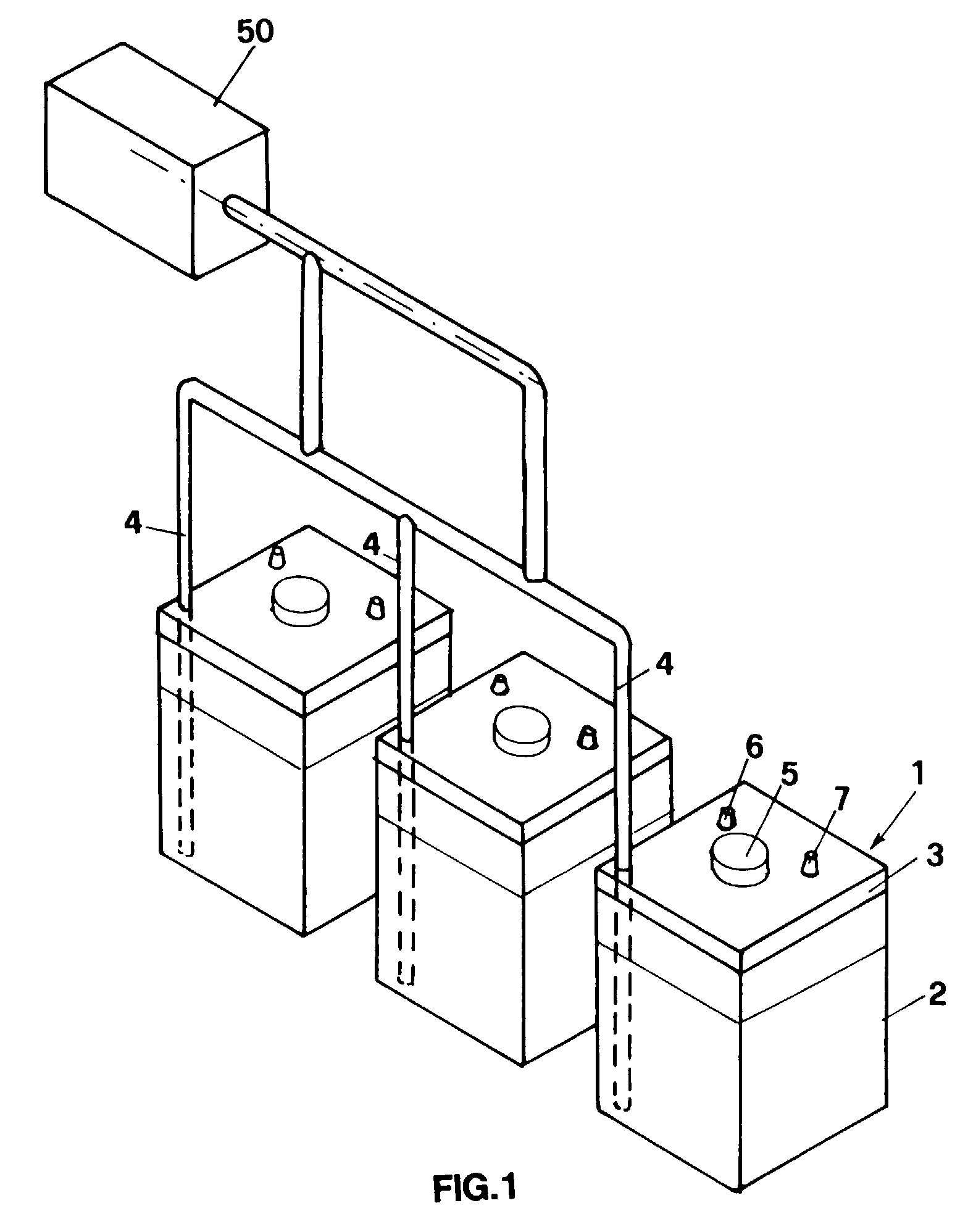
- Fig. 1 shows in a prospective view three storage batteries connected with a device
suited to realize the method of agitation of electrolyte according to the invention;
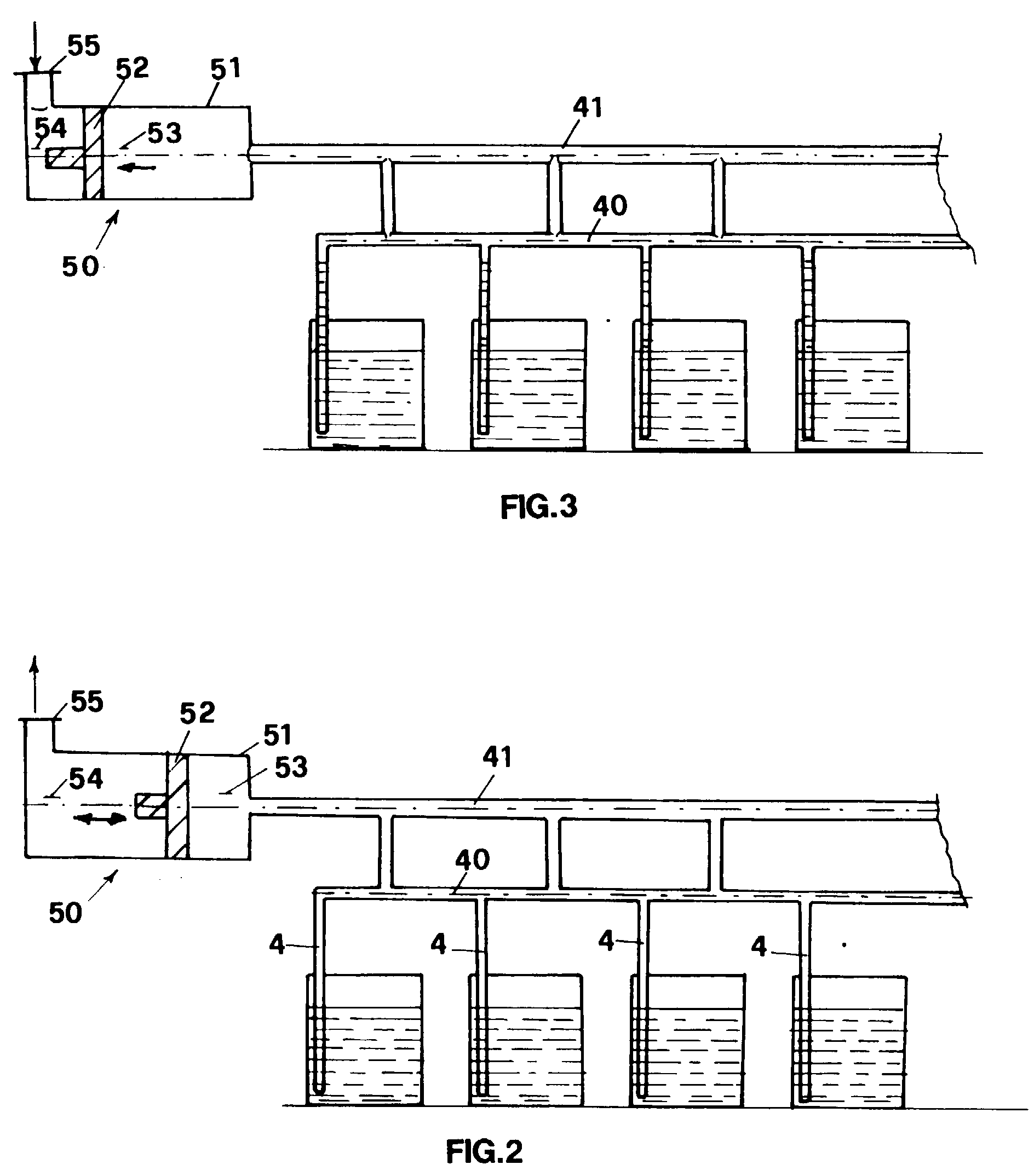
- Fig. 2 shows in a cross-section an application sketch of the method according to the
invention before the decreasing phase of the pressure inside the storage batteries;
- Fig. 3 shows the drawing of Fig. 2 during the phase of maximum decrease of the pressure
inside the storage battery.
[0008] With reference to the mentioned Figures, it can be observed that each container,
indicated as a whole with 1, presents a box 2 and a lid 3 sealed on box 2. Each storage
battery 1 is also equipped with a canalization duct of electrolyte, indicated with
4. Each storage battery also presents a topping up hole for the electrolyte provided
with a seal-tight cap 5 besides the two poles 6 and 7. During the recharging phase
of the storage batteries, several storage batteries are connected with one another,
each in correspondence with the canalization ducts 4 by means of tubes 40 and 41 which
are connected to the device 50 which realizes the alternative cycles of the pressure
variation inside each container 1.
[0009] As can be observed in the Figs. from 2 to 3, the device 50 consists of a cylinder
51 inside which a piston 52 slides alternatively, driven by known means not represented
in the drawing. In correspodence with the head of the cylinder there is an opening
connected to duct 41 and, therefore, to each canalization duct 4 of electrolyte. As
can be observed in Fig. 3, once piston 52 has moved in the direction opposite to the
entrance duct 41, the electrolyte will raise in the canalization ducts 4 in order
to realize a variation in volume whose total value is equal to the variation in volume
of the space 53 created by the stroke of piston 52. In the meantime, the air contained
in the inner space 54 comes out of valve 55. Piston 52 then reverts its stroke, without
uncovering the port of valve 55 in space 53, so that the intial pressure inside the
containers 1 is restored and, therefore, the electrolyte drops down to its inital
level, as can be observed in Fig. 2.
[0010] It is clear that by varying the frequency of the strokes of piston 52 it is possible
to obtain a variation in the frequency of the ascent and descent of electrolyte and,
therefore, of the degree of agitation of the electrolyte itself. Of course, the devices
which realize repetitive and alternative cycles of the pressure decrease and the return
to the initial pressure can differ from the one now described. However, an important
fact is still present, that is in this way the electrolyte is agitated and, therefore,
there is a mixing of the electrolyte itself, with a levelling in the electrolyte density
and moreover, there will be a removal of possible fume bubbles which had remained
adherent to the plates.
1. A method to obtain the agitation of the electrolyte inside a group of lead-acid storage
batteries, said batteries comprising each one at least one canalisation duct (4) of
electrolyte immersed inside the storage battery and emerging from the lid of said
battery,
characterized in that it consists in:
- connecting each of said canalisation ducts (4) through tubes (40, 41) with a device
(50) suited to carry out repetitive and alternative cycles of pressure decrease and
of return to the initial pressure in the section of tubes (40, 41) which connects
said device to said canalisation ducts, said cycles causing the movement of the electrolyte
which is sucked and dropped respectively, in said canalisation ducts.
2. A device for carrying out the method of claim 1), comprising a cylinder (51) with
a piston (52) alternatively moved by actuating means, said cylinder being in communication
with a duct (41) from which canalisation ducts (4) depart to reach each storage battery
(1), each of said canalisation duct (4) being partially immersed inside each container
of said storage battery (1) and partially outside the lid of said storage battery.
3. The device of claim 2, characterized in that the lid (3) of each storage battery (1) is sealed with the box (2) with which is
connected, said lid presenting a topping up hole for the filling of the electrolyte
with a seal-tight cap (5).
1. Eine Methode zur Erzielung der Rührung der Füllsäure in einer Gruppe von Bleisäure-Akkumulatorenbatterien,
wobei jede dieser Batterien wenigstens einen in der Akkumulatorenbatterie versenkten
Füllsäure-Durchgang (4), der aus dem Deckel dieser Batterie auftaucht, aufweist,
dadurch gekennzeichnet, dass sie aus folgendem besteht:
- Verbindung jeden der genannten Durchgänge (4) durch Röhren (40, 41) mit einer Vorrichtung
(50), die geeignet ist, sich wiederholende und abwechselnde Druckminderungszyklen
und der Rückkehr zum Anfangsdruck in dem Abschnitt der Röhren (40, 41) auszuführen,
welcher diese Vorrichtung mit den Durchgängen verbindet, wobei diese Zyklen die Bewegung
der Füllsäure verursachen, die in den Durchgängen jeweils angesaugt wird und wieder
heruntertropft.
2. Vorrichtung zur Ausführung der Methode aus Patentanspruch 1), die folgendes umfasst
einen Zylinder (51) mit einem Kolben (52), der abwechselnd durch Antriebsmittel bewegt
wird, wobei dieser Zylinder mit einer Leitung (41) kommuniziert, aus der Durchgänge
(4) ausgehen, um jede Akkumulatorenbatterie (1) zu erreichen, wobei jeder dieser Durchgänge
(4) teilweise in jedem Behälter der Akkumulatorenbatterie (1) versenkt ist und teilweise
aus dem Deckel dieser Akkumulatorenbatterie herausragt.
3. Vorrichtung gemäß Patentanspruch 1), dadurch gekennzeichnet, dass der Deckel (3) jeder Akkumulatorenbatterie (1) mit dem Kasten (2) verschweißt ist,
mit dem er verbunden ist, wobei dieser Deckel eine Nachfüllöffnung zum Einfüllen der
Füllsäure mit einer dicht abschließenden Kappe (5) aufweist.
1. Une méthode pour obtenir l'agitation de l'électrolyte à l'intérieur d'un groupe d'accumulateurs
au plomb, chacun desdits accumulateurs comprenant au moins un conduit de canalisation
(4) de l'électrolyte plongé à l'intérieur de l'accumulateur et émergeant du couvercle
dudit accumulateur,
caractérisée en ce qu'elle consiste à:
- relier chacun desdits conduits de canalisation (4) au moyen de tuyaux (40, 41) à
un dispositif (50) indiqué pour réaliser des cycles répétitifs et alternatifs pour
la diminution de la pression et de retour à la pression initiale dans la section des
tuyaux (40, 41), qui relie ledit dispositif auxdits conduits de canalisation, lesdits
cycles causant le mouvement de l'électrolyte qui est respectivement aspiré et fait
tomber dans lesdits conduits de canalisation.
2. Un dispositif pour la réalisation de la méthode de la revendication 1) comprenant
un cylindre (51) avec un piston (52) déplacé alternativement par des moyens d'actionnement,
ledit cylindre étant en communication avec un conduit (41) duquel des conduits de
canalisation (4) partent pour atteindre chaque accumulateur (1), chacun desdits conduits
de canalisation (4) étant partiellement plongé à l'intérieur de chaque boîtier dudit
accumulateur (1) et partiellement à l'extérieur du couvercle dudit accumulateur.
3. Le dispositif de la revendication 2), caractérisé en ce que le couvercle (3) de chaque accumulateur (1) est fixé hermétiquement au boîtier (2)
avec lequel il est relié, ledit couvercle présentant un trou pour le remplissage de
l'électrolyte avec un bouchon de fermeture étanche (5).