| (19) |
 |
|
(11) |
EP 0 936 593 B1 |
| (12) |
EUROPEAN PATENT SPECIFICATION |
| (45) |
Mention of the grant of the patent: |
|
22.10.2003 Bulletin 2003/43 |
| (22) |
Date of filing: 13.02.1998 |
|
|
| (54) |
Dynamical visual presentation of marks on motor vehicles and rider
Dynamische visuelle Darstellung von Zeichen auf Motorfahrzeugen und Fahrer
Présentation dynamique visuelle des marques sur des véhicules à moteur et sur le conducteur
|
| (84) |
Designated Contracting States: |
|
AT BE CH DE DK ES FI FR GB GR IE IT LI LU MC NL PT SE |
| (43) |
Date of publication of application: |
|
18.08.1999 Bulletin 1999/33 |
| (73) |
Proprietor: NORDERSON Limited |
|
Oxford OX1 2AJ (GB) |
|
| (72) |
Inventor: |
|
- RAGAZZI, Barbara
35141 Padova (IT)
|
| (74) |
Representative: Sassatelli, Franco T., Dr. et al |
|
c/o INIP
5, via Ruggi
40137 Bologna
40137 Bologna (IT) |
| (56) |
References cited: :
EP-A- 0 703 558
DE-U- 29 717 560
|
DE-U- 9 215 519
FR-A- 2 648 604
|
|
| |
|
|
|
|
| |
|
| Note: Within nine months from the publication of the mention of the grant of the European
patent, any person may give notice to the European Patent Office of opposition to
the European patent
granted. Notice of opposition shall be filed in a written reasoned statement. It shall
not be deemed to
have been filed until the opposition fee has been paid. (Art. 99(1) European Patent
Convention).
|
[0001] The invention refers to a new method realizing an industrial advancement in the advertisement
field of the stamping of marks or other commercial images to be used both on saddle-mounted
motor vehicles and on the clothing of the riders. Said method permits to have a full
field of view using jointly the parts of the vehicle and of the rider to form a support
for the marks to be stamped. This because the stamping (mark or other advertising
image) is deformed in such a way to adapt it to different supports (motor vehicle
and rider clothing) so to give a correct visual perception of the same from a perspective
and full point of view. Another feature that the invented method permits, is that,
as the stamping is placed on two fixed parts, i.e. two sectors of the vehicle, and
on a moving part, i.e. the rider and its clothing, the rider movement during the motor-vehicle
run causes the movement of the stamping supports where said movement arranges and
disarranges the image composition continuously through a process which allows to see
said image always in a correct way. The above state phenomenology -which takes place
in the central part of the stamping- determines a dynamic perception of the same image.
Thus, a blown-up three dimensional view of the stamping is observed by the onlookers
and in this way the perception of the advertisement massage remains vivid, relevant
and time-lasting. The invented method to be applied in the sports and hobbies motovehicles,
such a racing motor-cycles, touring motor-cycles, cross country motor cycles, mopeds,
sidecars, water motor-cycles, go-kart and all types of saddle-mounted vehicles. The
patent motivation is to be seen in the fact that the known art considering the rider's
body like a breaking of full image visual field, determines the division of said field
so permitting the stamping of the marks, or other similar ones, only in a separate
way onto the three different parts of the vehicle; for this reason only small size
stampings can be used, which are seen by the onlooker only like a whole fixed image
inside a moving complex formed by the rider and by the motor-cycle, while the said
marks come to form only secondary image references. The invented method considers
the motor-vehicle and the rider as an only body so forming an only exhibition space
where the vehicle mechanical parts, the vehicle body and the clothing and accessories
of the rider come to be used as a support on which the stamping is to be placed. While,
with the vehicle without the rider, the stamping can be seen in the same zone by substituting
the image of the central mobile part (the rider) with another one printed on the fixed
part of the zone covered by the rider when in a driving position. The invented method
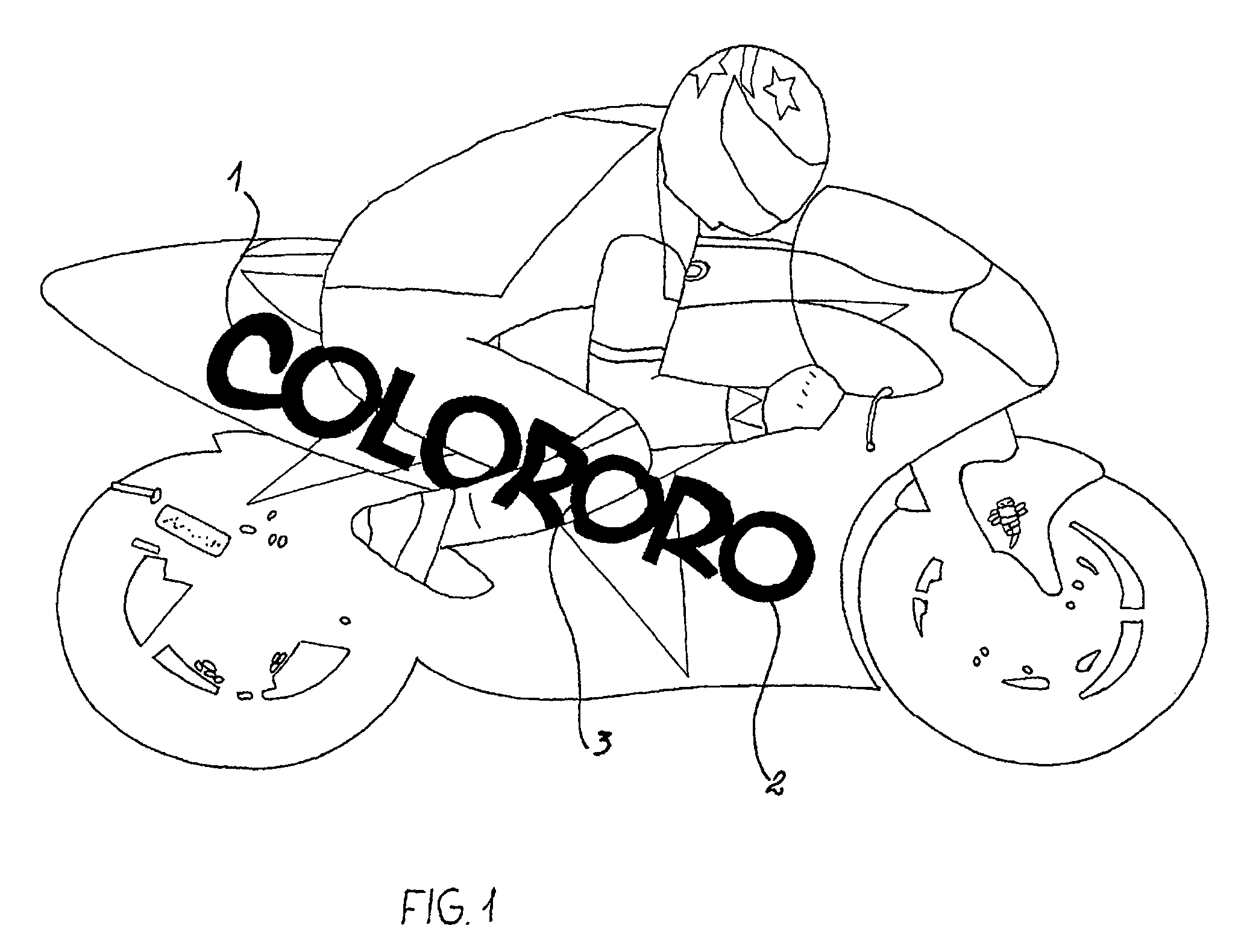
forms a full image field by two part on the vehicle, a back part 1 and a front part
2, separated by a mobile central part 3 formed by one or more elements corresponding
to the rider clothing. The said mobile central part 3 gives a dynamic effect to the
whole stamping thus creating a macroscopic, dynamical, three-dimensional view perception.
The invented method makes use of a scanner to receive three dimensional data or the
optical sensing of the existing models through which the three dimensional coordinates
-that make part of the physical model- are obtained, i.e. the motorcycle and the rider
dimensions. Subsequently, the three dimensional data at disposal as well as the mark
stamping data, i.e. all the necessary information about the mark or the image to be
stamped on, its size and the place where to put it, are entered in a computer with
a special software. The stated data are processed to obtain a complete image of the
deformed stamping as the said image gets the characteristics of the basic data (motor-cycle
- rider) or surface to be covered. Subsequently, the image thus obtained is applied
in the curved surface without its sight perception getting altered. An innovative
feature obtained with the invented method is the fact that the rider makes part of
a three dimensional advertisment message in motion. The method allows the fit one
or more stampings, even of several manufacturers, to all types of saddle-mounted motor-vehicle
and relative riders, or to any other appliance, as the said stamping can be stamped
considering void spaces as full spaces and all the vehicle parts as forming an only
surface on which the images to be advertised are projected. In order to allow a correct
view of the real deformed image, the present method provides in the case of the vehicle
without the rider feature, in the vehicle zone where the rider sits, as a substitution
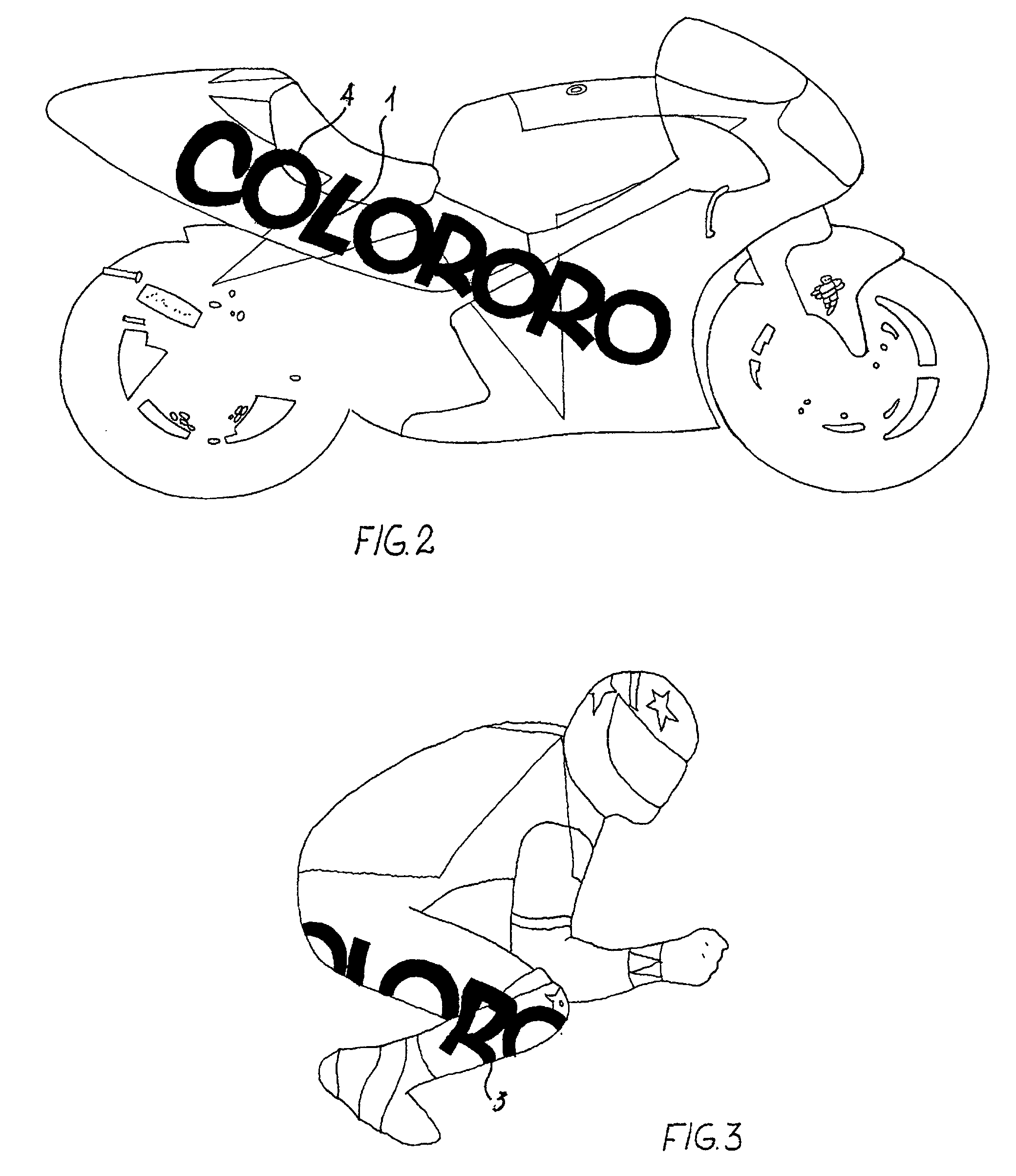
of the stamping portion of lacking central part 3, another stamping part 4 deformed
according to the surface on which is must be stamped. An embodiment obtained with
the invented method is illustrated by way of example in the drawings of sheets 1 and
2. In sheet 1 fig. 1 is a view of the racing motor-cycle with the rider having a mark
stamped in total view as seen by a hypothetical onlooker. In sheet 2 fig. 2 is a view
of the only motor-cycle as it appears in fig. 1 to allow the view of the mark even
without the rider. Fig. 3 is a view of the only rider in driving position with part
of the stamped on him. The method permits to pace the advertisement message even on
only fixed part 1 or 2 and on the mobile part sector 3 for all the possible views
available, i.e. side view, back-view, front-view, middle-view and top-view. All the
above stated views can be easily perceived by the onlookers during the races. When
put into effect, the invented method may feature other means to obtain a correct virtual
image according to the latest technology currently in use, as well as all stamping
means to means marks on motor-vehicles.
1. Method for the production of a "full field image of an advertisement mark" on a motor
vehicle with its rider in a riding position, comprising the steps of:
a) - collecting with a scanner dimensional data concerning the shape of the advertisement
mark;
b) - transferring said data into a computer;
c) - processing said scanned data in order to combine them with predetermined three-dimensional
coordinates of the vehicle with its rider;
and
d) - processing, by means of an appropriate software, the combined three-dimensional
data in order to produce a three-dimensional shape of a full field image of the mark,
which shape, when applied on the curved surface of the vehicle and its rider in riding
position, generates on a side observer, the perception of an undeformed full field
image (1,2,3), on the vehicle with the rider in riding position, of the originally
scanned advertisement mark.
2. Method according to claim 1, further characterized by the step of dividing the full field image of the advertising mark into three parts,
a back part (1) and a front part (2), on the vehicle separated by a central part (3)
formed by one or more elements corresponding to the rider clothing.
3. Method according to claim 2, further characterized the step of providing in the vehicle zone where the rider sits a substitution of
the stamping present on the rider clothing, a fourth part (4) stamped in conformity
with the shape of the vehicle, so as to allow a correct view in the case of the vehicle
without the rider.
4. Method according to claim 1, characterized by the step of limiting the advertisement mark to be stamped to only one part of the
vehicle (1 or 2) and on the part (3) corresponding to the rider clothing.
5. Method according to claim 2, further characterized by the step of selecting the locations for said three parts, so that the rider becomes
part of a three-dimensional advertisement message during motion.
1. Verfahren zum Herstellen einer "Abbildung mit vollem Betrachtungsbereich eines Werbezeichens"
auf einem Motorfahrzeug, dessen Fahrer sich in einer Fahrposition befind et, mit den
Schritten:
a) - Sammeln, mit einem Scanner, von Abmessungsdaten, die die Gestalt des Werbezeichens
betreffen;
b) - Uebertragen der Daten in einem Computer;
c) - Verarbeiten der gescannten Daten, um sie mit vorbestimmten dreidimensionalen
Koordinaten des Fahrzeugs mit seinem Fahrer zu kombinieren; und
d) - Verarbeiten, mit Hilfe einer geeigneten Software, der kombinierten dreidimensionalen
Daten,um eine dreidimensionale Gestalt einer Abbildung mit vollständigem Betrachtungsbereich
des Zeichens herzustellen, wobei diese Gestalt, wenn sie auf die gekrümmte Oberfläche
des Fahrzeugs und dessen in Fahrposition befindlichen Fahrers aufgebtract wird, für
einen seitlichen Beobachter die Wahrnehmung einer unverformten Abbildung (1, 2, 3)
mit vollständigem Betrachtungsbereich erzeugt, auf dem Fahrzeug, dessen Fahrer sich
in Fahrposition befindet, des ursprüglich eingescannten Werbezeichens.
2. Verfahren nach Anspruch 1, weiter gekennzeichnet durch den Schritt, daß die Abbildung mit vollständigem Betrachtungsbereich des Werbezeichens
in drei Teile aufgeteilt wird, einen hinteren Teil (1) und einen vorderen Teil (2),
auf dem Fahrzeug, getrennet durch einen zentralen Teil (3), der von einem oder mehreren Elementen gebildet wird, die
der Kleidung des Fahrers entsprechen.
3. Verfahren nach Anspruch 2, weiter gekennzeichnet durch den Schritt, daß in der Zone des Fahrzeugs, in der der Fahrer sitzt, ein Ersatz des
Aufdrucks oder aufgebrachten Gegenstands, der sich auf der Kleidung des Fahrers befindet,
bereitgestellt wird, wobei ein vierter Teil (4) entsprechend der Form der Fahrzeugs
aufgebracht wird, so daß die Möglichkeit einer zutreffenden Wahrnehmung im Falle,
daß sich dsa Fahrzeug ohne Fahrer befindet, gescahffen wird.
4. Verfahren nach Anspruch 1, gekennzeichnet durch den Schritt, daß das Werbezeichen, das auf lediglich einen Teil des Fahrzeuges (1
oder 2), und auf den Teil (3), der der Kleidung des Fahrers entspricht,aufzubringen
ist, beschränkt wird.
5. Verfahren nach Anspruch 2, weiter gekennzeichnet durch den Schritt, daß die Stellen für die genannten drei Teile ausgewählt werden, so daß
der Fahrer während der Bewegung ein Teil einer dreidimensionalen Werbebotschäft wird.
1. Présentation dynamique visuelle des marques sur des véhicules à moteur et sur le conducteur,
comprenant les étapes consistant à:
a) - recueillir avec un scanner des données dimensionnelles concernant la forme de
la marque publicitaire;
b) - transférer lesdites données dans un ordinateur;
c) - traiter lesdites données scannées afin de les combiner avec des coordonnées tridimensionnelles
prédéterminées du véhicule avec son conducteur;
et
d) - traiter, au moyen d'un logiciel approprié, les données tridimensionnelles combinées
afin de produire une forme tridimensionnelles combinées afin de produire une forme
tridimensionnelle d'une image plein champ de la marque, forme qui, lorsqu'elle est
appliquée sur la surface incurvée du véhicule et son conducteur en position de conduite,
crée pour un observateur placé sur le côté la perception d'une image plein champ non
déformée (1, 2, 3), sur le véhicule avec le conducteur en position de conduite, de
la marque publicitaire scannée au départ.
2. Présentation dynamique visuelle des marques sur des véhicules à moteur et sur le conducteur
selon la revendication 1, caractérisé en outre par l'étape consistant à diviser l'image plein champ de la marque publicitaire en trois
parties, une partie arrière (1), une partie avant (2), sur le véhicule séparé par
une partie centrale (3) formée d'un ou plusieurs éléments correspondant à l'équipement
vestimentaire du conducteur.
3. Présentation dynamique visuelle des marques sur des véhicules à moteur et sur le conducteur
selon la revendication 2, caractérisé en outre par l'étape consistant à fournir dans la zone du véhicule où s'assoi le conducteur une
substitution de l'impression présente sur l'équipement vestimentaire du conducteur,
une quatrième partie (4) imprimée en correspondance avec la forme du véhicule, de
façon à permettre une visualisation correcte en cas de véhicule sans le conducteur.
4. Présentation dynamique visuelle des marques sur des véhicules à moteur et sur le conducteur
selon la revendication 1, caractérisé en outre par l'étape consistant à limiter la marque publicitaire à imprimer à une seule partie
du véhicule (1 ou 2) et sur la partie (3) correspondant à l'équipement vestimentaire
du conducteur.
5. Présentation dynamique visuelle des marques sur des véhicules à moteur et sur le conducteur
selon la revendication 2, caractérisé en outre par l'étape consistant à choisir les emplacements desdites trois parties, afin que le
conducteur fasse partie du message publicitaire tridimensionnel pendant le déplacement.