|
(11) | EP 0 939 336 B1 |

| (12) | EUROPEAN PATENT SPECIFICATION |
|
|
| (54) |
New product and new process for obtaining industrial radiography Neues Erzeugnis und neues Verfahren für industrielle Radiographie Nouveau produit et nouveau procédé pour l'obtention de radiographies industrielles |
|
|
|||||||||||||||||||||||||||||||
| Note: Within nine months from the publication of the mention of the grant of the European patent, any person may give notice to the European Patent Office of opposition to the European patent granted. Notice of opposition shall be filed in a written reasoned statement. It shall not be deemed to have been filed until the opposition fee has been paid. (Art. 99(1) European Patent Convention). |
FIELD OF THE INVENTION
[0001] The present invention relates to a silver halide radiographic product intended for exposure to high-energy ionizing radiation, to a new radiographic system, and to a process for forming a radiographic image. In particular, the present invention relates to a product for high-energy industrial radiography, which has improved sensitivity.
BACKGROUND
[0002] Industrial radiography is a technique for non-destructive inspection and analysis of defects in parts such as items made with glass, paper, wood or metal. This technique is widely used in aeronautics, the nuclear industry, or the petroleum industry, because it enables the detection of defects in welding or in the texture of materials in parts for aircraft, nuclear reactors or pipelines.
[0003] This technique consists in the exposure to ionizing radiation, usually X or γ rays, of a radiographic product containing a silver halide emulsion. The sensitivity to X or γ rays of radiographic emulsions is due to the absorption of part of these rays by the silver halide grains, which causes a secondary emission of electrons that proceed to form an internal latent image. The radiographic product is then developed and fixed.
[0004] In contrast to medical radiographic films that are exposed by means of luminescent screens that reemit visible light, films for industrial radiography do not have to be sensitive to visible light, which is why they are not usually color sensitized. Films for industrial radiography are either exposed directly to the ionizing radiation, or exposed through an ionizing ray intensifying screen. These screens, usually of metal, increase the proportion of ionizing radiation absorbable by the silver halide grains.
[0005] Products for industrial radiography are usually composed of a silver halide emulsion comprising mainly thick grains (three-dimensional or cubic) in order to be able to absorb the maximum amount of ionizing radiation that crosses the emulsion layer.
[0006] Industrial radiography films comprising tabular grains emulsions are also known, such as those described for example in U.S. Patent 4,883,748 or EP 757,286.
[0007] US Patent 5,576,170 discloses a photographic element comprising a support with a silver halide emulsion layer, the emulsion further comprising an alkylamine compound and at least one dihydroxyaryl compound. The alkynylamine compound cannot be used alone since it increases the fog level.
SUMMARY OF THE INVENTION
[0008] The object of the present invention is to provide a new product for industrial radiography whose sensitometric properties are improved.
[0009] In one aspect this invention is directed to a radiographic product for industrial radiography having a silver coating coverage between 50 and 200 mg/dm2, which comprises a support having on at least one side thereof a silver halide emulsion layer exhibiting native silver halide spectral sensitivity and containing an alkynylamine of formula (I) in a quantity between 0.05 x 10⁻³ mol/mol Ag and 1 x 10⁻³ mol/mol Ag.
in which Y1 and Y2 each independently represent a hydrogen atom, an alkyl group or an aromatic nucleus, or Y1 and Y2 taken together represent the atoms necessary to form an aromatic or alicyclic ring substituted or not containing atoms selected from among carbon, oxygen, selenium or nitrogen; R1 represents a hydrogen atom, a substituted or unsubstituted alkyl or aryl group; and X is selected from among oxygen, sulfur or selenium.
DESCRIPTION OF PREFERRED EMBODIMENTS
[0010] The invention relates to a radiographic product intended for exposure to ionizing radiation with an energy level at least equal to 40 keV , and having a silver coating coverage between 50 and 200 mg/dm2; a product which comprises a support having on at least one side thereof a silver halide emulsion layer exhibiting the native spectral sensitivity of silver halide and containing an alkynylamine of formula (I) in a quantity between 0.05 x 10⁻³ mol/mol Ag and 1 x 10⁻³ mol/mol Ag
wherein Y1, Y2 each independently represent a hydrogen atom, an alkyl group or an aromatic nucleus, or Y1 and Y2 taken together represent the atoms necessary to form an aromatic or alicyclic ring containing atoms selected from among carbon, oxygen, selenium or nitrogen; R1 represents a hydrogen atom, a substituted or unsubstituted alkyl or aryl group; and X is selected from among oxygen, sulfur or selenium.
[0011] The present invention also relates to a process for forming an industrial radiographic image that comprises exposing an ionizing radiation having a energy level of at least 40 keV, of the radiographic product of the invention to form a latent image, and developing the product to form a radiographic image.
[0012] In one embodiment of the invention, the exposure of the radiographic product is performed with radiation at an energy level between 40 keV and 20 MeV.
[0013] In particular, this new radiographic product has a surprising increase in sensitivity when exposed to ionizing radiation, which increases as the energy of the exposure increases.
[0014] According to the present invention, alkynylamine is preferably a compound with the formula:
wherein R1 and X are as defined above, X being preferably an oxygen atom; R2 and R3 each independently represent a hydrogen atom, a halogen atom, a substituted or unsubstituted alkyl or alkoxy group, preferably having 1 to 10 carbon atoms. Preferably, R1, R2 and R3 are hydrogen atoms.
[0016] According to the present invention, one or more alkynylamines can be incorporated in the radiographic product.
[0017] Preferably, the alkynylamines are incorporated in a quantity between 0.05 x 10⁻³ mol/mol silver and 0.5 x 10⁻³ mol/mol silver.
[0018] In one particular embodiment, alkynylamine (A) is used in quantities between 4 and 80 mg/mol Ag.
[0019] The silver halide emulsions useful in the scope of the invention are emulsions conventionally used in industrial radiography. These emulsions can have very varied forms, structures and compositions.
[0020] These emulsions can be three-dimensional grain emulsions, for example cubic grains, cubooctahedric, etc., or tabular grain emulsions. Such emulsions are for example described in Research Disclosure, Section I. Products for industrial radiography conventionally comprise cubic grain emulsions. In a particular embodiment, the radiographic product contains a tabular grain emulsion.
[0021] Advantageously, the silver coating coverage of these products can be reduced by using tabular grain emulsions. "Tabular grains" are grains having 2 parallel faces wider than the other faces of the grain. These grains are characterized by their aspect ratio (R), which is the ratio of the average equivalent circular diameter (ECD) to the average thickness of the grains (e). Such an emulsion comprises tabular grains having an aspect ratio greater than or equal to 2, preferably between 10 and 20.
[0022] A tabular grain emulsion is an emulsion wherein at least 50 %, preferably at least 80 %, of the grains are comprised of tabular grains, having an aspect ratio greater than or equal to 2
[0023] With a radiographic product containing tabular grains, the silver coating coverage can be reduced to 25 % compared with the silver coating coverage of conventional radiographic products containing thick or three-dimensional grain emulsions, while maintaining similar sensitometry.
[0024] The presence of tabular grains further allows a speed improvement when exposed to ionizing radiation, while keeping similar silver coating coverage.
[0025] Useful emulsions in the scope of the present invention preferably comprise grains essentially containing silver bromide, that is silver bromide constitutes the major part of the silver halides. Silver halide grains useful in the scope of the invention can contain silver iodide or silver chloride. In one embodiment, the emulsion grains of the radiographic product of the invention contain at least 90 % (mol) silver bromide. These grains can contain a quantity of chloride or iodide less than or equal to 10 % (mol).
[0026] In one preferred embodiment, the silver halide grains of the emulsions for industrial radiography are silver bromoiodide grains containing a quantity of iodide less than 3 % iodide, iodide that can be localized in one part of the volume of the silver halide grain or distributed uniformly throughout this volume.
[0027] The emulsions of the radiographic product of the present invention comprise silver halide grains dispersed in a binder that is conventionally a water-permeable hydrophilic colloid such as gelatin, gelatin derivatives, albumin, a polyvinyl alcohol, vinyl polymers.
[0028] These silver halide emulsions can contain dopants such as ions of rhodium, indium, osmium, iridium, etc. (see Section I-D3 of Research Disclosure) usually in small quantities. These dopants are usually introduced during the precipitation of the emulsion.
[0029] The silver halide emulsions can be chemically sensitized according to methods described in Section IV of Research Disclosure. The chemical sensitizers usually used are sulfur and/or selenium and/or gold compounds. Reduction sensitization can also be used.
[0030] The silver halide emulsions can contain, among other things, brighteners, antifoggants, surfactants, plasticizers, lubricants, hardeners, stabilizers, absorbing and/or scattering agents as described in Sections II-B, IV, VII, VIII, IX of Research Disclosure.
[0031] Further to the silver halide emulsion layer, the radiographic product of the invention can comprise other layers conventionally used in radiographic products such as protective layers (overcoat layer), interlayers, filter layers or antihalation layers. The support can be any suitable support used for industrial radiography products. Conventional supports are polymer supports such as polyethylene terephthalate.
[0033] Preferably, the invention products for industrial radiography comprise a support having on both sides thereof a silver halide emulsion, the emulsions located on each side of the support being of the same or different size, composition, silver coating coverage.
[0034] Radiographic products of the invention can be hardened using hardeners such as those described in Research Disclosure, Section II.B. These hardeners can be organic or inorganic hardeners such as chromium salts, aldehydes, N-methylol compounds, dioxane derivatives, compounds comprising active vinyl groups, compounds comprising active halogens.
[0035] The radiographic products of the present invention can be used as a radiographic system constituted of two ionizing ray intensifying screens, arranged on either side of the radiographic product.
[0036] These intensifying screens are screens that allow an increase of the proportion of ionizing rays absorbed by the silver halide grains. The ionizing rays interact with the intensifying screen, thus producing electron emission in all directions. The silver halide grains of the emulsion layer will absorb part of these electrons to form latent image sites. By increasing the number of electrons emitted in the direction of the grains, the quantity of electrons absorbed by the grains is increased. These screens are generally made of metal.
[0037] The screens usually employed are in the form of a sheet of lead, lead oxide, or dense metals such as copper or steel. The thickness of these screens is between 0.025 mm and 0.5 mm, and depends on the type of ionizing rays used.
[0038] The radiographic image is obtained by exposing the radiographic product to the ionizing radiation either directly or through such an intensifying screen.
[0039] The processing methods for industrial radiography comprise a black and white developing bath containing a developing agent, and a fixing bath comprising a silver halide solvent such as thiosulfate, thiocyanate, or suiftir-containing organic compounds. Conventional developing agents are generally dihydroxybenzene, 3-pyrazolidone or aminophenol compounds. An ascorbic acid or ascorbic acid derivative developing agent can also be used.
[0040] The present invention is illustrated by the following examples that demonstrate the advantages of the invention.
EXAMPLES
EXAMPLE 1
[0041] In this example, the radiographic products used comprised an ESTAR® support coated on each side with a silver halide emulsion comprising tabular grains with a silver coating coverage of 75 mg/dm2/side (total silver coating coverage 150 mg/dm2). The emulsion comprised AgBrI tabular grains (0.06 % iodide), ECD = 1.0 µm, e = 0.10 µm.
[0042] Each silver halide emulsion layer was coated with a protective layer of gelatin containing a matting agent.
[0043] The product was hardened with a quantity of bis(vinylsulfonylmethyl)ether, in the order of 3 % by weight of total dry gelatin contained in the product.
[0044] The tabular grains accounted for more than 90 % of the total number of grains making up the emulsion.
[0045] The emulsion was prepared by double jet precipitation. When compound (A) was present, it was added in the quantities described below, after sulfur and gold chemical sensitization of the silver halide emulsion.
[0046] Each radiographic product was placed between two lead screens (25 µm) with copper filtering of 8 mm, and then exposed to radiation whose energy level is indicated in the table below.
[0047] After exposure, each product was developed by the Kodak MX800® process for industrial radiography (8 min., 26°C, dry-to-dry), which comprised a hardening development step with a hydroquinone-phenidone developer solution (2 min.), a fixing step (2.5 min.), a washing step (2 min.), and a drying step. For each sample, the minimum density Dmin (density of the support and fog) and the speed of the film for a density D = Dmin + 2 were measured.
[0048] The table below shows the speed difference between the radiographic product not containing compound (A), and the radiographic product of the invention, the speed of the radiographic product not containing compound (A) having been normalized at 100.
TABLE 1
| Compound (A) (mg/mol Ag) |
Speed exp: 220 keV |
Speed exp: Co60 |
|
| Ex. 1 | 20 | +2 | +5 |
[0049] This example demonstrates that when a radiographic product containing compound (A) is exposed to ionizing radiation the film speed is significantly increased.
EXAMPLE 2
[0050] In this example, a radiographic product was used under the conditions of Example 1, and having the characteristics of the product of Example 1, but which contained an AgBr tabular grain emulsion whose grains had an ECD of 0.47 µm and a thickness of 0.11 µm. The speed differences are reported in the table below.
TABLE 2
| Compound (A) (mg/mol Ag) |
Δ Speed exp: 220 keV |
Δ Speed exp: Ir192 |
|
| Ex. 2.1 | 40 | +3 | +6 |
| Ex. 2.2 | 60 | +3 | +7 |
| Ex. 2.3 | 80 | +3 | +6 |
EXAMPLE 3
[0051] In this example, a radiographic product was used under the conditions of Example 1, and having the characteristics of the product of Example 1, but which contained an AgBr tabular grain emulsion whose grains had an ECD of 0.35 µm and a thickness of 0.08 µm. The speed differences are reported in the table below.
TABLE 3
| Compound (A) (mg/mol Ag) |
Speed exp: 220 keV |
Speed Co60 |
|
| Ex.3 | 27 | +4 | +7 |
1. A radiographic product for industrial radiography having a silver coating coverage
between 50 and 200 mg/dm2, which comprises a support having on at least one side thereof a silver halide emulsion
layer exhibiting native silver halide spectral sensitivity and containing an alkynylamine
of formula (I) in a quantity between 0.05 x 10⁻³ mol/mol Ag and 1 x 10⁻³ mol/mol Ag.

in which Y1 and Y2 each independently represent a hydrogen atom, an alkyl group or an aromatic nucleus, or Y1 and Y2 taken together represent the atoms necessary to form an aromatic or alicyclic ring substituted or not containing atoms selected from among carbon, oxygen, selenium or nitrogen; R1 represents a hydrogen atom, a substituted or unsubstituted alkyl or aryl group; and X is selected from among oxygen, sulfur or selenium.
in which Y1 and Y2 each independently represent a hydrogen atom, an alkyl group or an aromatic nucleus, or Y1 and Y2 taken together represent the atoms necessary to form an aromatic or alicyclic ring substituted or not containing atoms selected from among carbon, oxygen, selenium or nitrogen; R1 represents a hydrogen atom, a substituted or unsubstituted alkyl or aryl group; and X is selected from among oxygen, sulfur or selenium.
2. A radiographic product according to Claim 1 wherein alkynylamine has the formula:

wherein R1 is a hydrogen atom; R2 and R3 each independently represent a hydrogen atom, a halogen atom, a substituted or unsubstituted alkyl or alkoxy group, preferably having 1 to 10 carbon atoms; and X is selected from among oxygen, sulfur or selenium.
wherein R1 is a hydrogen atom; R2 and R3 each independently represent a hydrogen atom, a halogen atom, a substituted or unsubstituted alkyl or alkoxy group, preferably having 1 to 10 carbon atoms; and X is selected from among oxygen, sulfur or selenium.
3. A radiographic product according to Claim 1 wherein the silver halide emulsion is
a tabular grain emulsion having an average aspect ratio of at least 2.
4. A radiographic product according to Claim 1 wherein the alkynylamine (I) is N-2-propynyl-2-benzoxazolamine.
5. A radiographic product according to Claim 1 wherein the alkynylamine (I) is present
in a quantity between 0.05 x 10⁻³ mol/mol Ag and 0.5 x 10⁻³ mol/mol Ag.
6. A radiographic product according to any one of Claims 1 to 5, which comprises a support
having on both sides thereof a silver halide emulsion layer, and on each of these
layers, a protective overcoat layer.
7. A process for forming an industrial radiograph that comprises exposing to ionizing
radiation having an energy level of at least 40 keV a radiographic product as defined
in Claim 1 to form a latent image; and developing the product to form a radiographic
image.
8. A system for industrial radiography comprising two ionizing ray intensifying screens,
and a radiographic product as defined in Claim 1, the screens being arranged on either
side of the product.
1. Radiographisches Produkt für die industrielle Radiographie mit einer Silberbeschichtungsstärke
zwischen 50 und 200 mg/dm2, mit einem Träger, der auf mindestens einer Seite eine Silberhalogenidemulsionsschicht
aufweist, die eine natürliche spektrale Silberhalogenid-Empfindlichkeit aufweist und
ein Alkynylamin der Formel (I) in einer Menge zwischen 0,05 x 10⁻³ Mol/Mol Ag und 1 x 10⁻³ Mol/Mol Ag enthält
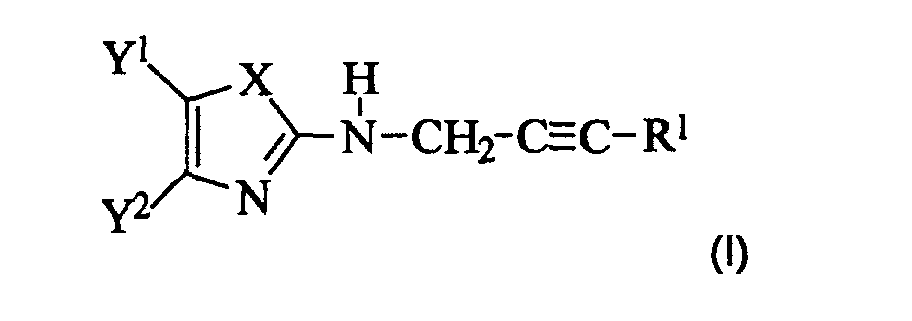
worin Y1 und Y2 jeweils unabhängig voneinander stehen für ein Wasserstoffatom, eine Alkylgruppe oder einen aromatischen Kern, oder worin Y1 und Y2 gemeinsam für die Atome stehen, die zur Bildung eines aromatischen oder alicyclischen Ringes erforderlich sind, der substituiert ist oder nicht und Atome ausgewählt aus Kohlenstoff, Sauerstoff, Selen oder Stickstoff enthält; worin R1 ein Wasserstoffatom darstellt, eine substituierte oder unsubstituierte Alkyl- oder Arylgruppe; und worin X ausgewählt ist aus Sauerstoff, Schwefel oder Selen.
worin Y1 und Y2 jeweils unabhängig voneinander stehen für ein Wasserstoffatom, eine Alkylgruppe oder einen aromatischen Kern, oder worin Y1 und Y2 gemeinsam für die Atome stehen, die zur Bildung eines aromatischen oder alicyclischen Ringes erforderlich sind, der substituiert ist oder nicht und Atome ausgewählt aus Kohlenstoff, Sauerstoff, Selen oder Stickstoff enthält; worin R1 ein Wasserstoffatom darstellt, eine substituierte oder unsubstituierte Alkyl- oder Arylgruppe; und worin X ausgewählt ist aus Sauerstoff, Schwefel oder Selen.
2. Radiographisches Produkt nach Anspruch 1, worin das Alkynylamin der Formel entspricht:
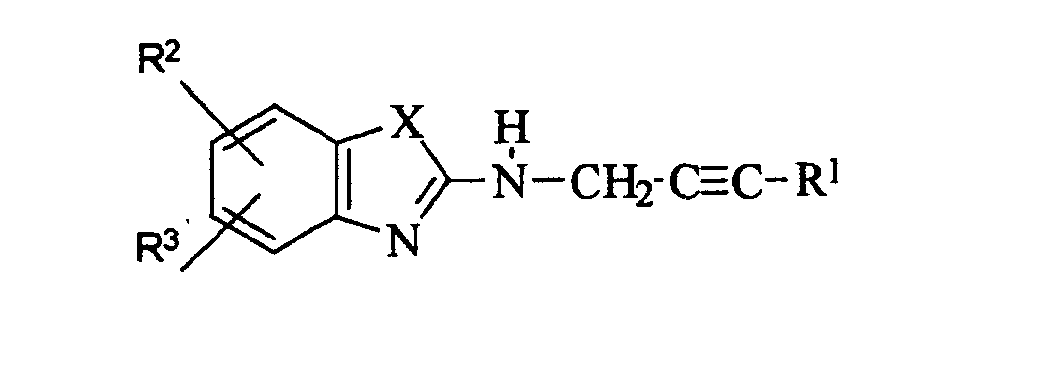
worin R1 für ein Wasserstoffatom steht; R2 und R3 jeweils unabhängig voneinander stehen für ein Wasserstoffatom, ein Halogenatom, eine substituierte oder unsubstituierte Alkyl- oder Alkoxygruppe, vorzugsweise mit 1 bis 10 Kohlenstoffatomen; und worin X ausgewählt ist aus Sauerstoff, Schwefel oder Selen.
worin R1 für ein Wasserstoffatom steht; R2 und R3 jeweils unabhängig voneinander stehen für ein Wasserstoffatom, ein Halogenatom, eine substituierte oder unsubstituierte Alkyl- oder Alkoxygruppe, vorzugsweise mit 1 bis 10 Kohlenstoffatomen; und worin X ausgewählt ist aus Sauerstoff, Schwefel oder Selen.
3. Radiographisches Produkt nach Anspruch 1, worin die Silberhalogenidemulsion eine Tafelkornemulsion
ist mit einem mittleren Aspektverhältnis von mindestens 2.
4. Radiographisches Produkt nach Anspruch 1, worin das Alkynylamin (I) N-2-Propynyl-2-benzoxazolamin
ist.
5. Radiographisches Produkt nach Anspruch 1, worin das Alkynylamin (I) in einer Menge
zwischen 0,05 x 10⁻³ Mol/Mol Ag und 0,5 x 10⁻³ Mol/Mol Ag vorliegt.
6. Radiographisches Produkt nach einem der Ansprüche 1 bis 5, das einen Träger aufweist,
der auf beiden Seiten eine Silberhalogenidemulsionsschicht aufweist und auf jeder
dieser Schichten eine schützende Deckschicht.
7. Verfahren zur Herstellung einer industriellen Radiographie, bei dem man das radiographische
Produkt gemäß Anspruch 1 einer ionisierenden Strahlung mit einem Energieniveau von
mindestens 40 keV unter Erzeugung eines latenten Bildes exponiert und das Produkt
unter Erzeugung eines radiographischen Bildes entwickelt.
8. System für die industrielle Radiographie, das zwei ionisierende Strahlung verstärkende
Schirme aufweist und ein radiographisches Produkt nach Anspruch 1, wobei die Schirme
auf beiden Seiten des Produktes angeordnet sind.
1. Produit radiographique pour la radiographie industrielle ayant un titre d'argent compris
entre 50 et 200 mg/dm2, qui comprend un support dont au moins l'une des faces est revêtue d'une couche d'émulsion
aux halogénures d'argent présentant une sensibilité spectrale intrinsèque de l'halogénure
d'argent et contenant une alkynylamine de formule (I) en une quantité comprise entre
0,05 x 10⁻³ moles/mole d'Ag et 1 x 10⁻³ moles/mole d'Ag
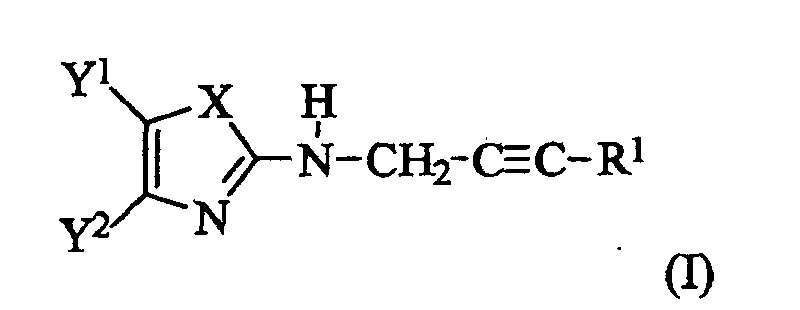
dans laquelle Y1 et Y2 représentent chacun séparément un atome d'hydrogène, un groupe alkyle ou un noyau aromatique, ou Y1 et Y2 ensemble, représentent les atomes nécessaires pour former un cycle aromatique ou alicyclique substitué ou non contenant des atomes choisis parmi le carbone, l'oxygène, le sélénium ou l'azote ; R1 représente un atome d'hydrogène, un groupe alkyle ou aryle substitué ou non et
X est choisi parmi l'oxygène, le soufre ou le sélénium.
dans laquelle Y1 et Y2 représentent chacun séparément un atome d'hydrogène, un groupe alkyle ou un noyau aromatique, ou Y1 et Y2 ensemble, représentent les atomes nécessaires pour former un cycle aromatique ou alicyclique substitué ou non contenant des atomes choisis parmi le carbone, l'oxygène, le sélénium ou l'azote ; R1 représente un atome d'hydrogène, un groupe alkyle ou aryle substitué ou non et
X est choisi parmi l'oxygène, le soufre ou le sélénium.
2. Produit radiographique selon la revendication 1, dans lequel l'alkynylamine est représentée
par la formule :
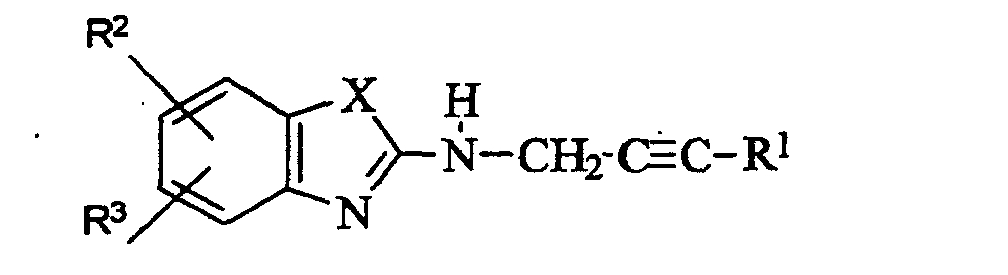
dans laquelle R1 est un atome d'hydrogène, R2 et R3 représentent chacun séparément un atome d'hydrogène, un atome d'halogène, un groupe alkyle ou alcoxy substitué ou non, ayant de préférence de 1 à 10 atomes de carbone et X est choisi parmi l'oxygène, le soufre ou le sélénium.
dans laquelle R1 est un atome d'hydrogène, R2 et R3 représentent chacun séparément un atome d'hydrogène, un atome d'halogène, un groupe alkyle ou alcoxy substitué ou non, ayant de préférence de 1 à 10 atomes de carbone et X est choisi parmi l'oxygène, le soufre ou le sélénium.
3. Produit radiographique selon la revendication 1, dans lequel l'émulsion aux halogénures
d'argent est une émulsion à grains tabulaires ayant un indice de forme moyen d'au
moins 2.
4. Produit radiographique selon la revendication 1, dans lequel l'alkynylamine (I) est
la N-2-propynyl-2-benzoxazolamine.
5. Produit radiographique selon la revendication 1, dans lequel l'alkynylamine (I) est
présente en une quantité comprise entre 0,05 x 10⁻³ et 0,5 x 10⁻³ moles/mole d'Ag.
6. Produit radiographique selon l'une quelconque des revendications 1 à 5, qui comprend
un support dont les deux faces sont revêtues d'une couche d'émulsion aux halogénures
d'argent, et sur chacune de ces couches, d'une surcouche protectrice.
7. Procédé de formation d'une radiographie industrielle qui comprend l'exposition d'un
produit radiographique tel que défini dans la revendication 1 à un rayonnement ionisant
ayant une énergie au moins égale à 40 keV, pour former une image latente et le développement
du produit pour former une image radiographique.
8. Système pour radiographie industrielle comprenant 2 écrans renforçateurs des rayons
ionisants et un produit radiographique tel que défini dans la revendication 1, les
écrans étant disposés de part et d'autre du produit.