|
(11) | EP 0 939 756 B1 |

| (12) | EUROPEAN PATENT SPECIFICATION |
|
|
| (54) |
A PROCESS FOR THE STEREOSELECTIVE REDUCTION OF ALPHA,BETA-UNSATURATED KETONES EIN VERFAHREN ZUR STEREOSELEKTIVEN REDUKTION VON ALPHA,BETA-UNGESÄTTIGTEN KETONEN PROCEDE POUR LA REDUCTION STEREOSELECTIVE DE CETONES ALPHA,BETA-INSATUREES |
|
|
|||||||||||||||||||||||||||||||
| Note: Within nine months from the publication of the mention of the grant of the European patent, any person may give notice to the European Patent Office of opposition to the European patent granted. Notice of opposition shall be filed in a written reasoned statement. It shall not be deemed to have been filed until the opposition fee has been paid. (Art. 99(1) European Patent Convention). |
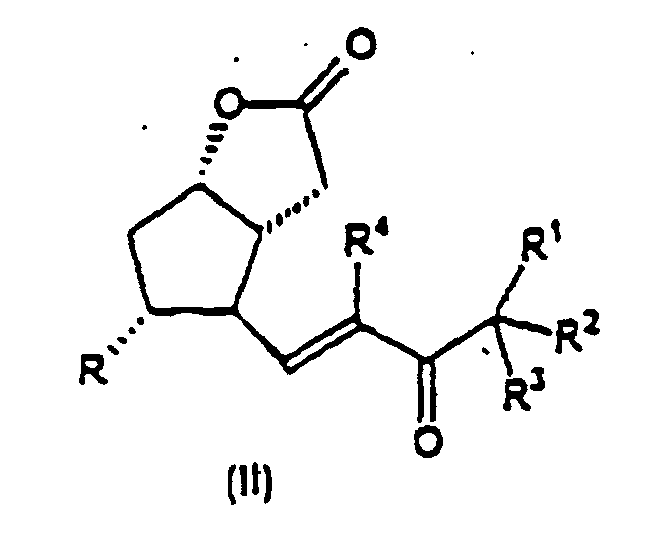
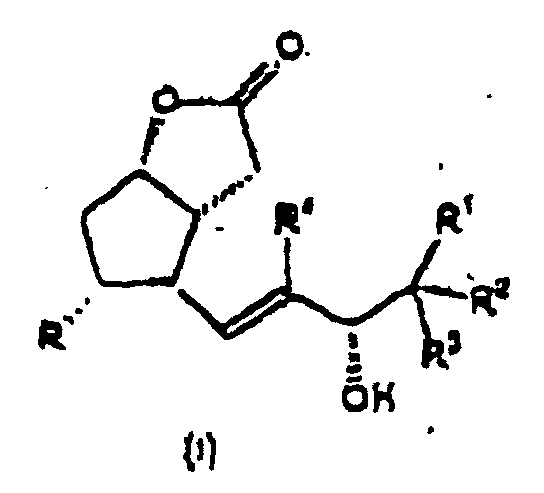
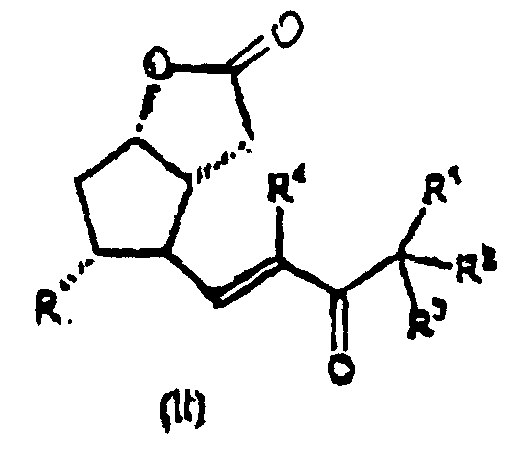
[0001] The present invention relates to a new process for the preparation of α, β-unsaturated alcohols of general formula (I) by the diastereoselective reduction of α, β - unsaturated ketons of general formula (II).
[0002] α, β- Unsaturated alcohols of general formula (I) are important key intermediates of prostaglandine derivatives used in veterinary and human medicine.
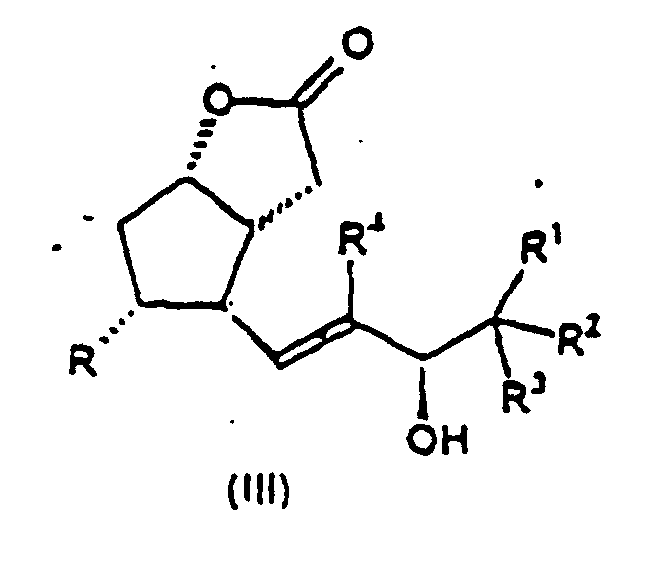
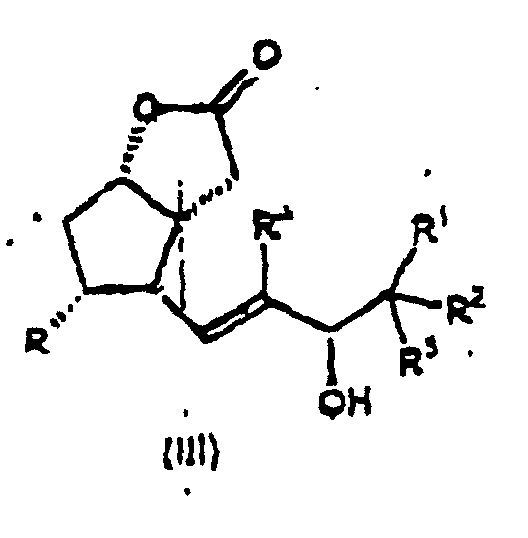
[0003] The synthesis of these compounds is carried out most frequently by reduction of α, β- unsaturated ketones of general formula (II) , when a mixture of α,β-unsaturated alcohols of general formula (I) and their epimers of general formula (III) is formed. These two epimer alcohols are separated directly or during some further steps of chemical transformation, usually by chromatographic procedures.
[0004] The reduction of the keto group of α, β- unsaturated ketones of general formula (II) was studied in detail in order to enhance the yield and ratio of α, β- unsaturated alcohols of general formula (I) and at the same time to avoid saturation of the α,β-double bond. In the prior art the reduction of α, β- unsaturated ketones of general formula (II) was realized by using borohydride reagents containing a bulky, possibly optically active substituent and in a solvent having ether character (e.g. in tetrahydrofurane, or in a mixture of tetrahydrofurane, diethyl -ether and pentane), at a temperature from -78°C to -130°C, where the ratio of α, β- unsaturated epimer alcohols of general formula (I) and of general formula (III) is altered between 1:2-4.5 (J. Am. Chem. Soc. 95, 1491 (1971); J. Am. Chem. Soc. 94, 8616 (1972); US-3,974,183 HU-PS-175.889 Hungarian Patent ). As reducing agents commercially not available lithium - diisopinocam - phenyl- tert- butyl- borohydride, lithium-2-thexyl-8-methyl-2-borobicyclo[3,3,1]nonyl-borohydride, lithium tricyclopentyl-borohvdride or lithium-diisobutyl- tert- butyl- aluminumhydride and L-selektride® (lithium-tri-sec.-butyl-borohydride) (all containing bulky groups) were used among others.
[0005] Some representatives of α, β- unsaturated ketons of general formula (II) were reduced by applying zinc borohydride too, in 1,2- dimethoxyethane at 0 °C and at room temperature, where the epimers of general formula (I) and general formula (III) were formed in an 1:1 ratio (J. Am. Chem. Soc. 91, 5675 (1969); J. Am. Chem. Soc. 94, 8616 (1972); US-3,970,684;
[0006] Using sodium borohydride in ethanol at -30°C or lithium- trialkyl-borohydride at a temperature lower than - 90°C as reducing agents, the ratio of the epimeric α, β-unsaturated alcohols of general formula (I) and of general formula (III) fluctuated between the ratios of 50:50 and 60:40 (J. Am. Chem. Soc. 94, 8616 (1972); EP-A-435,443; EP-A-455,448; EP-A-467,564; J. Med. Chem. 24, 1353 (1981). Using sodium borohydride as reducing agent the selectivity of the reduction could be increased when the reduction was carried out at - 78°C in methanol or in a mixture of methanol and dichloromethane, in the presence of cerium (III) chloride (EP-A-219,580; US-4,739,078). Using borane as the reducing agent in the presence of 5-10 % air and humidity sensitive oxazaborolydines, a far more favourable diastereomer ratio could be achieved (J. Am. Chem.Soc. 109, 7925 (1987)), but this method can not be applied on a larger scale. Using diisobutyl-aluminum-(2,6-di-tert.butyl-4-methyl phenoxide) (J. Org. Chem. 44, 1363 (1979); Bull.Chem.Soc. Japan 54, 3033 (1981)) at - 78°C; aluminium- isopropoxide in nitrogen atmosphere and in hot toluene (Synthetic Communications 4, 211 (1974)), di(isobornyloxy)-aluminium-isopropoxide or other modified lithium-aluminium-hydrides (J.Am.Chem.Soc. 106, 6717 (1984); Synthetic Communications 9, 799 (1979); Synthetic Communications 9, 483 (1979)) did not represent any advantage either because of difficulties of preparing these reagents, their sensitivity, and/or the costs of preparing them.
[0007] Under the conditions of catalytic hydrogenation, e.g. using charcoal containing palladium catalyst of 5 % metal content, the carbon-carbon double bond of the α, β-unsaturated ketons of general formula (II) saturates without the reduction of the ketone group (EP-A-289,349; Synthetic Communications 19, 245 (1989); EP-A-435,443.
[0008] Other reductions of ketones in the presence of borohydrides have been described in Chemical and Pharmaceutical Bulletin 1980, volume 28, no.25, pages 1422-1431, EP 0 219 580 A and Bollettino Chimico Farmaceutico, volume 129, no. 5, May 1990, pages 195-198. It is the object of this invention to provide an industrially feasible process, which is suitable at room temperature and without applying special additives, extreme conditions and reagents for the preparation of compounds of general formula (I) by diastereomeric reduction of ketones of general formula (II) in higher yields them in any known processes. The base of this new process achieving this object is the unexpected finding that α, β- unsaturated alcohols of general formula (I) - wherein R means an alkyl group containing 1-4 carbon atoms, or in a given case benzoyl group substituted with phenyl group; R1 means hydrogen atom or an alkyl group containing 1-4 carbon atoms; R2 means hydrogen atom or alkyl group containing 1-4 carbon atoms; R3 means in a given case an alkyl group containing 1-6 carbon atoms substituted with phenyl group or with cycloalkyl group containing 5-7 carbon a toms, or in a given case phenoxy group substituted with halogen atom or a cycloalkyl group containing 5-7 carbon atoms; R4 means hydrogen atom or halogen atom - are formed diastereoselectively upon reduction of α, β- unsaturated ketones of general formula (II) - wherein the meanings of R, R1,R2,R3, and R4 are as given above - if alkali borohydrides of small space demand are applied and the reaction is carried out in a heterogen phase, in an aprotic solvent in the presence of inorganic substances which are dissoluble in the reaction mixture and their particle sizes are small.
[0009] According to our experiences within the conditions described above and within the temperature range of -10°C and + 30°C diastereoselectivity barely fluctuated. Thus the reaction can be carried out at about the room temperature.
The term of inorganic substances dissoluble in the reaction mixture and having small particle sizes means farourably silicium compounds and/or aluminium compounds or mixtures thereof. These are preferably the silica gels, different types of aluminium oxide, in the first place the "active" aluminium oxides which can be acidic,
basic, or neutral in their reaction, the adsorptive capacity of which can be determined by the Brockmann scale./ Römp Chemical Encyclopedia Vol. I. p. 116-117 (Müszaki Könyvkiadó=Technical Publishing House, Bp. 1982)/. The term of silica gels which are useful in the claimed new process means silicic acid gels as defined in Romp Chemical Encyclopedia Vol.II. P. 977-978 / Müszaki Könyvkiadó, Budapest. 1982/. These are for example Silica gel 60, Silica gel G. "Small particle sizes" means 0.01-10000 micrometer preferably the particle size range is from 1 µm to 1000 µm.
[0010] Applicable aprotic solvents preferably halogenated hydrocarbons as chlorobenzene, methylene chloride, carbon tetrachloride, chloroform, 1,1,2,2-tetrachloroctane; alkane carboxylic acid esters as ethyl acetate, methyl acetate, methyl propionate; hydrocarbons as xylene, or toluene; alkyl nitriles as acetonitrile; ethers as tetrahydrofurane or diethyl-ether can be used. If we use ethanol as solvent for the reduction, or we carry out the reduction without the presence of silica gel, then diasteroeselectivity decreases substantially. The presence of small quantity of alcohol of short carbon chain e.g. methanol however facilitates the reaction.
[0011] As borohydrides of small space demand can be applied preferably their commercially available representatives sodium[trimethoxy-borohydride], lithium borohydride, sodium borohydride, potassium borohydride or sodium cyano borohydride, all of which can be used in solid or powdered form, or their aqueous or methanolic solution.
[0012] After filtering out the insoluble inorganic substance(s) particles from the reaction mixture eraporation of the filtrate a mixture of epimeric alcohols having general formula (III) and (I) - wherein the meanings of R, R1, R2, R3, and R4 are as given above - is obtained . From this mixture the desired α, β-unsaturated alcohol of general formula (I) can be isolated by applying the known separation methods for example by chromatography on a silica gel column. If desired the isolated isolated α, β- unsaturated alcohol of general formula (I) can be further purified by crystallization.
[0013] The following examples are intended to provide those of ordinary skill in the art with a complete disclosure and description of how to conduct the present synthetic process.
EXAMPLES
Example 1
[0014] To 10 ml of an an hydrous solution prepared by dissolving 1130 mg of (1S,5R,6R,7R)-6-[(E)-2-bromo-5-cyclohexyl-3-oxo-1-pentenyl]-7-(4-phenylbenzoyloxy)-2-oxabicyclo[3.3.0]octane-3- one in chloroform 1,5 g silica gel with particle size 63-200 µm / Silicagel 60, Merck Cat No 107734/ was added. During rigorous stirring of the obtained mixture at 19 - 20 °C the solution prepared by dissolving 114 mg of sodium borohydride in 0,22 ml of water was added and stirring was continued intensively for further 60 minutes. The reaction mixture was cooled below 0°C, and the excess reducing agent was reacted with 1,5 ml 2N hydrochloric acid solution. After stirring for 5 minutes 2 ml methanol was added to the mixture and after stirring for further 5 minutes the silica gel was filtered out. Silicagel was washed twice in succession with 3 ml chloroform-methanol mixture of 5:1 volume ratio. The filtrate was flusted with ethyl acetate into a 25 ml volumetric flask and this flask was filled up to the mark with ethyl acetate. The proportion of the produced epimer alcohols, the (1S,5R,6R,7R)-6-[(E)-2-bromo-5-cyclohexyl-3(S)-hydroxy-1-pentenyl]-7-(4-phenyl-benzoyloxy)-2-oxabicyclo[3.3.0] octane-3- one and the 3(R)- hydroxy epimer is 83:17 as determined by HPLC (Nova-Pac® Silica 4 µm, 150x3,9 cm column mobile phase n-hexane and ethanol in 94:6 volume ratio). After evaporation of above solution, the main product the 3(S)-hydroxy epimer was obtained with 75 % yield, by isolating it in a column filled with silica gel, and applying a mixture of toluene and ethyl acetate as mobil phase. The obtained crystalline substance melted at 127-129 °C, crystallized from the mixture of toluene and n-hexane.
| Analysis on the base of molecular formula C31H35BrO5; | ||
| Calculated | C 76,20 %; | H 7,43 %; |
| Found | C 75,96 %; | H 7,44 %. |
Example 2
[0015] The process was carried out analogously to Example 1 but as starting α, β-unsaturated keton (1S,5R,6R,7R)-6-[(E)-5-cyclohexyl-3-oxo-1-pentenyl]-7-(4-phenyl-benzoyloxy)-2-oxabicyclo[3.3.0]octane-3-one was applied. The proportion of the produced epimeric alcohols, (1S,5R,6R,7R)-6-[(E)-5-cyclohexyl-3(S)-hydroxy-1-pentenyl]-7-(4-phenyl-benzoyloxy)-2-oxabicyclo[3.3.0]octane-3- one and the 3(R)-hydroxy epimer was 77:23 and from the mixture the 3(S)-hydroxy epimer was obtained in 72 % yield using column chromatography.
| Analysis on the base of molecular formula C31H36O5; | ||
| Calculated | C 76,20 %; | H 7,43 %; |
| Found | C 75,96 %; | H 7,44 %. |
Example 3
[0016] The process was carried out analogously to Example 1 but as starting α, β-unsaturated keton (1S,5R,6R,7R)-6-[(E)-4-cyclohexyl-3-oxo-1-butenyl]-7-(4-phenylbenzoyloxy)-2-oxabicyclo[3.3.0]octane-3-one was applied. The ratio of the formed epimeric alcohols, the (1S,5R,6R,7R)-6-[(E)-4-cyclohexyl-3(S)-hydroxy-1-butenyl]-7-(4-phenyl-benzoyloxy)-2-oxabicyclo[3.3.0]octane-3-one and its 3(R)- hydroxy epimer was 75:25. The main component which was obtained in 73 % yield was prepared by chromatography using a column filled with silica gel. The obtained crystalline substance melted at 92-94°C, crystallized from a mixture of ethyl acetate, diisopropyl ether and n- hexane.
| Analysis on the base of molecular formula C30H34O5; | ||
| Calculated | C 75,92 %; | H 7,22 %; |
| Found | C 76,14 %; | H 7,19 %. |
Example 4
[0017] The process was carried out analogously to Example 1 but as the starting α, β-unsaturated keton (1S,5R,6R,7R)-6-[(E)-4-cyclopentyl-3-oxo-1-butenyl]-7-(4-phenyl-benzoyloxy)-2-oxabicyclo[3.3.0]octane-3-one was applied. The ratio of the formed epimeric alcohols, the (1S,5R,6R,7R)-6-[(E)-4-cyclopentyl-3(S)-hydroxy-1-butenyl]-7-(4-phenyl-benzoyloxy)-2-oxabicyclo[3.3.0]octane-3-one and its 3(R)-hydroxy epimer was 76:24. The main component which was obtained in 71 % yield was prepared by chromatography using a column filled with silica gel.
| Analysis on the base of molecular formula C29H32O5; | ||
| Calculated | C 75,63 %; | H 7,00 %; |
| Found | C 75,81 %; | H 6,88 %. |
Example 5
[0018] The process was carried out analogously to Examle 1 but (1S,5R,6R,7R)-6-[(E)-4-phenoxy-3-oxo-1-butenyl]-7-(4-phenyl-benzoyloxy)-2-oxabicyclo[3.3.0]octane-3-one was applied as starting material. The ratio of the formed epimeric alcohols, the (1S,5R,6R,7R)-6-[(E)-4-phenoxy-3(S)-hydroxy-1-butenyl]-7-(4-phenyl-benzoyloxy)-2-oxabicyclo[3.3.0]octane-3-one and its 3(R)- hydroxy epimer was 61:39. The main component which was obtained in 58 % yield was prepared by chromatography using a column filled with silica gel. The obtained crystalline substance melted at 131 - 132 °C crystallized from the mixture of ethyl acetate, diisopropylether and n-hexane.
| Analysis on the base of molecular formula C30H28O6; | ||
| Calculated | C 74,36 %; | H 5,82 %; |
| Found | C 74,18 %; | H 5,91 %. |
Example 6
[0019] The process was carried out analogously to Example 1 but (1S,5R,6R,7R)-6-[(E)-4-(m-chloro-phenoxy)-3-oxo-1-butenyl]-7-(4-phenyl-benzoyloxy)-2-oxabicyclo[3.3.0] octane-3-one was applied as starting material. The ratio of the formed epimeric alcohols, the (1S,5R,6R,7R)-6-[(E)-4- (m-chloro-phenoxy)-3(S)-hydroxy-1-butenyl]-7-(4-phenyl-benzoyloxy)-2-oxabicyclo[3.3.0]octane-3-one and its 3(R)- hydroxy epimer was 58:42. The main component which was obtained in 56 % yield was prepared by chromatography using a column filled with silica gel. The obtained crystalline substance melted at 105 - 108 °C crystallized from the mixture of ethyl acetate and diisopropylether.
| Analysis on the base of molecular formula C30H27ClO6; | |||
| Calculated | C 69,43 %; | H 5,24 %; | Cl 6,83 % |
| Found | C 69,62 %; | H 5,20 %. | Cl 6,91 %. |
Example 7
[0020] The process was carried out analogously to Example 1 but (1S,5R,6R,7R)-6-[(E)-5-phenyl-3-oxo- 1-pentenyl]-7-(4-phenyl-benzoyloxy)-2-oxabicyclo[3.3.0]octane-3-one was applied as starting material.
The ratio of the formed epimeric alcohols, the (1S,5R,6R,7R)-6-[(E)-5-phenyl-3(S)-hydroxy-1-pentenyl]-7-(4-phenyl-benzoyloxy)-2-oxabicyclo[3.3.0]octane-3-one and its 3(R)- hydroxy epimer was 76:24. The main component which was obtained in 69 % yield was prepared by chromatography using a column filled with silica gel. The obtained crystalline substance melted at 131 - 132 °C crystallized from the mixture of ethyl acetate and diisopropylether .
| Analysis on the base of molecular formula C31H30O5; | ||
| Calculated | C 77,16 %; | H 6,27 %; |
| Found | C 76,94 %; | H 6,27 %. |
Example 8
[0021] The process was carried out analogously to Example 1 but (1S,5R,6R,7R)-6-[(E)-4,4-dimethyl-3-oxo-1-octenyl]-7-(4-phenyl-benzoyloxy)-2-oxabicyclo[3.3.0]octane-3-one was used as starting material. The ratio of the formed epimeric alcohols, the (1S,5R,6R,7R)-6-[(E)-4,4-dimethyl-3(S)-hydroxy-1-octenyl]-7-(4-phenylbenzoyloxy)-2-oxabicyclo[3.3.0]octane-3-one and its 3(R)- hydroxy epimer was 79:21. The main component which was obtained in 70 % yield was prepared by chromatography using a column filled with silica gel. The obtained crystalline substance melted at 113 - 114 °C crystallized from the mixture of diisopropylether and n-hexane.
| Analysis on the base of molecular formula C30H36O5; | ||
| Calculated | C 75,60 %; | H 7,61 %; |
| Found | C 75,75 %; | H 7,49 %. |
Example 9
[0022] The process was carried out analogously to Example 1 but (1S,5R,6R,7R)-6-[(E)-4,4-dimethyl-3-oxo-1-octenyl]-7-methyl-2-oxabicyclo[3.3.0]octane-3-one was applied as starting material. The ratio of the formed epimeric alcohols, the (1S,5R,6R,7R)-6-[(E)-4,4-dimethyl-3(S)-hydroxy-1-octenyl]-7-methyl-2-oxabicyclo[3.3.0]octane-3-one and its 3(R)- hydroxy epimer was 80:20. The main component which was obtained in 79 % yield was prepared by chromatography using a column filled with silica gel.
| Analysis on the base of molecular formula C18H30O3; | ||
| Calculated | C 73,43 %; | H 10,27 %; |
| Found | C 73,39 %; | H 10,32%. |
Example 10
[0023] The process was carried out analogously to Example 1 but (1S,5R,6R,7R)-6-[(E)-3-oxo-1-octenyl]-7-(4-phenyl-benzoyloxy)-2-oxabicyclo[3.3.0]octane-3-one was used as starting material. The ratio of the formed epimeric alcohols, the (1S,5R,6R,7R)-6-[(E)-3(S)-hydroxy-1-octenyl]-7-(4-phenyl-benzoyloxy)-2-oxabicyclo[3.3.0]octane-3-one and its 3(R)- hydroxy epimer is 74:26. The main component which was obtained in 68 % yield was prepared by chromatography using a column filled with silica gel. The obtained crystalline substance melted at 64-67 °C crystallized from the mixture of diisopropylether and n-hexane.
| Analysis on the base of molecular formula C28H32O5, | ||
| Calculated | C 74,98 %; | H 7,19 %; |
| Found | C 75,21 %; | H 7,43 %. |
Example 11
[0024] The process was carried out analogously to Example 10 but solid lithium borohydride was used instead of aqueous sodium borohydride solution as reducing agent. The ratio of the formed epimeric alcohols was 60:40 %. The main component (1S,5R,6R,7R)-6-[(E)-3(S)-hydroxy-1-octenyl]-7-(4-phenyl-benzoyloxy)-2-oxabicyclo[3.3.0]octane-3-one was prepared by column chromatography. The thus obtained product did not show any decrease of melting point when it was mixed in discretional ratio with the product prepared according to example 10.
Example 12
[0025] The process was carried out analogously to Example 10 but solid potassium borohydride was used as reducing agent instead of sodium borohydride solution, a 72.28 ratio mixture of aqueous 3(S)- and 3(R) epimeric alcohols was obtained, from which the epimeric 3(S)- alcohol was prepared by chromatography. The thus obtained product did not show any decrease of melting point when it was mixed in discretional ratio with the product prepared according to examples 10 or 11.
Example 13
[0026] The process was carried out analogously to Example 11 but sodium trimethoxyborohydride was used instead of lithium borohydride, a 67:33 ratio mixture of epimeric 3(S)- and 3(R) alcohols was obtained, from which the main product was prepared by chromatography. The thus obtained product did not show any decrease of melting point when it was mixed in discretional ratio with the product prepared according to example 10.
Example 14
[0027] The process was carried out analogously to Example 10 but carbon tetrachloride was used as solvent instead of chloroform, a 75:25 ratio mixture of epimeric alcohols was obtained, from which the main product, (1S,5R,6R,7R)-6-[(E)-3(S)-hydroxy-1-octenyl]-7-(4-phenyl-benzoyloxy)- 2-oxabicyclo[3.3.0]octane-3-one- produced with 40 % yield- was prepared by column chromatography. The thus obtained product did not show any decrease of melting point when mixed in discretional ratio with the product prepared according to example 10.
Example 15
[0028] The process was carried out analogously to Example 14 but toluene was used as solvent instead of carbon tetrachloride, a 74:26 ratio mixture of epimeric alcohols was obtained, from which the 3(S)- alcohol - produced with 57 % yield - was prepared by column chromatography. The thus obtained product did not show any decrease of melting point when it was mixed in discretional ratio with the product prepared according to example 10.
Example 16
[0029] The process was carried out analogously to Example 14 but methylene chloride was used as solvent, a 73:28 ratio mixture of epimeric 3(S)- and 3(R) alcohols was obtained, from which the 3(S)- alcohol -produced with 63 % yield - was prepared by column chromatography.
Example 17
[0030] The process was carried out analogously to Example 14 but acetonitrile was used as solvent, a 60:40 ratio mixture of epimeric 3(S)- and 3(R) alcohols was obtained, from which the 3(S)- alcohol -produced with 48 % yield - was prepared by column chromatography processing.
Example 18
[0031] The process was carried out analogously to Example 14 but tetrahydrofurane was used as solvent, a 61:39 ratio mixture of epimeric 3(S)- and 3(R) alcohols was obtained, from which the 3(S)- alcohol -produced with 45 % yield - was prepared by column chromatography.
Example 19
[0032] The process was carried out analogously to Example 14 but ethyl acetate was used as solvent, a 70:30 ratio mixture of epimeric 3(S)- and 3(R) alcohols was obtained, from which the 3(S)- alcohol -produced with 53 % yield - was prepared by column chromatography.
Neither of the products prepared according to examples 16., 17., 18., and 19 showed any decrease of melting point when they were mixed in discretional ratio with the product prepared according to example 10.
Example 20
[0033] The process was carried out analogously to Example 10 but silica gel of 40 - 63 µm particle size /"Silicagel 60" Merck Cat. No. 109385/ was used. From the formed mixture of epimeric 3(S)- and 3(R) alcohols (ratio was 62:26) the main product was obtained by chromatography. It did not show any decrease of melting point when it was mixed in discretional ratio with the product prepared according to example 10.
Example 21
[0034] The process was carried out analogously to Example 10 but silica gel of 5 - 40 µm particle size / " Silicagel G" Merck Cat. No. 107731/ was used. From the formed mixture of epimeric 3(S)- and 3(R) alcohols (ratio 62:26) the main product was obtained by chromatography. It did not show any decrease of melting point when it was mixed in discretional ratio with the product prepared according to example 10.
Example 22
[0035] The process was carried out analogously to Example 10 but Brockmann I acidic aluminium oxide/ Aldrich Cat.No. 19996-6/ was used instead of silica gel. From the formed mixture of epimeric 3(S)- and 3(R) alcohols (ratio was 33:13) the main product was obtained by chromatography. It did not show any decrease of melting point when it was mixed in discretional ratio with the product prepared according to example 10.
Example 23
[0036] The process was carried out analogously to Example 10 but Brockmann I basic aluminium oxide/ Aldrich Cat.No. 19944-3/ was used instead of silica gel . From the formed mixture of epimeric 3(S)- and 3(R) alcohols (ratio was 2:1) obtain the main product by chromatography. It did not show any decrease of melting point when it was mixed in discretional ratio with the product prepared according to example 10.
Example 24
[0037] The process was carried out analogously to Example 10 but Brockmann I neutral aluminium oxide/ Aldrich Cat. No. 19997-4/ was used instead of silica gel. From the formed mixture of epimeric 3(S)- and 3(R) alcohols (ratio was 2.5:1.4) obtain the main product by chromatography. It did not show any decrease of melting point when it was mixed in discretional ratio with the product prepared according to example 10.
1. A process for the preparation of α,β-unsaturated alcohols of general formula (I),
wherein
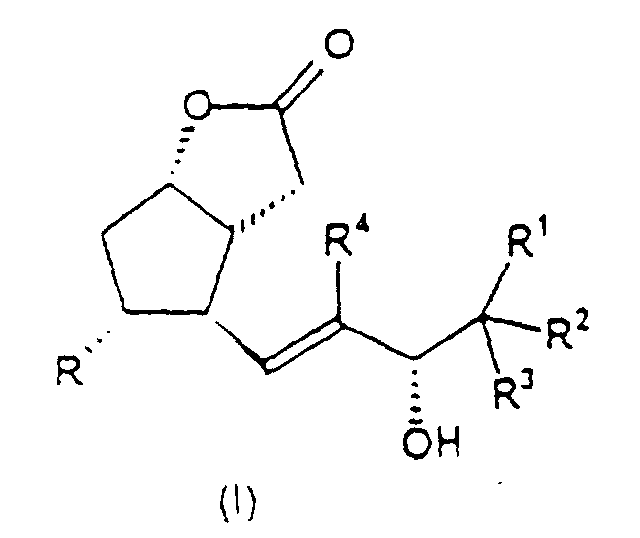
R means an alkyl group of 1-4 carbon atoms, or benzoyloxy group optionally substituted with a phenyl group;
R1 means a hydrogen atom or an alkyl group of 1-4 carbon atoms;
R2 means a hydrogen atom or an alkyl group of 1-4 carbon atoms;
R3 means an alkyl group of 1-6 carbon atoms optionally substituted by phenyl group or cycloalkyl group of 5-7 carbon atoms; or a phenoxy group optionally substituted by a halogen atom, or a cycloalkyl group of 5-7 carbon atoms;
R4 means a hydrogen atom or a halogen atom -
characterised in that a α,β-unsaturated ketones of general formula (II)
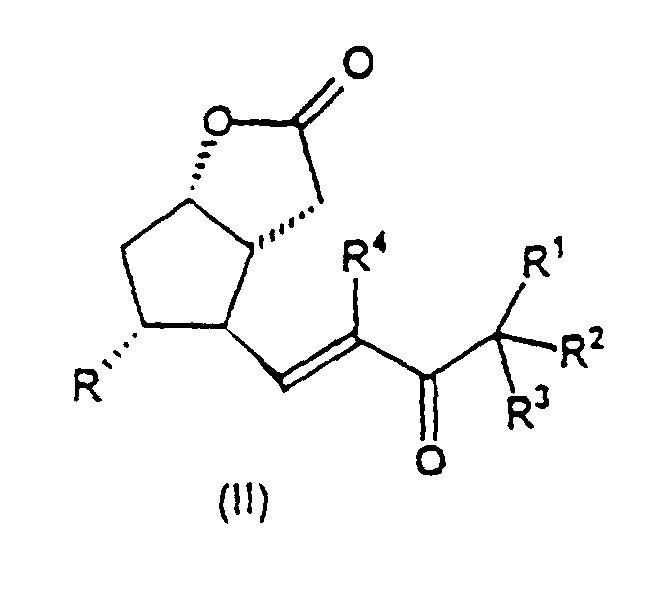
wherein the meanings of R, R1, R2, R3, and R4 are as given above - is diastereoselectively reduced with a borohydride type compound in an aprotic solvent, in the presence of an inorganic substance insoluble in the reaction mixture and having particle size from 0.01 micrometer to 10000 micrometer and optionally from the resulting mixture of epimeric, α,β-unsaturated alcohols of general formula (I) and (III)
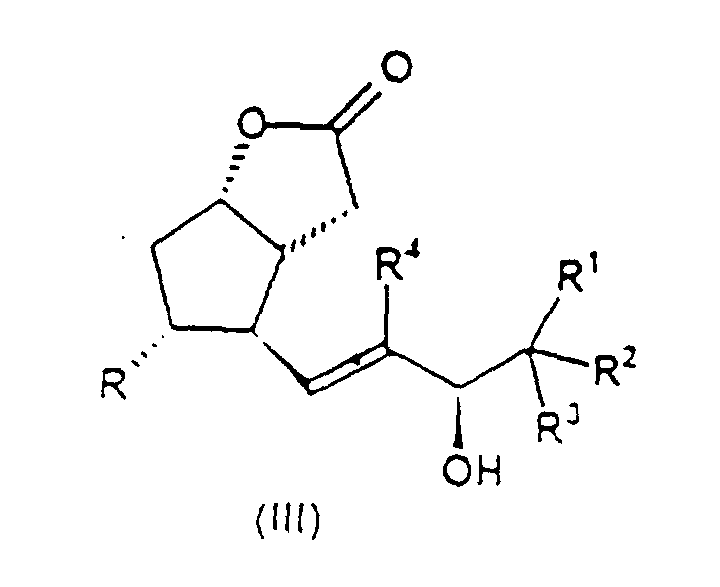
wherein the meanings of R, R1, R2, R3, and R4 are as given above - the α,β-unsaturated alcohol of general formula (I) is separated by methods known per se, characterised in that silica gel or aluminium oxide is used as inorganic substance insoluble in the reaction mixture.
R means an alkyl group of 1-4 carbon atoms, or benzoyloxy group optionally substituted with a phenyl group;
R1 means a hydrogen atom or an alkyl group of 1-4 carbon atoms;
R2 means a hydrogen atom or an alkyl group of 1-4 carbon atoms;
R3 means an alkyl group of 1-6 carbon atoms optionally substituted by phenyl group or cycloalkyl group of 5-7 carbon atoms; or a phenoxy group optionally substituted by a halogen atom, or a cycloalkyl group of 5-7 carbon atoms;
R4 means a hydrogen atom or a halogen atom -
characterised in that a α,β-unsaturated ketones of general formula (II)
wherein the meanings of R, R1, R2, R3, and R4 are as given above - is diastereoselectively reduced with a borohydride type compound in an aprotic solvent, in the presence of an inorganic substance insoluble in the reaction mixture and having particle size from 0.01 micrometer to 10000 micrometer and optionally from the resulting mixture of epimeric, α,β-unsaturated alcohols of general formula (I) and (III)
wherein the meanings of R, R1, R2, R3, and R4 are as given above - the α,β-unsaturated alcohol of general formula (I) is separated by methods known per se, characterised in that silica gel or aluminium oxide is used as inorganic substance insoluble in the reaction mixture.
2. A process according to claim 1, characterised in that a silica gel having particle size from 1 µm to 1000 µm is used.
3. A process according to claim 1, characterised in that an activated, acidic, basic, or neutral aluminium oxide is used as an inorganic substance.
4. A process according to any of claims 1 to 3 characterised in that a halogenated hydrocarbon, for example carbon tetrachloride, chloroform, or methylenechloride
is used as aprotic solvent.
5. A process according to any of claims 1 to 3 characterised in that an aliphatic carboxylic acid ester, for example ethyl acetate, is used as an aprotic
solvent.
6. A process according to any of claims 1 to 3 characterised in that an ether-type solvent, for example tetrahydrofuran, is used as an aprotic solvent.
7. A process according to any of claims 1 to 3 characterised in that a hydrocarbon, for example, toluene or xylene is used as an aprotic solvent.
8. A process according to any of claims 1 to 3 characterised in that an alkylnitrile, for example acetonitrile, is used as aprotic solvent.
9. A process according to any of claims 1 to 8 characterised in that methanol or ethanol are used as a cosolvent containing short carbon chain.
10. A process according to any of claims 1 to 9 characterised in that an alkali- trialkoxy-borohydride is used as borohydride type compound.
11. A process according to claim 10 characterised in that sodium-[trimethoxy-borohydride] is used as alkalitrialkoxy-borohydride.
12. A process according to any of claims 1 to 9 characterised in that an alkali borohydride is used as a borohydride type compound.
13. A process according to claim 12 characterised in that lithium borohydride, sodium borohydride, or potassium borohydride is used as alkali
borohydride.
1. Verfahren zur Herstellung von α, β-ungesättigten Alkoholen der allgemeinen Formel
(I):
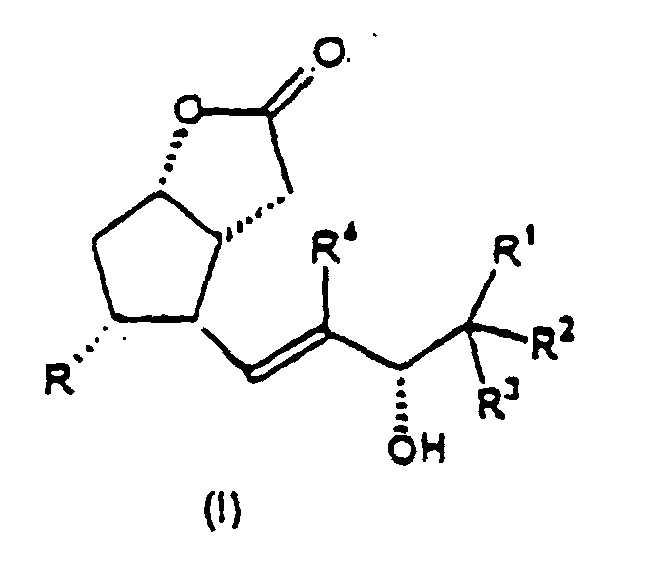
in der R eine Alkylgruppe mit 1 - 4 Kohlenstoffatomen oder eine Benzoyloxygruppe, die gegebenenfalls mit einer Phenylgruppe substituiert ist, bedeutet,
R1 ein Wasserstoffatom oder eine Alkylgruppe mit 1 - 4 Kohlenstoffatomen bedeutet,
R2 ein Wasserstoffatom oder eine Alkylgruppe mit 1 - 4 Kohlenstoffatomen bedeutet,
R3 eine Alkylgruppe mit 1 - 6 Kohlenstoffatomen, die gegebenenfalls mit einer Phenylgruppe oder einer Cycloalkylgruppe mit 5 - 7 Kohlenstoffatomen substituiert ist, oder eine Phenoxygruppe, die gegebenenfalls mit einem Halogenatom substituiert ist, oder eine Cycloalkylgruppe mit 5 - 7 Kohlenstoffatomen bedeutet,
R4 ein Wasserstoffatom oder ein Halogenatom bedeutet,
dadurch gekennzeichnet, dass α, β-ungesättigte Ketone der allgemeinen Formel (II):
in der R, R1, R2, R3 und R4 die oben angegebenen Bedeutungen haben, diasteroeselektiv mit einer Verbindung vom Borhydrid-Typ in einem aprotischen Lösungsmittel in Gegenwart einer anorganischen Substanz, die in dem Reaktionsgemisch unlöslich ist und eine Teilchengröße von 0,01 µm bis 10000 µm hat, reduziert werden und gegebenenfalls aus dem sich ergebenden Gemisch epimerer α,β-ungesättigter Alkohole der allgemeinen Formeln (I) und (III)
in denen R, R1, R2, R3 und R4 die oben angegebenen Bedeutungen haben, der α, β-ungesättigte Alkohol der allgemeinen Formel (I) mit an sich bekannten Verfahren isoliert wird, dadurch gekennzeichnet, dass Silikagel oder Aluminiumoxid als in dem Rektionsgemisch unlösliche anorganische Substanz verwendet wird.
in der R eine Alkylgruppe mit 1 - 4 Kohlenstoffatomen oder eine Benzoyloxygruppe, die gegebenenfalls mit einer Phenylgruppe substituiert ist, bedeutet,
R1 ein Wasserstoffatom oder eine Alkylgruppe mit 1 - 4 Kohlenstoffatomen bedeutet,
R2 ein Wasserstoffatom oder eine Alkylgruppe mit 1 - 4 Kohlenstoffatomen bedeutet,
R3 eine Alkylgruppe mit 1 - 6 Kohlenstoffatomen, die gegebenenfalls mit einer Phenylgruppe oder einer Cycloalkylgruppe mit 5 - 7 Kohlenstoffatomen substituiert ist, oder eine Phenoxygruppe, die gegebenenfalls mit einem Halogenatom substituiert ist, oder eine Cycloalkylgruppe mit 5 - 7 Kohlenstoffatomen bedeutet,
R4 ein Wasserstoffatom oder ein Halogenatom bedeutet,
dadurch gekennzeichnet, dass α, β-ungesättigte Ketone der allgemeinen Formel (II):
in der R, R1, R2, R3 und R4 die oben angegebenen Bedeutungen haben, diasteroeselektiv mit einer Verbindung vom Borhydrid-Typ in einem aprotischen Lösungsmittel in Gegenwart einer anorganischen Substanz, die in dem Reaktionsgemisch unlöslich ist und eine Teilchengröße von 0,01 µm bis 10000 µm hat, reduziert werden und gegebenenfalls aus dem sich ergebenden Gemisch epimerer α,β-ungesättigter Alkohole der allgemeinen Formeln (I) und (III)
in denen R, R1, R2, R3 und R4 die oben angegebenen Bedeutungen haben, der α, β-ungesättigte Alkohol der allgemeinen Formel (I) mit an sich bekannten Verfahren isoliert wird, dadurch gekennzeichnet, dass Silikagel oder Aluminiumoxid als in dem Rektionsgemisch unlösliche anorganische Substanz verwendet wird.
2. Verfahren nach Anspruch 1, dadurch gekennzeichnet, dass ein Silikagel mit einer Teilchengröße von 1 µm - 1000 µm verwendet wird.
3. Verfahren nach Anspruch 1, dadurch gekennzeichnet, dass ein aktiviertes, saures, basisches oder neutrales Aluminiumoxid als anorganische
Substanz verwendet wird.
4. Verfahren nach einem der Ansprüche 1 - 3, dadurch gekennzeichnet, dass ein halogenierter Kohlenwasserstoff, beispielsweise Tetrachlorkohlenstoff, Chloroform
oder Methylenchlorid, als aprotisches Lösungsmittel verwendet wird.
5. Verfahren nach einem der Ansprüche 1 - 3, dadurch gekennzeichnet, dass ein Ester einer aliphatischen Carbonsäure, beispielsweise Ethylacetat, als aprotisches
Lösungsmittel verwendet wird.
6. Verfahren nach einem der Ansprüche 1 - 3, dadurch gekennzeichnet, dass ein Lösungsmittel vom Ether-Typ, beispielsweise Tetrahydrofuran, als aprotisches
Lösungsmittel verwendet wird.
7. Verfahren nach einem der Ansprüche 1 - 3, dadurch gekennzeichnet, dass ein Kohlenwasserstoff, beispielsweise Toluol oder Xylol, als aprotisches Lösungsmittel
verwendet wird.
8. Verfahren nach einem der Ansprüche 1 - 3, dadurch gekennzeichnet, dass ein Alkylnitril, beispielsweise Acetonitril, als aprotisches Lösungsmittel verwendet
wird.
9. Verfahren nach einem der Ansprüche 1 - 8, dadurch gekennzeichnet, dass Methanol oder Ethanol als Co-Lösungsmittel, das eine kurze Kohlenstoffkette enthält,
verwendet werden.
10. Verfahren nach einem der Ansprüche 1 - 9, dadurch gekennzeichnet, dass ein Alkalitrialkoxyborhydrid als Verbindung vom Borhydrid-Typ verwendet wird.
11. Verfahren nach Anspruch 10, dadurch gekennzeichnet, dass Natrium-[trimethoxyborhydrid] als Alkalitrialkoxyborhydrid verwendet wird.
12. Verfahren nach einem der Ansprüche 1 - 9, dadurch gekennzeichnet, dass ein Alkaliborhydrid als Verbindung vom Borhydrid-Typ verwendet wird.
13. Verfahren nach Anspruch 12, dadurch gekennzeichnet, dass Litiumborhydrid, Natriumborhydrid oder Kaliumborhydrid als Alkaliborhydrid verwendet
wird.
1. Procédé pour la préparation d'alcools α,β-insaturés ayant la formule générale (I),
dans laquelle
R représente un groupe alkyle ayant 1-4 atomes de carbone, ou un groupe benzoyloxy éventuellement substitué avec un groupe phényle ;
R1 représente un atome d'hydrogène ou un groupe alkyle ayant 1-4 atomes de carbone ;
R2 représente un atome d'hydrogène ou un groupe alkyle ayant 1-4 atomes de carbone ;
R3 représente un groupe alkyle ayant 1-6 atomes de carbone éventuellement substitué par un groupe phényle ou un groupe cycloalkyle ayant 5-7 atomes de carbone ; ou un groupe phénoxy éventuellement substitué par un atome d'halogène, ou un groupe cycloalkyle ayant 5-7 atomes de carbone ;
R4 représente un atome d'hydrogène ou un atome d'halogène,
caractérisé en ce que les cétones α,β-insaturées de formule générale (II)
dans laquelle R, R1, R2, R3 et R4 sont comme indiqués ci-dessus - sont diastéréosélectivement réduites avec un composé de type borohydrure dans un solvant aprotique, en présence d'une substance inorganique insoluble dans le mélange réactif et ayant une taille de particule de 0,01 micromètre à 10000 micromètres et éventuellement à partir du mélange résultant d'alcools α,β-insaturés épimères de formules générales (I) et (III)
dans laquelle R, R1, R2, R3 et R4 sont comme indiqués ci-dessus - l'alcool α,β-insaturé de la formule générale (I) est séparé par des méthodes connues en soi, caractérisé en ce que le gel de silice ou l'oxyde d'aluminium est utilisé en tant que substance inorganique insoluble dans le mélange réactif.
R représente un groupe alkyle ayant 1-4 atomes de carbone, ou un groupe benzoyloxy éventuellement substitué avec un groupe phényle ;
R1 représente un atome d'hydrogène ou un groupe alkyle ayant 1-4 atomes de carbone ;
R2 représente un atome d'hydrogène ou un groupe alkyle ayant 1-4 atomes de carbone ;
R3 représente un groupe alkyle ayant 1-6 atomes de carbone éventuellement substitué par un groupe phényle ou un groupe cycloalkyle ayant 5-7 atomes de carbone ; ou un groupe phénoxy éventuellement substitué par un atome d'halogène, ou un groupe cycloalkyle ayant 5-7 atomes de carbone ;
R4 représente un atome d'hydrogène ou un atome d'halogène,
caractérisé en ce que les cétones α,β-insaturées de formule générale (II)
dans laquelle R, R1, R2, R3 et R4 sont comme indiqués ci-dessus - sont diastéréosélectivement réduites avec un composé de type borohydrure dans un solvant aprotique, en présence d'une substance inorganique insoluble dans le mélange réactif et ayant une taille de particule de 0,01 micromètre à 10000 micromètres et éventuellement à partir du mélange résultant d'alcools α,β-insaturés épimères de formules générales (I) et (III)
dans laquelle R, R1, R2, R3 et R4 sont comme indiqués ci-dessus - l'alcool α,β-insaturé de la formule générale (I) est séparé par des méthodes connues en soi, caractérisé en ce que le gel de silice ou l'oxyde d'aluminium est utilisé en tant que substance inorganique insoluble dans le mélange réactif.
2. Procédé selon la revendication 1, caractérisé en ce qu'un gel de silice ayant une taille de particule de 1 µm à 1000 µm est utilisé.
3. Procédé selon la revendication 1, caractérisé en ce qu'un oxyde d'aluminium neutre, basique, acide ou activé est utilisé comme substance
inorganique.
4. Procédé selon l'une quelconque des revendications 1 à 3, caractérisé en ce qu'un hydrocarbure halogéné, par exemple du tétrachlorure de carbone, du chloroforme
ou du chlorure de méthylène, est utilisé comme solvant aprotique.
5. Procédé selon l'une quelconque des revendications 1 à 3, caractérisé en ce qu'un ester d'acide carboxylique aliphatique, par exemple l'acétate d'éthyle, est utilisé
comme solvant aprotique.
6. Procédé selon l'une quelconque des revendications 1 à 3, caractérisé en ce qu'un solvant de type éther, par exemple, du tétrahydrofurane, est utilisé comme solvant
aprotique.
7. Procédé selon l'une quelconque des revendications 1 à 3, caractérisé en ce qu'un hydrocarbure, par exemple, le toluène ou le xylène, est utilisé comme solvant aprotique.
8. Procédé selon l'une quelconque des revendications 1 à 3, caractérisé en ce qu'un alkylnitrile, par exemple de l'acétonitrile, est utilisé comme solvant aprotique.
9. Procédé selon l'une quelconque des revendications 1 à 8, caractérisé en ce qu'un méthanol ou de l'éthanol sont utilisés comme co-solvant contenant une chaîne de
carbone courte.
10. Procédé selon l'une quelconque des revendications 1 à 9, caractérisé en ce qu'un trialkoxy-borohydrure alcalin est utilisé comme composé de type borohydrure.
11. Procédé selon la revendication 10, caractérisé en ce que du sodium-[triméthoxy-borohydrure] est utilisé comme trialkoxy-borohydrure alcalin.
12. Procédé selon l'une quelconque des revendications 1 à 9, caractérisé en ce qu'un borohydrure alcalin est utilisé comme composé de type borohydrure.
13. Procédé selon la revendication 12, caractérisé en ce que du borohydrure de lithium, du borohydrure de sodium, ou du borohydrure de potassium,
est utilisé comme borohydrure alcalin.