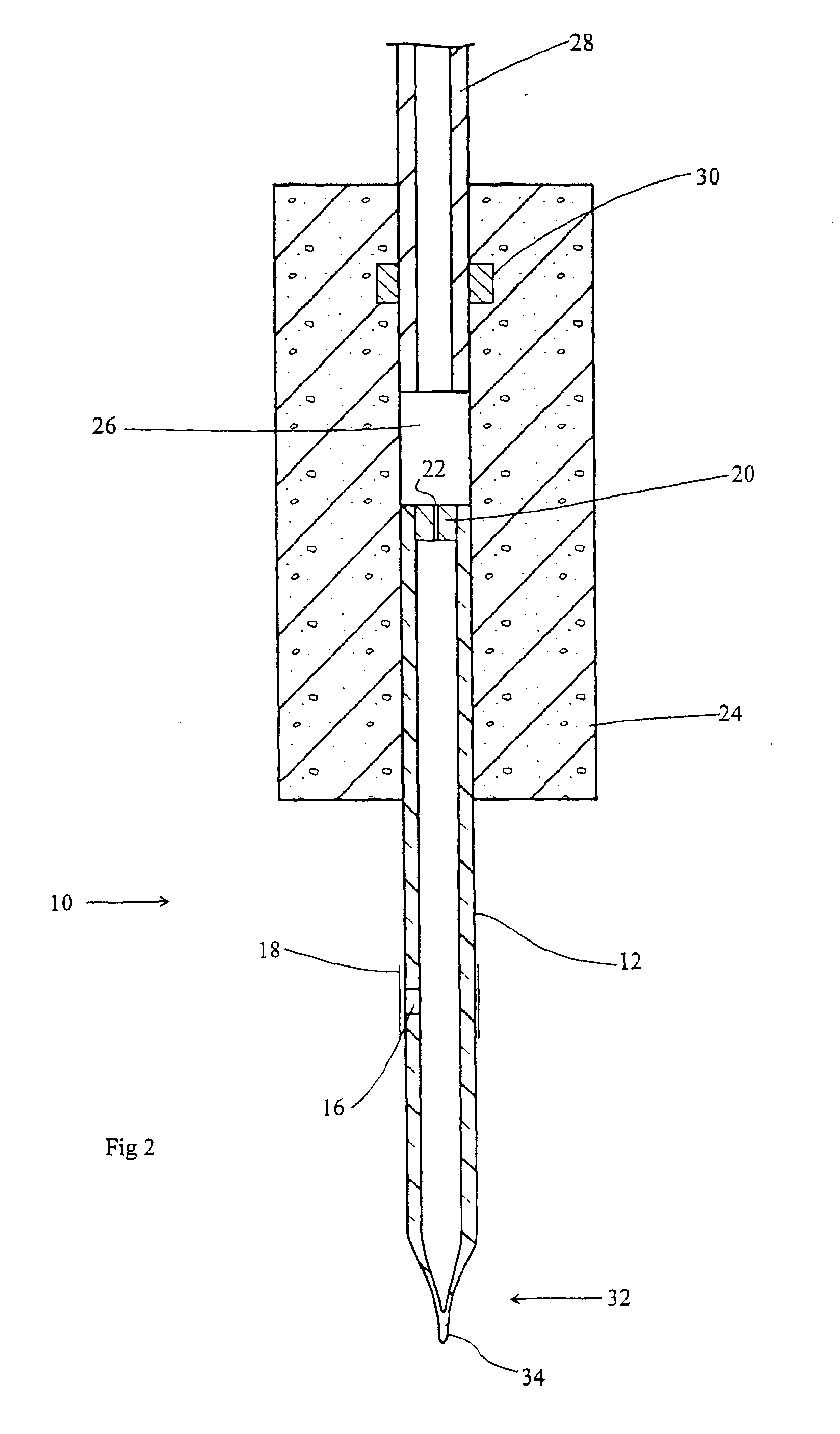
(57) The application describes an improved apparatus for removing samples from depth,
and is particularly applicable to molten metal sampling. The sampling device comprises
a hollow brittle member sealed at its lower end, having an aperture on a side wall
thereof, the aperture being covered with a layer of an adhesively bonded film. When
immersed, the adhesively bonded film will disintegrate and allow liquid into the interior
of the brittle member. However, the film will take a definite time to disintegrate,
and this will allow the device to be submerged to the appropriate depth. On disintegration,
only liquid from that depth will enter the brittle member. The exact time taken will
vary from material to material, and can be independently varied by varying the thickness.
Thickness variation can easily be achieved by applying a plurality of layers of material,
or by selecting alternative available thicknesses. Suitable thicknesses are between
0.14 and 0.19 mm, more preferably 0.17 to 0.18 mm. Thicknesses above 0.2 mm tend to
take rather a long time to disintegrate, although this may not be the case in particularly
harsh environments. A preferred adhesively bonded film is crepe paper, with a cured
rubber backing. Acetate is an alternative. It is preferred if the brittle member is
elongate and cylindrical, the aperture being on a circumferential face. This can,
for example, be a tube with the lower end sealed and the aperture formed therein.
It is preferred if the lower end has been drawn to a frangible tip. This facilitates
fracture of the brittle member in order to retrieve the metal sample. A suitable material
for the brittle member is quartz, as this can be obtained in tube form and the end
of the tube sealed and (if desired) drawn.
|
|
