(57) An electric contact with twin-knife insertion coupling, particularly for disconnectors,
switches or the like, comprising two mutually facing knives and a spacer which delimits
the maximum mutual approach of the knives. The knives can move together in order to
pass from an active position, in which their mutually facing lateral surfaces engage
a main contact pin, to an inactive position, in which they are disengaged from the
main contact pin, or viceversa. An element is provided which elastically contrasts
the mutual spacing of the knives in order to maintain the contact of the knives, in
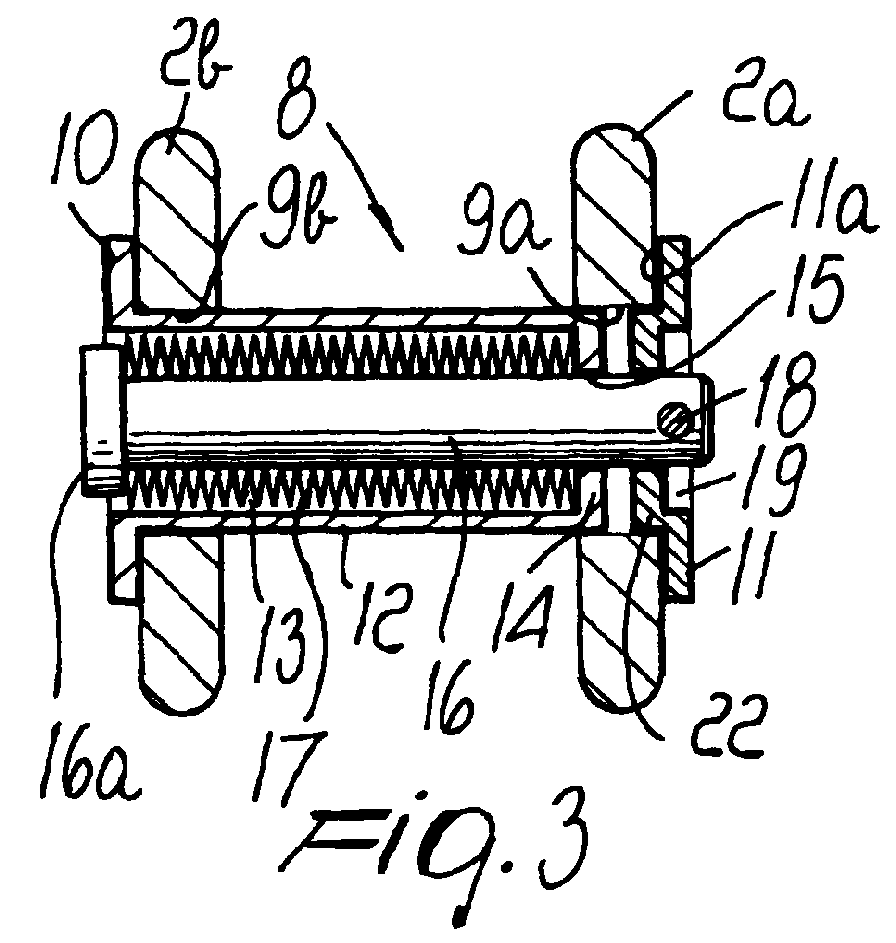
the active position, with the main contact pin. The element comprises a contrast pin
which passes through two seats which are formed in the two knives and are mutually
aligned along a direction which is substantially perpendicular to the planes of arrangement
of the knives. The contrast pin has, at its axial ends, two portions which form two
mutually opposite shoulders which engage the lateral surfaces of the knives that lie
opposite with respect to the mutually facing lateral surfaces. The two portions of
the contrast pin can move away from each other in contrast with elastic means contained
within the axial dimensions of the contrast pin.
|
|
