|
(11) | EP 0 952 924 B1 |

| (12) | EUROPEAN PATENT SPECIFICATION |
|
|
| (54) |
LITHOGRAPHIC PLATES FLACHDRUCKPLATTEN PLAQUES LITHOGRAPHIQUES |
|
|
|||||||||||||||||||||||||||||||
| Note: Within nine months from the publication of the mention of the grant of the European patent, any person may give notice to the European Patent Office of opposition to the European patent granted. Notice of opposition shall be filed in a written reasoned statement. It shall not be deemed to have been filed until the opposition fee has been paid. (Art. 99(1) European Patent Convention). |
[0001] This invention relates in particular to radiation sensitive lithographic plates which can be used in a computer-to-plate process but which also can be imagewise exposed through a photographic mask to U.V. light.
[0002] A number of such plates have been described in prior published patent applications but when we have tested the proposed compositions they have been found to be unstable or not fast enough for computer-to-plate use. Other proposed compositions are difficult to prepare or use unacceptable solvents, some require two exposures one a laser exposure and the other an overall U.V. exposure. Two separate exposures are not welcomed by commercial printers.
[0003] EP-A-543761 describes a negative working photoresist comprising a polymer, an acid catalyzable crosslinking agent which forms a hydroxy-stabilized carbonium ion, and a radiation degradable acid generator. Mid U.V., deep U.V., i-line, e-beam and x-ray radiation may be used.
[0004] EP-A-613050 describes a negative working microlithographic resist comprising a crosslinking agent, a polymeric binder, and a compound that generates a strong acid on exposure to imaging radiation, namely U.V., i-beam, e-beam or x-ray radiation. Deep U.V., about 180-300 nm, is preferred.
[0005] One composition which would seem to meet all the requirements is described in EP-A-625728. The composition described in this application comprises 1) a novolak resin, 2) a resole resin, 3) a latent Bronsted acid and an infra-red absorber.
[0006] We have devised an alternative system which does not require the presence of both a resole resin and a novolak resin in the composition.
[0007] Therefore according to the present invention there is provided a lithographic printing plate precursor comprising on a support a radiation sensitive composition which comprises (1) a novolak resin, (2) a condensing agent for the novolak resin which is either a methylol polyvinyl phenol compound or a bis hydroxymethyl compound, (3) a radiation sensitive latent acid generating compound and (4) an infra-red absorbing compound or an infra-red sensitising dye.
[0009] A particularly suitable bis hydroxymethyl condensing agent is 2,6-bis(hydroxymethyl)-p-cresol.
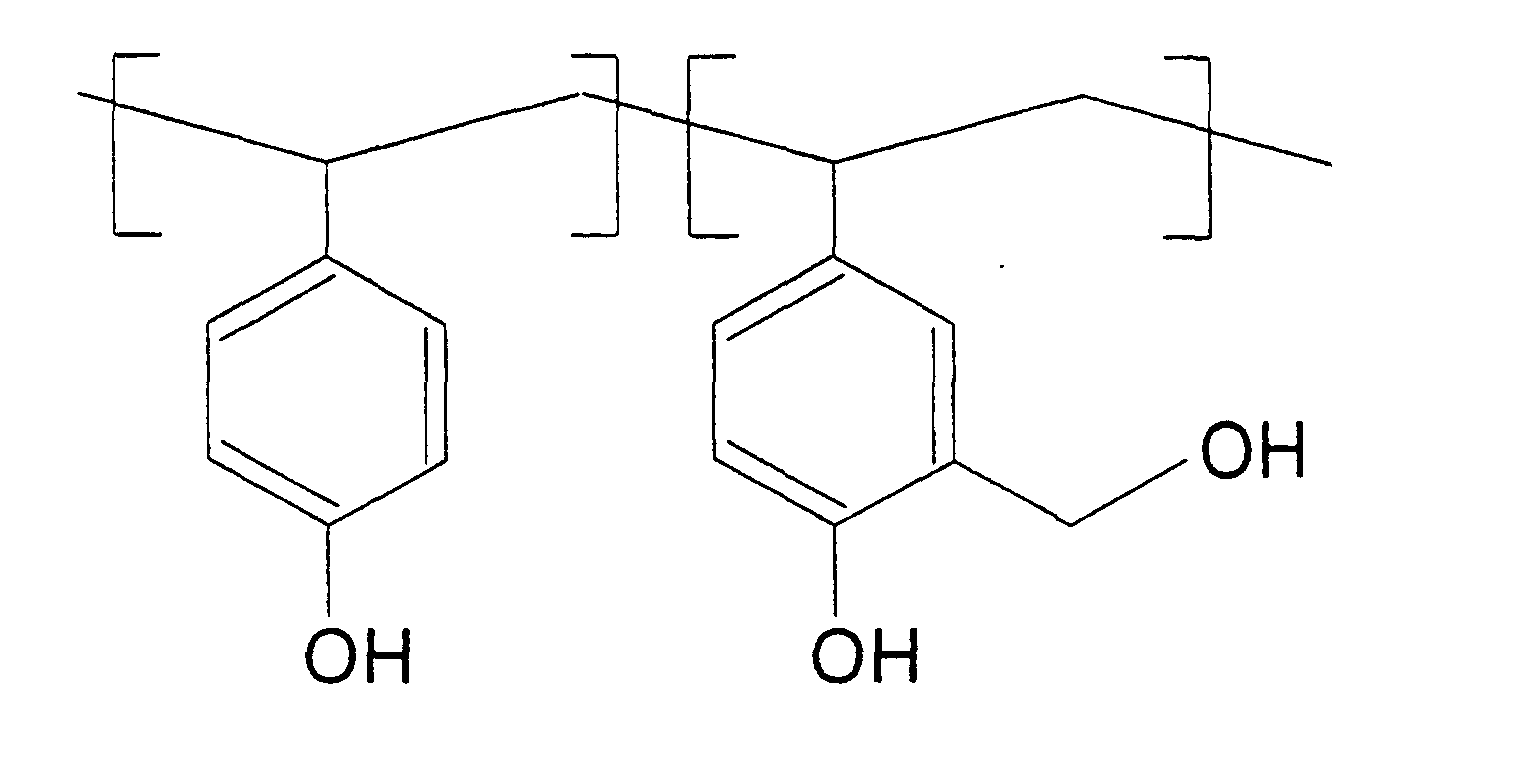
[0010] A particularly suitable methylol polyvinyl phenol compound is a copolymer of the following structure:
[0011] Suitable latent acid generating compounds are latent Bronsted acids and haloalkyl-substituted-s-triazines.
[0012] Other examples of latent Bronsted acid generators are iodonium, sulphonium, phosphonium, selenonium, diazonium and arsonium salts and particularly salts of fluorophosphoric acid.
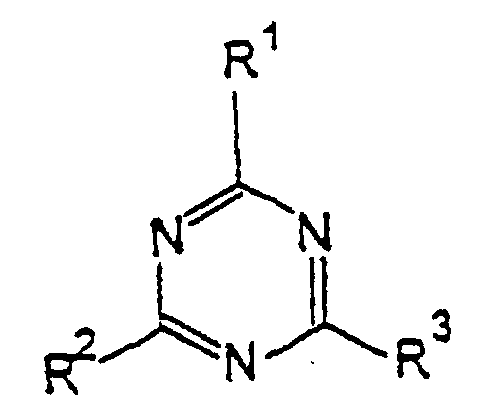
[0013] If a haloalkyl-substituted-s-triazine is used. as the latent acid generating compound preferably it is of the formula:-
wherein R1 is a substituted or unsubstituted aliphatic or aromatic group, R2 and R3 are each a trihaloalkyl group.
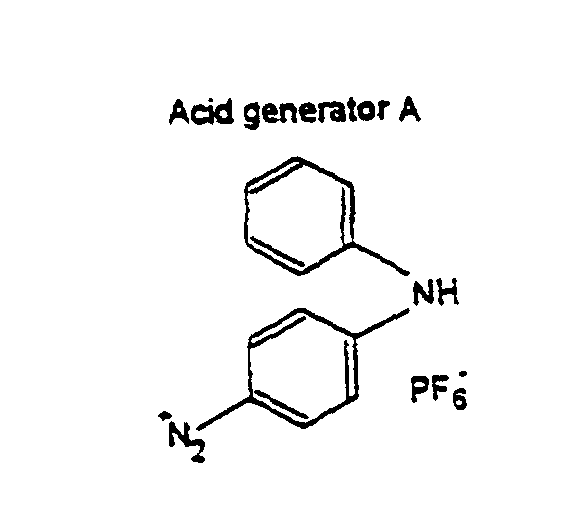
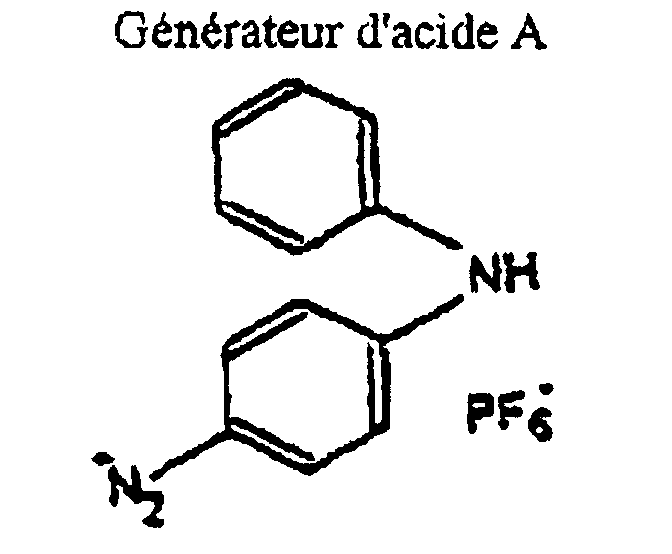
[0014] A particularly useful diazonium salt for use as an acid generator (acid generator A) is the compound of formula:-
[0015] The above mentioned latent Bronsted acids with the exception of diazonium salts are all decomposed by both UV and infra-red light to liberate an acid.
[0016] Diazonium salts are decomposed by U.V. light to liberate an acid but as diazonium salts can not be light-sensitised they are not decomposed by infra-red light. However, if an infra-red absorber is present in the composition which converts infra-red light to heat then the diazonium salts which are heat sensitive are decomposed as in the examples which follow.
[0017] Carbon black is a useful infra-red absorbing agent which converts infra-red radiation to heat. Other pigments can also be used.
[0018] Examples of useful infra-red sensitising dyes are dyes of the following classes, squarylium, croconate, cyanine, merocyanine, indolizine, pyrylinium or a metal dithiolene dye.
[0019] The composition of the present invention is of particular use because it can be UV imaged in the normal manner using a mask or it can be imaged by a laser digitally. Also negative plates or direct positive plates can be prepared.
[0020] According to another aspect of the present invention there is provided a method of preparing a lithographic printing plate which comprises infra-red laser imaging a lithographic printing plate precursor as just set forth, heating the imaged plate overall and then subjecting the heated plate to development in an aqueous alkali solution to yield a negative working plate.
[0021] Preferably the infra-red absorbing compound is one whose absorption spectrum is significant at the wavelength output of the laser which is to be used in the method of the present invention. For example gallium arsenide diode lasers emit at 830nm and Nd YAG lasers emit at 1064nm.
[0022] In the method of the present invention the laser imaging of the plate followed by heat treatment hardens the composition imagewise. The unexposed composition on the plate is removed by the development step. This yields a negative image.
[0023] However, the lithographic plate precursor of the present invention can be used to produce a direct positive plate. In this method the plate is imagewise exposed through a mask to U.V. light or directly using a laser then developed. In this case the exposed areas become alkali-soluble leaving the unexposed areas as the direct positive image.
[0024] Preferably in the lithographic assembly used in the method of the present invention where heat is generated by the infra-red laser there is present between the photosensitive layer and the base a heat insulator layer which attenuates the thermal conductivity to the base. This is especially useful if the base is an aluminium plate base. In the preparation of an aluminium plate base for use in lithography there usually forms on the base a thin layer of aluminium oxide which is often between 2 to 3 µm in thickness. However, in some method of preparing the base a layer of aluminium oxide is formed which is from 10 to 15 µm in thickness. Such a thickness of aluminium oxide acts very efficiently as a heat insulation layer. However, if the thickness of the aluminium oxide layer is much greater than 15 µm an unstable layer can be formed which tends to flake off.
[0025] Thermal conduction from the imaging layer may also be reduced by optimisation of anodising conditions to produce an anodic sub-layer of low porosity and low thermal conductivity.
[0026] Thermal conduction from the imaging layer may also be reduced by use of hydrophilising layers such as those described in E.P.A. 626273.
[0027] Preferably as much infra-red absorber is present in the photosensitive composition so as not to interfere with the alternative U.V. exposure method. Dyes with the selective IR absorption can be present in a greater amount than a black body such as carbon.
[0028] By having a thermal insulating layer and by varying the amount of infra-red absorber present in the photosensitive composition it is possible to minimise the loss of resolution through lateral heat conductivity whilst maintaining sufficient sensitivity.
[0029] The base which can be used as a lithographic base is preferably an aluminium plate which has undergone the usual anodic, graining and post-anodic treatments well known in the lithographic art for enabling a photosensitive composition to be coated thereon.
[0030] Another base material which may be used in the method of the present invention is a plastics material base or a treated paper base as used in the photographic industry. A particularly useful plastics material base is polyethylene terephthalate which has been subbed to render its surface hydrophilic. A so-called resin coated paper which has been corona discharge treated may also be used.
[0031] An example of a suitable practical developing solution is an aqueous solution of 8% metasilicate, 0.1% of an organic phosphate ester of an ethoxylated alcohol and 0.01% of polyoxylpropylane methyl ethyl ammonium chloride.
LASER IMAGING
[0032] The coated substrate to be imaged was cut into a circle of 105mm diameter and placed on a disc that could be rotated at a constant speed of 2500 revolutions per minute. Adjacent to the spinning disc a translating table held the source of the laser beam so that the laser beam impinged normal to the coated substrate, while the translating table moved the laser beam radially in a linear fashion with respect to the spinning disk. The exposed image was in the form of a spiral whereby the image in the centre of the spiral represented slow laser scanning speed and long exposure time and the outer edge of the spiral represented fast scanning speed and short exposure time.
[0033] The laser used was a single mode 830nm wavelength 200mW laser diode which was focused to a 10 µm spot. The laser power supply was a stabilised constant current source.
PROCESSING AFTER IMAGING
[0034] The exposed disc was developed by immersing in the alkaline developer solution which removed the non-imaged coating leaving the exposed spiral image. The larger the diameter of the resulting spiral image corresponded to the less exposure time required to form the image. Exposure time quoted in the examples was the calculated time required for the laser to pass over a theoretical 10 µm square on the surface of the substrate and corresponded to an exposure sufficient to produce an image line that resisted the developer treatment.
CONVENTIONAL IMAGING
[0035] It is to be understood, that the precursors prepared in the present invention can also be U.V. imaged to yield a positive working plate or can be reversal imaged to yield a negative working plate. The U.V. source may be a carbon arc lamp, a mercury vapour lamp, a fluorescent lamp or a tungsten filament lamp.
DEVELOPERS
[0036] Different coatings had different alkali solubility and required different developer compositions. Below are the basic compositions of three developers two of which are used in the examples.
Developer A
Developer B
Developer C
[0039] 14% Sodium Metasilicate pentahydrate in water.
The imaged substrate was developed for 30 seconds.
MATERIALS
[0040] The following substances were used in the examples which follow
In the Example which follows the condensing agent was polyvinyl phenol with substituted methylol groups
Example 1
[0045] A solution containing 0.59g of 40% w/w novolak A in methoxypropanol, 0.24g polyvinyl phenol substituted with methylol groups, 0.055g of acid generator B, 0.22g of dye A, 3.09g of methoxypropanol and 1g of DMF was prepared and coated onto a substrate consisting of a sheet of aluminium that had been electrograined and anodised, giving a coating weight of 1.3gm-2 after thoroughly drying at 100°C in an oven for 3 minutes.
| COMPONENT | WEIGHT (g) | % SOLIDS |
| Novolak A | 0.59 | 42 |
| Methylol-P.V.Phenol | 0.59 | 42 |
| Acid generator B | 0.55 | 12 |
| Dye A | 0.022 | 4 |
| Methoxypropanol | 3.09 | 0 |
| DMF | 1 | 0 |
[0046] The resulting plate was imaged using a 200mW laser diode at a wavelength of 830nm using the imaging device described previously. The plate was then heated to 130°C for one minute. The plate was then developed using the alkaline developer B for 30 seconds which removed the parts of the coating on the plate that were not struck by the laser beam giving an image. The imaging energy density required to give a suitable image was 200mJ/cm-2using developer B.
Example 2
[0047] A solution containing 0.59g of 40% w/w novolak A in methoxypropanol, 0.24g polyvinyl phenol substituted with hydroxymethyl groups, 0.055g of acid generator A, 0.22g of dye A, 3.09g of methoxypropanol and 1g of DMF was prepared and coated onto a substrate consisting of a sheet of aluminium that had been electrograined and anodised, giving a coating weight of 1.3gm-2 after thoroughly drying at 100°C in an oven for 3 minutes.
| COMPONENT | WEIGHT (g) | % SOLIDS |
| novolak A | 0.59 | 42 |
| methylol-P.V.Phenol | 0.24 | 42 |
| acid generator A | 0.02 | 12 |
| dye A | 0.022 | 4 |
| methoxypropanol | 3.09 | 0 |
| DMF | 1 | 0 |
[0048] The resulting plate was imaged using a 200mW laser diode at a wavelength of 830nm using the imaging device described previously. The plate was then heated to 100°C for one minute. The plate was then developed using the alkaline developer B for 120 seconds which removed the parts of the coating on the plate that were not struck by the laser beam giving an image. The imaging energy density required to give a suitable image was 200mJ/cm-2using developer B.
Example 3
[0049] A solution containing 1.18g of 40% w/w novolak B in methoxypropanol, 0.55g bis(hydroxymethyl)p-cresol, 0.055g of acid generator B 0.22g of dye A, 272g of methoxypropanol and 1g of DMF was prepared and coated onto a substrate consisting of a sheet of aluminium that had been electrograined and anodised, giving a coating weight of 1.3gm-2 after thoroughly drying at 100°C in an oven for 3 minutes.
| COMPONENT | WEIGHT (g) | % SOLIDS |
| novolak B | 1.18 | 81.8 |
| bis(hydroxymethyl) | 0.55 | 9.6 |
| p-cresol | ||
| acid generator B | 0.02 | 4.8 |
| dye A | 0.022 | 3.8 |
| methoxypropanol | 3.09 | 0 |
| DMF | 1 | 0 |
[0050] The resulting plate was imaged using a 200mW laser diode at a wavelength of 830nm using the imaging device described previously. The plate was then heated to 100°C for one minute. The plate was then developed using the alkaline developer B for 120 seconds which removed the parts of the coating on the plate that were not struck by the laser beam giving an image. The imaging energy density required to give a suitable image was 200m/cm-2using developer C.
Example 4
[0051] A solution containing 1.18g of 40% w/w novolak B in methoxypropanol, 0.55g bis(hydroxymethyl)p-cresol,0.055g of acid generator A 0.22g of dye A, 272g of methoxypropanol and 1g of DMF was prepared and coated onto a substrate consisting of a sheet of aluminium that had been electrograined and anodised, giving a coating weight of 1.3gm-2 after thoroughly drying at 100°C in an oven for 3 minutes.
| COMPONENT | WEIGHT (g) | % SOLIDS |
| novolak B | 1.18 | 81.8 |
| bis(hydroxymethyl) | 0.55 | 9.6 |
| p-cresol | ||
| acid generator A | 0.02 | 4.8 |
| dye A | 0.022 | 3.8 |
| methoxypropanol | 3.09 | 0 |
| DMF | 1 | 0 |
[0052] It is to be understood that a lithographic plate precursor as prepared in the examples could be imaged conventionally: a positive plate can be obtained by UV imaging and developing and a negative plate can be obtained by UV imaging, heating and developing.
[0053] As the precursor plates of the present invention rely on a heating process, any suitable light of sufficient power which is absorbed by components in the system to generate heat in the composition, and be used.
Example 5
[0054] A solution containing 0.59g of 40% w/w novolak A in methoxypropanol, 0.59g of a 40% polyvinyl phenol (substituted with methylol groups) solution in methoxypropanol, 0.55g of a 10% solution of acid generator C in DMF, 0.022g of dye A, 1.51g of methoxypropanol and 1.73g of DMF was prepared and coated onto a substrate consisting of a sheet of aluminium that had been electrograined and anodised, giving a coating film weight of 1.3gm-2 after thoroughly drying at 100°C in an oven for 3 minutes.
| COMPONENT | WEIGHT (g) | % SOLIDS |
| novolak A | 0.59 | 42 |
| methylol-P.V. phenol | 0.59 | 42 |
| acid generator C | 0.55 | 12 |
| dye A | 0.022 | 4 |
| Methoxypropanol | 1.51 | 0 |
| DMF | 1.73 | 0 |
[0055] The resulting plate was imaged using a 200mW laser diode at a wavelength of 830nm using the imaging device described previously. The plate was then heated to 100°C for one minute. The plate was then developed using the alkaline developer C for 120 seconds which removed the parts of the coating on the plate that were not struck by the laser beam giving an image. The imaging energy density required to give a suitable image was 480mJ/cm-2 using developer B.
Example 6
[0056] A solution containing 1.18g of 40% w/w novolak B in methoxypropanol, 0.14g of a 40% solution of bis(hydroxymethyl)p-cresol in methoxypropanol, 0.055g of a 10% solution of acid generator C in DMF, 0.022g of dye A, 1.42g of methoxypropanol and 1.96g of DMF was prepared and coated onto a substrate consisting of a sheet of aluminium that had been electrograined and anodised, giving a coating film weight of 1.3gm-2 after thoroughly drying at 100°C in an oven for 3 minutes.
| COMPONENT | WEIGHT (g) | % SOLIDS |
| Novolak B | 1.18 | 81.8 |
| bis(hydroxymethyl) | ||
| p-cresol | 0.55 | 9.6 |
| acid generator C | 0.02 | 4.8 |
| dye A | 0.022 | 3.8 |
| Methoxypropanol | 3.09 | 0 |
| DMF | 1 | 0 |
[0057] The resulting plate was imaged using a 200mW laser diode at a wavelength of 830nm using the imaging device described previously. The plate was then heated to 100°C for one minute. The plate was then developed using the alkaline developer C for 120 seconds which removed the parts of the coating on the plate that were not struck by the laser beam giving an image. The imaging energy density required to give a suitable image was 600mJ/cm-2 using developer B.
1. A lithographic printing plate precursor comprising on a support a radiation sensitive
composition which comprises (1) a novolak resin, (2) a condensing agent for the novolac
resin which is a either a methylol polyvinyl phenol compound or a bishydroxymethyl
compound, (3) a radiation sensitive latent acid generating compound and (4) an infra
red absorbing compound or an infra-red sensitising dye.
2. A lithographic printing plate precursor according to claim 1 wherein the novolak resin
is derived from m-cresol and formaldehyde.
3. A lithographic printing plate precursor according to claim 1 wherein the bis hydroxymethyl
condensing agent is 2,6-bis(hydroxymethyl)-p-cresol.
4. A lithographic printing plate precursor according to claim 1 wherein the methylol
polyvinyl phenol compound has the following structure:-
5. A lithographic printing plate precursor according to claim 1 wherein the radiation
sensitive latent acid generating compound is a latent Bronsted acid or a haloalkyl-substutited
s-triazine.
6. A lithographic printing plate precursor according to claim 5 wherein the latent acid
generating compound is an iodonium, sulphonium, phosphonium, selenonium, diazonium
or arsonium salt or a fluorophosphoric acid.
7. A lithographic plate precursor according to claim 6 wherein the iodonium salt is iodonium
hexafluorophosphate.
8. A lithographic plate precursor according to claim 6 wherein the diazonium salt has
the formula:-
9. A lithographic printing plate precursor according to claim 5 wherein the haloalkyl-substituted
s-triazine is of the formula:-

wherein R1 is a substituted or unsubstituted aliphatic or aromatic radical, and R2 and R3 are each a haloalkyl group.
wherein R1 is a substituted or unsubstituted aliphatic or aromatic radical, and R2 and R3 are each a haloalkyl group.
10. A lithographic printing plate precursor according to claim 1 wherein the infra-red
absorbing compound is carbon black.
11. A lithographic plate precursor according to claim 1 wherein the infra-red sensitising
dye is a dye of one of the following classes of dye:- squarylium, croconate, cyanine,
merocyanine, indolizine, pyrylinium or metal dithiolene dye.
1. Lithographische Druckplatten-Vorstufe, umfassend auf einem Träger eine strahlungsempfindliche
Zusammensetzung, die (1) ein Novolakharz, (2) ein Kondensationsmittel für das Novolakharz,
bei dem es sich entweder um eine Methylol-Polyvinylphenol-Verbindung oder eine Bishydroxymethyl-Verbindung
handelt, (3) eine strahlungsempfindliche eine latente Säure bildende Verbindung und
(4) eine IR-absorbierende Verbindung oder einen für Infrarot sensibilisierenden Farbstoff
umfaßt.
2. Lithographische Druckplatten-Vorstufe nach Anspruch 1, wobei das Novolakharz von m-Cresol
und Formaldehyd abgeleitet ist.
3. Lithographische Druckplatten-Vorstufe nach Anspruch 1, wobei das Bishydroxymethyl-Kondensationsmittel
2,6-Bis(hydroxymethyl)-p-cresol ist.
4. Lithographische Druckplatten-Vorstufe nach Anspruch 1, wobei die Methylol-Polyvinylphenol-Verbindung
die folgende Struktur aufweist:

5. Lithographische Druckplatten-Vorstufe nach Anspruch 1, wobei die strahlungsempfindliche
eine latente Säure bildende Verbindung eine latente Brönstedt-Säure oder ein Halogenalkyl-substituiertes
s-Triazin ist.
6. Lithographische Druckplatten-Vorstufe nach Anspruch 5, wobei die eine latente Säure
bildende Verbindung ein Iodonium-, Sulfonium-, Phosphonium-, Selenonium-, Diazonium-
oder Arsoniumsalz oder eine Fluorophosphorsäure ist.
7. Lithographische Druckplatten-Vorstufe nach Anspruch 6, wobei das Iodoniumsalz Iodoniumhexafluorophosphat
ist.
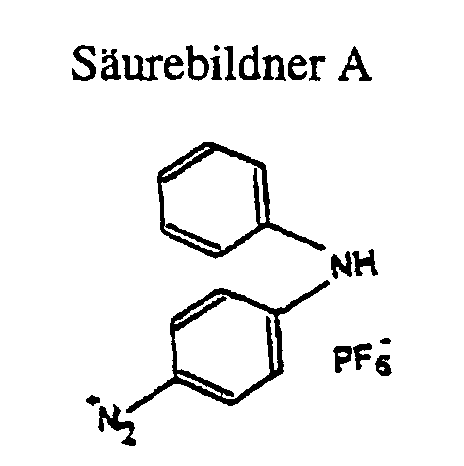
8. Lithographische Druckplatten-Vorstufe nach Anspruch 6, wobei das Diazoniumsalz die
folgende Formel hat:
9. Lithographische Druckplatten-Vorstufe nach Anspruch 5, wobei das Halogenalkylsubstituierte
s-Triazin die folgende Formel hat:
in der R1 ein substituierter oder unsubstituierter aliphatischer oder aromatischer Rest ist und R2 und R3 jeweils einen Halogenalkylrest bedeuten.
in der R1 ein substituierter oder unsubstituierter aliphatischer oder aromatischer Rest ist und R2 und R3 jeweils einen Halogenalkylrest bedeuten.
10. Lithographische Druckplatten-Vorstufe nach Anspruch 1, wobei die IR-absorbierende
Verbindung Ruß ist.
11. Lithographische Druckplatten-Vorstufe nach Anspruch 1, wobei der für Infrarot sensibilisierende
Farbstoff ein Farbstoff aus einer der folgenden Klassen von Farbstoffen ist: Squarylium-,
Croconat-, Cyanin-, Merocyanin-, Indolizin-, Pyrylinium- oder Metalldithiolen-Farbstoff.
1. Précurseur de plaque d'impression lithographique comprenant, sur un support, une composition
sensible à un rayonnement qui comprend (1) une résine novolaque, (2) un agent de condensation
pour la résine novolaque qui est soit un composé méthylolpolyvinylphénol soit un composé
bishydroxyméthylique, (3) un composé générateur d'acide latent, sensible à un rayonnement,
et (4) un composé absorbant le rayonnement infrarouge ou un colorant sensibilisateur
à l'infrarouge.
2. Précurseur de plaque d'impression lithographique selon la revendication 1 dans lequel
la résine novolaque est dérivée de m-crésol et de formaldéhyde.
3. Précurseur de plaque d'impression lithographique ,selon la revendication 1 dans lequel
l'agent de condensation bishydroxyméthylique est le 2,6-bis(hydroxyméthyl)-p-crésol.
4. Précurseur de plaque d'impression lithographique selon la revendication 1 dans lequel
le composé méthylolpolyvinylphénol a la structure suivante

5. Précurseur de plaque d'impression lithographique selon la revendication 1 dans lequel
le composé générateur d'acide latent, sensible à un rayonnement, est un acide de Brönsted
latent ou une s-triazine à substitution halogénoalkyle.
6. Précurseur de plaque d'impression lithographique selon la revendication 5 dans lequel
le composé générateur d'acide latent est un sel d'iodonium, de sulfonium, de phosphonium,
de sélénonium, de diazonium ou d'arsonium ou un acide fluorophosphorique.
7. Précurseur de plaque lithographique selon la revendication 6 dans lequel le sel d'iodonium
est l'hexafluorophosphate d'iodonium.
8. Précurseur de plaque lithographique selon la revendication 6 dans lequel le sel de
diazonium a pour formule:
9. Précurseur de plaque d'impression lithographique selon la revendication 5 dans lequel
la s-triazine à substitution halogénoalkyle a pour formule:
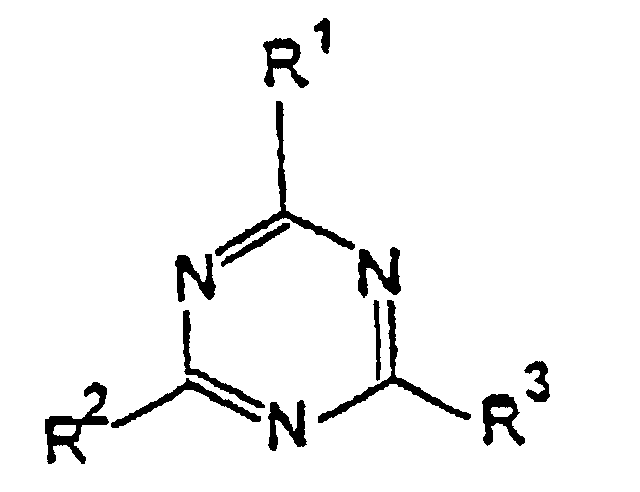
dans laquelle R1 est un radical aliphatique ou aromatique substitué ou non substitué et R2 et R3 sont chacun un groupe halogénoalkyle.
dans laquelle R1 est un radical aliphatique ou aromatique substitué ou non substitué et R2 et R3 sont chacun un groupe halogénoalkyle.
10. Précurseur de plaque d'impression lithographique selon la revendication 1 dans lequel
le composé absorbant le rayonnement infrarouge est le noir de carbone.
11. Précurseur de plaque d'impression lithographique selon la revendication 1 dans lequel
le colorant sensibilisateur à l'infrarouge fait partie de l'une des familles de colorants
suivantes: squarylium, croconate, cyanine, mérocyanine, indolizine, pyrylinium ou
métal-dithiolène.