| (19) |
 |
|
(11) |
EP 0 954 555 B1 |
| (12) |
EUROPEAN PATENT SPECIFICATION |
| (45) |
Mention of the grant of the patent: |
|
03.01.2007 Bulletin 2007/01 |
| (22) |
Date of filing: 28.11.1997 |
|
| (51) |
International Patent Classification (IPC):
|
| (86) |
International application number: |
|
PCT/GB1997/003286 |
| (87) |
International publication number: |
|
WO 1998/023702 (04.06.1998 Gazette 1998/22) |
|
| (54) |
REFRIGERANT COMPOSITION
KÜHLMITTELZUSAMMENSETZUNG
COMPOSITION REFRIGERANTE
|
| (84) |
Designated Contracting States: |
|
AT BE CH DE DK ES FI FR GB GR IE IT LI LU MC NL PT SE |
| (30) |
Priority: |
28.11.1996 GB 9624818
|
| (43) |
Date of publication of application: |
|
10.11.1999 Bulletin 1999/45 |
| (73) |
Proprietor: E.I. du Pont de Nemours and Company |
|
Wilmington, DE 19808 (US) |
|
| (72) |
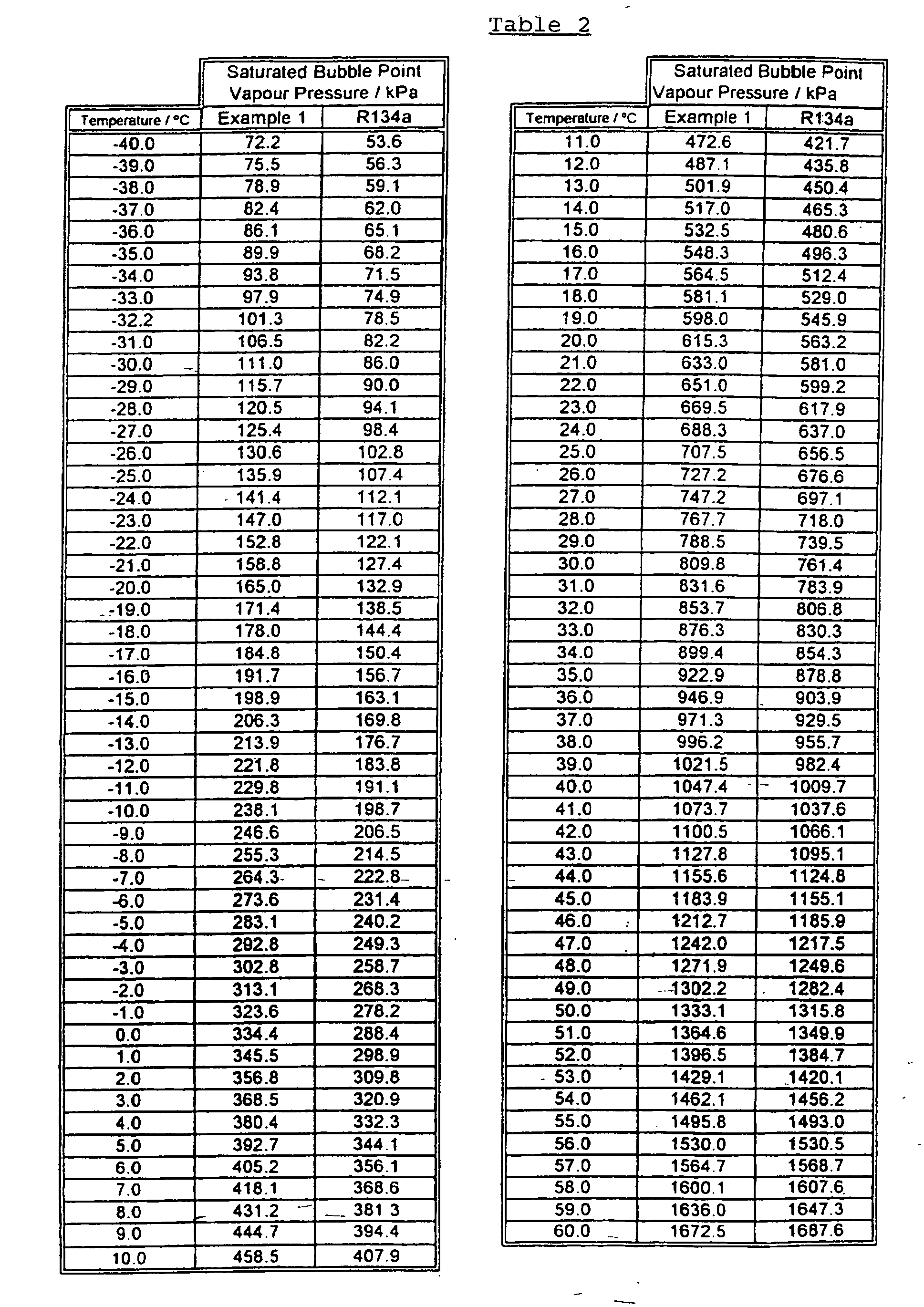
Inventor: |
|
- ROBERTS, Neil
Bristol BS17 3SP (GB)
|
| (74) |
Representative: Thomson, James B. et al |
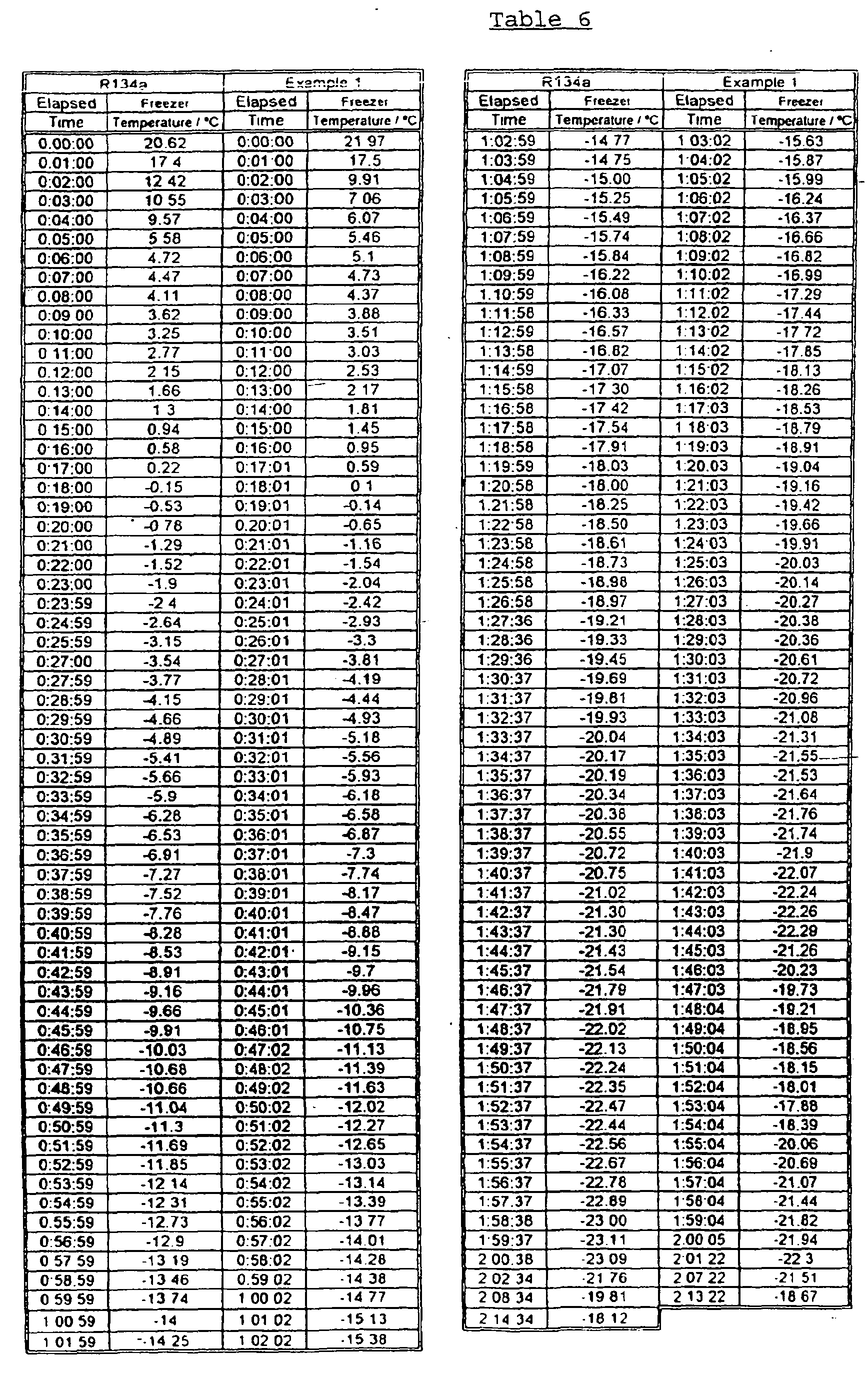
|
Frank B. Dehn & Co.
St Bride's House
10 Salisbury Square
London EC4Y 8JD
London EC4Y 8JD (GB) |
| (56) |
References cited: :
EP-A- 0 565 265
WO-A-94/18282
WO-A-96/37571
|
EP-A- 0 779 352
WO-A-95/08602
GB-A- 2 291 884
|
|
| |
|
|
- PEARSON, S. F.: "Automatic calorimeter for mixed refrigerants" PROC. - INT. CONGR.
REFRIG., 19TH (1995), VOLUME 4A, 481-487 PUBLISHER: INSTITUT INTERNATIONAL DU FROID,
PARIS, FR. CODEN: 64VHAQ, 1995, XP002056974
|
|
| |
|
| Note: Within nine months from the publication of the mention of the grant of the European
patent, any person may give notice to the European Patent Office of opposition to
the European patent
granted. Notice of opposition shall be filed in a written reasoned statement. It shall
not be deemed to
have been filed until the opposition fee has been paid. (Art. 99(1) European Patent
Convention).
|
[0001] The present invention relates to a refrigerant composition suitable for use in compression
refrigeration.
[0002] Chlorofluorocarbons (CFCs), such as dichlorodifluoromethane (CFC-12), have traditionally
been used as refrigerants for compression refrigeration systems. Refrigeration systems
that use CFCs as refrigerants generally use mineral oils to lubricate the compressor.
These lubricating mineral oils are also known as napthalenic oils. A lubricating mineral
oil is typically a lube oil fraction having a viscosity index of from -300 to 140,
which has been dewaxed, deasphalted and hydrogenated. The mineral oil may contain
up to 15% by weight of an additive such as an antioxidant or a corrosion inhibitor.
Typically, it has a kinematic viscosity at 40°C of from 10 mm
2/s to 220 mm
2/s (10cSt to 220 cSt).
[0003] In compression refrigeration systems it is desirable that all the lubricant should
remain in the compressor to ensure that the compressor is adequately lubricated. In
practice, however, an amount of lubricant is invariably aspirated into the surrounding
pipework of the refrigeration cycle. If the lubricant is insoluble in the refrigerant,
there is a danger that it will separate from the refrigerant and fail to return to
the compressor. In this event, the compressor becomes inadequately lubricated. Refrigeration
systems that use CFCs such as CFC-12 generally use mineral oil lubricants because
such CFCs are soluble with the mineral oils throughout the entire range of refrigeration
temperatures.
[0004] However, recent concern regarding depletion of the ozone layer by CFCs has led to
the use of CFCs being restricted. CFC-12 has an ozone depletion potential of 0.9,
where the ozone depletion potential of trichloromethane is defined to be 1. Alternative
refrigerants are therefore required. Perfluorocarbons are not suitable as alternative
refrigerants as they have a high global warming potential (GWP) and excessive atmospheric
lifetimes. The GWP is the time-integrated commitment to climate forcing from the instantaneous
release of 1kg of refrigerant expressed relative to that from 1kg of carbon dioxide,
which is taken as having a GWP of 1.
[0005] 1,1,1,2-tetrafluoroethane (R134a) is becoming widely used as an alternative to chlorofluorocarbon
refrigerants. It has substantially no ozone depletion potential. It has a GWP, measured
on the basis of a 100 year integrated time horizon, of about 1300. However, R134a
has the disadvantage that it is substantially immiscible with the mineral oil lubricants
used in existing refrigeration equipment. In other words, R134a cannot be used by
itself in such equipment.
[0006] Various attempts have been made to find lubricants which can be used with fluorinated
hydrocarbons such as R134a. Various polyolesters and polyalkylene glycols have been
proposed for this purpose.
[0007] Unfortunately, however, these new lubricants are considerably more expensive than
the conventional mineral oil lubricants. Also, they are often hydroscopic and absorb
atmospheric moisture. Clearly, in order to minimise the changes necessary to the equipment
or operating conditions when replacing CFCs in compression refrigeration systems with
alternative refrigerants, it is desirable to be able to use the conventional mineral
oils as used with the CFCs.
[0008] There is therefore a demand for a refrigerant which possesses the desirable properties
of R134a but which can be used with the conventional mineral oil lubricants as used
with the CFCs. Existing refrigerants which can be used with the mineral oil lubricants
are invariably deficient in some other respect.
[0009] A novel refrigerant composition has now been devised, according to the present invention,
which has substantially no ozone depletion potential, which is sufficiently compatible
with the conventional mineral oil lubricants to be used with them and which has an
operating performance equal to or superior to fluorinated hydrocarbons such as R134a
and chlorofluorocarbons such as CFC-12.
[0010] For the contracting states AT, BE, CH, DK, FI, GR, IE, LI, LU, MC and PT, the present
invention provides a non-azeotropic refrigerant composition having a vapour pressure
at -20°C of from 70 to 190 kPa (0.7 to 1.9 bar), at +20°C of from 510 to 630 kPa (5.1
to 6.3 bar) and at +60°C of from 1620 to 1740 kPa (16.2 to 17.4 bar), which composition
comprises:
- (a) 1,1,2,2-tetrafluoroethane (R134), 1,1,1,2-tetrafluoroethane (R134a), difluoromethoxytrifluoromethane
(E125) or a mixture of two or more thereof, in an amount of from 60 to 99% by weight,
based on the weight of the composition;
- (b) from 1 to 10% by weight, based on the weight of the composition, of an unsubstituted
hydrocarbon of the formula CnHm in which n is at least 4 and m is at least 2n-2; and,
- (c) up to 39% by weight, based on the weight of the composition, of a vapour pressure
depressant having substantially no ozone depletion potential.
[0011] In view of EP 077935A, citable under Art. 54(3) EPC in respect of DE, ES, FR, GB,
IT, NL and SE, the invention provides for those contracting states such a composition
but with the proviso that four specific compositions, as set out in claim 1 below
for these states, are excluded, and the vapor pressure depressant is required to be
present.
[0012] Typically, a composition is "non-azeotropic" if, at any given pressure and temperature,
the composition of the liquid and the composition of the vapour above the liquid are
substantially not equal. Thus, any loss of vapour from a non-azeotropic composition
will result in a composition change of the remaining liquid. In contrast, loss of
vapour from an azeotrope does not result in a change of liquid composition.
[0013] Preferred non-azeotropic compositions are those in which, after about 50% of the
composition is removed such as by evaporation or boiling off, the difference in the
original composition and the composition remaining is more than about 2%, more preferably
more than about 10%.
[0014] Typically, component (a) is present in an amount of from 70 to 95%, preferably from
80 to 90%, more preferably from 82 to 86%, by weight based on the composition.
[0015] Component (b) is an unsubstituted hydrocarbon of the formula C
nH
m, in which n is at least 4 and m is at least 2n-2. Typically, n is from 4 to 6, preferably
4 or 5. Typically, the unsubstituted hydrocarbon has no triple bonds. Preferably,
the unsubstituted hydrocarbon is saturated except for one double bond. More preferably,
the unsubstituted hydrocarbon is fully saturated.
[0016] Typically, the unsubstituted hydrocarbon is methylenecyclopropane, 1-butene, cis
and trans-2-butene, butane, 2-methyl propane, cyclopentene, cyclopentane, 2-methyl-1-butene,
2-methyl-2-butene, 3-methyl-1-butene, 1-pentene, cis and trans-2-pentene, 2-methylbutane,
pentane or a mixture of two or more thereof. Preferably, it is cyclobutane, more preferably
n-butane (R600) or 2-methylpropane (R600a).
[0017] Typically, the unsubstituted hydrocarbon is present in an amount of from 1 to 8%,
preferably from 2 to 6%, more preferably from 2 to 5%, by weight based on the composition.
[0018] The unsubstituted hydrocarbon serves to improve the compatibility of the refrigerant
composition of the invention with mineral oil lubricants. Unfortunately it increases
the vapour pressure of the composition of the invention. It may also increase the
flammability of the composition of the invention.
[0019] Accordingly, component (c) is required in order to reverse the increase in vapour-pressure
caused by component (b). Component (c) is a vapour-pressure depressant, i.e. a compound
capable of lowering the vapour pressure of the refrigerant composition.
[0020] Typically, the vapour-pressure depressant is 1,1-difluoroethane, 1,1,1,2,2,3,3-heptafluoropropane,
1,1,1,2,3,3,3-heptafluoropropane, octafluorocyclobutane, 1,1,1,2,2-pentafluoropropane,
1,1,2,2,3-pentafluoropropane, trifluoromethoxymethane, trifluoromethoxypentafluoroethane,
difluoromethoxypentafluoroethane, trifluoromethoxy-1,2,2,2-tetrafluoroethane, fluoromethoxytrifluoromethane,
difluoromethoxymethane, pentafluoroethoxypentafluoroethane, difluoromethoxydifluoromethane,
trifluoromethoxy-2,2,2-trifluoroethane, fluoromethoxymethane, difluoromethoxy-1,2,2,2-tetrafluoroethane,
fluoromethoxyfluoromethane, difluoromethoxy-2,2,2-trifluoroethane, methoxy-2,2,2-trifluoroethane,
methoxy-1,1,2,2-tetrafluoroethane or a mixture of two or more thereof. Preferably
it is 1,1-difluoroethane (R152a), 1,1,1,2,2,3,3-heptafluoropropane (R227ca), 1,1,1,2,3,3,3-heptafluropropane
(R227ea), 1,1,1,2,2-pentafluoropropane (R245cb), octafluorocyclobutane (RC-318) or
a mixture of two or more thereof.
[0021] Component (c) is typically present in an amount of from 4 to 29%, preferably from
8 to 18%, more preferably from 12 to 16%, by weight based on the composition. The
amount of vapour-pressure depressant depends on the nature and amount of components
(a) and (b). If a large amount of component (b) is present (i.e. more than about 5%
by weight, based on the composition), then a correspondingly greater amount of component
(c) (or of R134) will be required to achieve an appropriate vapour pressure.
[0022] The amount of component (c), if any, in the compositions claimed for the contracting
states AT, BE, CH, DK, FI, GR, LI, LU, MC and PT, but which is required to be present
in the compositions claimed for the contracting states DE, ES, FR, GB, IT, NL and
SE, should be such that the composition has a vapour pressure at -20°C of from 70
to 190 kPa, preferably from 90 to 190 kPa, more preferably from 120 to 180 kPa, at
20°C of from 510 to 630 kPa, preferably from 530 to 630 kPa, more preferably from
580 to 620 kPa, and at 60°C of from 1620 to 1740 kPa, preferably from 1630 to 1720
kPa, more preferably from 1650 to 1700 kPa. This amount can, of course, be readily
determined by routine experiment. It is particularly preferred that the vapour pressure
depressant is present in an amount so that the composition has a vapour pressure substantially
equal to that of R134a.
[0023] When the vapour-pressure depressant is present in an amount of more than 20% by weight,
based on the weight of the composition, it is preferred that the vapour-pressure depressant
comprises two or more compounds, each of which being present in an amount of 20% by
weight or less, based on the weight of the composition.
[0024] The refrigerant composition of the invention may further comprise component (d),
a flammability supressant. Preferably, the composition comprises a flammability supressent
when the unsubstituted hydrocarbon (b) is present in an amount greater than about
2% by weight based on the composition. It is particularly preferred that the composition
comprises a flammability supressent when the unsubstituted hydrocarbon (b) is present
in an amount of about 3% by weight or more based on the composition. Thus compositions
which do not contain a flammability supressent typically contain less than 3%, for
example from 1 to 2%, by weight of the hydrocarbon (b) based on the composition.
[0025] Typically the flammability supressant is 1,1,1,2,2,3,3-heptafluoropropane, 1,1,1,2,3,3,3-heptafluoropropane,
octafluorocyclobutane, octafluoropropane, trifluoromethoxytrifluoromethane, difluoromethoxytrifluoromethane,
trifluoromethoxypentafluoroethane, difluoromethoxypentafluoroethane, trifluoromethoxy-1,2,2,2-tetrafluoroethane,
or a mixture of two or more thereof. The vapour-pressure depressant may also function
as a flammability supressant. Vapour-pressure depressants which also function as flammability
supressants include 1,1,1,2,2,3,3-heptafluoropropane (R227ca), 1,1,1,2,3,3,3-heptafluoropropane
(R227ea), octafluorocyclobutane (RC-318) trifluoromethoxypentafluoroethane (E218),
difluoromethoxypentafluoroethane (E227ea) and trifluoromethoxy-1,2,2,2-tetrafluoroethane
(E227ca).
[0026] If component (d) is present, components (c) and (d) are typically together present
in an amount of up to 39%, preferably from 4 to 29%, more preferably from 8 to 18%,
most preferably from 12 to 16%, by weight based on the composition. Typically, when
component (d) is present, component (c) is present in an amount of up to 19% by weight,
based on the composition and component, (d) is present in an amount of up to 20% by
weight, based on the composition.
[0027] When the flammability supressant and the vapour-pressure depressant are together
present in an amount of 20% by weight or more, based on the weight of the composition,
it is preferred that no single compound comprised in the flammability supressant or
vapour-pressure depressant is present in an amount of 20% by weight or more, based
on the weight of the composition.
[0028] Clearly, any flammability supressant or vapour-pressure depressant used must not
render the refrigerant composition unsuitable for use in compression refrigeration.
Thus, the choice of vapour-pressure depressant or flammability supressant should not
be such as to significantly decrease solubility in the mineral oil lubricants. Typically,
addition of the vapour-pressure depressant or flammability supressant causes no more
than a 10%, preferably no more than a 5%, decrease in the solubility of the composition
in the mineral oil lubricants.
[0029] Typically, any flammability supressant or vapour-pressure__depressant used should
have a GWP, measured on the basis of a 100 year integrated time horizon, of less than
5,000, preferably less than 4,000, most preferably less than 3,500.
[0030] In addition, any flammability supressant or vapour-pressure depressant used should
not impart undue toxicity to the refrigerant composition. The Occupational Exposure
Limit (OEL) of the refrigerant composition of the invention is typically from 800
to 1000, preferably from 850 to 950, ppm.
[0031] The flammability supressant and vapour pressure depressant should have substantially
no ozone depletion potential.
[0032] Furthermore, the flammability supressant and/or vapour-pressure depressant should
not unduly decrease the operating performance of the refrigerant composition of the
invention. Typically, the cooling capacity of a compression refrigeration apparatus,
using, as refrigerant, the composition of the invention, is not more than 10% less,
preferably not more than 5% less, more preferably not less than, the cooling capacity
of an identical compression refrigeration apparatus, operating under identical conditions,
using, as refrigerant, CFC-12 or R134a.
[0033] Typically, the refrigerant composition of the invention contains substantially no
lubricant such as polyalkylene glycol.
[0034] Typically, the energy consumption of a compression refrigeration apparatus using,
as refrigerant, the composition of the invention, is not more than 10% less, preferably
not more than 5% less, more preferably not less than, the energy consumption of an
identical compression refrigeration apparatus, operating under identical conditions,
using, as refrigerant, CFC-12 or R134a.
[0035] The following compositions are particularly preferred:
- 1) compositions in which component (a) is R134 and/or R134a, component (b) is R600
and/or R600a and component (c) is R152a, R227ca, R227ea or a mixture of two or more
thereof;
- 2) compositions in which component (a) is R134 and/or R134a, component (b) is R600
and/or R600a and component (c) is R152a;
- 3) Compositions in which component (a) is R134 and/or R134a, component (b) is R600
and/or R600a and component (c) is R227ca and/or R227ea.
[0036] Typically, in the refrigerant composition of the present invention, the ratio of
the total number of fluorine atoms in the composition to the total number of hydrogen
atoms in the composition is desirably at least 1.25:1, preferably at least 1.5:1,
more preferably at least 2:1. Typically, the refrigerant composition has a lower flammable
limit (LFL) of more than 7% v/v in air, preferably, a LFL of more than 14% v/v in
air. Most preferably, the refrigerant composition is non-flammable.
[0037] Preferably, the refrigerant composition of the present invention has a vapour pressure
substantially equal to that of R134a. R134a has a vapour pressure at -20°C of about
134kPa (5 psi.g), at 20°C of about 572kPa (68 psi.g) and at 60°C of about 1680kPa
(229 psi.g). Typically, the composition of the invention has a vapour pressure not
exceeding ± 60 kPa (0.6 bar), preferably not exceeding ± 40 kPa (0.4 bar) of that
of R134a between -30°C and +60°C.
[0038] The refrigerant composition of the invention has substantially no ozone depletion
potential. Typically, it has a global warming potential (GWP), measured on the basis
of a 100 year integrated time horizon, of less than 2000, preferably less than 1600,
more preferably less than 1300.
[0039] The refrigerant composition of the present invention is preferably used in a domestic
refrigeration apparatus. Typically, it is used in a compression refrigeration apparatus
which contains not more than 1kg of refrigerant.
[0040] The present invention also provides a process of producing refrigeration, comprising
condensing a composition of the invention and thereafter evaporating the composition
in the vicinity of a body to be cooled.
[0041] The refrigerant composition of the present invention can be prepared by transferring
the individual components by autogenous pressure into an initially evacuated pressure
vessel, in order of ascending vapour pressure at room temperature. The amount of each
component can be checked by weighing the vessel and contents before and after transferring
it.
[0042] The refrigerant composition of the present invention is advantageous as it does not
deplete the ozone layer, it has a low global warming potential (GWP) relative to CFC-12
or R134a, it is compatible with mineral oil lubricants and it has an operating performance
equal to or superior to conventional refrigerants such as R134a and CFC-12.
[0043] The refrigerant composition of the present invention is compatible with the mineral
oil lubricants as used with CFC refrigerants. Prior to the present invention it was
thought that, for a refrigerant and lubricant to be compatible, the liquid phases
must be miscible. However, it has now surprisingly been found that satisfactory results
are achieved if gaseous refrigerant is at least partly soluble in the liquid lubricant.
Although the refrigerant composition of the present invention is not fully miscible
with mineral oil lubricants when in its liquid phase, in the gaseous phase it is partially
soluble in the mineral oil. The refrigerant composition of the invention is thus compatible
with mineral oil lubricants.
[0044] The refrigerant composition also has a high operating performance. Refrigeration
systems containing the composition of the present invention are up to 10% more efficient
than refrigeration systems containing conventional refrigerants.
[0045] It is surprising that the above advantages are achieved by the refrigerant composition
of the present invention because the refrigerant composition is a blend of fluorohydrocarbons
and hydrocarbons rather than a single compound. Prior to the present invention it
was thought to be undesirable to use non-azeotropic mixtures as refrigerants as these
mixtures show a temperature glide. A temperature glide of a mixture is the absolute
value of the difference between the starting and ending temperatures of the gas/liquid
phase change by the mixture. It can be measured by determining the difference between
the bubble point of the mixture (the temperature at which the mixture of liquids starts
to boil) and the dew point of a corresponding mixture of gases (the temperature at
which the mixture of gases starts to condense).
[0046] Temperature glide was thought to lead to variable temperatures in the evaporator
of a compression refrigeration system and hence was thought to be undesirable. However,
although the refrigerant compositions of the present invention are found to have up
to a 9K temperature glide when tested in the laboratory, it has surprisingly been
found that the temperature of an evaporator of a domestic refrigeration system containing
the refrigerant composition of the present invention is substantially constant.
[0047] The following Examples illustrate the invention.
EXAMPLES 1 TO 6
[0048] 1000g of refrigerant composition was prepared in each case by mixing together varying
amounts of compounds in a 1000cm
3 pressure vessel. The amounts of each compound used are shown in Table 1.
TABLE 1
| |
Amount of R134a/10 |
Amount of R152a/10 |
Amount of R227ea/10 |
Amount of R227ca/10 |
Amount of R600/10 |
Amount of R600a/10 |
| EX. 1 |
82.0g |
12.5g |
0 |
0 |
0 |
5.5g |
| EX. 2 |
84.5g |
12.5g |
0 |
0 |
0 |
3.0g |
| EX. 3 |
85g |
5g |
5 |
0 |
5 |
0 |
| EX. 4 |
75g |
5g |
18 |
0 |
0 |
2 |
| EX. 5 |
75g |
0 |
12 |
12 |
1 |
0 |
| EX. 6 |
85.5g |
6g |
6g |
0 |
0 |
2.5g |
EXAMPLE 7
[0049] The vapour pressure of the refrigerant composition of Example 1 was measured at varying
temperature using a 300cm
3 internal volume stainless steel cylinder, fitted with a calibrated Bourdon gauge
suspended in a temperature controlled bath containing a glycol solution. The temperatures
were determined using a calibrated platinum resistance thermometer.
[0050] The results are shown in Table 2.
EXAMPLE 8
[0051] The vapour pressure of the refrigerant composition of Example 2 was measured at varying
temperature in the same way as in Example 7. The results are shown in Table 3.
EXAMPLE 9
[0052] The vapour pressure of the refrigerant composition of Example 6 was measured at varying
temperature in the same way as in Example 7. The results are shown in Table 4.
EXAMPLE 10
[0053] The global warming potentials (GWPs) of the compositions of Examples 2 to 6 were
calculated on a mass ratio basis, i.e. by taking the sum of the products of the global
warming potentials of each component of the composition in question with the mass
ratio of that component in the composition
[0054] Thus, the GWP of the composition of Example 2 is calculated as follows:
| Component of Example 2 |
Mass Ratio |
GWP |
Mass Ratio x GWP |
| R134a |
0.845 |
1300 |
1098.5 |
| R152a |
0.125 |
140 |
17.5 |
| R600a |
0.030 |
3 |
0.09 |
| GWP of composition of Example 2 = 1098.5 + 17.5 + 0.09 = 1116.09 |
[0055] The global warming potentials of R134a and CFC-12 are provided as comparisons (data
taken from BS 4434, 1995). The results are shown in Table 5.
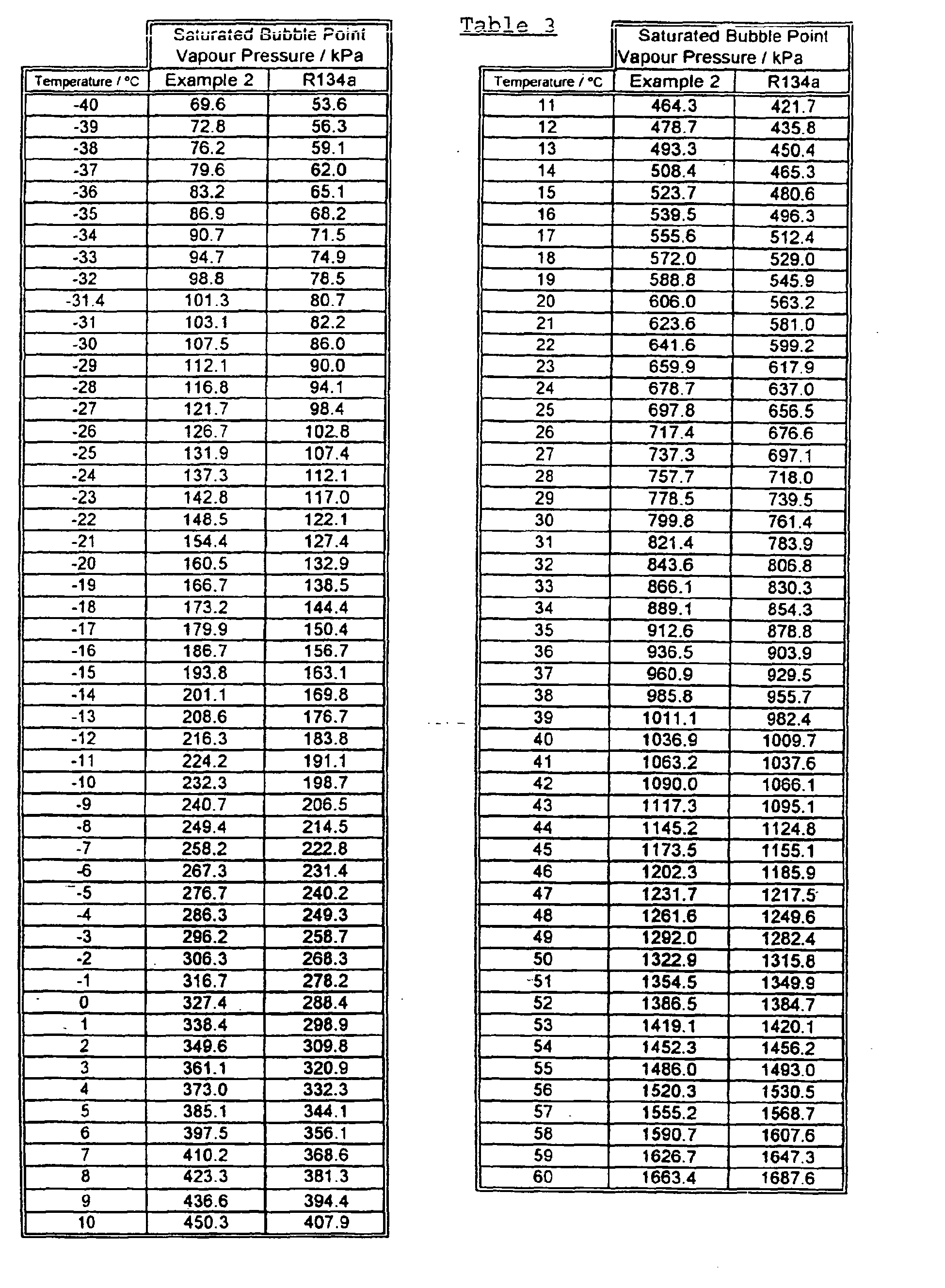
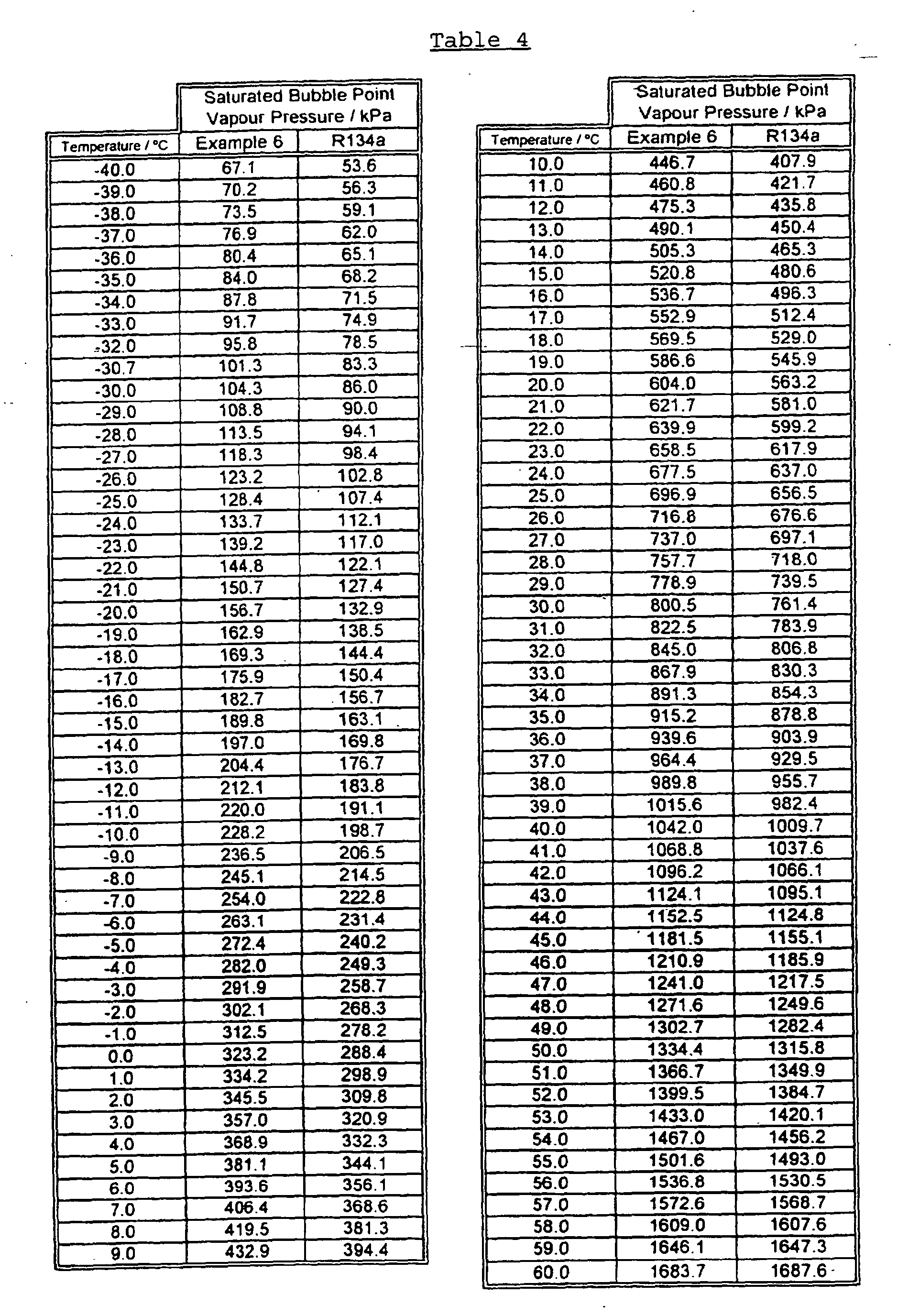
TABLE 5 - Comparison of Global Warming Potential
| Working Fluid |
GWP (100 year ITH) |
| R134a |
1300 |
| Example 2 |
1116 |
| Example 3 |
1227 |
| CFC-12 |
8500 |
| Example 4 |
1576 |
| Example 5 |
1767 |
| Example 6 |
1284 |
EXAMPLE 11
[0056] The rate of cooling in a Bauknecht GKC 3333/O WS Class N freezer having a gross volume
of 332 litres and a refrigerant charge of 180g was measured using the composition
of Example 1 as a refrigerant. The rate of cooling in the same domestic freezer using
R134a as a refrigerant was also measured.
[0057] Thermocouples were connected to the inlet and outlet of the evaporator coil inside
the freezer compartment as well as the compressor discharge line. A further thermocouple
was placed inside the freezer compartment near the thermostat sensor. Pressure gauges
were fitted to the suction and discharge lines and the power supply to the freezer
was passed through a kilowatt hour meter.
[0058] The temperatures from the thermocouples were logged by a data logger typically at
1 minute intervals. The freezer, factory charged with R134a, was placed in a temperature
controlled environment, typically 22°C ± 1°C, and allowed to temperature equilibrate
for at least 24 hours. The freezer and data logger were turned on and the time taken
to reduce the internal freezer temperature to a level at which the thermostat cut-in
was determined.
[0059] The procedure was repeated after replacing the R134a with the composition of Example
1.
[0060] Placing the freezer in a temperature controlled environment ensured that the quantity
of energy which must be removed in each case to reduce the internal temperature by
a given amount is approximately equivalent. A comparison of refrigerating effect can
therefore be made between the two refrigerants. The faster the internal temperature
reached the desired temperature, the larger the refrigeration effect. The power consumption,
taken directly from the kilowatt hour meter, gives a direct comparison of the efficiency
of the refrigerant composition of Example 1 compared to R134a.
[0061] The results are shown in Table 6
EXAMPLE 12
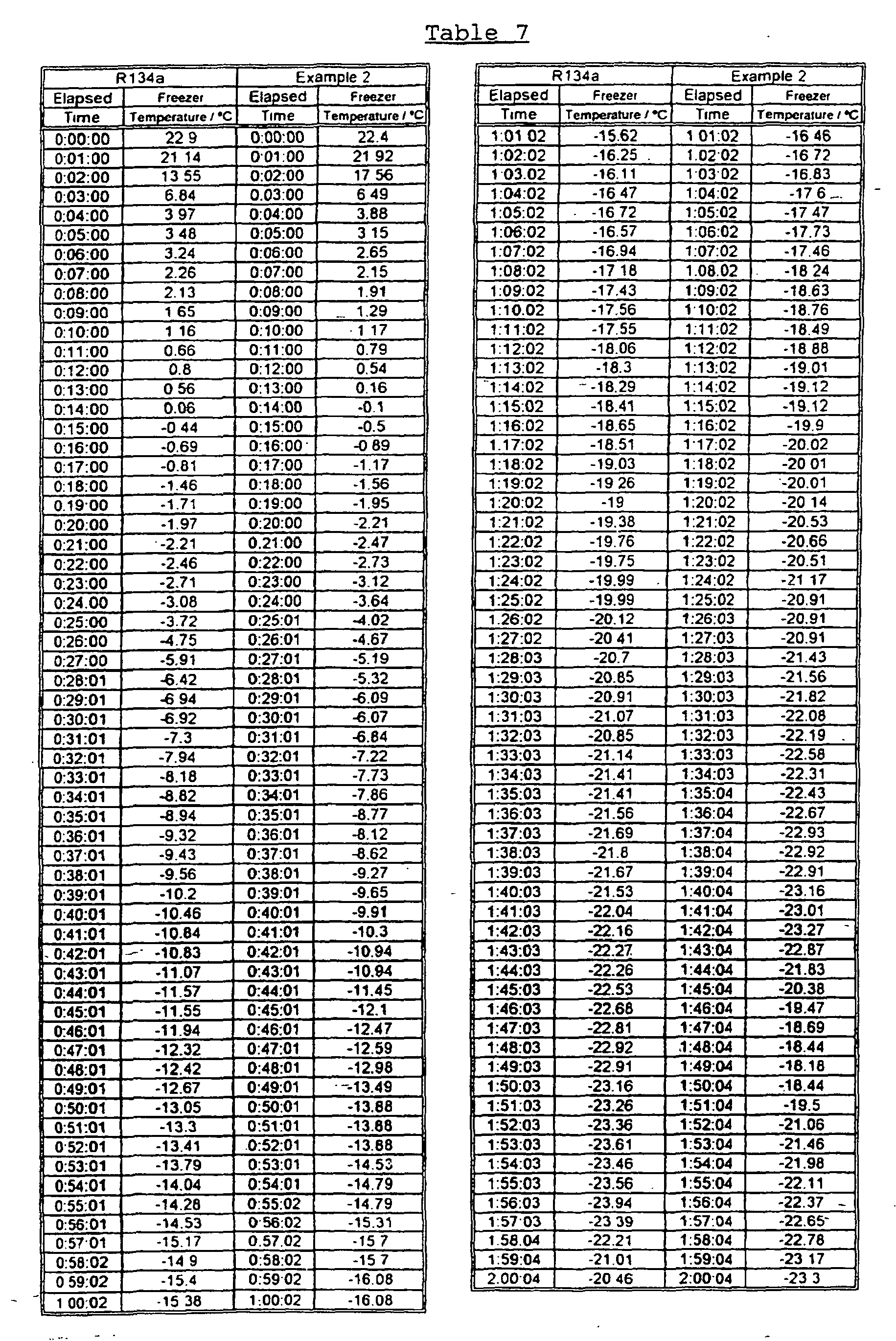
[0062] The rate of cooling was measured in the same way as in Example 11 except that the
composition of Example 2 was used in place of the composition of Example 1.
[0063] The results are shown in Table 7.
EXAMPLE 13
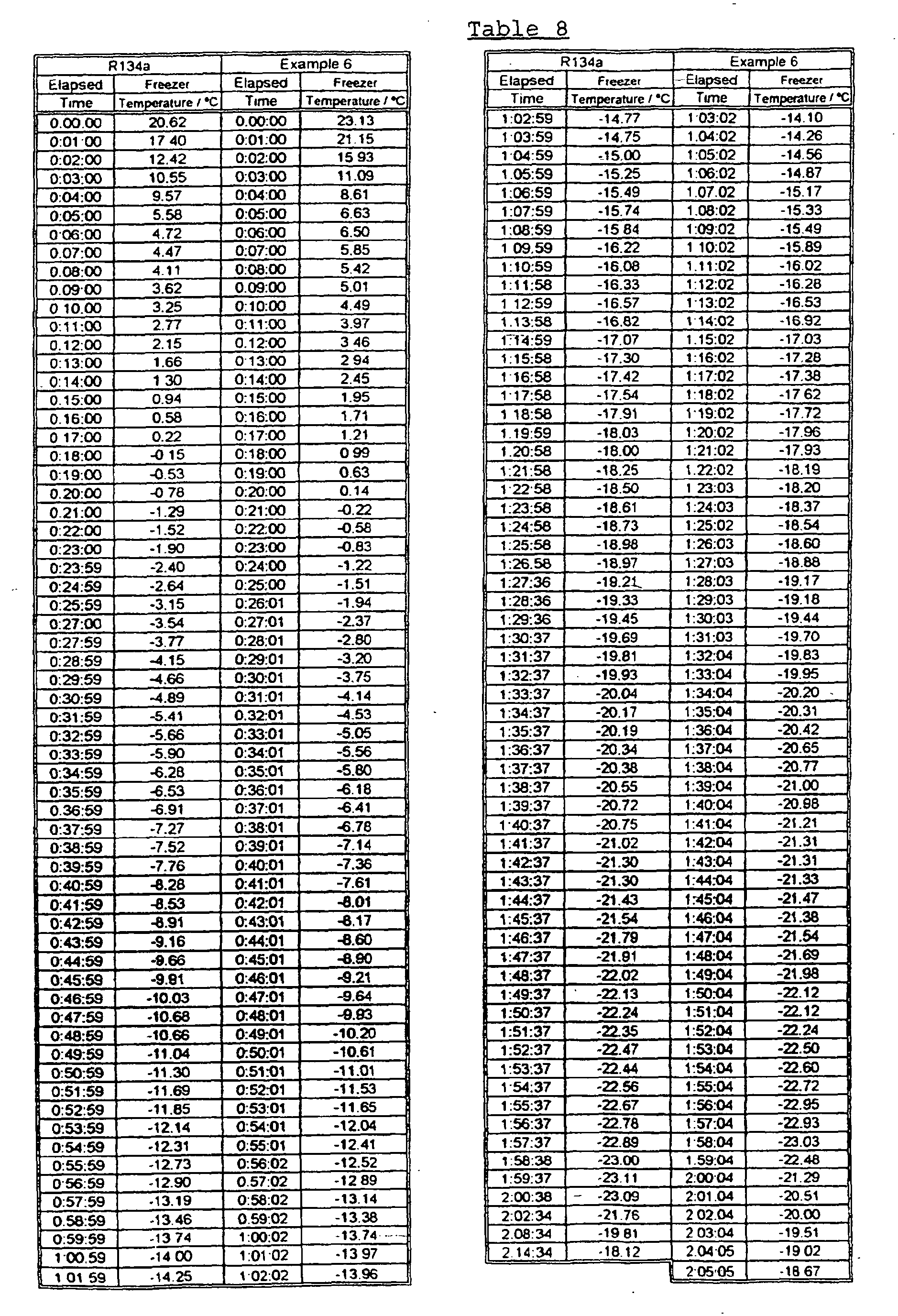
[0064] The rate of cooling was measured in the same way as in Example 11, except that the
composition of Example 6 was used in place of the composition of Example 1.
[0065] The results are shown in Table 8.
EXAMPLE 14
[0066] The maximum and minimum cabinet temperature, average evaporator and condenser pressure,
average compressor discharge temperature and average power consumption of the freezer
used in Example 11, using the composition of Example 2 as a refrigerant, were measured
while the freezer was running.
[0067] Similar measurements were taken with the same freezer using R134a as a refrigerant.
[0068] Thermocouples were connected to the inlet and outlet of the evaporator coil inside
the freezer compartment as well as the compressor discharge line. A further thermocouple
was placed inside the freezer compartment near the thermostat sensor. Pressure gauges
were fitted to the suction and discharge lines and the power supply to the freezer
was passed through a kilowatt hour meter.
[0069] The temperatures from the thermocouples were logged by a data logger typically at
1 minute intervals.
[0070] The freezer, factory charged with R134a, was placed in a temperature controlled environment,
typically 22°C ± 1°C,
and allowed to temperature equilibrate for at least 24 hours. The freezer and data
logger were turned on and the performance characteristics specified above were recorded
over a period of at least 30 hours.
[0071] The procedure was repeated after replacing the R134a with the composition of Example
2.
[0072] The results are shown in Table 9.
TABLE 9 - (Ambient temperature 23°C)
| Parameter |
R134a |
Example 2 |
| Maximum cabinet temperature/°C |
-18.4 |
-18.3 |
| Minimum cabinet temperature/°C |
-23.8 |
-23.6 |
| †Average evaporator pressure/psi.a |
4.5 |
6.6 |
| †Average Condenser pressure/psi.a |
150 |
150 |
| †Average compressor discharge temperature/°C |
87 |
89 |
| Average power consumption/W.hr-1 |
60.7 |
58.4 |
Claims for the following Contracting State(s): DE, ES, FR, GB, IT, NL, SE
1. A non-azeotropic refrigerant composition having a vapour pressure at -20°C of from
70 to 190 kPa (0.7 to 1.9 bar), at +20°C of from 510 to 630 kPa(5.1 to 6.3 bar) and
at +60°C of from 1620 to 1740 kPa (16.2 to 17.4 bar), which composition comprises:
(a) 1,1,2,2-tetrafluoroethane (R134), 1,1,1,2-tetrafluorethane (R134a), difluoromethoxytrifluoromethane
(E125) or a mixture of two or more thereof, in an amount of from 60 to 99% by weight,
based on the weight of the composition;
(b) from 1 to 10% by weight, based on the weight of the composition, of an unsubstituted
hydrocarbon of the formula CnHm in which n is at least 4 and m is at least 2n-2; and,
(c) up to 39% by weight, based on the weight of the composition, of a vapour pressure
depressant having substantially no ozone depletion potential wherein the vapor pressure
depressant is required to be present as with the proviso that the composition is not:
(a) 71% by weight of R134a
(b) 5% by weight of n-butane
(c) 24% by weight of 1,1,1,2,3,3,3-heptafluoropropane
or
(a) 86% by weight of R134a
(b) 5% by weight of iso-butane
(c) 9% by weight of 1,1,1,2,3,3,3-heptafluoropropane,
or
(a) 65% by weight of R134a
(b) 10% by weight of n-butane and/or iso-butane
(c) 25% by weight of 1,1,1,2,3,3,3-heptafluoropropane
or
(a) 94% by weight of R134a
(b) 1% by weight of n-butane and/or iso-butane
(c) 5% by weight of 1,1,1,2,3,3,3, heptafluoropropane.
2. A composition according to claim 1 wherein component (b) is fully saturated except
for one double bond, or is fully saturated.
3. A composition according to claim 1 wherein component (b) is methylenecyclopropane,
1-butene, cis and trans-2-butene, butane, 2-methyl propane, cyclopentene, cyclopentane,
2-methyl-1-butene, 2-methyl-2-butene, 3-methyl-1-butene, 1-pentene, cis and trans-2-pentene,
2-methylbutane, pentane or a mixture of two or more thereof.
4. A composition according to any one of the preceding claims wherein component (c) is
1,1-difluoroethane, 1,1,1,2,2,3,3-heptafluoropropane, 1,1,1,2,3,3,3-heptafluoropropane,
octafluorocyclobutane, 1,1,1,2,2-pentafluoropropane, 1,1,2,2,3-oentafluoropropane,
trifluoromethoxymethane, trifluoromethoxypentafluoroethane, difluoromethoxypentafluoroethane,
trifluoromethoxy-1,2,2,2-tetrafluoroethane, fluoromethoxytrifluoromethane, difluoromethoxymethane,
pentafluoroethoxypentafluoroethane, difluoromethoxydifluoromethane, trifluoromethoxy-2,2,2-trifluoroethane,
fluoromethoxymethane, difluoromethoxy-1,2,2,2-tetrafluoroethane, fluoromethoxyfluoromethane,
difluoromethoxy-2,2,2-trifluoroethane, methoxy-2,2,2-trifluoroethane, methoxy-1,1,2,2-tetrafluoroethane
or a mixture of two or more thereof.
5. A composition according to any one of the preceding claims, in which component (a)
is present in an amount of from 70 to 95% by weight, based on the composition, component
(b) is present in an amount of from 1 to 8% by weight, based on the composition, and
component (c) is present in an amount of from 4 to 29% by weight, based on the composition.
6. A composition according to any one of the preceding claims, in which component (a)
is present in an amount of from 30 to 90% by weight, based on the composition, component
(b) is present in an amount of from 2 to 6% by weight, based on the composition, and
component (c) is present in an amount of from 8 to 18% by weight, based on the composition.
7. A composition according to any one of the preceding claims, in which component (a)
is present in an amount of from 82 to 86% by weight, based on the composition, component
(b) is present in an amount of from 2 to 5% by weight, based on the composition, and
component (c) is present in an amount of from 12 to 16% by weight, based on the composition.
8. A composition according to any one of the preceding claims, further comprising component
(d), a flammability supressant.
9. A composition according to claim 8, in which component (c) is present in an amount
up to 19% by weight, based on the composition, and component (d) is present in an
amount up to 20% by weight, based on the composition.
10. A composition according to claim 8 or 9 wherein the flammability suppressant is 1,1,1,2,2,3,3-heptafluoropropane,
1,1,1,2,3,3,3-heptafluoropropane, octafluorocyclobutane, octafluoropropane, trifluoromethoxytrifluoromethane,
difluoromethoxytrifluoromethane, trifluoromethoxypentafluoroethane, difluoromethoxypentafluoroethane,
trifluoromethoxy-1,2,2,2-tetrafluoroethane, or a mixture of two or more thereof.
11. A composition according to any one of the preceding claims which has a vapour-pressure
not exceeding ± 60 kPa (0.6 bar) of the vapour pressure of R134a between -30°C and
+60°C.
12. A composition according to any one of the preceding claims wherein the ratio of the
total number of fluorine atoms in the composition to the total number of hydrogen
atoms in the composition is at least 1.25 : 1.
13. A composition according to any one of the preceding claims in which component (a)
is R134 and/or R134a, component (b) is R600 and/or R600a and component (c) is R152a,
R227ca, R227ea or a mixture of two or more thereof.
14. A composition according to any one of the preceding claims in which component (a)
is R134 and/or R134a, component (b) is R600 and/or R600a and component (c) is R152a.
15. A composition according to any one of the preceding claims in which component (c)
is R152a.
16. A composition according to any one of claims 1 to 13 in which component (a) is R134
and/or R134a, component (b) is R600 and/or R600a and component (c) is R227ca and/or
R227ea.
17. Use of a composition according to any one of the preceding claims as a refrigerant
in a compression refrigeration apparatus which contains not more than 1 kg of refrigerant.
18. A process for producing refrigeration, comprising condensing a composition according
to any one of claims to 16 and thereafter evaporating the composition in the vicinity
of a body to be cooled.
19. A compression refrigeration apparatus containing, as refrigerant, a composition according
to any one of claims 1 to 16.
Claims for the following Contracting State(s): AT, BE, CH, DK, FR, GB, IE, LI, LU,
MC, PT
1. A non-azeotropic refrigerant composition having a vapour pressure at -20°C of from
70 to 190 kPa (0.7 to 1.9 bar), at +20°C of from 510 to 630 kPa (5.1 to 6.3 bar) and
at +60°C of from 1620 to 1740 kPa (16.2 to 17.4 bar), which composition comprises:
(a) 1,1,2,2-tetrafluoroethane (R134), 1,1,1,2-tetrafluoroethane (R134a), difluoromethoxytrifluoromethane
(E125) or a mixture of two or more thereof, in an amount of from 60 to 99% by weight,
based on the weight of the composition;
(b) from 1 to 10% by weight, based on the weight of the composition, of an unsubstituted
hydrocarbon of the formula CnHm in which n is at least 4 and m is at least 2n-2; and,
(c) up to 39% by weight, based on the weight of the composition, of a vapour pressure
depressant having substantially no ozone depletion potential.
2. A composition according to claim 1 wherein component (b) is fully saturated except
for one double bond, or is fully saturated.
3. A composition according to claim 1 wherein component (b) is methylenecyclopropane,
1-butene, cis and trans-2-butene, butane, 2-methyl propane, cyclopentene, cyclopentane,
2-methyl-1-butene, 2-methyl-2-butene, 3-methyl-1-butene, 1-pentene, cis and trans-2-pentene,
2-methylbutane, pentane or a mixture of two or more thereof.
4. A composition according to any one of the preceding claims wherein component (c) is
1,1-difluoroethane, 1,1,1,2,2,3,3-heptafluoropropane, 1,1,1,2,3,3,3-heptafluoropropane,
octafluorocyclobutane, 1,1,1,2,2-pentafluoropropane, 1,1,2,2,3-pencafluoropropane,
trifluoromethoxymethane, trifluoromethoxypentafluroethane, difluoromethoxypentafluoroethane,
trifluoromethoxy-1,2,2,2-tetrafluoroethane, fluoromethoxytrifluoromethane, diflucromethoxvmethane,
pentafluoroethoxypentafluoroethane, difluoromethoxydifluoromethane, trifluoromethoxy-2,2,2-trifluoroethane,
fluoromethoxymethane, difluoromethoxy-1,2,2,2-tetrafluoroethane, fluoromethoxyfluoromethane,
difluoromethoxy-2,2,2-trifluoroethane, methoxy-2,2,2-trifluoroethane, methoxy-1,1,2,2-tetrafluoroethane
or a mixture of two or more thereof.
5. A composition according to any one of the preceding claims, in which component (a)
is present in an amount of from 70 to 95% by weight, based on the composieion, component
(b) is present in an amount of from 1 to 8% by weight, based on the composition, and
component (c) is present in an amount of from 4 to 29% by weight, based on the composition.
6. A composition according to any one of the preceding claims, in which component (a)
is present in an amount of from 30 to 90% by weight, based on the composition, component
(b) is present in an amount of from 2 to 6% by weight, based on the composition, and
component (c) is present in an amount of from 8 to 18% by weight, based on the composition.
7. A composition according to any one of the preceding claims, in which component (a)
is present in an amount of from 82 to 86% by weight, based on the composition, component
(b) is present in an amount of from 2 to 5% by weight, based on the composition, and
component (c) is present in an amount of from 12 to 16% by weight, based on the composition.
8. A composition according to any one of the preceding claims, further comprising component
(d), a flammability supressant.
9. A composition according to claim 8, in which component (c) is present in an amount
up to 19% by weight, based on the composition, and component (d) is present in an
amount up to 20% by weight, based on the composition.
10. A composition according to claim 8 or 9 wherein the flammability suppressant is 1,1,1,2,2,3,3-heptafluoropropane,
1,1,1,2,3,3,3-heptafluoropropane, octafluorocyclobutane, octafluoropropane, trifluoromethoxytrifluoromethane,
difluoromethoxytrifluoromethane, trifluoromethoxypentafluoroethane, difluoromethoxypentafluoroethane,
trifluoromethoxy-1,2,2,2-tetrafluoroethane, or a mixture of two or more thereof.
11. A composition according to any one of the preceding claims which has a vapour-pressure
not exceeding ± 60 kPa (0.6 bar) of the vapour pressure of R134a between -30°C and
+60°C.
12. A composition according to any one of the preceding claims wherein the ratio of the
total number of fluorine atoms in the composition to the total number of hydrogen
atoms in the composition is at least 1.25 : 1.
13. A composition according to any one of the preceding claims in which component (a)
is R134 and/or R134a, component (b) is R600 and/or R600a and component (c) is R152a,
R227ca, R227ea or a mixture of two or more thereof.
14. A composition according to any one of the preceding claims in which component (a)
is R134 and/or R134a, component (b) is R600 and/or R600a and component (c) is R152a.
15. A composition according to any one of the preceding claims in which component (c)
is R152a.
16. A composition according to any one of claims 1 to 13 in which component (a) is R134
and/or R134a, component (b) is R600 and/or R600a and component (c) is R227ca and/or
R227ea.
17. Use of a composition according to any one of the preceding claims as a refrigerant
in a compression refrigeration apparatus which contains not more than 1 kg of refrigerant.
18. A process for producing refrigeration, comprising condensing a composition according
to any one of claims 1 to 16 and thereafter evaporating the composition in the vicinity
of a body to be cooled.
19. A compression refrigeration apparatus containing, as refrigerant, a composition according
to any one of claims 1 to 16.
Patentansprüche für folgende(n) Vertragsstaat(en): DE, ES, FR, GB, IT, NL, SE
1. Nichtazeotrope Kühlmittelzusammensetzung, die einen Dampfdruck von 70 bis 190 kPa
(0,7 bis 1,9 bar) bei -20°C, von 510 bis 630 kPa (5,1 bis 6,3 bar) bei +20°C und von
1620 bis 1740 kPa (16,2 bis 17,4 bar) bei +60°C aufweist, welche Zusammensetzung Folgendes
umfasst:
(a) 1,1,2,2-Tetrafluorethan (R134), 1,1,1,2-Tetrafluorethan (R134a), Difluormethoxytrifluormethan
(E125) oder eine Mischung von zwei oder mehreren derselben in einer Menge von 60 bis
99 Gew.-%, auf das Gewicht der Zusammensetzung bezogen;
(b) 1 bis 10 Gew.-%, auf das Gewicht der Zusammensetzung bezogen, eines unsubstituerten
Kohlenwasserstoffs der Formel CnHm, wobei n mindestens 4 und m mindestens 2n-2 ist; und
(c) bis zu 39 Gew.-%, auf das Gewicht der Zusammensetzung bergen, eines Dampfdruckreduzierers,
der im Wesentlichen kein Ozonzehrpotential ausweist, wobei der Dampfdruekfeduzierer
vorliegen muss, und mit der Maßgabe, dass die Zusammensetzung nicht Folgendes beträgt:
(a) 71 Gew.-% R134a
(b) Gew.-% n-Butan
(c) 24 Gew.-% 1,1,1,2,3,3,3-Heptafluorpropan
oder
(a) 86 Gew.-% R 134a
(b) 5 Gew.-% Isobutan
(c) 9 Gew.-% 1,1,1,2,3,3,3-Heptafluorpropan
oder
(a) 65 Gew,-% R134a
(b) 10 Gew,-% n-Butan und/oder Isobutan
(c) 25 Gew.-% 1,1,1,2,3,3,3-Heptafluorpropan
oder
(a) 94 Gew.-% R134a
(b) 1 Gew.-% n-Butan und/oder Isobutan
(c) 5 Gew.-% 1,1,1,2,3,3,3-Heptafluorpropan.
2. Zusammensetzung nach Anspruch 1, wobei die Komponente (b) mit Ausnahme einer Doppelbindung
vollständig gesättigt ist oder vollständig gesättigt ist.
3. Zusammensetzung nach Anspruch 1, wobei die Komponente (b) Methylencyclopropan, 1-Buten,
cis- und trans-2-Buten, Butan, 2-Methylpropan, Cyclopenten, Cyclopentan, 2-Methyl-1-buten,
2-Methyl-2-buten, 3-Methyl-1-buten, 1-Penten, cis- und trans-2-Penten, 2-Methylbutan,
Pentan oder eine Mischung von zwei oder mehreren derselben ist.
4. Zusammensetzung nach einem der vorhergehende Ansprüche, wobei die Komponente (c) 1,1-Difluorethan,
1,1,1,2,2,3,3-Heptafluorpropan, 1,1,1,2,3,3,3-Hcptafluorpropan, Octafluorcyclobutan,
1,1,1,2,2-Pentafluorpropan, 1,1,2,2,3-Pentafluorpropan, Trifluorimethoxymethan, Trifluormethoxypentafluorethan,
Difluormethoxypentafluorethan, Trifluormethoxy-1,2,2,2-tetrafluorethan, Fluormethoxytrifluormethan,
Difluormethoxymethan, Pentafluorethoxypentafluorethan, Dufluormethoxydifluormethan,
Trifluormethoxy-2,2,2-trifluorethan, Fluormethoxymethan, Difluormethoxy-1,2,2,2-tetrafluorethan,
Fluormethoxyfluormethan, Difluormethoxy-2,2,2-trifluorethan, Methoxy-2,2,2-trifluorethan,
Methoxy-1,1,2,2-tetrafluorethan oder eine Mischung von zwei oder mehreren derselben
ist.
5. Zusammensetzung nach einem der vorhergehenden Ansprüche, wobei die Komponente (a)
in einer Menge von 70 bis 95 Gew.-%, auf das Gewicht der Zusammensetzung bezogen,
vorliegt, die Komponente (b) in einer Menge von 1 bis 8 Gew.-%, auf das Gewicht der
Zusammensetzung bezogen, vorliegt und die Komponente (c) in einer Menge von 4 bis
29 Gew.-%, auf das Gewicht der Zusammensetzung bezogen, vorliegt.
6. Zusammensetzung nach einem der vorhergehenden Ansprüche, wobei Komponente (a) in einer
Menge von 80 bis 90 Gew.-%, auf das Gewicht der Zusammensetzung bezogen, vorliegt,
die Komponente (b) in einer Menge von 2 bis 5 Gew,-%, auf das Gewicht der Zusammensetzung
bezogen, vorliegt und die Komponente (c) in einer Menge von 8 bis 18 Gew.-%, auf das
Gewicht der Zusammensetzung bezogen, vorliegt.
7. Zusammensetzung nach einem der vorhergehenden Ansprüche, wobei Komponente (a) in einer
Menge von 82 bis 86 Gew.-%, auf das Gewicht der Zusammensetzung bezogen, vorliegt,
die Komponente (b) in einer Menge von 2 bis 5 Gew.-%, auf das Gewicht der Zusammensetzung
bezogen, vorliegt und die Komponente (c) in einer Menge von 12 bis 16 Gew.-%, auf
das Gewicht der Zusammensetzung bezogen, vorliegt.
8. Zusammensetzung nach einem der vorhergehenden Ansprüche, des Weiteren umfassend die
Komponente (d), ein Entflanmbarkoitsuutcrdrückungsmittel,
9. Zusammensetzung nach Anspruch 8, wobei Komponente (c) in einer Menge von bis zu 19
Gew.-%, auf das Gewicht der Zusammensetzung bezogen, vorliegt und die Komponente (d)
in einer Menge von bis zu 20 Gew.-%, auf das Gewicht der Zusammensetzung bezogen,
vorliegt.
10. Zusammensetzung nach Anspruch 8 oder 9, wobei das Entflammbarkeitsunterdrückungsmittel
1,1,1,2,2,3,3-Heptafluorpropan, 1,1,1,2,3,3,3-Hcptafluorpropan, Octafluorocyclobutan,
Octafluorpropan, Trifluormethoxytrifluormethan. Difluormethoxytrifluormethan, Trifluormethoxypentafluorethan,
Difluormethoxypentafluorethan, Trifluormethoxy-1,2,2,2-tetrafluorethan oder eine Mischung
von zwei oder mehreren derselben ist.
11. Zusammensetzung nach einem der vorhergehenden Ansprüche, die einen Wasserdampfdruck
von nicht mehr als ± 60 kPa (0,6 bar) des Wasserdwnpfdrucks von R134a zwischen - 30°C
und + 60°C aufweist.
12. Zusammensetzung nach einem der vorhergehenden Ansprüche, wobei das Verhältnis der
Gesamtanzahl von Fluoratomen in der Zusammensetzung zur Gesamtanzahl von Wasserstoffatomen
in der Zusammensetzung mindestens 1,25:1 beträgt.
13. Zusammensetzung nach einem der vorhergehenden Ansprüche, wobei die Komponente (a)
R134 und/oder R134a ist, die Komponente (b) R600 und/oder R600a ist und die Komponente
(c) R152a, R227ca, R227ca oder eine Mischung von zwei oder mehreren derselben ist.
14. Zusammensetzung nach einem der vorhergehenden Ansprüche, wobei die Komponente (a)
R134 und/oder R134a ist, die Komponente (b) R600 und/oder R600a ist und die Komponente
(c) R152a ist
15. Zusammensetzung nach einem der vorhergehenden Ansprüche, wobei die Komponente (c)
R152a ist.
16. Zusammensetzung nach, einem der Ansprüche 1 bis 13, wobei die Komponente (a) R134
und/oder R134a ist, die Komponente (b) R600 und/oder R600a ist und die Komponente
(c) R227ca und/oder R227ca, ist.
17. Verwendung einer Zusammensetzung nach einem der vorhergehenden Ansprüche als Kühlmittel
in einer Kompressionskälteinaschine, die nicht mehr als 1 kg Kältemittel enthält.
18. Verfahren zum Erzeugen von Kühlung, umfassend das Kondensieren einer Zusammensetzung
nach einem der Ansprüche I bis 16 und daraufhin Verdampfen der Zusammensetzung in
der Nähe eines zu kühlenden Körpers.
19. Kompressionskältemaschine enthaltend als Kühlmittel eine Zusammensetzung nach einem
der Ansprüche 1 bis 16.
Patentansprüche für folgende(n) Vertragsstaat(en): AT, BE, CH, DK, FI, GR, IE, LI,
LU, MC, PT
1. Nichtazeotrope Kühlmittelzusammensetzung, die einen Dampfdruck von 70 bis 190 kPa
(0,7 bis 1,9 bar) bei -20°C, von 510 bis 630 kPa (5,1 bis 6,3 bar) bei +20°C und von
1620 bis 1740 kPa (16,2 bis 17,4 bar) bei +60°C aufweist, welche Zusammensetzung Folgendes
umfasst:
(a) 1,1,2,2-Tetrafluorethan (R134), 1,1,1,2-Tetrafluorethan (R134a), Difluormethoxytrifluormethan
(E125) oder eine Mischung von zwei oder mehreren derselben in einer Menge von 60 bis
99 Gew.-%, auf das Gewicht der Zusammensetzung bezogen;
(b) 1 bis 10 Gew.-%, auf das Gewicht der Zusammensetzung bezogen, eines unsubstituierten
Kohlenwasserstoffs der Formel CnHm, wobei n mindestens 4 und m mindestens 2n-2 ist; und
(c) bis zu 39 Gew.-%, auf das Gewicht der Zusammensetzung bezogen, eines Dampfdruckreduzierers,
der im Wesentlichen kein Ozonzehrpotential aufweist.
2. Zusammensetzung nach Anspruch 1, wobei die Komponente (b) mit Ausnahme einer Doppelbindung
vollständig gesättigt ist oder vollständig gesättigt ist.
3. Zusammensetzung nach Anspruch 1, wobei die Komponente (b) Methylencyclopropan, 1-Buten,
cis- und trans-2-Buten, Butan, 2-Methylpropan, Cyclopenten, Cyclopentan, 2-Methyl-1-buten,
2-Methyl-2-buten, 3-Methyl-1-buten, 1-Penten, cis- und trans-2-Penten, 2-Methylbutan,
Pentan oder eine Mischung von zwei oder mehreren derselben ist.
4. Zusammensetzung nach einem der vorhergehenden Ansprüche, wobei die Komponente (c)
1,1-Difluorethan, 1,1,1,2,2,3,3-Heptafluorpropan, 1,1,1,2,3,3,3-Heptafluorpropan,
Octafluorcyclobutan, 1,1,1,2,2-Pentafluorpropan, 1,1,2,2,3-Pentafluorpropan, Trifluormethoxymethan,
Trifluormethoxypentafluorethan, Difluormethoxypentafluorethan, Trifluormethoxy-1,2,2,2-tetrafluorethan,
Fluormethoxytrifluormethan, Difluormethoxymethan, Pentafluorethoxypentafluorethan,
Dufluormethoxydifluormethan, Trifluormethoxy-2,2,2-trifluorethan, Fluormethoxymethan,
Difluormethoxy-1,2,2,2-tetrafluorethan, Fluormethoxyfluormethan, Difluormethoxy-2,2,2-trifluorethan,
Methoxy-2,2,2-trifluorethan, Methoxy-1,1,2,2-tetrafluorethan oder eine Mischung von
zwei oder mehreren derselben ist.
5. Zusammensetzung nach einem der vorhergehenden Ansprüche, wobei die Komponente (a)
in einer Menge von 70 bis 95 Gew.-%" auf das Gewicht der Zusammensetzung bezogen,
vorliegt, die Komponente (b) in einer Menge von 1 bis 8 Gew.-%, auf das Gewicht der
Zusammensetzung bezogen, vorliegt und die Komponente (c) in einer Menge von 4 bis
29 Gew.-%, auf das Gewicht der Zusammensetzung bezogen, vorliegt.
6. Zusammensetzung nach einem der vorhergehenden Ansprüche, wobei Komponente (a) in einer
Menge von 80 bis 90 Gew.-%, auf das Gewicht der Zusammensetzung bezogen, vorliegt,
die Komponente (b) in einer Menge von 2 bis 5 Gew.-%, auf das Gewicht der Zusammensetzung
bezogen, vorliegt und die Komponente (c) in einer Menge von 8 bis 18 Gew.-%, auf das
Gewicht der Zusammensetzung bezogen, vorliegt.
7. Zusammensetzung nach einem der vorhergehenden Ansprüche, wobei Komponente (a) in einer
Menge von 82 bis 86 Gew.-%, auf das Gewicht der Zusammensetzung bezogen, vorliegt,
die Komponente (b) in einer Menge von 2 bis 5 Gew.-%, auf das Gewicht der Zusammensetzung
bezogen, vorliegt und die Komponente (c) in einer Menge von 12 bis 16 Gew.-%, auf
das Gewicht der Zusammensetzung bezogen, vorliegt.
8. Zusammensetzung nach einem der vorhergehenden Ansprüche, des Weiteren umfassend die
Komponente (d), ein Entflammbarkeitsunterdrückungsmittel.
9. Zusammensetzung nach Anspruch 8, wobei Komponente (c) in einer Menge von bis zu 19
Gew.-%, auf das Gewicht der Zusammensetzung bezogen, vorliegt und die Komponente (d)
in einer Menge von bis zu 20 Gew.-%, auf das Gewicht der Zusammensetzung bezogen,
vorliegt.
10. Zusammensetzung nach Anspruch 8 oder 9, wobei das Entflammbarkeitsunterdrückungsmittel
1,1,1,2,2,3,3-Heptafluorpropan, 1,1,1,2,3,3,3-Heptafluorpropan, Octafluorcyclobutan,
Octafluorpropan, Trifluormethoxytrifluormethan, Difluormethoxytrifluormethan, Trifluormethoxypentafluorethan,
Difluormethoxypentafluorethan, Trifluormethoxy-1,2,2,2-tetrafluorethan oder eine Mischung
von zwei oder mehreren derselben ist.
11. Zusammensetzung nach einem der vorhergehenden Ansprüche, die einen Wasserdampfdruck
von nicht mehr als ± 60 kPa (0,6 bar) des Wasserdampfdrucks von R134a zwischen - 30°C
und + 60°C aufweist.
12. Zusammensetzung nach einem der vorhergehenden Ansprüche, wobei das Verhältnis der
Gesamtanzahl von Fluoratomen in der Zusammensetzung zur Gesamtanzahl von Wasserstoffatomen
in der Zusammensetzung mindestens 1,25:1 beträgt.
13. Zusammensetzung nach einem der vorhergehenden Ansprüche, wobei die Komponente (a)
R134 und/oder R134a ist, die Komponente (b) R600 und/oder R600a ist und die Komponente
(c) R152a, R227ca, R227ea oder eine Mischung von zwei oder mehreren derselben ist.
14. Zusammensetzung nach einem der vorhergehenden Ansprüche, wobei die Komponente (a)
R134 und/oder R134a ist, die Komponente (b) R600 und/oder R600a ist und die Komponente
(c) R152a ist
15. Zusammensetzung nach einem der vorhergehenden Ansprüche, wobei die Komponente (c)
R152a ist.
16. Zusammensetzung nach einem der Ansprüche 1 bis 13, wobei die Komponente (a) R134 und/oder
R134a ist, die Komponente (b) R600 und/oder R600a ist und die Komponente (c) R227ca
und/oder R227ea ist.
17. Verwendung einer Zusammensetzung nach einem der vorhergehenden Ansprüche als Kühlmittel
in einer Kompressionskältemaschine, die nicht mehr als 1 kg Kältemittel enthält.
18. Verfahren zum Erzeugen von Kühlung, umfassend das Kondensieren einer Zusammensetzung
nach einem der Ansprüche 1 bis 16 und daraufhin Verdampfen der Zusammensetzung in
der Nähe eines zu kühlenden Körpers.
19. Kompressionskältemaschine enthaltend als Kühlmittel eine Zusammensetzung nach einem
der Ansprüche 1 bis 16.
Revendications pour l'(les) Etat(s) contractant(s) suivant(s): DE, ES, FR, GB, IT,
NL, SE
1. Composition réfrigérante non azéotrope ayant une pression de vapeur comprise entre
70 et 190 kPa (0,7 et 1,9 bar) à -20°C, entre 510 et 630 kPa (5,1 et 6,3 bar) à +20°C
et entre 1 620 et 1740 kPa (16,2 et 17,4 bar) à +60°C, ladite composition comprenant:
(a) du 1,1,2,2-tétrafluoroéthane (R134), 1,1,1,2-tétrafluoroéthane (R134a), difluorométhoxytrifluorométhane
(E125) ou un mélange de deux ou plusieurs de ces composés à une quantité comprise
entre 60 et 99% en poids (sur la base du poids de la composition);
(b) de 1 à 10% on poids (sur la base du poids de la composition) d'un hydrocarbure
non substitué de formule CnHm, où 11 est égal à 4 au moins et m à 2n-2 au moins; et
(c) jusqu'à 39% en poids (sur la base du poids de la composition) d'un agent abaissant
la pression de vapeur essentiellement exempt du potentiel d'amincir la couche d'ozone,
où il est requis que l'agent abaissant la vapeur de pression soit présent dans la
composition et à condition que la composition ne correspondent à aucune des suivantes:
(a) 71% en poids de R134a
(b) 5% en poids de n-butane
(c) 24% en poids de 1,1,1,2,3,3,3-heptafluoropropane
ou
(a) 86% en poids de R134a
(b) 5% en poids d'iso-butane
(c) 9% en poids de 1,1,1,2,3,3,3-heptafluoropropane
ou
(a) 65% en poids de R134a
(b) 10% en poids de n-butane et/ou d'iso-butane
(c) 25% en poids de 1,1,1,2,3,3,3,3-heptafluoropropane
ou
(a) 94% en poids de R134a
(b) 1 % en poids de n-butane et/ou d'iso-butane
(c) 5% en poids de 1,1,1,2,3,3,3-heptafluoropropane
2. Composition selon la revendication 1, où le composant (b) est entièrement saturé à
l'exception de une double liaison ou est entièrement saturé.
3. Composition selon la revendication 1, où le composant (b) est sélectionné parmi les
suivants: méthylènecyclopropane, 1-butène, cis- et transe-butène, butane, 2-métllylpropane,
cyclopentène, cyclopentane, 2-méthyl-1-butène, 2-méthyl-2-butène, 3-méthyl-1-butène,
1-pentène, cis- et trans-2-pentène, 2-méthylbutanc, pentane ou mélange de deux ou
plus de ces composés.
4. Composition selon l'une quelconque des revendications précédentes, où le composant
(o) est sélectionné parmi les suivants: 1,1-difluoroéthane, 1,1,1,2,2,3,3-heptafluoropropane,
1,1,1,2,3,3,3-heptafluoropropane, octafluorocyclobutane, 1,1,1,2,2-pentafluoropropane,
1,1,2,2,3-pentafluoropropane, trifluorométhoxyméthane, trifluorométhoxypentafluoroéthane,
difluorométhoxypentafluoroéthane, trifluorométhoxy-1,2,2,2-tétrafluoroéthane, fluorométhoxytrifluorométhane,
difluorométhoxyméthane, pentafluoroéthoxypentafluoroéthane, difluorométhoxydifluorométhane,
trifluorométhoxy-2,2,2-trifluoroéthane, fluorométhoxyméthane, difluorométhoxy-1,2,2,2-tétrafluoroéthane,
fluorométhoxyfluorométhane, difluorométhoxy-2,2,2-trifluoroéthane, méthoxy-2,2,2-trifluoroéthane,
méthoxy-1,1,2,2-tétrafluoroéthane ou mélange de deux ou plus de ces composés,
5. Composition selon l'une quelconque des revendications précédentes, où le composant
(a) est présent à une quantité comprise entre 70 et 95% en poids (sur la base du poids
de la composition), le composant (b) est présent à une quantité comprise entre 1 et
8% en poids (sur la base du poids de la composition) et le composant (c) est présent
à une quantité comprise entre 4 et 29% en poids (sur la base du poids de la composition).
6. Composition selon l'une quelconque des revendications précédentes, où le composant
(a) est présent à une quantité comprise entre 80 et 90% en poids (sur la base du poids
de la composition), le composant (b) est présent à une quantité comprise entre 2 et
5% en poids (sur la base du poids de la composition) et 1c composant (c) est présent
à une quantité comprise entre 8 et 18% en poids (sur la base du poids de la composition).
7. Composition selon l'une quelconque des revendications précédentes, où le composant
(a) est présent à une quantité comprise entre 82 et 86% en poids (sur la base du poids
de la composition), le composant (b) est présent à une quantité comprise entre 2 et
5% en poids (sur la base du poids de la composition) et le composant (c) est présent
à une quantité comprise entre 12 et 16% en poids (sur la base du poids de la composition).
8. Composition selon l'une quelconque des revendications précédentes, qui comprend également
un composant (d) qui est un inhibiteur de flamme.
9. Composition selon la revendication 8, où le composant (c) est présent à une quantité
allant jusqu'à 19% en poids (sur la base du poids de la composition) et le composant
(d) à une quantité allant jusqu'à 20% en poids (sur la base du poids de la composition).
10. Composition selon la revendication 8 ou 9, où l'inhibiteur de flamme est sélectionné
parmi les suivants: 1,1,1,2,2,3,3-heptafluoropropane, 1,1,1,2,3,3,3-heptafluoropropane,
octafluorocyclobutane, octafluoropropane, trifluorométhoxytrifluorométhane, difluorométhoxytrifluorométhane,
trifluorométhoxypentafluoroéthane, difluorométhoxypentafluoroéthane, trifluorométhoxy-1,2,2,2-tétrafluoroéthane
ou mélange de deux on plus de ces composés.
11. Composition selon l'une quelconque des revendications précédentes, dont la pression
de vapeur ne s'écarte pas de ± 60 kPa (0,6 bar) de la pression de vapeur du R134a
entre -30°C et +60°C.
12. Composition selon l'une quelconque des revendications précédentes, où le rapport entre
le nombre total d'atomes de fluor et le nombre total d'atomes d'hydrogène dans la
composition est d'au moins 1,25:1.
13. Composition selon l'une quelconque des revendications précédentes, où le composant
(a) est R134 et/ou R134a, le composant (b) est R600 et/ou R600a et le composant (c)
est R152a, R227ca, R227ca ou un mélange de deux ou plus de ces composés.
14. Composition selon l'une quelconque des revendications précédentes, où le composant
(a) est R134 et/ou R134a, le composant (b) est R600 et/ou R600a et le composant (c)
est R152a.
15. Composition selon l'une quelconque des revendications précédentes, où le composant
(c) est R152a.
16. Composition selon l'une quelconque des revendications 1 à 13, où le composant (a)
est R134 et/ou R134a, le composant (b) est R600 et/ou R600a et le composant (c) est
R227ca et/ou R227ea.
17. Utilisation d'une composition selon l'une quelconque des revendications précédentes
comme réfrigérant dans un appareil de réfrigération à compression qui ne contient
pas plus de 1 kg de réfrigérant.
18. Procédé de production d'une réfrigération, qui comprend la condensation d'une composition
selon l'une quelconque des revendications 1 à 16 suivie de l'évaporation de la composition
à proximité d'un corps à refroidir.
19. Appareil de réfrigération à compression qui contient, comme réfrigérant, une composition
selon l'une quelconque des revendications 1 à 16.
Revendications pour l'(les) Etat(s) contractant(s) suivant(s): AT, BE, CH, DK, FI,
GR, IE, LI, LU, MC, PT
1. Composition réfrigérante non azéotrope ayant une pression de vapeur comprise entre
70 et 190 kPa (0,7 et 1,9 bar) à -20°C, entre 510 et 630 kPa (5,1 et 6,3 bar) à +20°C
et entre 1 620 et 1 740 kPa (16,2 et 17,4 bar) à +60°C, ladite composition comprenant:
(a) du 1,1,2,2-tétrafluoroéthane (R134), 1,1,1,2-tétrafluoroéthane (R134a), ditluorométhoxytrifluorométhane
(E125) ou un mélange de deux ou plusieurs de ces composés à une quantité comprise
entre 60 et 99% en poids (sur la base du poids de la composition);
(b) de 1 à 10% en poids (sur la base du poids de la composition) d'un hydrocarbure
non substitué de formule CnHm, où n est égal à 4 au moins et m à 2n-2 au moins; et
(c) jusqu'à 39% en poids (sur la base du poids de la composition) d'un agent abaissant
la pression de vapeur essentiellement exempt du potentiel d'amincir la couche d'ozone.
2. Composition selon la revendication 1, où le composant (b) est entièrement saturé à
l'exception de une double liaison ou est entièrement saturé.
3. Composition selon la revendication 1, où le composant (b) est sélectionné parmi les
suivants: méthylènecyclopropane, 1-butène, cis- et trans-2-butène, butane, 2-méthylpropane,
cyclopentène, cyclopentane, 2-méthyl-1-butène, 2-méthyl-2-butène, 3-méthyl-1-butène,
1-pentène, cis- et trans-2-pentène, 2-méthylbutane, pentane ou mélange de deux ou
plus de ces composés.
4. Composition selon l'une quelconque des revendications précédentes, où le composant
(c) est sélectionné parmi les suivants: 1,1-difluoroéthane, 1,1,1,2,2,3,3-heptafluoropropane,
1,1,1,2,3,3,3-heptafluoropropane, octafluorocyclobutane, 1,1,1,2,2-pentafluoropropane,
1,1,2,2,3-pentafluoropropane, trifluorométhoxyméthane, trifluorométhoxypentafluoroéthane,
difluorométhoxypentafluoroéthane, trifluorométhoxy-1,2,2,2-tétrafluoroéthane, fluorométhoxytrifluorométhane,
difluorométhoxyméthane, pentafluoroéthoxypentafluoroéthane, difluorométhoxydifluorométhane,
trifluorométhoxy-2,2,2-trifluoroéthane, fluorométhoxyméthane, difluorométhoxy-1,2,2,2-tétrafluoroéthane,
fluorométhoxyfluorométhane, difluorométhoxy-2,2,2-trifluoroéthane, méthoxy-2,2,2-trifluoroéthane,
méthoxy-1,1,2,2-tétrafluoroéthane ou mélange de deux ou plus de ces composés.
5. Composition selon l'une quelconque des revendications précédentes, où le composant
(a) est présent à une quantité comprise entre 70 et 95% en poids (sur la base du poids
de la composition), le composant (b) est présent à une quantité comprise entre 1 et
8% en poids (sur la base du poids de la composition) et le composant (c) est présent
à une quantité comprise entre 4 et 29% en poids (sur la base du poids de la composition).
6. Composition selon l'une quelconque des revendications précédentes, où le composant
(a) est présent à une quantité comprise entre 80 et 90% en poids (sur la base du poids
de la composition), le composant (b) est présent à une quantité comprise entre 2 et
5% en poids (sur la base du poids de la composition) et le composant (c) est présent
à une quantité comprise entre 8 et 18% en poids (sur la base du poids de la composition).
7. Composition selon l'une quelconque des revendications précédentes, où le composant
(a) est présent à une quantité comprise entre 82 et 86% en poids (sur la base du poids
de la composition), le composant (b) est présent à une quantité comprise entre 2 et
5% en poids (sur la base du poids de la composition) et le composant (c) est présent
à une quantité comprise entre 12 et 16% en poids (sur la base du poids de la composition).
8. Composition selon l'une quelconque des revendications précédentes, qui comprend également
un composant (d) qui est un inhibiteur de flamme.
9. Composition selon la revendication 8, où le composant (c) est présent à une quantité
allant jusqu'à 19% en poids (sur la base du poids de la composition) et le composant
(d) à une quantité allant jusqu'à 20% en poids (sur la base du poids de la composition).
10. Composition selon la revendication 8 ou 9, où l'inhibiteur de flamme est sélectionné
parmi les suivants: 1,1,1,2,2,3,3-heptafluoropropane, 1,1,1,2,3,3,3-heptafluoropropane,
octafluorocyclobutane, octafluoropropane, trifluorométhoxytrifluorométhane, difluorométhoxytrifluorométhane,
trifluorométhoxypentafluoroéthane, difluorométhoxypentafluoroéthane, trifluorométhoxy-1,2,2,2-tétrafluoroéthane
ou mélange de deux ou plus de ces composés.
11. Composition selon l'une quelconque des revendications précédentes, dont la pression
de vapeur ne s'écarte pas de ±60kPa (0,6 bar) de la pression de vapeur du R134a entre
-30°C et +60°C.
12. Composition selon l'une quelconque des revendications précédentes, où le rapport entre
le nombre total d'atomes de fluor et le nombre total d'atomes d'hydrogène dans la
composition est d'au moins 1,25:1.
13. Composition selon l'une quelconque des revendications précédentes, où le composant
(a) est R134 et/ou R134a, le composant (b) est R600 et/ou R600a et le composant (c)
est R152a, R227ca, R227ea ou un mélange de deux ou plus de ces composés.
14. Composition selon l'une quelconque des revendications précédentes, où le composant
(a) est R134 et/ou R134a, le composant (b) est R600 et/ou R600a et le composant (c)
est R152a.
15. Composition selon l'une quelconque des revendications précédentes, où le composant
(c) est R152a.
16. Composition selon l'une quelconque des revendications 1 à 13, où le composant (a)
est R134 et/ou R134a, le composant (b) est R600 et/ou R600a et le composant (c) est
R227ca et/ou R227ea.
17. Utilisation d'une composition selon l'une quelconque des revendications précédentes
comme réfrigérant dans un appareil de réfrigération à compression qui ne contient
pas plus de 1 kg de réfrigérant.
18. Procédé de production d'une réfrigération, qui comprend la condensation d'une composition
selon l'une quelconque des revendications 1 à 16 suivie de l'évaporation de la composition
à proximité d'un corps à refroidir.
19. Appareil de réfrigération à compression qui contient, comme réfrigérant, une composition
selon l'une quelconque des revendications 1 à 16.