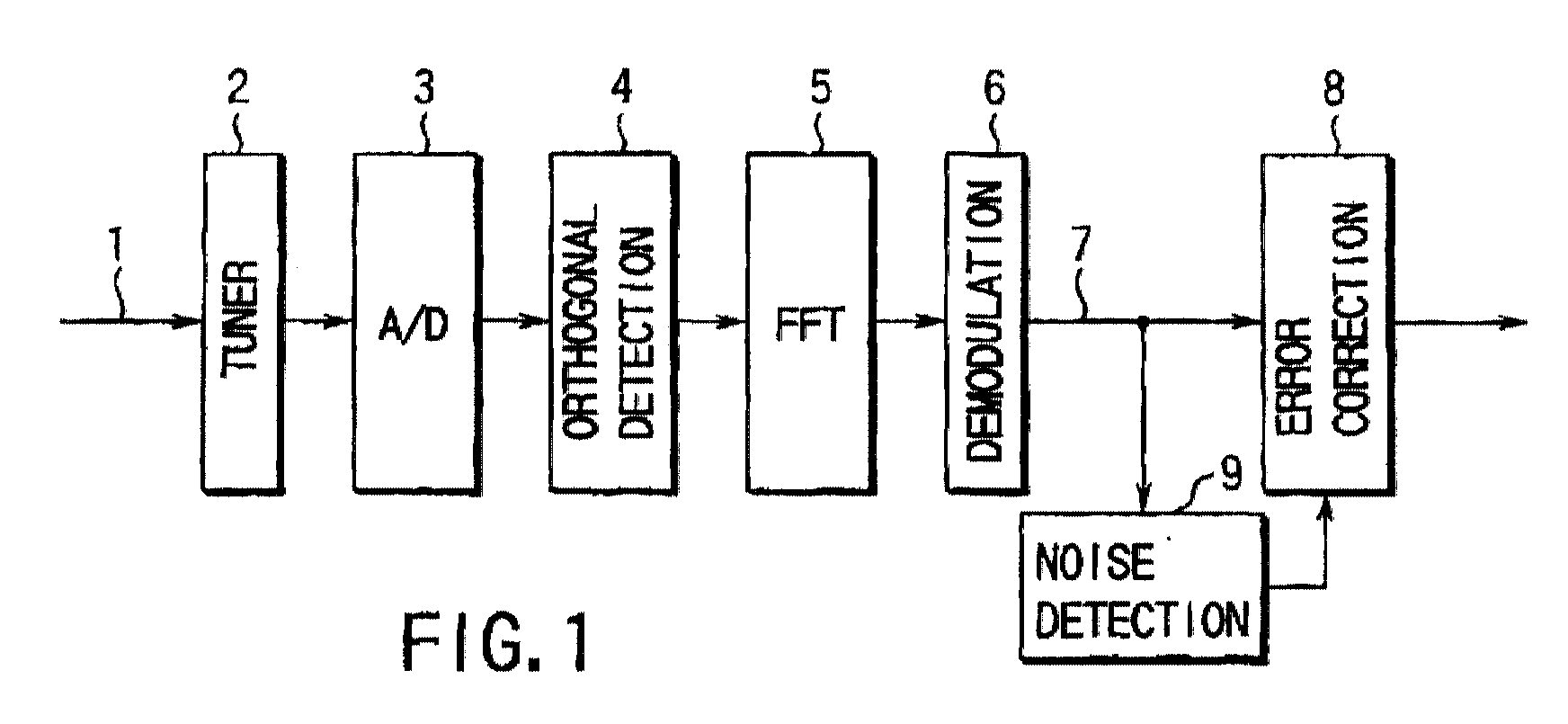
(57) When there is an interference by frequency selective noise, the gain of a particular
carrier drops, but the amplitude of the carrier is returned to its usual value by
equalization. At this time, however, the C/N value of the carrier degrades, and therefore
its dispersion value increases. Accordingly, concerning dispersion values along the
frequency axis, it is understood that the carrier with a high dispersion value is
interrupted by frequency selective noise. In light of this, the dispersion value of
each carrier is calculated from a corresponding demodulation output of a noise detecting
section (9), thereby determining, from the dispersion value, the carrier interrupted
by frequency selective noise, then weighting the demodulated signal of the carrier,
and performing error correction such as erasure decoding by an error correcting section
(8). As a result, even when there is an interference by frequency selective noise,
effective error correction can be performed to thereby enhance the characteristics
of a receiving system.
|
|
