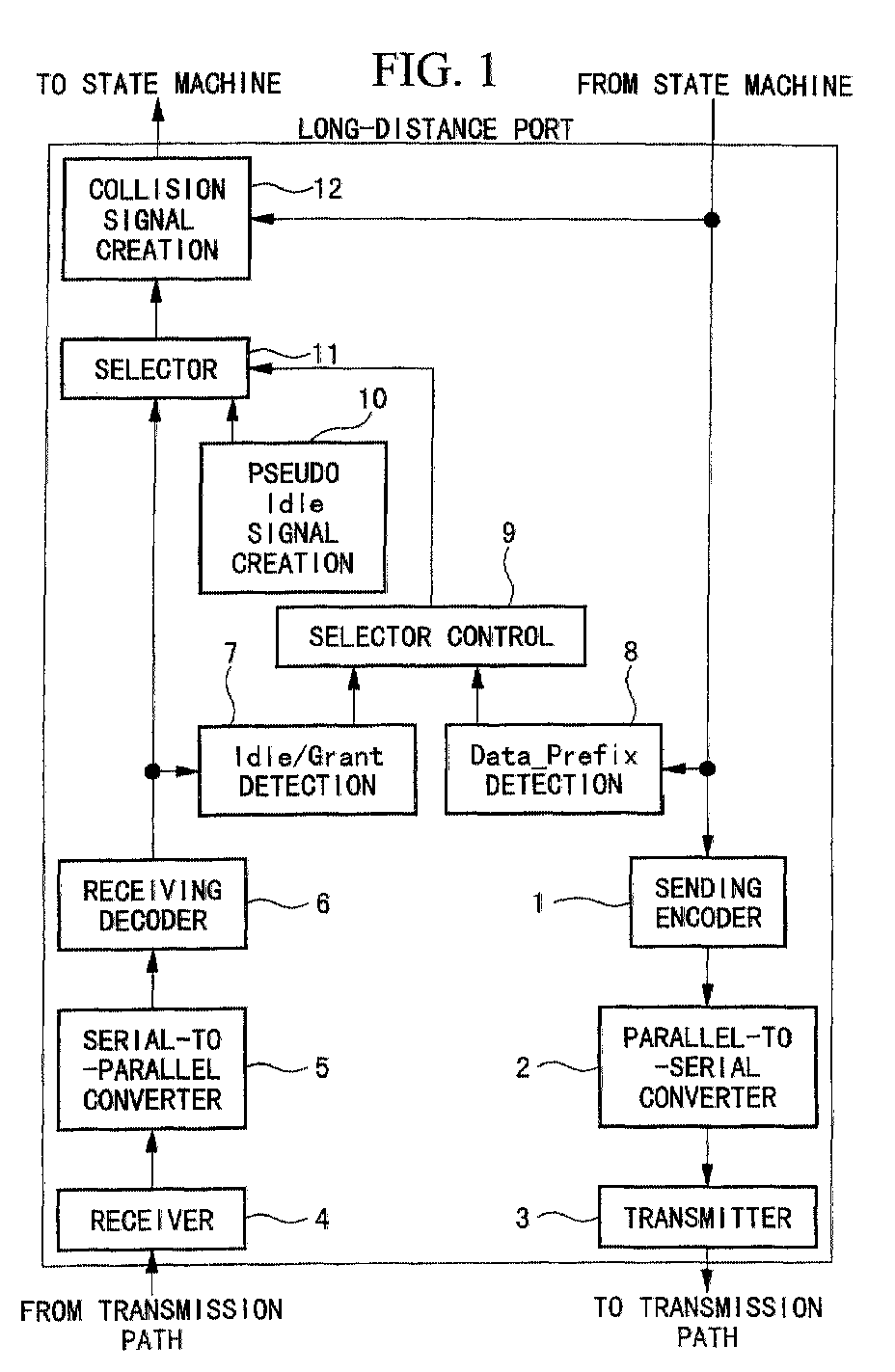
(57) A signal sending-and-receiving circuit is used for a long-distance port in a node
having a state machine within a serial-bus network, wherein a sending section (1-3)
performs scrambling, coding and conversion on signals given from the state machine
to produce serial signals which are sent onto a transmission path, while a receiving
section (4-6) performs conversion, de-scrambling and decoding on signals given from
the transmission path to produce decoded signals. A control signal is created based
on a Data_prefix signal detected from the signals of the state machine, and an Idle
signal or a Grant signal detected from the decoded signals. The control signal controls
a selector (11) to selectively output either the decoded signals or a pseudo Idle
signal which is newly created. Then, a collision signal is created in response to
an output of the selector. Thus, it is possible to avoid collision between a grant
signal and a Self ID packet, so it is possible to prevent the Self ID packet from
being damaged. In addition, the state machine is designed to have six states, namely,
S0 (Self ID Start), S1 (Self ID Grant), S2 (Self ID Receive), S3 (Send Speed Capabilities),
S4 (Self ID Transmit) and S5 (Self ID Suspend). Herein, the state machine is placed
in the state S5 to suspend the Self ID process until the node detects Idle at a parent
port connected to a parent node after detecting Idle at a receive port receiving the
Self ID packet from another node.
|
|
