| (19) |
 |
|
(11) |
EP 0 969 162 B1 |
| (12) |
EUROPEAN PATENT SPECIFICATION |
| (45) |
Mention of the grant of the patent: |
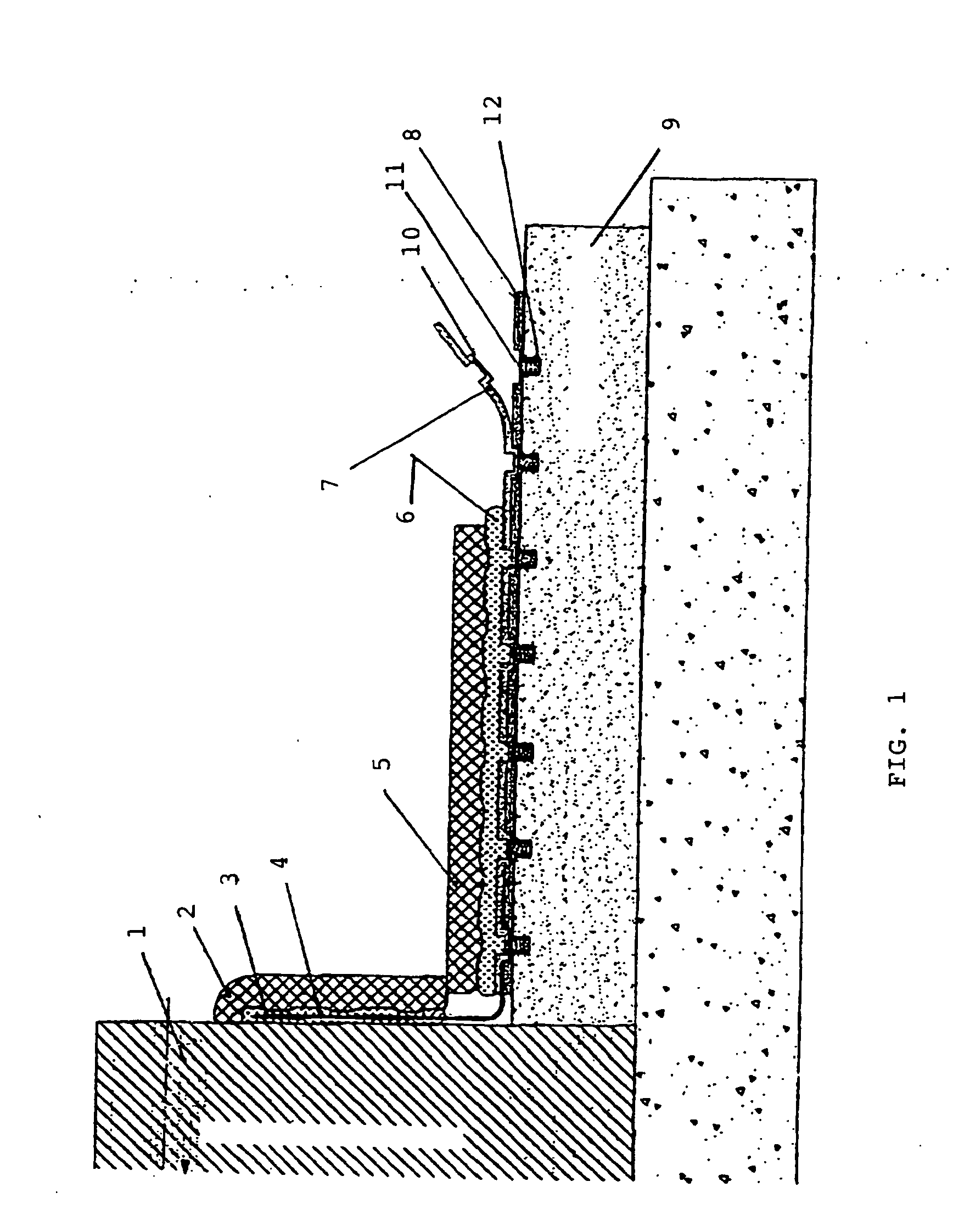
|
27.08.2008 Bulletin 2008/35 |
| (22) |
Date of filing: 25.06.1999 |
|
| (51) |
International Patent Classification (IPC):
|
|
| (54) |
A method of laying floors and/or coverings of majolica tiles and the like as well
as pulling them up quickly in case of their replacement, and means for carrying out
the same
Verfahren zum Verlegen eines Fussbodens und/oder Verkleidungen von Majolika Fliesen
und dergleichen sowie zum schnellen Herausziehen im Falle einer Ersetzung, und Mittel
zu seiner Durchführung
Procédé pour poser un plancher et/ou un revêtement de carreaux de majolique et similaires
ainsi que pour les arracher rapidement au cas d'un remplacement, et moyens pour la
mise en oeuvre dudit procédé
|
| (84) |
Designated Contracting States: |
|
AT BE CH CY DE DK ES FI FR GB GR IE IT LI LU MC NL PT SE |
|
Designated Extension States: |
|
AL LT LV MK RO SI |
| (30) |
Priority: |
03.07.1998 IT RM980450
|
| (43) |
Date of publication of application: |
|
05.01.2000 Bulletin 2000/01 |
| (73) |
Proprietor: Raineri, Gabriele |
|
95036 Randazzo (IT) |
|
| (72) |
Inventor: |
|
- Raineri, Gabriele
95036 Randazzo (IT)
|
| (74) |
Representative: Sarpi, Maurizio |
|
Studio FERRARIO
Via Collina, 36
00187 Roma
00187 Roma (IT) |
| (56) |
References cited: :
EP-A- 0 043 714
EP-A- 0 763 637
|
EP-A- 0 270 888
DE-A- 4 234 792
|
|
| |
|
|
|
|
| |
|
| Note: Within nine months from the publication of the mention of the grant of the European
patent, any person may give notice to the European Patent Office of opposition to
the European patent
granted. Notice of opposition shall be filed in a written reasoned statement. It shall
not be deemed to
have been filed until the opposition fee has been paid. (Art. 99(1) European Patent
Convention).
|
[0001] The present invention relates to building and more particularly a method of laying
floor tiles and/or coverings allowing the same to be pulled up quickly in case of
their replacement, and means for carrying out such method as well.
[0002] Destructive operations of coverings and floors tiled with majolica and the like and,
if necessary, also the demolition of the floor foundation are currently needed in
case of replacement thereof. In such case electric or pneumatic chisels and/or hammers
are used causing discomfort as far as noise, dust and rubbles is concerned.
Another problem of the common techniques of pulling up floors and/or coverings is
the considerable labour and time needed for such work with the result of an increase
in the total cost.
[0003] It is known, from
EP0763637, a tiling or plating system for removably laying wall or floor tiles or wall or floor
plates on a surface such as a floor or wall including a magnetically conductive support
layer made of metal or the like and a magnetic layer applied to the rear side of the
tiles or plates, the magnetic layer being magnetically adhered to the support layer.
[0004] It is also known, from
EP0270888, a floor-covering construction for a load-bearing ground, with a hard wearing layer
fastened on it by means of glue or other adhesive means, is equipped for rapid removal
with substantially less noise and dirt than hitherto, with a hard wearing covering
connected to an intermediate layer consisting of a pressure-resistant and tear-proof
material and which is fastened at least partially releasably to the hard wearing layer.
[0005] Furthermore, from
DE4234792, it is known a covering designed to be laid on a supporting surface and fixed reversibly
to the supporting surface by magnetic attraction. In order to ensure high precision
and ease of laying, magnetically attracting or magnetically attracted material in
the form of a freely flowing material is integrated, at the covering-manufacturing
stage, in the part of the covering designed to lie against the supporting surface.
The above mentioned prior art documents disclose systems wherein the fixed and the
removable layers are joined together by means of magnetic or adhesive means, but none
of them disclose a fixed support and a removable support which have facing surfaces
conjugated in order to provide mechanical interaction between them.
[0006] One object of the invention is to overcome the above-mentioned problems relative
to the demolition of floors in order to reduce dust and noise caused by the pulling
up of tiles.
A second object of the invention is to strongly reduce the time needed for pulling
up the tiles to be replaced.
[0007] A third object of the present invention is to allow tiles to be replaced without
removing the floor foundation.
Such objects are accomplished by sticking the tiles to a supporting bed to be anchored
in a removable way to a fixed support conjugated thereto which is secured in a not
removable way to the floor foundation.
[0008] A better understanding of the invention will result from the following description
with reference to the sole accompanying drawing which shows a preferred embodiment
only by way of a not limiting example.
[0009] Figure 1 is a sectioned view of the connection portion between floor and wall along
a vertical plane perpendicular to floor and wall.
[0010] The inventive step involved by the present invention consists substantially of sticking
tiles 5 upon their laying to a removable supporting bed 7 which has been anchored
in a removable way to a fixed support 8 conjugated thereto and anchored in turn to
floor foundation 9 in a not removable way.
In the embodiment shown in the drawing removable supporting bed 7 has a lifting handle
3 that is placed and stuck behind skirting board 2 which is applied to wall 1, as
usual, upon laying the floor by adhesive 4 or nails.
According to the invention, removable supporting bed 7 and fixed support 8 are conjugated
to each other so that removable supporting bed 7 is applied in a removable way on
fixed support 8 in order to guarantee a firm anchoring for the tiles stuck to removable
supporting bed 7.
To this end the lower surface of removable supporting bed 7 mating the upper surface
of fixed support 8 is provided with projections 10 which enter corresponding recesses
11 in the upper surface of fixed support 8 having a shape conjugated to projections
10. Such projections 10 and recesses 11 have such a shape as to prevent any relative
movement of removable supporting bed and fixed support 8 in their lying plane. However,
movements perpendicular to such plane are allowed, i.e. any movement causing projections
10 to be removed from recesses 11.
Fixed support 8 is further provided at its lower surface with suitable projections
12 which are embodied into floor foundation 9 upon laying the floor in order that
fixed support 8 is reliably secured to floor foundation 9.
According to the invention the floor or covering tiles have to be laid according to
the following operating steps in order to allow the subsequent lifting of the tiles
to be replaced quickly and without noise and dust:
- a) providing a floor foundation 9 and applying the fixed support 8 thereon so that
lifting handle(s) 3 is(are) near one wall;
- b) positioning removable supporting bed 7 on fixed support 8;
- c) applying an adhesive layer 6 on removable supporting bed 7 and laying tiles 5 in
the typical way;
- d) concealing lifting handle(s) 3 behind skirting board 2 stuck to wall 1.
As mentioned above, if it is requested to remove the tiles, the skirting board is
detached so as to show lifting handle(s) 3 which is(are) pulled upwards for lifting
removable supporting bed 7 and the tiles stuck thereon. Once the removable supporting
bed with the tiles stuck thereon is removed, fixed support 8 is ready for the next
set of new tiles stuck on a new removable supporting bed 7 previously laid thereon
in the same way as already described.
The operating method according to the present invention allows advantageously floorings
which are aesthetically and functionally identical to floorings of the conventional
type while giving the possibility of replacing quickly the tiles without using tools
or pneumatic hammers or the like and without dust and noise.
Removable supporting bed 7 and fixed support 8 may be of any material tough enough.
In particular removable supporting bed 7 consists of a material which is flexible
and capable of being deformed enough to allow it to be bent in case the tiles have
to be lifted for their replacement.
Another advantage of the invention consists in that fixed support 8 can be used again
with or without a new removable supporting bed 7 after tiles to be replaced are lifted
and before new tiles are laid.
1. A method of laying floor tiles (5) and/or coverings providing the use of a fixed support
and of a removable supporting bed,
characterized in that in order to allow the tiles to be replaced quickly and without noise and dust, tiles
(5) are stuck upon laying the same to the removable supporting bed (7) which has been
mechanically anchored in a removable way to the fixed support (8) conjugated thereto
and anchored in turn to floor foundation (9) in a not removable way; said method comprising
the following operating steps:
a) providing a floor foundation (9) and applying the fixed support (8) thereon so
that lifting handle(s) (3) is(are) near one wall;
b) positioning removable supporting bed (7) on fixed support (8);
c) applying an adhesive layer (6) on removable supporting bed (7) and laying tiles
(5) in the typical way;
d) concealing lifting handle(s) attached to the removable supporting bed (3) behind
skirting board (2) stuck to wall (1).
2. The method of claim 1, characterized in that, if it is requested to remove the tiles, skirting board (2) is detached so as to show
lifting handle(s) (3) which is(are) pulled upwards for lifting removable supporting
bed (7) and the tiles stuck thereon, whereupon removable supporting bed (7) together
with the tiles stuck thereon is removed and fixed support 8 is ready for the next
set of new tiles stuck on a new removable supporting bed (7) previously laid thereon
in the same way as described.
3. Supports suitable for laying floors and/or coverings according to the method of the
preceding claims, comprising a fixed support (8) and a removable supporting bed (7),
characterized in that said removable supporting bed (7) and fixed support (8) are conjugated to each other
so that removable supporting bed (7) is suitable to be mechanically fitted - in a
removable way - in said fixed support (8) in order to guarantee a firm anchoring for
the tiles stuck to removable supporting bed (7); said fixed support (8) being suitable
to be anchored to floor foundation (9) in a not removable way and said removable supporting
bed (7) being suitable to be spread with an adhesive layer (6) for laying tiles (5)
thereon in a known manner, wherein there is provided on the removable supporting bed
at least one lifting handle (3) suitable to be concealed behind skirting board (2)
stuck to wall (1).
4. Supports of claim 3, characterized in that the lower surface of removable supporting bed (7) mating the upper surface of fixed
support (8) is provided with projections (10) which enter corresponding recesses (11)
in the upper surface of fixed support (8) having a shape conjugated to projections
(10).
5. Supports of claims 3 and 4, characterized in that said projections (10) and recesses (11) have such a shape as to prevent any relative
movement of removable supporting bed (7) and fixed support (8) in their lying plane,
however, movements perpendicular to such plane being allowed, i.e. any movement causing
projections (10) to be removed from recesses (11).
6. Supports of claims 3 to 5, characterized in that fixed support (8) is further provided at its lower surface with suitable projections
(12) which are embodied into floor foundation (9) upon laying the floor in order that
fixed support (8) is reliably secured to floor foundation (9).
1. Verfahren zum Verlegen von Fußbodenfliesen (5) und/oder Belägen, das die Verwendung
einer festen Stütze und eines entfernbaren Stützbetts vorsieht,
dadurch gekennzeichnet, dass, um ein rasches Ersetzen der Fliesen ohne Lärm und Staub zu gestatten, die Fliesen
(5) bei deren Verlegen an dem entfernbaren Stützbett (7) festsitzen, das entfernbar
an der festen Stütze (8) mechanisch verankert wurde, dieser zugeordnet ist und wiederum
an dem Bodenfundament (9) nicht entfernbar verankert wird, wobei das Verfahren die
folgenden Schritte umfasst:
a) Vorsehen eines Bodenfundaments (9) und Aufbringen der festen Stütze (8) hierauf,
so dass sich der(die) Hebegriff(e) (3) nahe einer Wand befindet(befinden);
b) Positionieren des entfernbaren Stützbetts (7) auf der festen Stütze (8);
c) Aufbringen einer haftenden Schicht (6) auf dem entfernbaren Stützbett (7) und Verlegen
der Fliesen (5) auf typische Weise;
d) Verbergen des(der) Hebegriffs(e) (3), der(die) an dem entfernbaren Stützbett befestigt
ist(sind), hinter der Fuß- bzw. Sockelleiste, die an der Wand (1) festsitzt.
2. Verfahren nach Anspruch 1, dadurch gekennzeichnet, dass wenn die Fliesen entfernt werden sollen, die Fußleiste (2) entfernt wird, um den(die)
Griff(e) (3) sichtbar zu machen, der(die) nach oben gezogen wird(werden), um das entfernbare
Stützbett (7) und die darauf festsitzenden Fliesen anzuheben, woraufhin das entfernbare
Stützbett (7) zusammen mit den darauf festsitzenden Fliesen entfernt wird, und die
feste Stütze (8) für den nächsten Satz neuer Fliesen bereit ist, die auf einem neuen,
entfernbaren Stützbett (7) festsitzen, das zuvor auf dieselbe beschriebene Weise darauf
gelegt wurde.
3. Stütze bzw. Stützmittel, geeignet zum Verlegen von Fußböden und/oder Belägen gemäß
dem Verfahren der vorhergehenden Ansprüche, umfassend: eine feste Stütze (8) und ein
entfernbares Stützbett (7), dadurch gekennzeichnet, dass das entfernbare Stützbett (7) und die feste Stütze (8) einander zugeordnet sind,
so dass das entfernbare Stützbett (7) dazu geeignet ist, auf entfernbare Weise, mechanisch
in die feste Stütze (8) eingepasst zu werden, um eine feste Verankerung der auf dem
entfernbaren Stützbett (7) festsitzenden Fliesen zu gewährleisten, wobei die feste
Stütze (8) dazu geeignet ist, an dem Bodenfundament (9) auf nicht entfernbare Weise
verankert zu werden, und wobei das entfernbare Stützbett (7) dazu geeignet ist, mit
einer haftenden Schicht (5) bedeckt zu werden, um die Fliesen (5) auf eine bekannte
Weise darauf zu verlegen, wobei auf dem entfernbaren Stützbett wenigstens ein Hebegriff
(3) vorgesehen ist, der dazu ausgelegt ist, hinter der an der Wand (1) festsitzenden
Fußleiste (2) verborgen zu werden.
4. Stütze gemäß Anspruch 4, dadurch gekennzeichnet, dass die Unterseite des entfernbaren Stützbetts (7), die mit der Oberseite der festen
Stütze (8) zusammenpasst, mit Vorsprüngen (10) versehen ist, die in zugehörige Ausnehmungen
(11) in der Oberseite der festen Stütze (8) eindringen und eine mit den Vorsprüngen
(10) zusammenpassende Gestalt haben.
5. Stütze nach Anspruch 3 und 4, dadurch gekennzeichnet, dass die Vorsprünge (10) und Ausnehmungen (11) so gestaltet sind, um jedwede relative
Bewegung des entfernbaren Stützbetts (7) und der festen Stütze (8) in ihrer Liegeebene
zu verhindern, wobei Bewegungen senkrecht zu einer solchen Ebene jedoch erlaubt sind,
d.h. jedwede Bewegung, die die Vorsprünge (11) dazu bringt, von dem Ausnehmungen (11)
gelöst zu werden.
6. Stütze nach den Ansprüchen 3 bis 5, dadurch gekennzeichnet, dass die feste Stütze (8) ferner an ihrer Unterseite mit geeigneten Vorsprüngen (12) versehen
ist, die beim Verlegen des Bodens in das Bodenfundament (9) eingebaut werden, damit
die feste Stütze (8) zuverlässig an dem Bodenfundament (9) befestigt ist.
1. Procédé pour poser des carrelages (5) et/ou des revêtements en prévoyant l'utilisation
d'un support fixe et d'un lit de support amovible,
caractérisé en ce qu'afin de permettre de remplacer rapidement les carrelages et sans bruit ni poussière,
les carrelages (5) sont collés après avoir posé ces derniers sur un lit de support
amovible (7) qui a été mécaniquement ancré d'une manière amovible sur le support fixe
(8) conjugué à celui-ci et ancré à son tour dans la dalle (9) d'une manière non amovible
; ledit procédé comprenant les étapes suivantes consistant à :
a) prévoir une dalle (9) et appliquer le support fixe (8) sur celle-ci de sorte qu'une
(des) poignée(s) de levage (3) est (sont) à proximité d'une paroi ;
b) positionner le lit de support amovible (7) sur le support fixe (8) ;
c) appliquer une couche adhésive (6) sur le lit de support amovible (7) et poser les
carrelages (5) de la manière typique ;
d) dissimuler la (les) poignée(s) de levage (3) fixée(s) au lit de support amovible
(7) derrière la plinthe (2) collée à la paroi (1).
2. Procédé selon la revendication 1, caractérisé en ce que, s'il faut retirer les carrelages, la plinthe (2) est détachée afin de laisser apparaître
la (les) poignée(s) de levage (3) qui est (sont) soulevée(s) pour soulever le lit
de support amovible (7) et les carrelages collés sur celui-ci, après quoi le lit de
support amovible (7) conjointement aux carrelages collés sur celui-ci est retiré et
le support fixe (8) est prêt pour l'ensemble suivant de nouveaux carrelages collés
sur un nouveau lit de support amovible (7) préalablement posé sur celui-ci de la même
manière que celle décrite.
3. Supports appropriés pour poser des planchers et/ou des revêtements, selon le procédé
des revendications précédentes, comprenant un support fixe (8) et un lit de support
amovible (7), caractérisés en ce que ledit lit de support amovible (7) et le support fixe (8) sont conjugués entre eux
de sorte que le lit de support amovible (7) est approprié pour être monté mécaniquement
- d'une manière amovible - dans ledit support fixe (8) afin de garantir un ancrage
ferme pour les carrelages collés sur le lit de support amovible (7) ; ledit support
fixe (8) étant approprié pour être ancré sur la dalle (9) d'une manière non amovible
et ledit lit de support amovible (7) étant approprié pour être recouvert d'une couche
adhésive (6) pour poser les carrelages (5) sur celui-ci d'une manière connue, dans
lesquels on prévoit, sur le lit de support amovible, au moins une poignée de levage
(3) appropriée pour être dissimulée derrière la plinthe (2) collée sur la paroi (1).
4. Supports selon la revendication 3, caractérisés en ce que la surface inférieure du lit de support amovible (7) se couplant avec la surface
supérieure du support fixe (8) est prévue avec des saillies (10) qui pénètrent dans
des évidements (11) correspondants dans la surface supérieure du support fixe (8)
ayant une forme conjuguée aux saillies (10).
5. Supports selon les revendications 3 et 4, caractérisés en ce que lesdites saillies (10) et les évidements (11) ont une forme telle qu'ils empêchent
tout mouvement relatif du lit de support amovible (7) et du support fixe (8) dans
leur plan, cependant, des mouvements perpendiculaires à un tel plan sont autorisés,
c'est-à-dire tout mouvement amenant les saillies (10) à être retirées des évidements
(11).
6. Supports selon les revendications 3 à 5, caractérisés en ce que le support fixe (8) est en outre prévu au niveau de sa surface inférieure avec des
saillies appropriées (12) qui sont mises en oeuvre dans la dalle (9) après avoir posé
le plancher de sorte que le support fixe (8) est fixé de manière fiable à la dalle
(9).
REFERENCES CITED IN THE DESCRIPTION
This list of references cited by the applicant is for the reader's convenience only.
It does not form part of the European patent document. Even though great care has
been taken in compiling the references, errors or omissions cannot be excluded and
the EPO disclaims all liability in this regard.
Patent documents cited in the description