| (19) |
 |
|
(11) |
EP 0 980 321 B1 |
| (12) |
EUROPEAN PATENT SPECIFICATION |
| (45) |
Mention of the grant of the patent: |
|
27.09.2000 Bulletin 2000/39 |
| (22) |
Date of filing: 01.05.1998 |
|
| (51) |
International Patent Classification (IPC)7: B60K 41/14 |
| (86) |
International application number: |
|
PCT/GB9801/288 |
| (87) |
International publication number: |
|
WO 9850/248 (12.11.1998 Gazette 1998/45) |
|
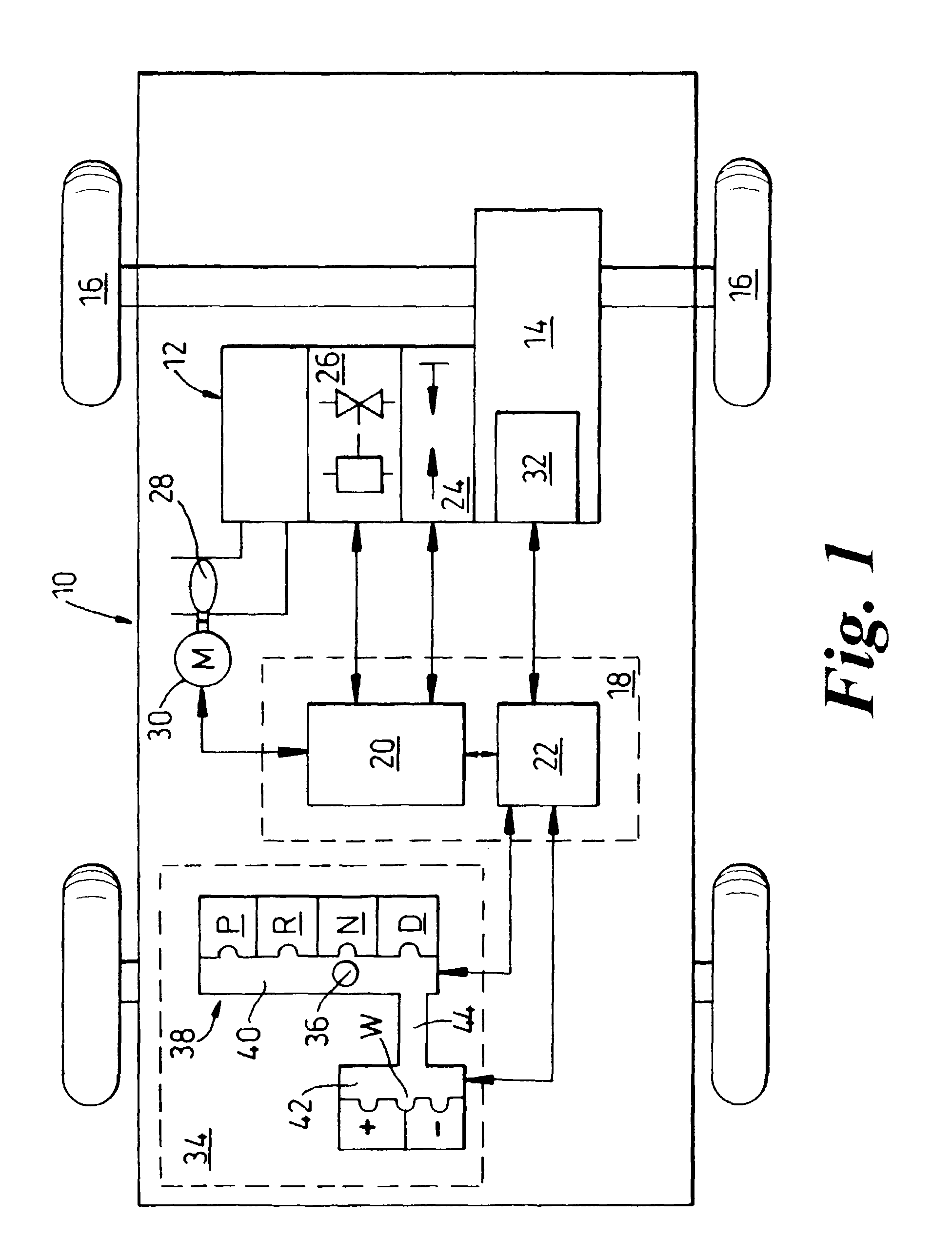
| (54) |
A TRANSMISSION CONTROL SYSTEM FOR A VEHICLE
GETRIEBESTEUERSYSTEM FÜR EIN FAHRZEUG
SYSTEME DE COMMANDE DE TRANSMISSION POUR VEHICULE
|
| (84) |
Designated Contracting States: |
|
AT DE ES IT NL SE |
| (30) |
Priority: |
07.05.1997 GB 9709074
|
| (43) |
Date of publication of application: |
|
23.02.2000 Bulletin 2000/08 |
| (73) |
Proprietor: ROVER GROUP LIMITED |
|
Warwick,
Warwickshire CV34 6RG (GB) |
|
| (72) |
Inventor: |
|
- JACKSON, Neil, David
Warwickshire CV33 9RF (GB)
|
| (74) |
Representative: Bullwein, Fritz et al |
|
Bayerische Motoren Werke Aktiengesellschaft
Patentabteilung AJ-33
80788 München
80788 München (DE) |
| (56) |
References cited: :
EP-A- 0 530 381
DE-A- 19 645 975
FR-A- 2 729 343
|
WO-A-94/24463
DE-C- 4 120 540
US-A- 4 764 155
|
|
| |
|
|
|
|
| |
|
| Note: Within nine months from the publication of the mention of the grant of the European
patent, any person may give notice to the European Patent Office of opposition to
the European patent
granted. Notice of opposition shall be filed in a written reasoned statement. It shall
not be deemed to
have been filed until the opposition fee has been paid. (Art. 99(1) European Patent
Convention).
|
[0001] This invention relates to transmission control systems for vehicles and in particular
to a transmission control system for a continuously variable transmission suitable
for use in a vehicle; to a method of controlling such a transmission control system;
and to a vehicle having such a transmission control system.
[0002] It is known to control a continuously variable transmission (CVT) by operating an
associated prime mover at its optimum efficiency and by continually varying the output
ratio of the transmission to fulfil the demands for torque output placed on the powertrain.
It is an object of the control systems for some known CVTs to provide a smooth output
from the transmission throughout the operating range of the powertrain.
[0003] When such a CVT is fitted to a vehicle, it is usually the aim of the designer to
ensure that the CVT has as smooth a torque output as possible. In this way, a user
experiences a power delivery which is refined and seamless, i.e. devoid of step changes.
One such prior art system is disclosed in US 4,653,005.
[0004] For some applications, however, it is desirable to provide noticeable changes in
powertrain output, in order to provide powertrain feedback to the user. For example,
in a sports car it is often perceived that the driving experience should involve feedback
from the powertrain at points in the power delivery which would simulate drops and
/ or surges in torque around gear shifts and thus be reminiscent of the manual gear
shifts beloved of some users of traditional or classic sports cars. Such a system
is disclosed by DE-C-41 20 540, which constitutes the closest prior art and shows
the features of the preambles of claims 1 and 13.
[0005] It is an object of this invention to provide: an improved transmission control system
for a continuously variable transmission suitable for use in a vehicle; a method of
controlling such an improved transmission control system; and to provide a vehicle
having such an improved transmission control system.
[0006] According to the invention there is provided a transmission control system for a
vehicle comprising a prime mover control means arranged in use to control the torque
output from a prime mover and a transmission control means arranged in use to control
a continuously variable transmission so as to operate in a plurality of substantially
discrete ratios and to control shifts between said ratios, characterised in that the
transmission control means is arranged to provide a shift signal to the prime mover
control means indicative of a shift between said ratios and the prime mover control
means is arranged to temporarily alter said torque output in response to said shift
signal, whereby in use a user is provided with feedback which is indicative of said
shift and which is in the form of a substantially stepped change in said torque output.
[0007] The prime mover control means may be arranged to alter said torque output by reducing
it and may be arranged to raise said torque output at the end of a shift between said
ratios.
[0008] The prime mover control means may be arranged to alter said torque output by increasing
it and may be arranged to reduce said torque output at the end of a shift between
said ratios.
[0009] The prime mover control means may be arranged to alter said torque output substantially
for the duration of each shift between said ratios.
[0010] The transmission control means may comprise a manual input means for manual selection
of shifts between said ratios.
[0011] The prime mover may comprise an engine and the prime mover control means may be arranged
to alter said torque output by varying the supply of fuel to a cylinder of said engine.
[0012] The prime mover may comprise a spark ignition engine and the prime mover control
means may be arranged to alter said torque output by varying the ignition timing of
said engine.
[0013] The prime mover may comprise an engine and the prime mover control means may be arranged
to alter said torque output by varying the supply of air to a cylinder of said engine.
[0014] The prime mover may comprise an electrical machine and the prime mover control means
may be arranged to alter said torque output by varying an electrical supply of said
electrical machine.
[0015] The invention also provides a vehicle having a transmission control system according
to the invention.
[0016] The invention also provides a method of controlling a transmission control system
for a vehicle comprising a prime mover control means arranged in use to control the
torque output from a prime mover and a transmission control means arranged in use
to control a continuously variable transmission so as to operate in a plurality of
substantially discrete ratios and to control shifts between said ratios, characterised
in that the method includes the steps of:
a) providing a shift signal from the transmission control means to the prime mover
control means indicative of a shift between said ratios; and
b) altering temporarily said torque output in response to said shift signal;
whereby in use a user is provided with feedback which is indicative of said shift
and which is in the form of a substantially stepped change in said torque output.
[0017] The method may include altering said torque output by reducing it and may include
raising said torque output at the end of a shift between said ratios.
[0018] The method may include altering said torque output by increasing it and may include
reducing said torque output at the end of a shift between said ratios.
[0019] The method may include altering said torque output substantially for the duration
of each shift between said ratios.
[0020] The method may include manually selecting shifts between said ratios using a manual
input means comprising part of the transmission control means.
[0021] The prime mover may comprise an engine and the method may include altering said torque
output by varying the supply of fuel to a cylinder of said engine.
[0022] The prime mover may comprise a spark ignition engine and the method may include altering
said torque output by varying the ignition timing of said engine.
[0023] The prime mover may comprise an engine and the method may include altering said torque
output by varying the supply of air to a cylinder of said engine.
[0024] The prime mover may comprise an electrical machine and the method may include altering
said torque output by varying an electrical supply of said electrical machine.
[0025] The invention will now be described by way of example with reference to the accompanying
drawing, in which:
[0026] Figure 1 is a schematic diagram of a vehicle having a transmission control system
according to the invention.
[0027] Referring to the figure, a vehicle 10 comprises a prime mover in the form of a spark
ignition engine 12 connected to a continuously variable transmission (CVT) 14 which
provides drive to a set of wheels 16.
[0028] The engine 12 and the CVT 14 are controlled by a combined powertrain controller 18,
comprising an engine management system (EMS) 20 and a CVT controller 22 which communicate
with each other.
[0029] The engine 12 has an ignition system 24 and a fuelling system comprising a fuel injection
means 26 and a throttle butterfly 28 driven by a motor 30, all under the control of
the EMS 20 to regulate the torque output of the engine 12. The CVT 14 has a shift
mechanism 32, which is under the control of the CVT controller 22, to control its
output to the wheels 16.
[0030] The vehicle 10 further comprises a transmission selector 34 having a user operated
gear lever 36 which is manually slideable between positions along a transmission gate
38 and which provides the CVT controller 22 with a signal indicating in which of the
positions the gear lever 36 has been placed. The gate 38 is divided into a first track
40 and a second track 42 which are interconnected by a cross track 44.
[0031] When moved along the first track 40, the selector lever 36 selects between positions
for; park P, reverse R, neutral N and drive D and can operate at any ratio within
its range in a conventional CVT manner. When in drive D, the selector lever 36 can
be moved across the cross track 44 and into the second track 42.
[0032] When the selector lever 36 is in the second track 42, it is spring loaded to a waiting
position W between an up-shift + and a down-shift - position. The gear lever is manually
moveable into the up-shift + or down-shift - position and returns to the waiting position
W by the spring loading on its release between movements.
[0033] When the selector lever 36 is moved between the up-shift + and the down-shift - positions,
the CVT controller 22 controls the shift mechanism 32 to operate the CVT 14 in a plurality
of discrete simulated fixed ratios and to shift up or down between them in accordance
with the manual selection. The continuously variable nature of the operation of the
CVT 14 makes it difficult to permanently fix the CVT output at specific ratios and
so the CVT controller 22 simulates fixed ratios by continuously adjusting the shift
mechanism 32 to operate around fixed points of the CVT output characteristic.
[0034] On each manually selected up-shift or down-shift, initiated using the selector lever
36, the CVT controller 22 sends a shift start signal to the EMS 20. On receipt of
the shift start signal, the EMS 20 temporarily alters the torque output of the engine
12.
[0035] The torque output is altered with time at the start of each ratio shift and simulates
the powertrain feedback the driver would experience if he were to be operating a vehicle
fitted with a manual shift mechanism, i.e. the feedback is in the form of a substantially
stepped change in the torque output, as if an accelerator pedal (not shown) were to
be released and a clutch pedal (not shown) were to be depressed.
[0036] When the torque has been altered, the CVT controller 22 operates the shift mechanism
32 to select a higher or lower simulated fixed ratio in accordance with the movement
of the selector lever 36 along the second track 42.
[0037] When the shift has been carried out, the CVT controller 22 sends a shift end signal
to the EMS 20, which then alters the torque output of the engine 12 with time so that
it matches the previous setting or adopts a new setting appropriate for the newly
selected transmission ratio. The alteration of the torque output at the end of a ratio
shift simulates the powertrain feedback the driver would experience if he were to
be operating a vehicle fitted with a manual shift mechanism, i.e. the feedback is
in the form of a substantially stepped change in the torque output, as if a clutch
pedal were to be released and an accelerator pedal were to be depressed.
[0038] The torque output is altered by using one or more of three techniques selected from
a look-up table programmed in the EMS 20, the selection being made in a tuneable manner
depending on the instant running conditions of the engine 12 and is further tuneable
to take account of individual user preferences. The three methods of altering the
torque output are: by varying the quantity of fuel supplied to the engine 12 by the
fuel injection system 26; by the EMS 20 controlling the motor 30 to partially or fully
open or close the throttle butterfly 28 and thereby varying the supply of air to the
engine 12; and by controlling the ignition system 24 to vary the spark timing.
[0039] The alteration in torque output may be by its reduction, increase or a mixture of
these two options as preferred, in order to suit each users' perceptions of feedback
for certain vehicles or under certain circumstances.
[0040] If the torque output is reduced for a shift, it should be increased at the end of
that shift. If on the other hand the torque output is raised for a shift, it should
be lowered at the end of that shift. In either case, the increase or reduction in
torque output at the end of the shift may not be necessary, depending on the torque
output demand placed on the engine 12 by the newly selected ratio.
[0041] The alteration in torque output does not have to be limited to the duration of the
ratio shift itself but may be implemented for a period varied in accordance with driver
expectations, which would be programmed in the combined powertrain controller 18 during
development testing. The simulation of a manual selection of ratios thus provides
a sporty feel to the vehicle 10 when the selector lever 36 is operated in the second
track 42.
[0042] This invention could also be applied to a CVT having a conventional cable operated
throttle butterfly, rather than the drive-by-wire motor operated butterfly 30 of the
embodiment described above. The powertrain controller could also comprise a fully
integrated powertrain controller in which the EMS 20 and the CVT controller 22 are
fully integrated in a single unit.
[0043] In a modification to the invention the prime mover comprises an electrical machine,
for example a traction motor, and the torque output is altered by varying an electrical
supply of the machine, for example by current control.
1. A transmission control system (18) for a vehicle (10) comprising a prime mover control
means (20) arranged in use to control the torque output from a prime mover (12) and
a transmission control means (22) arranged in use to control a continuously variable
transmission (14) so as to operate in a plurality of substantially discrete ratios
and to control shifts between said ratios, the control system (18) characterised in
that the transmission control means (22) is arranged to provide a shift signal to
the prime mover control means (20) indicative of a shift between said ratios and the
prime mover control means (20) is arranged to temporarily alter said torque output
in response to said shift signal, whereby in use a user is provided with feedback
which is indicative of said shift and which is in the form of a substantially stepped
change in said torque output.
2. A transmission control system (18) according to Claim 1, wherein the prime mover control
means (20) is arranged to alter said torque output by reducing it.
3. A transmission control system (18) according to Claim 2, wherein the prime mover control
means (20) is arranged to raise said torque output at the end of a shift between said
ratios.
4. A transmission control system (18) according to Claim 1, wherein the prime mover control
means (20) is arranged to alter said torque output by increasing it.
5. A transmission control system (18) according to Claim 4, wherein the prime mover control
means (20) is arranged to reduce said torque output at the end of a shift between
said ratios.
6. A transmission control system (18) according to any preceding claim, wherein the prime
mover control means (20) is arranged to alter said torque output substantially for
the duration of each shift between said ratios.
7. A transmission control system (18) according to any preceding claim, wherein the transmission
control means (22) comprises a manual input means (36) for manual selection of shifts
between said ratios.
8. A transmission control system (18) according to any preceding claim, wherein the prime
mover (12) comprises an engine and the prime mover control means (20) is arranged
to alter said torque output by varying the supply of fuel to a cylinder of the engine.
9. A transmission control system (18) according to any preceding claim, wherein the prime
mover (12) comprises a spark ignition engine and the prime mover control means is
arranged to alter said torque output by varying the ignition timing of the engine.
10. A transmission control system (18) according to any preceding claim, wherein the prime
mover (12) comprises an engine and the prime mover control means (20) is arranged
to alter said torque output by varying the supply of air to a cylinder of the engine.
11. A transmission control system (18) according to any one of Claims 1 to 7, wherein
the prime mover (12) comprises an electrical machine and the prime mover control means
(20) is arranged to alter said torque output by varying an electrical supply of said
electrical machine.
12. A vehicle having a transmission control system (18) according to any preceding claim.
13. A method of controlling a transmission control system (18) for a vehicle (10) comprising
a prime mover control means (20) arranged in use to control the torque output from
a prime mover (12) and a transmission control means (22) arranged in use to control
a continuously variable transmission (14) so as to operate in a plurality of substantially
discrete ratios and to control shifts between said ratios, characterised in that the
method includes the steps of:
a) providing a shift signal from the transmission control means (22) to the prime
mover control means (20) indicative of a shift between said ratios; and
b) altering temporarily said torque output in response to said shift signal;
whereby in use a user is provided with feedback which is indicative of said shift
and which is in the form of a substantially stepped change in said torque output.
14. A method according to Claim 13, including altering said torque output by reducing
it.
15. A method according to Claim 14, including raising said torque output at the end of
a shift between said ratios.
16. A method according to Claim 13, including altering said torque output by increasing
it.
17. A method according to Claim 16, including reducing said torque output at the end of
a shift between said ratios.
18. A method according to any one of Claims 13 to 17, including altering said torque output
substantially for the duration of each shift between said ratios.
19. A method according to any one of Claims 13 to 18, including manually selecting shifts
between said ratios using a manual input means (36) comprising part of the transmission
control means (22).
20. A method according to any one of Claims 13 to 19, the prime mover (12) comprising
an engine and including altering said torque output by varying the supply of fuel
to a cylinder of said engine.
21. A method according to any one of Claims 13 to 20, the prime mover (12) comprising
a spark ignition engine and including altering said torque output by varying the ignition
timing of said engine.
22. A method according to any one of Claims 13 to 21, the prime mover (12) comprising
an engine and including altering said torque output by varying the supply of air to
a cylinder of said engine.
23. A method according to any one of Claims 13 to 19, the prime mover (12) comprising
an electrical machine and including altering said torque output by varying an electrical
supply of said electrical machine.
1. Getriebesteuersystem (18) für ein Fahrzeug (10), das folgendes umfaßt: ein Kraftmaschinensteuermittel
(20), das ausgelegt ist, bei Betrieb die Drehmomentausgabe von einer Kraftmaschine
(12) zu steuern, und ein Getriebesteuermittel (22), das so ausgelegt ist, daß es bei
Betrieb ein stufenloses Getriebe (14) so steuert, daß es in mehreren im wesentlichen
diskreten Übersetzungen arbeitet, und Schaltvorgänge zwischen den Übersetzungen steuert,
wobei das Steuersystem (18) dadurch gekennzeichnet ist, daß das Getriebesteuermittel
(22) ausgelegt ist, um dem Kraftmaschinensteuermittel (20) ein Schaltvorgangssignal
zu liefern, das einen Schaltvorgang zwischen den Übersetzungen anzeigt, und das Kraftmaschinensteuermittel
(20) ausgelegt ist, die Drehmomentausgabe als Reaktion auf das Schaltvorgangssignal
vorübergehend zu ändern, wodurch ein Benutzer bei Betrieb eine Rückmeldung erhält,
die den Schaltvorgang anzeigt und die in Form einer im wesentlichen stufenförmigen
Änderung der Drehmomentausgabe vorliegt.
2. Getriebesteuersystem (18) nach Anspruch 1, wobei das Kraftmaschinensteuermittel (20)
so ausgelegt ist, daß es die Drehmomentausgabe ändert, indem es sie reduziert.
3. Getriebesteuersystem (18) nach Anspruch 2, wobei das Kraftmaschinensteuermittel (20)
so ausgelegt ist, daß es die Drehmomentausgabe am Ende eines Schaltvorgangs zwischen
den Übersetzungen anhebt.
4. Getriebesteuersystem (18) nach Anspruch 1, wobei das Kraftmaschinensteuermittel (20)
so ausgelegt ist, daß es die Drehmomentausgabe ändert, indem es sie erhöht.
5. Getriebesteuersystem (18) nach Anspruch 4, wobei das Kraftmaschinensteuermittel (20)
so ausgelegt ist, daß es die Drehmomentausgabe am Ende eines Schaltvorgangs zwischen
den Übersetzungen reduziert.
6. Getriebesteuersystem (18) nach einem der vorhergehenden Ansprüche, wobei das Kraftmaschinensteuermittel
(20) ausgelegt ist, die Drehmomentausgabe im wesentlichen für die Dauer jedes Schaltvorgangs
zwischen den Übersetzungen zu ändern.
7. Getriebesteuermittel (18) nach einem der vorhergehenden Ansprüche, wobei das Getriebesteuermittel
(22) ein manuelles Eingabemittel (36) zur manuellen Auswahl von Schaltvorgängen zwischen
den Übersetzungen umfaßt.
8. Getriebesteuermittel (18) nach einem der vorhergehenden Ansprüche, wobei die Kraftmaschine
(12) einen Motor umfaßt und das Kraftmaschinensteuermittel (20) so ausgelegt ist,
daß es die Drehmomentausgabe durch Verstellen der Zufuhr von Kraftstoff zu einem Zylinder
der Maschine ändert.
9. Getriebesteuermittel (18) nach einem der vorhergehenden Ansprüche, wobei die Kraftmaschine
(12) einen Fremdzündungsmotor umfaßt und das Kraftmaschinensteuermittel so ausgelegt
ist, daß es die Drehmomentausgabe durch Verstellen des Zündzeitpunkts des Motors ändert.
10. Getriebesteuermittel (18) nach einem der vorhergehenden Ansprüche, wobei die Kraftmaschine
(12) einen Motor umfaßt und das Kraftmaschinensteuermittel (20) so ausgelegt ist,
daß es die Drehmomentausgabe durch Verstellen der Zufuhr von Luft zu einem Zylinder
des Motors ändert.
11. Getriebesteuermittel (18) nach einem der Ansprüche 1 bis 7, wobei die Kraftmaschine
(12) eine elektrische Maschine umfaßt und das Kraftmaschinensteuermittel (20) so ausgelegt
ist, daß es die Drehmomentausgabe durch Verstellen einer Stromzufuhr der elektrischen
Maschine ändert.
12. Fahrzeug mit einem Getriebesteuersystem (18) nach einem der vorhergehenden Ansprüche.
13. Verfahren zum Steuern eines Getriebesteuersystems (18) für ein Fahrzeug (10), das
folgendes umfaßt: ein Kraftmaschinensteuermittel (20), das so ausgelegt ist, daß es
bei Betrieb die Drehmomentausgabe von einer Kraftmaschine (12) steuert, und ein Getriebesteuermittel
(22), das so ausgelegt ist, daß es bei Betrieb ein stufenloses Getriebe (14) so steuert,
daß es in mehreren im wesentlichen diskreten Übersetzungen arbeitet, und Schaltvorgänge
zwischen den Übersetzungen steuert, dadurch gekennzeichnet, daß das Verfahren folgende
Schritte enthält:
a) Liefern eines Schaltvorgangssignals von dem Getriebesteuermittel (22) an das Kraftmaschinensteuermittel
(20), das einen Schaltvorgang zwischen den Übersetzungen anzeigt; und
b) vorübergehendes Ändern der Drehmomentausgabe als Reaktion auf das Schaltvorgangssignal;
wodurch bei Betrieb ein Benutzer eine Rückmeldung erhält, die den Schaltvorgang
anzeigt und die in Form einer im wesentlichen stufenförmigen Änderung der Drehmomentausgabe
vorliegt.
14. Verfahren nach Anspruch 13, einschließlich dem Ändern der Drehmomentausgabe durch
Reduzieren.
15. Verfahren nach Anspruch 14, einschließlich dem Anheben der Drehmomentausgabe am Ende
eines Schaltvorgangs zwischen den Übersetzungen.
16. Verfahren nach Anspruch 13, einschließlich dem Ändern der Drehmomentausgabe durch
Erhöhen.
17. Verfahren nach Anspruch 16, einschließlich dem Reduzieren der Drehmomentausgabe am
Ende eines Schaltvorgangs zwischen den Übersetzungen.
18. Verfahren nach einem der Ansprüche 13 bis 17, einschließlich dem Ändern der Drehmomentausgabe
im wesentlichen für die Dauer jedes Schaltvorgangs zwischen den Übersetzungen.
19. Verfahren nach einem der Ansprüche 13 bis 18, einschließlich dem manuellen Auswählen
von Schaltvorgängen zwischen den Übersetzungen unter Verwendung eines manuellen Eingabemittels
(36), das Teil des Getriebesteuermittels (22) umfaßt.
20. Verfahren nach einem der Ansprüche 13 bis 19, wobei die Kraftmaschine (12) einen Motor
umfaßt und es das Ändern der Drehmomentausgabe durch Verstellen der Zufuhr von Kraftstoff
zu einem Zylinder des Motors enthält.
21. Verfahren nach einem der Ansprüche 13 bis 20, wobei die Kraftmaschine (12) einen Fremdzündungsmotor
umfaßt und es das Ändern der Drehmomentausgabe durch Verstellen des Zündzeitpunkts
des Motors enthält.
22. Verfahren nach einem der Ansprüche 13 bis 21, wobei die Kraftmaschine (12) einen Motor
umfaßt und es das Ändern der Drehmomentausgabe durch Verstellen der Zufuhr von Luft
zu einem Zylinder des Motors enthält.
23. Verfahren nach einem der Ansprüche 13 bis 19, wobei die Kraftmaschine (12) eine elektrische
Maschine umfaßt und es das Ändern der Drehmomentausgabe durch Verstellen einer Stromzufuhr
der elektrischen Maschine enthält.
1. Système de commande (18) de transmission pour un véhicule (10) comprenant un moyen
de commande (20) de moteur d'entraînement prévu, en fonctionnement, pour commander
le couple en sortie d'un moteur d'entraînement (12) et un moyen de commande (22) de
transmission prévu, en fonctionnement, pour commander une transmission variable en
continu (14) de manière à fonctionner dans une pluralité de rapports substantiellement
discrets et à commander des décalages entre lesdits rapports, le système de commande
(18) étant caractérisé en ce que le moyen de commande (22) de transmission est prévu
pour fournir un signal de décalage au moyen de commande (20) du moteur d'entraînement,
indiquant un décalage entre lesdits rapports, et le moyen de commande (20) du moteur
d'entraînement est prévu pour modifier temporairement ledit couple en sortie en réponse
audit signal de décalage, un utilisateur recevant ainsi, en fonctionnement, une réponse
indiquant ledit décalage et qui se présente sous la forme d'un changement substantiellement
étagé dudit couple en sortie.
2. Système de commande (18) de transmission selon la revendication 1, dans lequel le
moyen de commande (20) du moteur d'entraînement est prévu pour modifier ledit couple
en sortie en le réduisant.
3. Système de commande (18) de transmission selon la revendication 2, dans lequel le
moyen de commande (20) du moteur d'entraînement est prévu pour augmenter ledit couple
en sortie à la fin d'un décalage entre lesdits rapports.
4. Système de commande (18) de transmission selon la revendication 1, dans lequel le
moyen de commande (20) du moteur d'entraînement est prévu pour modifier ledit couple
en sortie en l'augmentant.
5. Système de commande (18) de transmission selon la revendication 4, dans lequel le
moyen de commande (20) du moteur d'entraînement est prévu pour réduire ledit couple
en sortie à la fin d'un décalage entre lesdits rapports.
6. Système de commande (18) de transmission selon l'une quelconque des revendications
précédentes, dans lequel le moyen de commande (20) du moteur d'entraînement est prévu
pour modifier ledit couple en sortie substantiellement pendant toute la durée de chaque
décalage entre lesdits rapports.
7. Système de commande (18) de transmission selon l'une quelconque des revendications
précédentes, dans lequel le moyen de commande (22) de transmission comprend un moyen
d'entrée manuel (36) pour la sélection manuelle de décalages entre lesdits rapports.
8. Système de commande (18) de transmission selon l'une quelconque des revendications
précédentes, dans lequel le moteur d'entraînement (12) comprend un moteur et le moyen
de commande (20) du moteur d'entraînement est prévu pour modifier ledit couple en
sortie en faisant varier l'alimentation en carburant d'un cylindre du moteur.
9. Système de commande (18) de transmission selon l'une quelconque des revendications
précédentes, dans lequel le moteur d'entraînement (12) comprend un moteur à allumage
par étincelle et le moyen de commande du moteur d'entraînement est prévu pour modifier
ledit couple en sortie en faisant varier le réglage de l'allumage du moteur.
10. Système de commande (18) de transmission selon l'une quelconque des revendications
précédentes, dans lequel le moteur d'entraînement (12) comprend un moteur et le moyen
de commande (20) du moteur d'entraînement est prévu pour modifier ledit couple en
sortie en faisant varier l'alimentation en air d'un cylindre du moteur.
11. Système de commande (18) de transmission selon l'une quelconque des revendications
1 à 7, dans lequel le moteur d'entraînement (12) comprend une machine électrique et
le moyen de commande (20) du moteur d'entraînement est prévu pour modifier ledit couple
en sortie en faisant varier l'alimentation électrique de ladite machine électrique.
12. Véhicule ayant un système de commande (18) de transmission selon l'une quelconque
des revendications précédentes.
13. Procédé de commande d'un système de commande (18) de transmission pour un véhicule
(10) comprenant un moyen de commande (20) de moteur d'entraînement prévu, en fonctionnement,
pour commander le couple en sortie d'un moteur d'entraînement (12) et un moyen de
commande (22) de transmission prévu, en fonctionnement, pour commander une transmission
variable en continu (14) de manière à fonctionner dans une pluralité de rapports substantiellement
discrets et à commander des décalages entre lesdits rapports, caractérisé en ce que
le procédé comporte les étapes consistant à :
a) fournir un signal de décalage du moyen de commande (22) de transmission au moyen
de commande (20) du moteur d'entraînement indiquant un décalage entre lesdits rapports
; et
b) modifier temporairement ledit couple en sortie en réponse audit signal de décalage
;
un utilisateur recevant ainsi, en fonctionnement, une réponse indiquant ledit décalage
et qui se présente sous la forme d'un changement substantiellement étagé dudit couple
en sortie.
14. Procédé selon la revendication 13, comportant la modification dudit couple en sortie
en le réduisant.
15. Procédé selon la revendication 14, comportant l'augmentation dudit couple en sortie
à la fin d'un décalage entre lesdits rapports.
16. Procédé selon la revendication 13, comportant la modification dudit couple en sortie
en l'augmentant.
17. Procédé selon la revendication 16, comportant la réduction dudit couple en sortie
à la fin d'un décalage entre lesdits rapports.
18. Procédé selon l'une quelconque des revendications 13 à 17, comportant la modification
dudit couple en sortie substantiellement pendant toute la durée de chaque décalage
entre lesdits rapports.
19. Procédé selon l'une quelconque des revendications 13 à 18, comportant la sélection
manuelle des décalages entre lesdits rapports en utilisant un moyen d'entrée manuel
(36) comprenant une partie du moyen de commande (22) de transmission.
20. Procédé selon l'une quelconque des revendications 13 à 19, le moteur d'entraînement
(12) comprenant un moteur et comportant la modification dudit couple en sortie en
faisant varier l'alimentation en carburant d'un cylindre dudit moteur.
21. Procédé selon l'une quelconque des revendications 13 à 20, le moteur d'entraînement
(12) comprenant un moteur à allumage par étincelle et comportant la modification dudit
couple en sortie en faisant varier le réglage de l'allumage dudit moteur.
22. Procédé selon l'une quelconque des revendications 13 à 21, le moteur d'entraînement
(12) comprenant un moteur et comportant la modification dudit couple en sortie en
faisant varier l'alimentation en air d'un cylindre dudit moteur.
23. Procédé selon l'une quelconque des revendications 13 à 19, le moteur d'entraînement
(12) comprenant une machine électrique et comportant la modification dudit couple
en sortie en faisant varier l'alimentation électrique de ladite machine électrique.