| (19) |
 |
|
(11) |
EP 0 984 792 B1 |
| (12) |
EUROPEAN PATENT SPECIFICATION |
| (45) |
Mention of the grant of the patent: |
|
05.02.2003 Bulletin 2003/06 |
| (22) |
Date of filing: 20.05.1998 |
|
| (86) |
International application number: |
|
PCT/US9810/273 |
| (87) |
International publication number: |
|
WO 9805/2621 (26.11.1998 Gazette 1998/47) |
|
| (54) |
STERILIZATION INDICATOR
STERILISATIONSINDIKATOR
INDICATEUR DE STERILISATION
|
| (84) |
Designated Contracting States: |
|
DE ES FR GB IT |
| (30) |
Priority: |
21.05.1997 US 859759
|
| (43) |
Date of publication of application: |
|
15.03.2000 Bulletin 2000/11 |
| (60) |
Divisional application: |
|
01129943.5 / 1188450 |
| (73) |
Proprietor: MINNESOTA MINING AND MANUFACTURING COMPANY |
|
St. Paul,
Minnesota 55133-3427 (US) |
|
| (72) |
Inventor: |
|
- IGNACIO, Ramon, T.
Saint Paul, MN 55133-3427 (US)
|
| (74) |
Representative: Meyers, Hans-Wilhelm, Dr.Dipl.-Chem. et al |
|
Patentanwälte
von Kreisler-Selting-Werner
Postfach 10 22 41
50462 Köln
50462 Köln (DE) |
| (56) |
References cited: :
WO-A-93/16386
WO-A-96/40299
|
WO-A-96/33242
US-A- 5 139 957
|
|
| |
|
|
- DATABASE WPI Section Ch, Week 7502 Derwent Publications Ltd., London, GB; Class D16,
AN 75-02985W XP002078279 & JP 49 046440 B (EIKEN CHEMICAL CO LTD) , 10 December 1974
|
|
| |
|
| Note: Within nine months from the publication of the mention of the grant of the European
patent, any person may give notice to the European Patent Office of opposition to
the European patent
granted. Notice of opposition shall be filed in a written reasoned statement. It shall
not be deemed to
have been filed until the opposition fee has been paid. (Art. 99(1) European Patent
Convention).
|
Background
[0001] Medical instruments and parenteral drugs are sterilized prior to use. A traditional
sterilization process uses steam under pressure. Alternative sterilization processes
use ethylene oxide or hydrogen peroxide in vapor form as the sterilant.
[0002] Sterilization indicators are used to monitor whether a sterilization process has
been performed. Sterilization indicators may include an indicator composition, carried
on a substrate, that changes color during the sterilization process.
[0003] US-A-5 139 957 discloses the monitoring of a H
2O
2 vapor phase sterilization process with an indicator comprising a substrate and potassium
dichromate, which changes colour in the presence of H
2O
2.
[0004] WO-A-96/33242 discloses indicator compositions comprising a substrate, a resin binder
and two colorants and their use in a H
2O
2 sterilization process.
[0005] Database WPI, Section Ch, Week 7502, Derwent Publ. Ltd, London, GB; Class D16, AN
75-02985W discloses the use of acid fuchsin to determine hydrogen peroxide in food.
Summary of the Invention
[0006] The invention features monitoring a sterilization process that uses hydrogen peroxide
vapor with a colorant that chemically reacts with hydrogen peroxide. The chemical
reaction causes the colorant to undergo a distinct color change during the sterilization
process, providing an indication that the sterilization process has occurred. A distinct
color change occurs if normal medical professionals can readily discern the color
change through visual observation.
[0007] The colorant comprises the dye acid fuchsin. Acid fuchsin changes from purple to
colorless when exposed to hydrogen peroxide vapor.
[0008] The invention also-features a sterilization indicator for use in monitoring a sterilization
process involving hydrogen peroxide vapor. The sterilization indicator includes an
indicator composition, containing the colorant, carried on a substrate such as a polyester
strip. The indicator composition optionally may also contain a resin that binds the
indicator composition to the substrate.
[0009] In addition, the composition optionally may contain a second colorant that does not
undergo a distinct color change during exposure to hydrogen peroxide vapor.
[0010] The invention also features the indicator composition itself. In addition, the invention
features manufacturing the sterilization indicator by printing the indicator composition
onto the substrate.
[0011] Additionally, the indicator composition may be utilized on sterilization indicator
tape.
[0012] Other features and advantages will be apparent from the description of the drawing
and the preferred embodiment thereof, and from the claims.
Brief Description of the Drawing
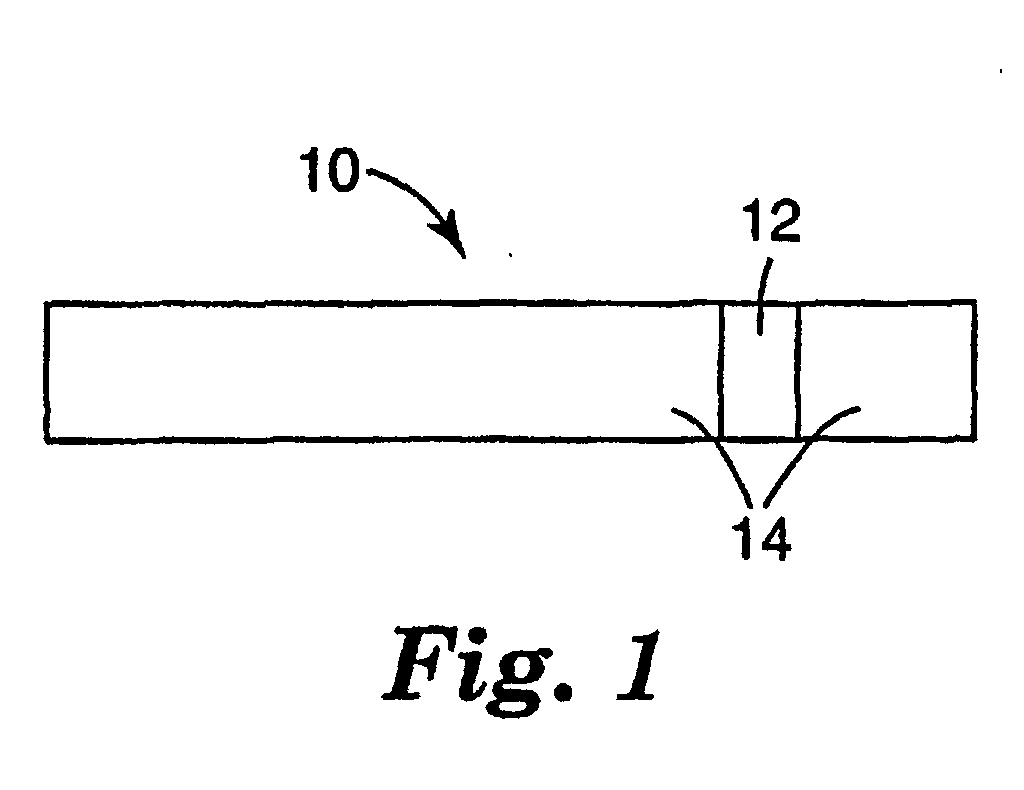
[0013] The figure is a face plan view of an embodiment of a sterilization indicator.
Detailed Description
[0014] The preferred sterilization indicator includes an indicator composition and a substrate.
[0015] The indicator composition contains acid fuchsin and undergoes a distinct color change
when exposed to hydrogen peroxide vapor. Preferably the indicator composition, after
incorporation into the sterilization monitor, will exhibit the distinct color change
within a certain period of time (e.g., 5 minutes, 15 minutes, or 2 hours) of exposure
to an atmosphere containing at least 30% hydrogen peroxide at 45°C. The indicator
composition preferably does not undergo fade if left exposed to UV light. For example,
the indicator composition preferably will not fade if the sterilization indicator
is exposed at a distance of several inches to a standard fluorescent light for one
or two days. It also preferably does not revert to its original color when exposed
to the air once the sterilization process is complete.
[0016] Enough of the dye should be included in the indicator composition to provide the
desired initial color intensity. The quantity of the dye in the composition also will
influence the rate at which the composition undergoes the distinct color change. The
indicator composition may contain, for example, between 0.05% and 5%, or between 0.1%
and 2.5%, of the dye by weight.
[0017] Although the dye that undergoes a distinct color change in response to hydrogen peroxide
vapor may be the sole colorant in the indicator composition, optionally the composition
may also include a second dye that does not change color when exposed to hydrogen
peroxide vapors. If the second dye is used in compositions containing a dye that becomes
colorless when exposed to hydrogen peroxide, the indicator composition will not fade
and become colorless during sterilization, but instead will change from an initial
color to the color of the second dye. For example, the second dye can be a green dye
which in combination with acid fuchsin initially provides the composition with a purple
color, but which after the acid fuchsin has become colorless because of exposure to
hydrogen peroxide vapor provides the composition with a green color.
[0018] A sufficient quantity of the second dye should be included in the indicator composition
to provide the targeted color intensity, both prior to and subsequent to exposure
to hydrogen peroxide vapor. Too large a quantity of the second dye, for example, may
overcome the color of the first dye (pre-exposure to hydrogen peroxide) in the composition.
The indicator composition may include, for example, between 0.05% and 5%, or between
0.1% and 2.5% of the second dye by weight.
[0019] The indicator composition may contain a resin that binds the composition to the substrate.
Examples of binder resins include shellac, ethyl cellulose, hydroxypropyl methylcellulose,
methyl cellulose, and ethyl hydroxyethyl ethylcellulose. The shellac can be, for example,
bleached bone dry shellac. A sufficient quantity of binder resin should be included
in the composition to provide adequate binding of the composition to the substrate.
[0020] The indicator composition also may include resins that perform functions other than
binding. For example, the composition may include a resin that functions as a dispersing
agent that assists in dispersing the ingredients of the composition in the solvent
used in application of the composition to a substrate. The composition also may include
a resin that makes the composition water resistant once applied to the substrate.
Examples of other indicator compositions include acrylic resins.
[0021] The binder resin and other resins in the indicator composition may influence the
rate at which hydrogen peroxide vapor penetrates into the composition during the,
sterilization process. The rate of hydrogen peroxide penetration, in turn, may influence
the rate of color change of the composition. As a result, the quantity of total resin
used in the composition should be selected to provide the targeted rate of color change.
The indicator composition may include, for example, between 20% and 99% of total resin
by weight. The resin may be all binder resin, or may be for example, a mixture of
binder resin and other resin(s). In the latter situation, the indicator composition
may contain, for example, between 30% and 70% of the binder resin by weight, and between
10% and 50% (or 20% and 40%) of the other resin(s) by weight.
[0022] The indicator composition may contain other ingredients such as opacifying agents
(e.g., titanium dioxide).
[0023] Prior to application to the substrate, the indicator .composition is dissolved/dispersed
in a suitable solvent (e.g., water or a lower-alkyl (C
1-C
4) alcohol like ethanol or isopropyl). Generally, anywhere from one to two parts of
solvent to one part of the indicator composition may be used.
[0024] The sterilization monitor preferably can be handled before and after the sterilization
process without irritating the skin of the handler. Hydrogen peroxide, particularly
at higher concentrations, is an irritant, and thus the preferred substrates are those
that do not absorb significant quantities of hydrogen peroxide during the sterilization
process. Examples of non-absorbent substrates include polyester, such as Melinex Polyester
film. Examples of absorbent substrates include paper substrates, such as blotter paper.
[0025] The substrate may be in the form of a strip (e.g., 10.78 x 1.57 cm (4.25 x 0.62 inch))
having the indicator composition at one end; the other end of the strip then can serve
as a grip for the user. When the substrate is an absorbent material such as blotter
paper, the grip portion of the strip may be laminated with a plastic outer surface
to minimize-the absorption of hydrogen peroxide by the grip during the sterilization
process.
[0026] The substrate may also have an adhesive on the bottom surface that allows the sterilization
indicator to be used as a label. An example of a suitable polyester label is Copycode
WH®, a white polyester with a printable topcoat manufactured by the Fasson Film Division
of Avery-Dennison Co.
[0027] The indicator composition may be applied to the substrate by any suitable technique.
For example, the indicator composition may be applied to the substrate using conventional
printing techniques such as flexographic printing or extrusion printing.
[0028] Examples 1-5 are examples of sterilization indicators.
Example 1
[0029] An indicator composition (in solvent) was prepared that contained the following ingredients:
| Ingredient |
Ouantity |
Supplier |
| Isopropyl Alcohol (Solvent) |
300 Grams |
--- |
| Acrysol I-545* |
150 Grams |
Rohm & Haas Co. |
| Shellac Bleached Bone Dry (V-117**) |
150 Grams |
Zehrong Corp. |
| |
| Ethanol (V-117 Solvent) |
150 Grams |
--- |
| Titanium Dioxide (P-23) |
25 Grams |
E.T. Horn |
| Green Dye (DB-892) |
3 Grams |
Colorcon |
| Acid Fuchsin |
3 Grams |
Aldrich Chemical |
| *Includes water. |
| **V-117 includes shellac bleached bone dry dissolved in ethanol. |
[0030] The composition was prepared by combining the isopropyl alcohol and V-117; separately
combining the acid fuchsin, the green dye, and the P-23; adding the dye/P-23 combination
to the isopropanol/V-117 solution; mixing vigorously; adding the Acrysol I-545; and
mixing until homogeneous.
[0031] The indicator composition was printed as a stripe on one end of 10.78 x 1.588 cm
(4 1/4 x 0.625) inch strip of blotter paper using an extrusion-type printing method.
Referring to the Figure, after the solvent evaporated, a sterilization indicator (10)
was provided having a stripe portion (12) that includes the indicator composition,
and two portions (14) consisting only of the paper substrate. The sterilization indicator
was hung inside a 453.6 g (16 ounce) jar (with a loose cap) containing 80 ml of H
2O
2 (31%) at a temperature of 50°C. Initially, portion (12) was purple, but the portion
turned green in less than an hour.
Example 2
[0032] A sterilization indicator was prepared that included the same indicator composition
and substrate described in Example 1, except that (1) basic fuchsin was substituted
for acid fuchsin, and (2) the green dye was removed. The sterilization indicator was
prepared using the procedure described in Example 1. The indicator composition initially
was reddish purple, but when tested according to the procedure described in Example
1 the composition turned yellow within an hour.
Example 3
[0033] A sterilization indicator was prepared that included the same indicator composition
and substrate described in Example 2, except that pinacyanole was used in place of
basic fuchsin. The sterilization indicator was prepared using the procedure described
in Example 1. The indicator composition initially was blue, but when tested according
to the procedure described in Example 1 the composition turned colorless within 24
hours.
Example 4
[0034] A sterilization indicator was prepared that included the same indicator composition
and substrate described in Example 2, except that ethyl red was used in place of basic
fuchsin. The sterilization indicator was prepared using the procedure described in
Example 1. The indicator composition initially was red, but when tested according
to the procedure described in Example 1 the composition turned colorless within for
24 hours.
Example 5
[0035] A sterilization indicator was prepared that included the same indicator composition
and substrate described in Example 2, except that aniline blue was used in place of
basic fuchsin. The sterilization indicator was prepared using the procedure described
in Example 1. The indicator composition initially was blue, but when tested according
to the procedure described in Example 1, the composition turned light blue within
for 24 hours.
[0036] The sterilization indicators can be used with commercially available sterilization
systems that use hydrogen peroxide vapor. The sterilization process may include, for
example, exposure to an atmosphere containing at least 25% hydrogen peroxide vapor
for at least 15 minutes. The sterilization process may be conducted at (greater than
40 degrees) elevated temperatures. The sterilization system may use solely hydrogen
peroxide vapor as the sterilant, or may use hydrogen peroxide vapor as part of a hydrogen
peroxide gas plasma sterilization process. (see, e.g., EP 0 707 186 Al).
[0037] For example, the sterilization indicator can be used with the STERRARD® 100 hydrogen
peroxide gas plasma sterilization system, which is available from Advanced Sterilization
Products, a division of Johnson & Johnson Medical, Inc. The STERRARD®100 can be used
to sterilize medical instruments (e.g., fiber optic devices, endoscopic equipment,
gloves, linen, parenteral drugs, etc.). The STERRARD®100 utilizes radio waves in hydrogen
peroxide vapors to create a gas plasma. Generally, the equipment to be sterilized
is placed in the sterilization chamber; the chamber is evacuated; hydrogen peroxide
vapor is generated in the chamber and is allowed to diffuse throughout the chamber;
the gas plasma is generated; and the chamber is evacuated. If, for example, the sterilization
indicator made in Example 1 is placed in the sterilization chamber prior to the cycle,
the indicator composition will convert from purple to green during the sterilization
process, thereby indicating that the equipment in the chamber has been exposed to
hydrogen peroxide vapor.
1. A method of monitoring a sterilization process including the use of hydrogen peroxide
vapor, comprising:
exposing an item to be sterilized and an indicator composition containing acid fuchsin
to hydrogen peroxide vapor,
wherein during said exposure to said hydrogen peroxide vapor, hydrogen peroxide
chemically reacts with said acid fuchsin to cause a distinct color change in said
indicator composition by said acid fuchsin becoming substantially colorless after
chemically reacting with said hydrogen peroxide.
2. The method of claim 1, wherein said indicator composition is carried on a substrate.
3. The method of claim 2, wherein said substrate comprises a polyester strip.
4. The method of claim 1, wherein said item comprises a medical instrument.
5. The method of claim 1, wherein said item and said indicator composition are exposed
to hydrogen. peroxide vapor for at least 15 minutes.
6. The method of claim 5, wherein the concentration of hydrogen peroxide in said hydrogen
peroxide vapor is at least 30%-.
7. The method of claim 1, wherein the concentration of hydrogen peroxide in said hydrogen
peroxide vapor is at least 30%.
8. A sterilization indicator, comprising: a substrate and, carried on said substrate,
an indicator composition that would undergo a distinct color change if said sterilization
indicator is exposed to hydrogen peroxide vapor, said indicator composition comprising
a binder and a colorant that would chemically react with hydrogen peroxide during
said exposure to hydrogen peroxide vapor to become colorless during said exposure
to hydrogen peroxide, said colorant comprising acid fuchsin.
9. The sterilization indicator of claim 8, wherein said indicator composition further
comprises a second colorant that would not change color during said exposure to hydrogen
peroxide vapor.
10. The sterilization indicator of claim 9, wherein said colorant that would react with
hydrogen peroxide to cause said distinct color change would become colorless during
said reaction, and said second colorant would provide said composition with its final
color after said exposure.
11. The sterilization indicator of claim 8, wherein said indicator composition, if having
undergone said distinct color change, will not revert to its original color.
12. The sterilization indicator of claim 8, wherein said indicator composition will not
fade if exposed to fluorescent light for 24 hours.
13. The sterilization indicator of claim 8, wherein said substrate is non-absorbent.
14. The sterilization indicator of claim 8, wherein said substrate comprises polyester.
15. The sterilization indicator of claim 8, wherein said substrate is in the form of a
strip.
16. The sterilization indicator of claim 8, wherein said indicator composition would undergo
a distinct color change if said sterilization indicator is exposed to an atmosphere
containing 31% hydrogen peroxide vapor for 60 minutes at 50°C.
17. The sterilization indicator of claim 8, wherein said sterilization indicator comprises
a grip portion including said substrate but not said indicator composition.
18. A sterilization indicator, comprising: a substrate and, carried on said substrate,
an indicator composition that would undergo a distinct color change if said sterilization
indicator is exposed to hydrogen peroxide vapor, said indicator composition comprising
a first colorant comprising acid fuchsin that would chemically react with hydrogen
peroxide during said exposure to hydrogen peroxide vapor to cause the distinct color
change in said composition, and a second colorant which during said exposure to hydrogen
peroxide vapor would not change color.
19. The sterilization indicator of claim 18, wherein said first colorant comprises a dye
that would become colorless during said exposure to hydrogen peroxide, and wherein
said second colorant would provide said composition with its final color after said
exposure.
20. The sterilization indicator of claim 18, wherein said second colorant comprises a
green dye.
21. The sterilization indicator of claim 18, wherein said indicator composition, if having
undergone said distinct color change, will not revert to its original color.
22. The sterilization indicator of claim 18, wherein said indicator composition will not
fade if exposed to fluorescent light for 24 hours.
23. The sterilization indicator of claim 18, wherein said substrate is non-absorbent.
24. The sterilization indicator of claim 18, wherein said substrate comprises polyester.
25. The sterilization indicator of claim 18, wherein said substrate is a strip.
26. The sterilization indicator of claim 18, wherein said indicator composition would
undergo a distinct color change if said sterilization indicator is exposed to an atmosphere
containing 31% hydrogen peroxide vapor for 60 minutes at 50°C.
27. The sterilization indicator of claim 19, wherein said sterilization indicator comprises
a grip portion including said substrate but not said indicator composition.
28. An indicator composition that can be used during a sterilization process using hydrogen
peroxide vapor, said indicator composition comprising a first colorant comprising
acid fuchsin that would become colorless if exposed to-hydrogen peroxide vapor, and
a second colorant that would not become colorless during said exposure.
29. The indicator composition of claim 28, wherein said indicator composition would undergo
said distinct color change if said sterilization indicator is exposed to an atmosphere
containing 31% hydrogen peroxide vapor for 60 minutes at 50°C.
30. A method of manufacturing a sterilization indicator, comprising: printing onto a substrate
an indicator composition that will undergo a distinct color change if said sterilization
indicator is exposed to hydrogen peroxide vapor, said indicator composition comprises
acid fuchsin.
31. The method of claim 30, wherein said indicator composition would undergo said distinct
color change if said sterilization indicator is exposed to an atmosphere containing
31% hydrogen peroxide vapor for 60 minutes at 50°C.
1. Verfahren zur Überwachung eines die Verwendung von Wasserstoffperoxiddampf einschließenden
Sterilisierungsverfahrens, umfassend:
das Einwirkenlassen von Wasserstoffperoxiddampf auf ein zu sterilisierendes Teil und
eine Säurefuchsin enthaltende Indikatorzusammensetzung,
wobei während der Einwirkung des Wasserstoffperoxiddampfes Wasserstoffperoxid mit
dem Säurefuchsin reagiert, wodurch durch das Säurefuchsin, das nach der chemischen
Reaktion mit dem Wasserstoffperoxid im wesentlichen farblos wird, eine deutliche Farbänderung
in der Indikatorzusammensetzung bewirkt wird.
2. Verfahren nach Anspruch 1, wobei die Indikatorzusammensetzung substratgestützt ist.
3. Verfahren nach Anspruch 2, wobei das Substrat einen Polyesterstreifen umfasst.
4. Verfahren nach Anspruch 1, wobei das Teil ein medizinisches Instrument umfasst.
5. Verfahren nach Anspruch 1, wobei wenigstens 15 min lang Wasserstoffperoxiddampf auf
das Teil und die Indikatorzusammensetzung einwirkt.
6. Verfahren nach Anspruch 5, wobei die Konzentration von Wasserstoffperoxid im Wasserstoffperoxiddampf
wenigstens 30 % beträgt.
7. Verfahren nach Anspruch 1, wobei die Konzentration von Wasserstoffperoxid im Wasserstoffperoxiddampf
wenigstens 30 % beträgt.
8. Sterilisierungsindikator, umfassend: ein Substrat und auf dem Substrat gestützt eine
Indikatorzusammensetzung, die eine deutliche Farbänderung erfährt, wenn Wasserstoffperoxiddampf
auf den Indikator einwirkt, wobei die Indikatorzusammensetzung ein Bindemittel und
ein farbgebendes Mittel umfasst, das bei der Einwirkung von Wasserstoffperoxiddampf
mit Wasserstoffperoxid chemisch so reagiert, dass es während der Einwirkung von Wasserstoffperoxid
farblos wird, wobei das farbgebende Mittel Säurefuchsin umfasst.
9. Sterilisierungsindikator nach Anspruch 8, wobei die Indikatorzusammensetzung weiterhin
ein zweites farbgebendes Mittel umfasst, das die Farbe während der Einwirkung von
Wasserstoffperoxiddampf nicht ändert.
10. Sterilisierungsindikator nach Anspruch 9, wobei das farbgebende Mittel, das mit Wasserstoffperoxid
unter Bildung der deutlichen Farbänderung während der Reaktion farblos wird und das
zweite farbgebende Mittel nach der Einwirkung der Zusammensetzung ihre endgültige
Farbe verleiht.
11. Sterilisierungsindikator nach Anspruch 8, wobei die Indikatorzusammensetzung, wenn
sie die deutliche Farbänderung erfahren hat, nicht zu ihrer ursprünglichen Farbe umschlägt.
12. Sterilisierungsindikator nach Anspruch 8, wobei die Indikatorzusammensetzung nicht
verblasst, wenn sie 24 h lang fluoreszierendem Licht ausgesetzt wird.
13. Sterilisierungsindikator nach Anspruch 8, wobei das Substrat nichtabsorbierend ist.
14. Sterilisierungsindikator nach Anspruch 8, wobei das Substrat Polyester umfasst.
15. Sterilisierungsindikator nach Anspruch 8, wobei das Substrat in Form eines Streifens
vorliegt.
16. Sterilisierungsindikator nach Anspruch 8, wobei die Indikatorzusammensetzung eine
deutliche Farbänderung erfährt, wenn bei 50 °C 60 min lang eine 31 % Wasserstoffperoxiddampf
enthaltende Atmosphäre auf den Sterilisierungsindikator einwirkt.
17. Sterilisierungsindikator nach Anspruch 8, wobei der Sterilisierungsindikator einen
Griffteil umfasst, der das Substrat, aber nicht die Indikatorzusammensetzung einschließt.
18. Sterilisierungsindikator, umfassend: ein Substrat und eine vom Substrat gestützte
Indikatorzusammensetzung, die eine deutliche Farbänderung erfährt, wenn Wasserstoffperoxiddampf
auf den Sterilisierungsindikator einwirkt, wobei die Indikatorzusammensetzung ein
erstes, Säurefuchsin umfassendes farbgebendes Mittel umfasst, das bei der Einwirkung
von Wasserstoffperoxiddampf mit Wasserstoffperoxid chemisch reagiert, wodurch die
deutliche Farbänderung in der Zusammensetzung bewirkt wird, und ein zweites farbgebendes
Mittel, das während der Einwirkung von Wasserstoffperoxiddampf nicht die Farbe ändert.
19. Sterilisierungsindikator nach Anspruch 18, wobei das erste farbgebende Mittel einen
Farbstoff umfasst, der während der Einwirkung von Wasserstoffperoxid farblos wird,
und wobei das zweite farbgebende Mittel der Zusammensetzung nach der Einwirkung die
endgültige Farbe verleiht.
20. Sterilisierungsindikator nach Anspruch 18, wobei das zweite farbgebende Mittel einen
grünen Farbstoff umfasst.
21. Sterilisierungsindikator nach Anspruch 18, wobei die Indikatorzusammensetzung nicht
zu ihrer ursprünglichen Farbe umschlägt, wenn sie die deutliche Farbänderung erfahren
hat.
22. Sterilisierungsindikator nach Anspruch 18, wobei die Indikatorzusammensetzung nicht
verblasst, wenn sie 24 h lang fluoreszierendem Licht ausgesetzt wird.
23. Sterilisierungsindikator nach Anspruch 18, wobei das Substrat nichtabsorbierend ist.
24. Sterilisierungsindikator nach Anspruch 18, wobei das Substrat Polyester umfasst.
25. Sterilisierungsindikator nach Anspruch 18, wobei das Substrat ein Streifen ist.
26. Sterilisierungsindikator nach Anspruch 18, wobei die Indikatorzusammensetzung eine
deutliche Farbänderung erfährt, wenn 60 min lang bei 50 °C eine 31 % Wasserstoffperoxiddampf
enthaltende Atmosphäre auf den Sterilisierungsindikator einwirkt.
27. Sterilisierungsindikator nach Anspruch 19, wobei der Sterilisierungsindikator einen
Griffteil umfasst, der das Substrat, aber nicht die Indikatorzusammensetzung einschließt.
28. Indikatorzusammensetzung, die bei einem Sterilisierungsverfahren unter Verwendung
von Wasserstoffperoxiddampf verwendet werden kann, wobei die Indikatorzusammensetzung
ein erstes, Säurefuchsin umfassendes farbgebendes Mittel, das farblos wird, wenn Wasserstoffperoxiddampf
darauf einwirkt, und ein zweites farbgebendes Mittel, das während der Einwirkung nicht
farblos wird, umfasst.
29. Indikatorzusammensetzung nach Anspruch 28, wobei die Indikatorzusammensetzung eine
deutliche Farbänderung erfährt, wenn 60 min lang bei 50 °C eine 31 % Wasserstoffperoxiddampf
enthaltende Atmosphäre auf den Sterilisierungsindikator einwirkt.
30. Verfahren zur Herstellung eines Sterilisierungsindikators, umfassend:
das Bedrucken eines Substrats mit einer Indikatorzusammensetzung, die eine deutliche
Farbänderung erfährt, wenn Wasserstoffperoxiddampf auf den Sterilisierungsindikator
einwirkt, wobei die Indikatorzusammensetzung Säurefuchsin umfasst.
31. Verfahren nach Anspruch 30, wobei die Indikatorzusammensetzung eine deutliche Farbänderung
erfährt, wenn 60 min lang bei 50°C eine 31 % Wasserstoffperoxiddampf enthaltende Atmosphäre
auf den Sterilisierungsindikator einwirkt.
1. Procédé de surveillance d'un procédé de stérilisation comprenant l'utilisation de
vapeur de peroxyde d'hydrogène, comprenant :
l'exposition d'un objet à stériliser et d'une composition d'indicateur contenant de
la fuchsine acide à de la vapeur de peroxyde d'hydrogène,
dans lequel pendant ladite exposition à ladite vapeur de peroxyde d'hydrogène,
le peroxyde d'hydrogène réagit chimiquement avec ladite fuchsine acide pour provoquer
un changement de couleur net dans ladite composition d'indicateur en rendant ladite
fuchsine acide essentiellement incolore après réaction chimique avec ledit peroxyde
d'hydrogène.
2. Procédé selon la revendication 1, dans lequel ladite composition d'indicateur est
déposée sur un substrat.
3. Procédé selon la revendication 2, dans lequel ledit substrat comprend une bande de
polyester.
4. Procédé selon la revendication 1, dans lequel ledit objet comprend un instrument médical.
5. Procédé selon la revendication 1, dans lequel ledit objet et ladite composition d'indicateur
sont exposés à de la vapeur de peroxyde d'hydrogène pendant au moins 15 minutes.
6. Procédé selon la revendication 5, dans lequel la concentration de peroxyde d'hydrogène
dans ladite vapeur de peroxyde d'hydrogène est d'au moins 30 %.
7. Procédé selon la revendication 1, dans lequel la concentration de peroxyde d'hydrogène
dans ladite vapeur de peroxyde d'hydrogène est d'au moins 30 %.
8. Indicateur de stérilisation, comprenant un substrat et, déposé sur ledit substrat,
une composition d'indicateur qui subit un changement de couleur net si ledit indicateur
de stérilisation est exposé à de la vapeur de peroxyde d'hydrogène, ladite composition
d'indicateur comprenant un liant et un colorant qui réagit chimiquement avec le peroxyde
d'hydrogène pendant ladite exposition à la vapeur de peroxyde d'hydrogène pour devenir
incolore pendant ladite exposition au peroxyde d'hydrogène, ledit colorant comprenant
de la fuchsine acide.
9. Indicateur de stérilisation selon la revendication 8, dans lequel ladite composition
d'indicateur comprend en outre un second colorant qui ne change pas de couleur pendant
ladite exposition à de la vapeur de peroxyde d'hydrogène.
10. Indicateur de stérilisation selon la revendication 9, dans lequel ledit colorant qui
réagit avec le peroxyde d'hydrogène pour provoquer un changement de couleur net devient
incolore pendant ladite réaction, et ledit second colorant communique à ladite composition
sa couleur finale après ladite exposition.
11. Indicateur de stérilisation selon la revendication 8, dans lequel ladite composition
d'indicateur, si elle a subi un changement de couleur net, ne reviendra pas à sa couleur
d'origine.
12. Indicateur de stérilisation selon la revendication 8, dans lequel ladite composition
d'indicateur ne se décolorera pas si elle est exposée à une lumière fluorescente pendant
24 heures.
13. Indicateur de stérilisation selon la revendication 8, dans lequel ledit substrat est
non absorbant.
14. Indicateur de stérilisation selon la revendication 8, dans lequel ledit substrat comprend
du polyester.
15. Indicateur de stérilisation selon la revendication 8, dans lequel ledit substrat est
sous la forme d'une bande.
16. Indicateur de stérilisation selon la revendication 8, dans lequel ladite composition
d'indicateur subit un changement de couleur net si ledit indicateur de stérilisation
est exposé à une atmosphère contenant 31 % de vapeur de peroxyde d'hydrogène pendant
60 minutes à 50°C.
17. Indicateur de stérilisation selon la revendication 8, dans lequel ledit indicateur
de stérilisation comprend une portion de manche incluant ledit substrat mais non ladite
composition d'indicateur.
18. Indicateur de stérilisation, comprenant un substrat et, déposée sur ledit substrat,
une composition d'indicateur qui subit un changement de couleur net si ledit indicateur
de stérilisation est exposé à de la vapeur de peroxyde d'hydrogène, ladite composition
d'indicateur comprenant un premier colorant comprenant de la fuchsine acide qui réagit
chimiquement avec le peroxyde d'hydrogène pendant ladite exposition à de la vapeur
de peroxyde d'hydrogène pour provoquer le changement de couleur net dans ladite composition,
et un second colorant qui ne change pas de couleur pendant ladite exposition à de
la vapeur de peroxyde d'hydrogène.
19. Indicateur de stérilisation selon la revendication 18, dans lequel ledit premier colorant
comprend un colorant qui devient incolore pendant ladite exposition à du peroxyde
d'hydrogène, et dans lequel ledit second colorant communique sa couleur finale à ladite
composition après ladite exposition.
20. Indicateur de stérilisation selon la revendication 18, dans lequel ledit second colorant
comprend un colorant vert.
21. Indicateur de stérilisation selon la revendication 18, dans lequel ladite composition
d'indicateur, si elle a subi un changement de couleur net, ne reviendra pas à sa couleur
d'origine.
22. Indicateur de stérilisation selon la revendication 18, dans lequel ladite composition
d'indicateur ne se décolorera pas si elle est exposée à une lumière fluorescente pendant
24 heures.
23. Indicateur de stérilisation selon la revendication 18, dans lequel ledit substrat
est non absorbant.
24. Indicateur de stérilisation selon la revendication 18, dans lequel ledit substrat
comprend du polyester.
25. Indicateur de stérilisation selon la revendication 18, dans lequel ledit substrat
est une bande.
26. Indicateur de stérilisation selon la revendication 18, dans lequel ladite composition
d'indicateur subit un changement de couleur net si ledit indicateur de stérilisation
est exposé à une atmosphère contenant 31 % de vapeur de peroxyde d'hydrogène pendant
60 minutes à 50°C.
27. Indicateur de stérilisation selon la revendication 19, dans lequel ledit indicateur
de stérilisation comprend une portion de manche incluant ledit substrat mais non ladite
composition d'indicateur.
28. Composition d'indicateur qui peut être utilisée pendant un procédé de stérilisation
utilisant de la vapeur de peroxyde d'hydrogène, ladite composition d'indicateur comprenant
un premier colorant comprenant de la fuchsine acide qui devient incolore s'il est
exposé à de la vapeur de peroxyde d'hydrogène, et un second colorant qui ne devient
pas incolore pendant ladite exposition.
29. Composition d'indicateur selon la revendication 28, dans laquelle ladite composition
d'indicateur subit un changement de couleur net si ledit indicateur de stérilisation
est exposé à une atmosphère contenant 31 % de vapeur de peroxyde d'hydrogène pendant
60 minutes à 50°C.
30. Procédé de fabrication d'un indicateur de stérilisation, comprenant : l'impression
sur un substrat d'une composition d'indicateur qui subira un changement de couleur
net si ledit indicateur de stérilisation est exposé à de la vapeur de peroxyde d'hydrogène,
ladite composition d'indicateur comprend de la fuchsine acide.
31. Procédé selon la revendication 30, dans lequel ladite composition d'indicateur subit
un changement de couleur net si ledit indicateur de stérilisation est exposé à une
atmosphère contenant 31 % de peroxyde d'hydrogène pendant 60 minutes à 50°C.