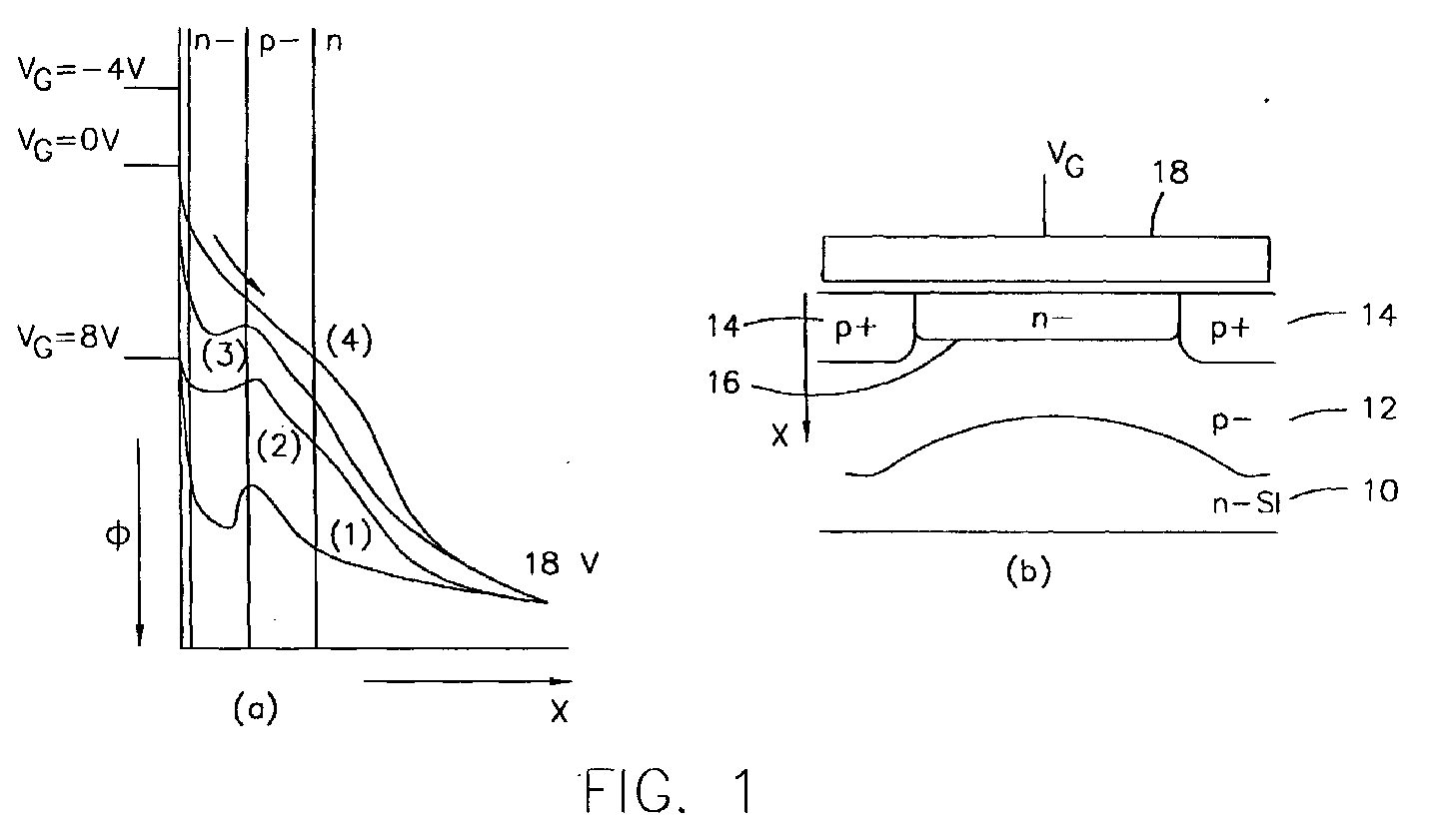
(57) Dynamic range extension (DRE) is achieved in CCD imagers with charge overflow structures
by varying the potential VG on the gate electrodes (18) of the pixel signal charge wells during charge integration.
The wells are formed to function with the charge overflow structures, e.g., vertical
overflow drains, VODs, a) to control the signal charge spreading due to illumination
overload and/or b) as a means for the control of signal integration time. Two different
VG levels are applied to the gate electrodes (18), the lower of the two levels VG - LOW is applied for a long duration and the higher level VG - HIGH is applied for a shorter duration during charge integration. At low levels
of incident illumination on the CCD surface, charge signals are integrated without
saturation, but, at levels of very intense illumination during the period with voltage
VG - LOW on the gates, the pixel wells will saturate before the end of charge integration,
resulting in the vertical overflow drain (VOD) operating to dump excess charge to
the substrate. With the subsequent imposition of VG - HIGH for a short time period near the end of the integration interval, pixel well
saturation is delayed and signals corresponding to high intensity are not lost. Consequently,
imposing VG - HIGH for a short time period near the end of the integration interval (a) increases
pixel charge storage capacity and (b) shortens the exposure time, which combination
allows high intensity signal information to be integrated without loss by saturation.
|
|
