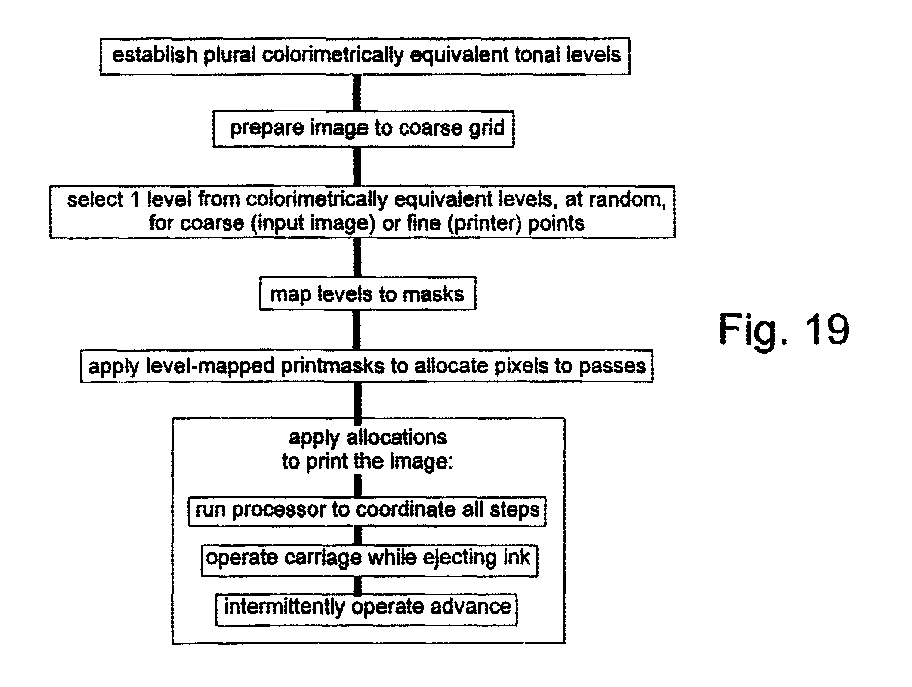
(57) Apparatus and method define colorimetrically equivalent printmasks (228), and from
among those select masks (225) for use. Ordinarily, nonvolatile memory holds operating
instructions (Fig. 19). A print stage (16, 18, 24, 51-55, 62-64) applies selected
masks to control marking on a print medium (61). Typically this stage has a case;
a reciprocating pen carriage (17); an advance mechanism (62-64) for orthogonal relative
motion of medium and carriage; and one or more pens (18) on the carriage making multiple
passes across each pixel, to eject ink (54) and so form the marks (Figs. 1, 3, 4).
One or more digital processors (72, 272, 372, 472) coordinate operation. Preferably
an image-processing stage (73, 273, 373, 473) assigns inking spatially among pixels;
each mask (228 etc.) assigns the spatially assigned inking among print passes. Preferably,
selected masks (87, 225 etc.) are used, for successive pixels, in randomized sequence
(Fig. 6, lower sequence; Fig. 11, lower two). Preferably each mask covers a small
fraction of the image, preferably well under six millimeters (one-quarter inch) in
both width and height. Preferably the image is defined as an array of input colorimetric
levels (Levels 0-3, Figs. 5, 7; Levels 0-4, Fig. 11); each level may be selectably
mapped (330) to any one of colorimetrically equivalent masks (328). Preferably colorimetrically
equivalent levels (308; Levels 2A, 2B in Fig. 6; Levels 2-6, Fig. 11) are defined,
and then assigned (through a substantially randomized procedure) independently to
particular masks. Preferably the image is prepared using a pixel grid (71) coarser
than the available printer resolution, and the plural colorimetrically equivalent
masks constructed by varying allocation (222, 226; 302, 316) of printer passes in
the coarser grid.
|
|
