|
(11) | EP 1 008 620 B2 |

| (12) | NEW EUROPEAN PATENT SPECIFICATION |
| After opposition procedure |
|
|
| (54) |
Chemically embossed metallocene polyethylene foam Chemisch geprägter Schaum aus metallocenkatalysiertem Polyethylen Mousse en polyéthylène préparé à partir de métallocène gaufré chimiquement |
|
|
|||||||||||||||||||||||||||||||
FIELD OF THE INVENTION
[0001] This invention relates to making a chemically embossed metallocene polyethylene (MPE) foam using a highly co-activated blowing agent of azodicarbonamide and an alkyl functionalized triazole derivative as an inhibitor. The alkylamino group of this liquid azole makes it readily dissolvable in non-polar inks which gives good adhesion to MPE surfaces. The compatibility of the hydrocarbon structure also increases permeation of the inhibitor into the polyethylene composition. The initial effort showed normally activated azodicarbonamides were not able to blow MPE. Use of a highly co-activated azodicarbonamide and a liquid azole compound in the present invention yield an unusually excellent textured MPE foam.
BACKGROUND OF THE INVENTION
[0002] Sheets of cellular resinous composition have been widely used as decorative surface coverings. It is well known to those skilled in the art that foamed polymer sheets may be textured by the process commonly referred to as "chemical embossing". Such chemical embossing techniques have normally involved coating/calendering a base material, such as a paper felt with a foamable polymer layer. A chemical blowing agent is normally uniformly dispersed in the foamable layer and is adapted, upon subsequent heating to a sufficiently elevated temperature, to decompose and to liberate gaseous decomposition products to expand and create the foamed product. For chemically embossed sheets, the surface of a foamable polymer is printed with an ink composition containing an agent which inhibits foaming in the printed areas when the foamable polymer composition is subsequently subjected to a heat treatment. The areas which have not been printed over thus expand normally on heating while expansion in the printed areas containing the inhibitor is suppressed, resulting in a textured surface with depressions in those areas printed with the inhibiting ink.
[0003] The most frequently used polymers in the preparation of resilient sheet flooring are polyvinyl chloride (PVC) and vinyl chloride copolymers. US-A-4407882 disclosed PVC based compositions and printing inks comprising benzotriazole derivatives. Each layer in a composite sheet structure provides unique functions for an overall performance. A foamable layer made of PVC has certain disadvantages such as poor strength and low elastic recovery, and there is accordingly need for an alternate foamable layer. It has now been found that a particular class of polyethylene-metallocene polyethylene (single site catalyst-based polyolefin resin) can provide excellent features for a foamable layer for flooring. It would be desirable to provide an economical way to produce an embossed MPE foam layer for commercial production.
[0004] The structure of cellular gas-filled polymers can be formed either by foaming a polymer system, by introducing gas-filled microspheres (microballons) into a system, or by extracting material by a post-treatment, resulting in the formation of cells or pores. The method of foaming is the one most generally employed for making polymers with a cellular structure. Based on the mechanism by which gas is liberated, the compounds used for foaming polymers may be classified as chemical and physical blowing agents. Chemical blowing agents (CBA) are individual solid compounds or mixtures of solid compounds that liberate gas as a result of chemical reactions, including thermal decomposition, or as a result of chemical reactions of chemical blowing agents. Physical blowing agents are liquid compounds that gasify as a result of physical process (evaporation, desorption) at elevated temperatures or reduced pressures.
[0005] A chemically embossed foam utilizes a chemical blowing agent. The blowing agents which have found the most wide-spread use are those compounds having the >N-N< or -N=N- linkages which decompose at elevated temperature to yield an inert gas high in nitrogen. Hereinafter, such blowing agents shall be referred to as "nitrogen containing blowing agents". One example of a nitrogen containing blowing agent is azodicarbonamide (or "azo"). Nitrogen has a low permeability in polymers. Decomposition is a function of chemical activation, particle size and temperature. It is common practice to add accelerators into the compositions to accelerate the decomposition of the blowing agents, reduce the decomposition temperature and/or narrow the decomposition temperature range. Typical activators for azo blowing agents include acids, bases, metal organic salts, oxides, amines and urea, etc. EP-A-0702032 discloses foamable metalocene polyethtylene compositions comprising azodicarbonamide as a blowing agent and zinc stearate and zinc oxide as blowing agent activators.
[0006] One critical requirement to be taken into account when selecting a chemical blowing agent is that the temperature of decomposition of the CBA must be close to the melting point and the hardening temperature of polymer. It would be desirable to find a suitable blowing agent and activators for a metallocene polyethylene, which has a low melting/softening temperature around 60°C (lower than 100°C).
[0007] The inhibitor for the blowing agent is applied to one surface of the resinous polymer composition in any desired area. The inhibitor is preferably applied in a liquid carrier which allows better control of the concentration of inhibitor applied. The inhibitor composition is conveniently formulated in the manner of a printing ink. The effectiveness of inhibition depends on the permeability (solubility and diffusion) of the inhibitor in a printing ink to the foam substrate. Polyethylene is not permeable to many solids and liquid organic and inorganic materials.
[0008] A wide range of compounds have been claimed to act as inhibitors for chemical embossing foam of floor and wall covering surfaces. The choice of an inhibitor for the blowing agent will depend on the particular blowing agent utilized in the system. Triazole compounds such as benzotriazole (BTA) and tolyltriazole (TTA) are widely used in solvent-based inks for chemically embossing foam made by azo blowing agents. However, their use in non-polar inks which give good adhesion to polyethylene surfaces, is limited by a lack of solubility. Therefore, these widely used inhibitors are of limited utility in polyethylene systems. It would be desirable to provide an inhibitor which is soluble or compatible in a non-polar ink, and has a high penetration rate into polyethylene for producing chemical embossing foam of MPE.
SUMMARY OF THE INVENTION
[0009] According to the present invention, there is a surface covering according to claim 1. The chemical blowing agent is a highly co-activated blowing agent comprising a nitrogen containing blowing agent, preferably azodicarbonamide, and at least two activators. Activators comprise citric acid, oxalic acid, p-toluene sulfonic acid, phosphoric acid, potassium carbonate, borax, triethanol amine, zinc chloride, zinc acetate, zinc oxide, zinc stearate, barium stearate, calcium stearate, urea, and polyethylene glycol. The preferred co-activators for this invention are zinc oxide and urea. The compositions of the activators are generally from about 10% to 70% by weight of the azodicarbonamide, preferably from 20% to 50%, and more preferably from about 35% to 45%. Preferably, the co-activator has the composition ratio for co-activators of 2:1 to 1:2 when two activators are used, and most preferably about 1:1, although ratios of 10:1 to 1:10 can also be useful
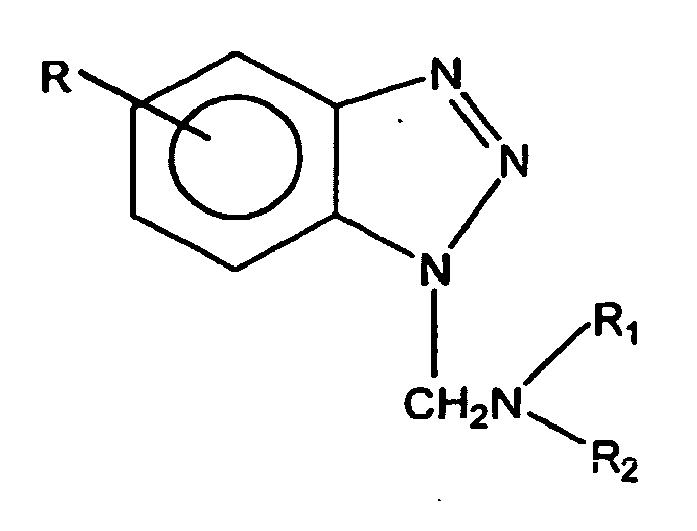
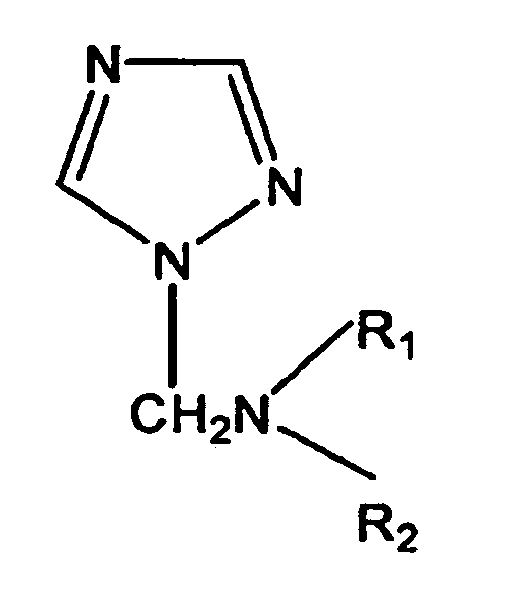
[0010] The inhibitor is a triazole compound of the formula:
or
where R can be hydrogen, one or more aliphatic moieties containing up to 20 carbon atoms, one or more cycloaliphatic moieties containing from 3 to 20 carbon atoms, or one or more aryl or substituted aryl groups containing from 6 to 30 carbon atoms and attached by a single bond to any or all of the atoms in the benzenoid ring moiety of the benzotriazole. R1 and R2 are the same or different and each can be an aliphatic moiety containing from 2 to 20 carbon atoms, a cycloaliphatic moiety containing from 3 to 20 carbon atoms or an aryl or substituted aryl moiety containing from 6 to 30 carbon atoms. Straight or branched alkylene radicals having 2 or 3 carbon atoms are preferred. Structures such as the above show excellent permeability into metallocene polyethylene.
[0011] A method of embossing a heat-foamable metallocene polyethylene material is by applying printing ink compositions| comprising blowing agent inhibitors to selected areas of the surface of a heat-foamable polymer containing a blowing agent, and the subsequently heating said material to above the decomposition temperature of the blowing agent.
[0012] It is thought that the embossing effect is caused by a reaction taking place between the inhibitor and the blowing agent/activator complex. The blowing agent/activator has a decomposition temperature below the blowing agent itself. The inhibitor reaction with the blowing agent/activator complex causes the decomposition temperature to increase and therefore areas treated with an effective inhibitor do not experience the same evolution of gas as those areas not treated with an inhibitor if the temperature is properly controlled. It is believed that the effectiveness of inhibition in flexible vinyl foams is associated with solubility or diffusibility in the foamable composition. Furthermore, it is believed that this solubility could be due largely to the presence of plasticizer in the composition. A further object of this invention is to provide a good inhibition effect without any plasticizer in the composition.
DETAILED DESCRIPTION OF THE INVENTION
[0013] This invention provides a method to make a chemically embossed metallocene polyethylene foam sheet suitable for floor coverings. These elastic, substantially linear ethylenic polymers have unusual properties, including an unusual combination of properties, which leads to enhanced processability of the novel polymers. The metallocene ethylenic polymers have processability similar to highly branched low density polyethylene, but the strength and toughness is similar to linear low density polyethylene. Another feature of the polyethylene resins used in the present invention is that they do not require the use of a plasticizer thereby significantly reducing environmental problems caused by the migration of liquid plasticizers out of the material and/or loss of property associated with the use of plasticizers.
[0014] A single site catalyst-based polyethylene for the present invention is generally produced by polymerization of ethylene monomers in the presence of particular single sited catalysts which restrict the progress of the polymerization and are known as metallocenes. The metallocene polymers have a relatively narrow molecular weight distribution (MWD) and a small amount of long chain branching. The metallocene polyethylene comprising ethylene homopolymers or a copolymer of ethylene with at least one C3 to C20 alpha-alkene comonomer are especially preferred. Suitable comonomers include 1-propene, isobutylene, 1-butene, 1-hexene, 4-methyl-pentene, 1-octene, styrene, and halo- or alkyl substituted styrenes. Other properties of metallocene polyethylenes include: a) a density preferably from about 0.85 grams/cubic centimeter (g/cm3) to about 0.97 g/cm3; b) a melt index, I2, from about 0.01 grams/10 minutes to about 1000 grams/10 minutes, preferably from about 0.1 grams/10 minutes to 100 grams/10 minutes, and especially preferably from 0.5 grams/10 minutes to 10 grams/10 minutes; c) preferably a melt flow ratio, I10/I2, from 7 to about 20; and d) a molecular weight distribution (Mw/Mn) preferably about 3.5 or less, more preferably form about 1.5 to about 2.5, and most preferably from about 1.7 to about 2.3.
[0015] Throughout this disclosure, "melt index" or "I2" is measured in accordance with ASTM D-1238 (190°C/2.16 kg); "I10" is measured in accordance with ASTM D-1238 (190°C/10 kg).
[0016] Excellent teachings of processes for making polyethylene foam are reported in C. P. Park, "Polyolefin Foam", Chapter 9, Handbook of Polymer foams and Technology, edited by D. Klempner and K. C. Frisch, Hanser Publishers, Munich, Vienna, New York, Barcelona (1991), which are incorporated herein by reference.
[0017] The foam material of the invention may be prepared by melt blending a metallocene ethylenic polymer material and a decomposable chemical blowing agent in an intensive mixer such as a Banbury mixer or an extruder, to form a foamable compound. The chemical blowing agent is preferably dry-blended with the polymer material prior to heating the polymer material to a melt form, but may also be added when the polymer material is compounded.
[0018] Cross-linking may be induced by addition of a cross-linking agent or by radiation. Induction of cross-linking and exposure to an elevated temperature to effect foaming or expansion may occur simultaneously or sequentially. If a cross-linking agent is used, it is preferably incorporated into the polymer material in the same manner as the chemical blowing agent. Further, if a cross-linking agent is used, the foamable melt polymer material is processed at a temperature of preferably less than 150°C to prevent decomposition of the cross-linking agent or the blowing agent and to prevent premature cross-linking. The compounded material is conveyed to a mill or calender to form a foamable sheet which is then cross-linked and expanded to an elevated temperature of 150-220°C such as in an oven to form the foam sheet. If radiation cross-linking is used, the foamable sheet is irradiated to cross-link the polymer material and then expanded at the high temperature as described above. Other ingredients in the present foam compositions include fillers/extenders, pigments, heat and light stabilizers, lubricants, etc.
[0019] Blowing agents useful in making the present foam sheet include decomposable chemical blowing agents. Such chemical blowing agents decompose at elevated temperatures to form gases or vapors to blow the polymer into cellular foam. Chemical blowing agents include azodicarbonamide, azodiisobutyro-nitrile, benzenesulfonhydrazide, p, p'-oxybis(benzene sulfonyl hydrazide), and p-toluene sulfonyl hydrazide. A highly co-activated azodicarbonamide is preferred to produce chemically embossed foam of metallocene polyethylene. The preferred co-activators for this invention are zinc oxide and urea. The compositions of the activators are generally from about 10% to 70% by weight of the azodicarbonamide, preferably from 20% to 50% and most preferably from about 35% to 45%. Preferably, the co-activator has the composition ratio for the co-activators of 2:1 to 1:2 when two activators are used, more preferably about 1:1, although ratios of 10:1 to 1:10 can also be useful.
[0020] Cross-linking agents useful in making the present foam sheet are the organic peroxides. Useful organic peroxides cross-linking agents include dicumyl peroxide, 1,1-di-(tert-butylperoxy)-3,3,5-trimethylcyclohexane, butyl 4,4-di-(tert-butylperoxy) valerate, 2,5-Dimethyl-2,5-di-(tert-butylperoxy)hexane-3 and 2,5-Dimethyl-2,5-di-(tert-butylperoxy)hexane. Dicumyl peroxide is the preferred agent.
[0021] Those skilled in the art will recognize that a very wide range of printing ink compositions exist with varying combinations of resin binders, pigments, inhibitors and viscosity-control additives. The pigments are optional, since it may be desirable to use a colorless, inhibitor containing printing ink.
[0022] The following examples are set forth to illustrate the preparation and advantages of metallocene polyethylene foam sheets, the preparation of printing ink formulations, and demonstration of the foaming and chemical embossing behavior of the claimed compounds. The examples should not be construed to limit the scope of the invention. Unless otherwise indicated, all parts and percentages given in the Examples are on a weight basis.
[0023] Comparative Examples 1 and 2 demonstrate normally activated azodicarbonamides were not able to blow MPE.
COMPARATIVE EXAMPLE 1
[0025] A foamable metallocene polyethylene sheet was formulated by mixing the following ingredients on a two-roll mill at the roll temperatures of 95-105°C:
| Ingredients | Parts |
| MPE Resin, melt index of 0.5, density of 0.8680 g/cm3 | 100 |
| Calcium Carbonate | 30 |
| Titanium Dioxide | 5 |
| 1,1 -Di-(tert-Butylperoxy)-3,3,5-Trimethylcyclohexane | 0.4 |
| Azodicarbonamide | 2 |
| Zinc Oxide | 0.7 |
| Lubricant | 2 |
COMPARATIVE EXAMPLE 2
[0026] A foamable metallocene polyethylene sheet was formulated by mixing the following ingredients on a two-roll mill at the roll temperatures of 95-105 °C:
| Ingredients | Parts |
| MPE Resin, melt index of 5, Density of 0.8799 g/cm3 | 100 |
| Calcium Carbonate | 35 |
| Titanium Dioxide | 10 |
| Dicumyl peroxide | 0.5 |
| Azodicarbonamide | 2 |
| Zinc Oxide | 1.1 |
| Glycerol Mono Stearate Lubricant | 2 |
EXAMPLE 1
[0027] A foamable metallocene polyethylene sheet was formulated by mixing the following ingredients on a two-roll mill at the roll temperatures of 95-105 °C:
| Ingredients | Parts |
| MPE Resin, melt index of 5, density of 0.8700 g/cm3 | 80 |
| EVA | 20 |
| Calcium Carbonate | 35 |
| Titanium Dioxide | 7.5 |
| 1,1-Di-(tert-Butylperoxy)-3,3,5-Trimethylcyclohexane | 0.8 |
| Highly Co-Activated Azodicarbonamide | 2.5 |
| Zinc Stearate Lubricant (and Activator) | 0.75 |
EXAMPLE 2
[0028] A foamable metallocene polyethylene sheet was formulated by mixing the following ingredients on a two-roll mill at the roll temperatures of95-105°C:
| Ingredients | Parts |
| MPE Resin, melt index of 5, density of 0.8700 g/cm3 | 100 |
| Calcium Carbonate | 35 |
| Titanium Dioxide | 7.5 |
| 1,1-Di-(tert-Butylperoxy)-3,3,5-Trimethylcyclohexane | 0.8 |
| Highly Co-Activated Azodicarbonamide | 2.5 |
| Zinc Oxide | 0.6 |
| Zinc Stearate Lubricant (and Activator) | 0.75 |
[0029] This foamable sheet was heated at 175 °C in an oven for 1.9 minutes. The same highly co-activated azodicarbonamide was used as in Example 1. An expansion of the sheet thickness of 3 times was observed.
EXAMPLE 3
[0030] A foamable metallocene polyethylene sheet was formulated by mixing the following ingredients on a two-roll mill at the roll temperatures of 95-105 °C:
| Ingredients | Parts |
| MPE Resin, melt index of 5, density of 0.8700 g/cm3 | 100 |
| Calcium Carbonate | 35 |
| Titanium Dioxide | 7.5 |
| 1.1-Di-(tert-Butylperoxy)-3,3,5-Trimethylcyclohexane | 0.8 |
| Highly Co-Activated Azodicarbonamide | 2.5 |
| Zinc Oxide | 0.5 |
| Zinc Stearate Lubricant (and Activator) | 0.75 |
[0031] This foamable sheet was heated at 175 °C in an oven for 1.9 minutes. The same highly co-activated azodicarbonamide was used as in Example 1. An expansion of the sheet thickness of 2.5 times was observed.
EXAMPLE 4
[0032] A foamable metallocene polyethylene sheet was formulated by mixing the following ingredients on a two-roll mill at the roll temperatures of 95-105°C:
| Ingredients | Parts |
| MPE Resin, melt index of 5, density of 0.8700 g/cm3 | 80 |
| EVA copolymer | 20 |
| Calcium Carbonate | 35 |
| Titanium Dioxide | 7.5 |
| 1,1-Di-(tert-Butylperoxy)-3,3,5-Trimethylcyclohexane | 0.8 |
| Highly Co-Activated Azodicarbonamide | 2.5 |
| Zinc Oxide | 0.75 |
| Zinc Stearate Lubricant (and Activator) | 0.75 |
[0033] The highly co-activated azodicarbonamide is 70% azodicarbonamide by weight and 30% of co-activators. The co-activators are believed to be zinc oxide and a compound other than urea. The average diameter of the highly co-activated azodicarbonamide package was about 4.2 microns as measured with a laser (about 2 or 3 microns using the Fisher measurement). The azo and co-activators were compounded (ground) together. The blowing temperature of this highly co-activated azodicarbonamide package was 175°C to 220°C. This foamable sheet was heated at 180°C in a hot air oven for 3 minutes. Some foaming was observed.
[0034] Comparative Examples 3 to 7 and Examples 5 to 8 are typical inhibitor ink compositions prepared by stirring all the ingredients together.
COMPARATIVE EXAMPLE 3
[0035]
| Ingredients | Parts |
| Naphtha (non-polar) solvent based ink | 80 |
| Benzotriazole Inhibitor | 20 |
COMPARATIVE EXAMPLE 4
COMPARATIVE EXAMPLE 5
[0038] The cyclohexyltriazole inhibitor was a mixture of 85% cyclohexyltriazole, 5% tolyltriazole, and 10% water.
EXAMPLE 5
[0039]
| Ingredients | Parts |
| Naphtha (non-polar) solvent based ink | 80 |
| Tolyltriazole Derivative Inhibitor | 20 |
[0040] The tolyltriazole derivative inhibitor was a liquid inhibitor of N, N-bis(2-ethylhexyl)-ar-methyl-1H-benzotriazole-1-methanamine.
EXAMPLE 6
[0042] The triazole derivative inhibitor was a liquid inhibitor of N, N-bis(2-ethylhexyl)-1H-1,2,4-triazole-1-methanamine.
COMPARATIVE EXAMPLE 6
[0043]
| Ingredients | Parts |
| Naphtha (non-polar) solvent based ink | 80 |
| Water Soluble Tolyltriazole Derivative Inhibitor | 20 |
[0044] The water soluble tolyltriazole derivative inhibitor was a liquid mixture of water and 2,2'-[[(Methyl-1H-benzotriazole-1-yl)methyl]mono]bisethanol.
COMPARATIVE EXAMPLE 7
COMPARATIVE EXAMPLE 8
EXAMPLES 7 and 8 and COMPARATIVE EXAMPLES 9-13
Printing of Inks and Resultant Embossing
[0047] The 10-mil foamable metallocene polyethylene sheets of Examples 2 and 3 were calendered on a release paper. The inks prepared in Examples 7 and 8 and Comparative Examples 9-13 were printed on these foamable substrates using a flat-bed gravure proof press. The inks printed and dried satisfactorily without any tack.
[0048] The printed samples were coated with 10 mils of a clear plastisol and heated at a temperature of 175°C for 1.9 minutes in a hot air Wemer Mathis oven to expand the 10-mil layer to about 22 mils. The clear plastisol formulation was 100 parts PVC resin, 40 parts plasticizers, 4 parts heat stabilizers and 4 parts mineral spirits viscosity modifier.
[0049] The thickness of the printed inhibited area was measured in mils and compared to the thickness of the unprinted expanded surrounding areas. This difference is reported as the depth of chemical embossing and is shown in Table I.
Table I
| Example | Printed foam sheets | Inhibitor Ink Example | Chemical Embossing Depth in mils | Adhesion to MPE Foamable Layer |
| Comp 9 | Example 3 | Comp 4 | 0 | Good |
| Comp 10 | Example 2 | Comp 5 | 0 | Good |
| 7 | Examples 2, 3 | 5 | 9.8 | Good |
| 8 | Example 3 | 6 | 9 | Good |
| Comp 11 | Example 3 | Comp 6 | 0 | Good |
| Comp 12 | Example 3 | Comp 7 | 9.3 | None |
| Comp 13 | Example 3 | Comp 8 | 7.0 | None |
[0050] No adhesion was shown between the inhibitor ink and MPE foamable layer in Comparative Examples 12 and 13. Chemical embossing was shown in the metallocene polyethylene foam when alkyl functionalized triazole derivatives were used as inhibitors in Examples 7 and 8 and Comparative Examples 12 and 13. These liquid triazole compounds have the advantage that they can be more easily incorporated in printing ink compositions. They have better compatibility with polyethylene resins, and they have high permeability into the MPE foam layer.
[0051] Other triazole compounds, such as 1H-benzotriazole-1-methanol, 1-N,N-di(cyclohexyl triazole methyl) aminopoly (ethylene-propylene) oxide, N-(1H-benzotriazole-1-ylmethyl) formanide, 2-(2H-benzotriazole-2-yl)-4,6-di-tert-pentylphenol, 2-(2H-benzotriazole-2-yl)-4-(1,1,3,3-tertra-methylbutyl) phenol, 1H-benzotriazole-1-ylmethyl isocyanide, were also evaluated as inhibitors. None showed inhibition.
1. A surface covering comprising a foamable resin composition, the foamable resin composition
comprising a metallocene polyethylene, a nitrogen-containing blowing agent, two blowing
agent activators and a blowing agent inhibitor, the inhibitor being a compound having
the general formula
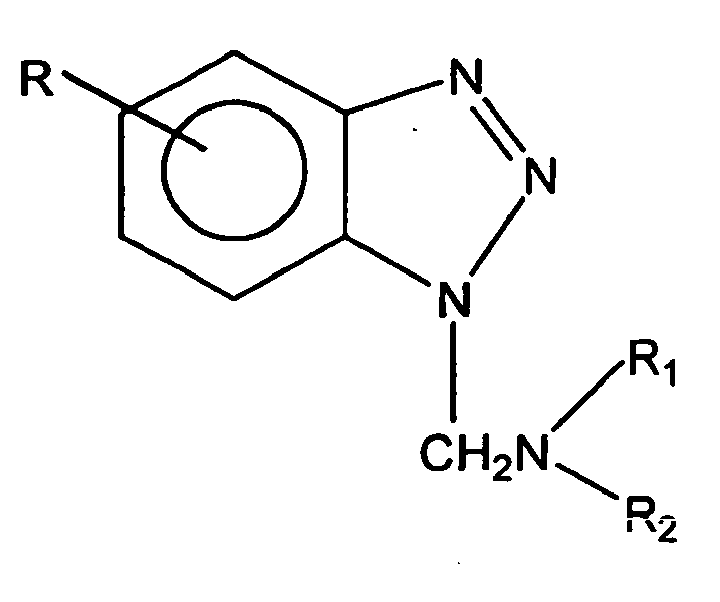
or
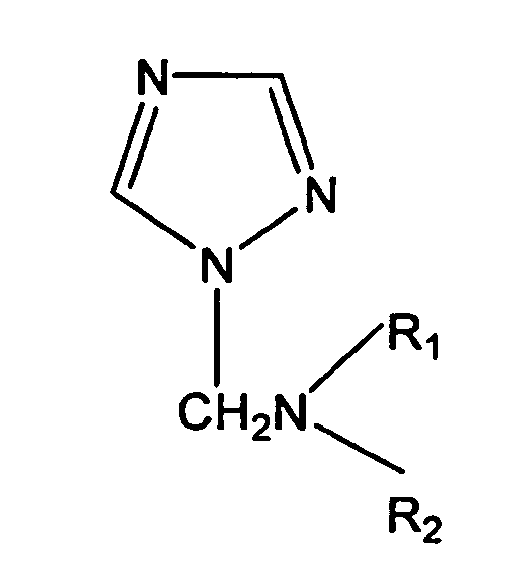
wherein R is hydrogen, one or more aliphatic moieties containing up to 20 carbon atoms, one or more cycloaliphatic moieties containing from 3 to 20 carbon atoms, or one or more aryl or substituted aryl groups containing from 6 to 30 carbon atoms, R1 and R2 are the same or different and each is an aliphatic moiety containing from 2 to 20 carbon atoms, a cycloaliphatic moiety containing from 3 to 20 carbon atoms or an aryl or substituted aryl moiety containing from 6 to 30 atoms, wherein the foamable resin has been blown and a portion of the blowing agent has been inhibited.
or
wherein R is hydrogen, one or more aliphatic moieties containing up to 20 carbon atoms, one or more cycloaliphatic moieties containing from 3 to 20 carbon atoms, or one or more aryl or substituted aryl groups containing from 6 to 30 carbon atoms, R1 and R2 are the same or different and each is an aliphatic moiety containing from 2 to 20 carbon atoms, a cycloaliphatic moiety containing from 3 to 20 carbon atoms or an aryl or substituted aryl moiety containing from 6 to 30 atoms, wherein the foamable resin has been blown and a portion of the blowing agent has been inhibited.
2. The surface covering of claim 1, wherein the nitrogen-containing blowing agent is
azodicarbonamide.
3. The surface covering as claimed in either claim 1 or claim 2, wherein the blowing
agent activators are selected from citric acid, oxalic acid, p-toluene sulfonic acid,
phosphoric acid, potassium carbonate, borax, triethanol amine, zinc chloride, zinc
acetate, zinc oxide, zinc stearate, barium stearate, calcium stearate, urea and polyethylene
glycol.
4. The surface covering of any one of the preceding claims, wherein the two activators
are zinc oxide and urea.
5. The surface covering of any one of the preceding claims, wherein the blowing agent
and two blowing agent activators are compounded together, prior to being added to
the metallocene polyethylene.
6. The surface covering of any one of the preceding claims, wherein the blowing agent
and two blowing agent activators have a minimum blowing temperature of less than 185°C.
7. The surface covering of claim 6, wherein the minimum blowing temperature is of less
than 175°C.
8. The surface covering of any one of the preceding claims, wherein the blowing agent
activators comprise 10% to 70% by weight of the blowing agent.
9. The surface covering of any one of the preceding claims, wherein the composition ratio
of first activator to the second activator is 2:1 to 1:2 by weight.
10. The surface covering of claim 9, wherein the composition ratio of first activator
to the second activator is about 1:1 by weight.
1. Oberflächenbedeckung, die eine schäumbare Harzzusammensetzung umfasst, wobei die schäumbare
Harzzusammensetzung ein Metallocen-Polyethylen, ein stickstoffhaltiges Treibmittel,
zwei Treibmittelaktivatoren und einen Treibmittelinhibitor umfasst, wobei der Inhibitor
eine Verbindung mit der folgenden allgemeinen Formel ist:
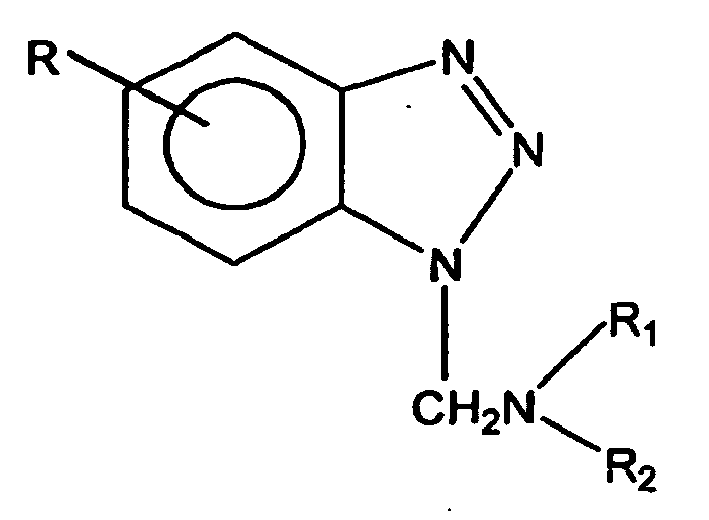
oder
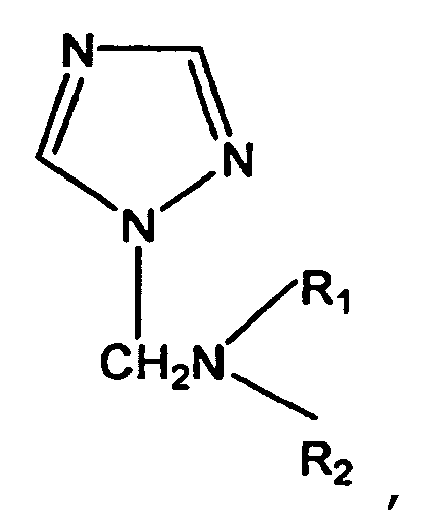
worin R Folgendes ist: Wasserstoff, eine oder mehrere aliphatische Einheiten, die bis zu 20 Kohlenstoffatome enthalten, eine oder mehrere cycloaliphatische Einheiten, die 3 bis 20 Kohlenstoffatome enthalten, oder eine oder mehrere Aryl- oder substituierte Arylgruppen, die 6 bis 30 Kohlenstoffatome enthalten, R1 und R2 gleich oder verschieden sind und jeweils Folgendes sind: eine aliphatische Einheit, die 2 bis 20 Kohlenstoffatome enthält, eine cycloaliphatische Einheit, die 3 bis 20 Kohlenstoffatome enthält, oder eine Aryl- oder substituierte Aryleinheit, die 6 bis 30 Atome enthält, worin das schäumbare Harz aufgetrieben wurde und ein Teil des Treibmittels inhibiert wurde.
oder
worin R Folgendes ist: Wasserstoff, eine oder mehrere aliphatische Einheiten, die bis zu 20 Kohlenstoffatome enthalten, eine oder mehrere cycloaliphatische Einheiten, die 3 bis 20 Kohlenstoffatome enthalten, oder eine oder mehrere Aryl- oder substituierte Arylgruppen, die 6 bis 30 Kohlenstoffatome enthalten, R1 und R2 gleich oder verschieden sind und jeweils Folgendes sind: eine aliphatische Einheit, die 2 bis 20 Kohlenstoffatome enthält, eine cycloaliphatische Einheit, die 3 bis 20 Kohlenstoffatome enthält, oder eine Aryl- oder substituierte Aryleinheit, die 6 bis 30 Atome enthält, worin das schäumbare Harz aufgetrieben wurde und ein Teil des Treibmittels inhibiert wurde.
2. Oberflächenbedeckung nach Anspruch 1, worin das stickstoffhaltige Treibmittel Azodicarbonamid
ist.
3. Oberflächenbedeckung nach Anspruch 1 oder Anspruch 2, worin die Treibmittelaktivatoren
aus Folgenden ausgewählt sind: Citronensäure, Oxalsäure, p-Toluolsulfonsäure, Phosphorsäure,
Kaliumcarbonat, Borax, Triethanolamin, Zinkchlorid, Zinkacetat, Zinkoxid, Zinkstearat,
Bariumstearat, Calciumstearat, Harnstoff und Polyethylenglycol.
4. Oberflächenbedeckung nach einem der vorstehenden Ansprüche, worin die zwei Aktivatoren
Zinkoxid und Harnstoff sind.
5. Oberflächenbedeckung nach einem der vorstehenden Ansprüche, worin das Treibmittel
und die zwei Treibmittelaktivatoren miteinander vermischt werden, bevor sie zu dem
Metallocen-Polyethylen gegeben werden.
6. Oberflächenbedeckung nach einem der vorstehenden Ansprüche, worin das Treibmittel
und die zwei Treibmittelaktivatoren eine minimale Treibtemperatur von weniger als
185°C aufweisen.
7. Oberflächenbedeckung nach Anspruch 6, worin die minimale Treibtemperatur weniger als
175°C beträgt.
8. Oberflächenbedeckung nach einem der vorstehenden Ansprüche, worin die Treibmittelaktivatoren
10 Gew.-% bis 70 Gew.-% des Treibmittels umfassen.
9. Oberflächenbedeckung nach einem der vorstehenden Ansprüche, worin das Zusammensetzungsverhältnis
des ersten Aktivators zum zweiten Aktivator, bezogen auf das Gewicht, 2 : 1 bis 1
: 2 beträgt.
10. Oberflächenbedeckung nach Anspruch 9, worin das Zusammensetzungsverhältnis des ersten
Aktivators zum zweiten Aktivator, bezogen auf das Gewicht, etwa 1 : 1 beträgt.
1. Revêtement pour surface comprenant une composition de résine pouvant former une mousse,
la composition de résine pouvant former une mousse comprenant un polyéthylène métallocène,
un agent d'expansion contenant de l'azote, deux activateurs d'agent d'expansion et
un inhibiteur d'agent d'expansion, l'inhibiteur étant un composé ayant la formule
générale
ou
dans lesquelles R est hydrogène, une ou plusieurs fractions aliphatiques contenant jusqu'à 20 atomes de carbone, une ou plusieurs fractions cycloaliphatiques contenant de 3 à 20 atomes de carbone, ou un ou plusieurs groupes aryles ou aryles substitués contenant de 6 à 30 atomes de carbone, R1 et R2 sont identiques ou différents et chacun est une fraction aliphatique contenant de 2 à 20 atomes de carbone, une fraction cycloaliphatique contenant de 3 à 20 atomes de carbone ou une fraction aryle ou aryle substitué contenant de 6 à 30 atomes, dans lesquelles la résine pouvant former une mousse a été expansée et une portion de l'agent d'expansion a été inhibée.
ou
dans lesquelles R est hydrogène, une ou plusieurs fractions aliphatiques contenant jusqu'à 20 atomes de carbone, une ou plusieurs fractions cycloaliphatiques contenant de 3 à 20 atomes de carbone, ou un ou plusieurs groupes aryles ou aryles substitués contenant de 6 à 30 atomes de carbone, R1 et R2 sont identiques ou différents et chacun est une fraction aliphatique contenant de 2 à 20 atomes de carbone, une fraction cycloaliphatique contenant de 3 à 20 atomes de carbone ou une fraction aryle ou aryle substitué contenant de 6 à 30 atomes, dans lesquelles la résine pouvant former une mousse a été expansée et une portion de l'agent d'expansion a été inhibée.
2. Revêtement pour surface selon la revendication 1, dans lequel l'agent d'expansion
contenant de l'azote est de l'azodicarbonamide.
3. Revêtement pour surface selon soit la revendication 1, soit la revendication 2, dans
lequel les activateurs d'agent d'expansion sont sélectionnés parmi de l'acide citrique,
de l'acide oxalique, de l'acide p-toluènesulfonique, de l'acide phosphorique, du carbonate
de potassium, du borax, de la triéthanolamine, du chlorure de zinc, de l'acétate de
zinc, de l'oxyde de zinc, du stéarate de zinc, du stéarate de baryum, du stéarate
de calcium, de l'urée et du polyéthylèneglycol.
4. Revêtement pour surface selon l'une quelconque des revendications précédentes, dans
lequel les deux activateurs sont de l'oxyde de zinc et de l'urée.
5. Revêtement pour surface selon l'une quelconque des revendications précédentes, dans
lequel l'agent d'expansion et les deux activateurs d'agent d'expansion sont mélangés
ensemble, avant d'être ajoutés au polyéthylène de métallocène.
6. Revêtement pour surface selon l'une quelconque des revendications précédentes, dans
lequel l'agent d'expansion et les deux activateurs d'agent d'expansion ont une température
d'expansion minimum inférieure à 185° C.
7. Revêtement pour surface selon la revendication 6, dans lequel la température d'expansion
minimum est inférieure à 175° C.
8. Revêtement pour surface selon l'une quelconque des revendications précédentes, dans
lequel les activateurs d'agent d'expansion comprennent de 10 % à 70 % en poids de
l'agent d'expansion.
9. Revêtement pour surface selon l'une quelconque des revendications précédentes, dans
lequel le rapport de composition du premier activateur sur le deuxième activateur
est de 2 : 1 à 1 : 2 en poids.
10. Revêtement pour surface selon la revendication 9, dans lequel le rapport de composition
du premier activateur sur le deuxième activateur est d'environ 1 : 1 en poids.
REFERENCES CITED IN THE DESCRIPTION
This list of references cited by the applicant is for the reader's convenience only. It does not form part of the European patent document. Even though great care has been taken in compiling the references, errors or omissions cannot be excluded and the EPO disclaims all liability in this regard.
Patent documents cited in the description
Non-patent literature cited in the description
- Polyolefin FoamC. P. PARKHandbook of Polymer foams and TechnologyHanser Publishers19910000 [0016]