|
(11) | EP 1 013 571 B1 |

| (12) | EUROPEAN PATENT SPECIFICATION |
|
|
| (54) |
Magnetic curves with improved magnetic field for conveyors Magnetisches Kurvenstück mit verbessertem Magnetfeld für einen Förderer Segment magnétique avec champ magnétique amélioré pour un convoyeur |
|
|
|||||||||||||||||||||||||||||||
| Note: Within nine months from the publication of the mention of the grant of the European patent, any person may give notice to the European Patent Office of opposition to the European patent granted. Notice of opposition shall be filed in a written reasoned statement. It shall not be deemed to have been filed until the opposition fee has been paid. (Art. 99(1) European Patent Convention). |
[0001] The present invention relates to innovative curves and series of curves for conveyors, of the type having magnets fitted therein for keeping a conveyor chain in place.
[0002] Curves for chain transporting installations are known which are provided with pockets or cavities in which magnets identical with each other are fitted and to which said magnets are differently fastened along the whole extension of a guide. For example, curves have been proposed in which a plurality of cavities, spaced apart the same distance along the guide extension, are formed in the guide body and in each cavity an identical magnet is housed. Curves of this type are shown in European Patents EP 0 159 074 and EP 0 509 605, for example.
[0003] It has been found however that by adopting known solutions the conveyor travelling over a curve is subjected to wobbling, jerks and in general to variations in the pulling force that do not appear to be directly due to the mechanical features of the sliding surfaces alone.
[0004] In accordance with the present invention, this is to be ascribed to irregularities in the magnetic field caused by an inappropriate distribution of the magnets as proposed in known chains. It is also to take into consideration the fact that, in order to optimise production, full series of curves having different extensions, radii of curvature, etc. employ the same magnet size.
[0005] The general object of the present invention is to obviate the above mentioned drawbacks by providing magnetic curves having improved sliding features enabling a more satisfactory distribution of the magnetic field. It is a further object of the invention to obtain a satisfactory distribution of the field in curves of different extension and geometry with use of a limited number of different typologies of magnets, so as to standardise construction of curve series.
[0006] In view of the above objects, in accordance with the invention, a magnetic curve for chain conveyors has been devised which comprises at least one path of travel and holding grooves for a plurality of magnets, characterised in that in the extension direction of the curve the magnets of the magnet plurality are housed in a continuous groove associated with said path of travel and the plurality of magnets is divided at least into magnets of a first length and magnets of a second length different from the first length.
[0007] Still in accordance with the invention, accomplishment has been devised of a series of curves different in length, radius of curvature, number of paths of travel, each curve being made as above described, characterised in that said first and second lengths are the same for all curves of the series.
[0008] For better explaining the innovatory principles of the present invention and the advantages it offers over the known art, possible embodiments applying said innovative principles will be given hereinafter, by way of non-limiting example, with the aid of the accompanying drawings. In the drawings:
- Fig. 1 is a diagrammatic plan view of a curve made in accordance with the known art;
- Fig. 2 is a view of a curve similar to that in Fig. 1 but applying the innovative principles of the present invention;
- Fig. 3 is a comparative chart of the course of the magnetic field in the curves of Figs. 1 and 2;
- Figs. 4-6 are diagrammatic views of various curves in accordance with the invention;
- Fig. 7 is a diagrammatic section view of the curves in accordance with the invention.
[0009] According to the invention it has been found that in order to optimise the magnetic field along the curve extension, use of a plurality of magnets is required, which plurality is formed of at least two different magnet typologies, different from each other for a different extension in the sliding direction of the curve.
[0010] In other words, it has been found that, by using combinations of magnets at least of a first length and of a second length a distribution of the field can be achieved along the curve extension that makes chain sliding more uniform. In particular, the field can be made more uniform as compared with the field present in known curves. This is in particular possible in multi-path curves where the number of magnets used is maintained limited in spite of the high difference in length between the innermost and the outermost paths.
[0011] In accordance with the invention it has been found particularly advantageous, for achieving the intended purposes, that lengths Lm of the employed magnets should satisfy the relation:
wherein L is the longest magnet among all magnets present.
[0012] It has been found particularly advantageous for the magnets not to be spaced apart more than half their length from each other.
[0013] It has been also found advantageous that, by ideally dividing the whole curve into circular sectors being multiples of a preestablished angle, magnets of different length should be distributed in each sector in such a manner that they are not placed astride the division. It is therefore necessary to pass to a different combination of magnets of preestablished lengths for each change of radius of curvature that would involve the need for placing a magnet along the curve extension with infringement of the above rule. The following examples will make the above explanation more apparent. A particularly advantageous angle for circular sectors has been found to be included between 6.5° and 9°, being in particular about 7.5°.
[0014] With magnets in accordance with the invention optimisation of the field can be obtained with only two typologies of magnets for a high range of curves different from each other as regards length, radius of curvature, etc. This enables standardisation of the magnets for complete curve series.
[0015] With reference to Fig. 1, a curve of known art has been shown in which a body 10 has a sliding channel 11 under which individual pockets 12 are present that are spaced apart the same distance and each of which holds an identical magnet 13.
[0016] Shown in Fig. 2 is a curve similar in sizes to that in Fig. 1, but made in accordance with the present invention.
[0017] This curve comprises a body 110 defining a sliding channel 111, under which there is a continuous channel 112 for housing a plurality of magnets of a first length 113a and of a second length 113b according to the above described relation. As shown in Fig. 7, magnets are formed of a first magnet element 115 which is more internal to the curve and a second magnet element 116 which is more external to the curve, said magnets being mounted to the ends of a plate of ferromagnetic material 117 extending transversely of the path of travel and below it.
[0018] As viewed from Fig. 2, magnets do not fall on the circular sector divisions, although they fill sectors in a satisfactory manner. Advantageously, screws 114 for guide fastening can be disposed along the circular sector divisions, i.e. at a region devoid of magnets.
[0019] Shown in thicker chain line in Fig. 3 is the course along the curve of the field produced by the inner magnets and in thicker solid line the field of the outer magnets for the curve in Fig. 2. Shown in thinner chain and solid lines respectively are the corresponding courses for the curve in Fig. 1. The substantial uniformity of the field in the curve according to the invention as compared with the curve of the known art can be immediately verified.
[0020] It has been found that in order to have satisfactory features in the conveyor movement, oscillations of the field along the curve extension must be maintained at about +-50% maximum of the average value substantially along the whole curve extension. In the curve of the known art shown in Fig. 1 oscillations reach +-100%.
[0021] It is possible to see that, in particular in the solutions employing separate pockets for each magnet, the magnetic field distribution is unsatisfactory and cannot be improved.
[0022] Shown in Fig. 4 is another embodiment in accordance with the invention having a radius of curvature R750, instead of the radius of curvature R860 of Fig. 2. As can be seen, in the curve (shown for the sake of convenience with the upper sliding channel removed) the same typologies of magnets 113a and 113b are employed thereby obtaining an equally satisfactory distribution of the magnetic field.
[0023] Shown in Fig. 5 is a further embodiment in accordance with the invention, which has a reduced angular extension relative to the preceding embodiments. It can be immediately seen that in the curve in Fig. 5 (which for the sake of convenience is also shown with the upper sliding channel removed) the same typologies of magnets 113a and 113b are still used, in this case too an equally satisfactory distribution of the magnetic field being achieved.
[0024] A still further embodiment in accordance with the invention referred to a six-channel multi-path curve is shown in Fig. 6. As can be immediately seen, by still employing only two typologies of magnets 113a, 113b a satisfactory distribution for all the curve paths can be obtained.
[0025] At this point it is apparent that the intended purposes are achieved. The above described innovative curves can all belong to a single series of curves, different in length, radius of curvature, number of paths of travel, but all provided with the same two typologies of magnets.
[0026] Obviously, the above description of embodiments applying the innovative principles of the present invention is given for purposes of illustration only and therefore must not be considered as a limitation of the scope of the invention as herein claimed. For example, the number of paths, the angular and transverse extensions can vary depending on the specific requirements.
1. A magnetic curve for chain conveyors, comprising at least one path of travel and holding
grooves for a plurality of magnets (113a, 113b), characterised in that in the extension direction of the curve the magnets of the magnet plurality are housed
in a continuous groove (112) associated with said path of travel and the plurality
of magnets is divided at least into magnets of a first length (113a) and magnets of
a second length (113b) different from the first lenght.
2. A magnetic curve as claimed in claim 1, characterised in that the lengths Lm of the employed magnets satisfy the relation:
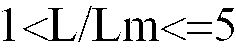
wherein L is the longest magnet among all magnets present in the magnet plurality.
wherein L is the longest magnet among all magnets present in the magnet plurality.
3. A magnetic curve as claimed in claim 1, characterised in that it comprises several paths of travel, each provided with an associated continuous
groove for holding magnets of said magnet plurality.
4. A magnetic curve as claimed in claim 1, characterised in that magnet distribution takes place in such a manner that, by ideally dividing the whole
curve into circular sectors being multiples of a preestablished angle, the magnets
of different length are distributed in each sector so that they do not fall astride
the division.
5. A magnetic curve as claimed in claim 3, characterised in that said angle is included between 6.5° and 9°, being in particular about 7.5°.
6. A magnetic curve as claimed in claim 1, characterised in that each magnet is formed of a pair of magnet elements mounted on two ends of a support
plate made of ferromagnetic material and extending transversely of the path of travel.
7. A magnetic curve as claimed in claim 1, characterised in that magnets are distributed along the curve extension to provide a field oscillation
not exceeding +-50% of the average value, substantially along the whole curve extension.
8. A magnetic curve as claimed in claim 1, characterised in that magnets are spaced apart no more than half their length from each other.
9. A series of curves different in length, radius of curvature, number of paths of travel,
each curve being made in accordance with claim 1, characterised in that said first and second lengths are the same for all curves of the series.
1. Magnetisches Kurvenstück für Kettenförderer mit mindestens einer Transportbahn und
Haltenuten für mehrere Magneten (113a, 113b) dadurch gekennzeichnet, daß die Magneten in Richtung der Kurvenausdehnung in einer kontinuierlichen Nut (112)
untergebracht sind, die zu der Transportbahn gehört, und die Magnete zumindest in
Magnete einer ersten Länge (113a) und Magnete einer zweiten Länge (113b) unterteilt
sind, die von der ersten Länge verschieden ist.
2. Magnetisches Kurvenstück nach Anspruch 1, dadurch gekennzeichnet, daß für die Längen Lm der eingesetzten Magnete die Beziehung:

gilt, wobei L der längste von allen Magneten ist.
gilt, wobei L der längste von allen Magneten ist.
3. Magnetisches Kurvenstück nach Anspruch 1, dadurch gekennzeichnet, daß es mehrere Transportbahnen umfaßt, wobei jede mit einer zugehörigen kontinuierlichen
Nut versehen ist, welche zur Halterung der Magnete dient.
4. Magnetisches Kurvenstück nach Anspruch 1, dadurch gekennzeichnet, daß die Magnete so verteilt sind, daß durch ideales Aufteilen des gesamten Kurvenstückes
in Kreissektoren, die Vielfache eines vorbestimmten Winkels bilden, die Magnete verschiedener
Länge in jedem Abschnitt so verteilt sind, daß sie nicht aus der Teilung herausfallen.
5. Magnetisches Kurvenstück nach Anspruch 3, dadurch gekennzeichnet, daß der Winkel zwischen 6,5° und 9°, insbesondere bei 7,5° liegt.
6. Magnetisches Kurvenstück nach Anspruch 1, dadurch gekennzeichnet, daß jeder Magnet als ein Paar Magnetelemente ausgebildet ist, die auf zwei Enden einer
Stützplatte montiert sind, welche aus ferromagnetischem Material besteht und sich
quer zur Transportbahn erstreckt.
7. Magnetisches Kurvenstück nach Anspruch 1, dadurch gekennzeichnet, daß Magnete entlang der Kurvenausdehnung verteilt sind, so daß eine Feldschwingung im
wesentlichen entlang der gesamten Kurvenausdehnung erzeugt wird, die nicht über ±
50% des Durchschnittswerts hinausreicht.
8. Magnetisches Kurvenstück nach Anspruch 1, dadurch gekennzeichnet, daß die Magnete einen Abstand voneinander haben, der nicht mehr als die Hälfte ihrer
Länge beträgt.
9. Folge von Kurvenstücken unterschiedlicher Längen, Kurvenradien und Transportbahnanzahlen,
wobei jedes Kurvenstück entsprechend Anspruch 1 ausgebildet ist, dadurch gekennzeichnet, daß die ersten und die zweiten Längen für alle Kurvenstücke gleich sind.
1. Segment courbe magnétique pour transporteurs à chaîne, comprenant au moins un chemin
de déplacement et des rainures de maintien pour une pluralité d'aimants (113a, 113b),
caractérisé en ce que, dans la direction d'extension du segment courbe, les aimants de la pluralité d'aimants
sont placés dans une rainure continue (112) associée audit chemin de déplacement,
et en ce que la pluralité d'aimants est divisée au moins en aimants d'une première longueur (113a)
et en aimants d'une deuxième longueur (113b) différente de la première longueur.
2. Segment courbe magnétique selon la revendication 1, caractérisé en ce que les longueurs Lm des aimants utilisés satisfont à la relation :

où L correspond à l'aimant le plus long parmi tous les aimants présents dans la pluralité d'aimants.
où L correspond à l'aimant le plus long parmi tous les aimants présents dans la pluralité d'aimants.
3. Segment courbe magnétique selon la revendication 1, caractérisé en ce qu'il comprend plusieurs chemins de déplacement, prévus chacun avec une rainure continue
associée pour le maintien des aimants de ladite pluralité d'aimants.
4. Segment courbe magnétique selon la revendication 1, caractérisé en ce que la répartition des aimants est choisie telle qu'en divisant idéalement la totalité
du segment courbe en secteurs circulaires multiples d'un angle prédéterminé, les aimants
de différentes longueurs sont répartis dans chaque secteur de telle sorte qu'ils ne
tombent pas à cheval sur la division.
5. Segment courbe magnétique selon la revendication 3, caractérisé en ce que ledit angle est compris entre 6,5° et 9°, étant en particulier voisin d'environ 7,5°.
6. Segment courbe magnétique selon la revendication 1, caractérisé en ce que chaque aimant est constitué d'une paire d'éléments d'aimant montés aux deux extrémités
d'une plaque support en matériau ferromagnétique, et s'étendant transversalement par
rapport au chemin de déplacement.
7. Segment courbe magnétique selon la revendication 1, caractérisé en ce que les aimants sont répartis le long de l'extension du segment courbe de manière à générer
une oscillation du champ ne dépassant pas ± 50 % de la valeur moyenne, sensiblement
le long de l'extension totale du segment courbe.
8. Segment courbe magnétique selon la revendication 1, caractérisé en ce que les aimants ne sont pas espacés les uns des autres de plus de la moitié de leur longueur.
9. Série de segments courbes différents en longueur, rayon de courbure, nombre de chemins
de déplacement, chaque segment courbe étant réalisé selon la revendication 1, caractérisée en ce que lesdites première et deuxième longueurs sont les mêmes pour tous les segments courbes
de la série.