| (19) |
 |
|
(11) |
EP 1 030 550 B1 |
| (12) |
EUROPEAN PATENT SPECIFICATION |
| (45) |
Mention of the grant of the patent: |
|
02.10.2002 Bulletin 2002/40 |
| (22) |
Date of filing: 09.11.1998 |
|
| (86) |
International application number: |
|
PCT/SE9802/016 |
| (87) |
International publication number: |
|
WO 9902/5180 (27.05.1999 Gazette 1999/21) |
|
| (54) |
AN ANIMAL STALL AND METHOD INCLUDING A GATE SENSOR MEANS
TIERSTALL UND VERFAHREN MIT TÜRSENSOR
STALLE POUR BETAIL
|
| (84) |
Designated Contracting States: |
|
AT BE CH CY DE DK ES FI FR GB GR IE IT LI LU MC NL PT SE |
| (30) |
Priority: |
14.11.1997 SE 9704175
|
| (43) |
Date of publication of application: |
|
30.08.2000 Bulletin 2000/35 |
| (73) |
Proprietor: DeLaval Holding AB |
|
147 21 Tumba (SE) |
|
| (72) |
Inventor: |
|
- NILSSON, Mats
S-145 64 Norsborg (SE)
|
| (74) |
Representative: Hammar, Ernst |
|
Albihns Stockholm AB,
Box 5581
114 85 Stockholm
114 85 Stockholm (SE) |
| (56) |
References cited: :
WO-A1-97/37528
NL-A- 9 000 845
US-A- 5 704 311
|
WO-A1-98/04120
US-A- 5 628 284
|
|
| |
|
|
- PATENT ABSTRACTS OF JAPAN; & JP 6343363 A (KUBOTA CORP) 20 December 1994.
- PATENT ABSTRACTS OF JAPAN; & JP 6225657 A (KUBOTA CORP) 16 August 1994.
|
|
| |
|
| Note: Within nine months from the publication of the mention of the grant of the European
patent, any person may give notice to the European Patent Office of opposition to
the European patent
granted. Notice of opposition shall be filed in a written reasoned statement. It shall
not be deemed to
have been filed until the opposition fee has been paid. (Art. 99(1) European Patent
Convention).
|
TECHNICAL FIELD OF THE INVENTION
[0001] The present invention relates to an animal stall according to the preamble of claim
1. It also relates to a method of performing an animal related operation in such an
animal stall.
[0002] An apparatus and a method of this kind is disclosed in EP-A-0 451 906.
BACKGROUND OF THE INVENTION
[0003] In order to efficiently perform milking of an animal, it is common to keep the animal
in a milking stall. Such milking stalls are accordingly used not only for manual milking
(manual attachment and detachment of teatcups) or semi-automatic milking (manual attachment
and automatic detachment of teatcups), but also for automatic milking (automatic attachment
and detachment of teatcups).
[0004] Different kinds of milking stalls for forcing an animal into a desired position in
the milking stall have been suggested. One of them is the above cited EP-A-0 451 906,
in which it is suggested to utilise the entrance gate of the stall to force a cow
into a desired position and to maintain i.a. the gate in contact with the cow for
maintaining her in said position. To this end, a locking device for the gate is provided.
After performed positioning of the cow, teatcups are attached to her teats by means
of a milking robot arm.
[0005] However, in case force is used on a cow (or any milking animal) while it enters the
milking stall, she may be reluctant to enter the stall the following times she is
to be milked, which may cause that the milking robot is not utilised as much as it
could be. Force used on the cow may also affect the milk yield, as a cow under stress
may not produce as much milk as it would, in case it felt comfortable.
[0006] It is thus the object of the invention to obtain an animal stall, that overcomes
these and other disadvantages.
SUMMARY OF THE INVENTION
[0007] This has been solved by an animal stall of the initially defined kind, which is characterised
by the characterising features of claim 1.
[0008] It has also been solved by a method of the initially defined kind, which is characterised
by the characterising features of claim 16.
[0009] Hereby is achieved a possibility to check whether the animal has correctly entered
the stall, i.e. that it has not become clamped by the entrance gate. Furthermore,
it is possible to check that the gate is working in a normal way.
[0010] Suitably, said control means is adapted to control a driving means adapted to perform
either of an opening movement and a closing movement. Hereby, it is possible to open
and close the gate as desired.
[0011] In case the gate has not been closed within a predetermined period of time, it may
be assumed that the cow has become clamped by the entrance gate. Accordingly, a first
timer means is adapted to measure a period of time from a defined starting point,
and wherein in case said sensor means has not sensed that said gate is closed within
a predetermined period of time, said driving means is controlled by said control means
to perform an opening movement of said gate. Hereby, the animal is let loose again,
so that it can either enter the stall properly, or leave the stall.
[0012] Preferably, said starting point is the point in time when the control means starts
controlling said driving means to perform a closing movement. Furthermore, an animal
presence sensor means associated with the control means is provided to for sense the
presence of an animal in the animal stall. Furthermore, said animal presence sensor
is associated with a second timer means for measuring the time lapsed from when the
presence of an animal has been sensed, said second timer means being adapted to generate
a signal to said control means after a predetermined period of time, said control
means being adapted to control said driving means to perform said closing movement
in response to said signal from said timing means. Hereby, simple starting indications
are given to the control means.
[0013] Suitably, said animal presence sensor comprises one of a photo cell, a laser sensor
and an ultrasonic sensor.
[0014] Preferably, said animal related means is adapted to perform said animal related operation
in response to said control means in case said entrance gate is closed. Hereby, a
starting signal for the animal related operation is given.
[0015] An animal may however stay in the position where it gets clamped e.g. because of
illness. There is accordingly a need for ending the repetition of the closing movement.
Thus, said control means is adapted to keep said gate open in case it has not been
possible to close it properly after a predetermined period of time. Alternatively,
or additionally, said control means is adapted to keep said gate open in case it has
not been possible to close it properly after a predetermined number of attempts.
[0016] Suitably, said animal related means is provided with a robot arm for performing said
animal related operation, said robot arm being associated with said control means.
[0017] Preferably, said robot arm is provided with a manipulating means for gripping an
animal related member.
[0018] Suitably, said animal related member is one of a teatcup and a teat cleaning unit.
[0019] Preferably said gate sensor means comprises a tactile sensing unit.
[0020] Suitably, said tactile sensing unit comprises a toggle switch
[0021] Preferably, said gate sensor means comprises a non-tactile sensing unit.
[0022] Suitably, said non-tactile sensing unit comprises one of an inductive sensor, a capacity
sensor and a laser sensor.
DRAWING SUMMARY
[0023] The invention will now be described in more detail with reference to the accompanying
drawings, in which
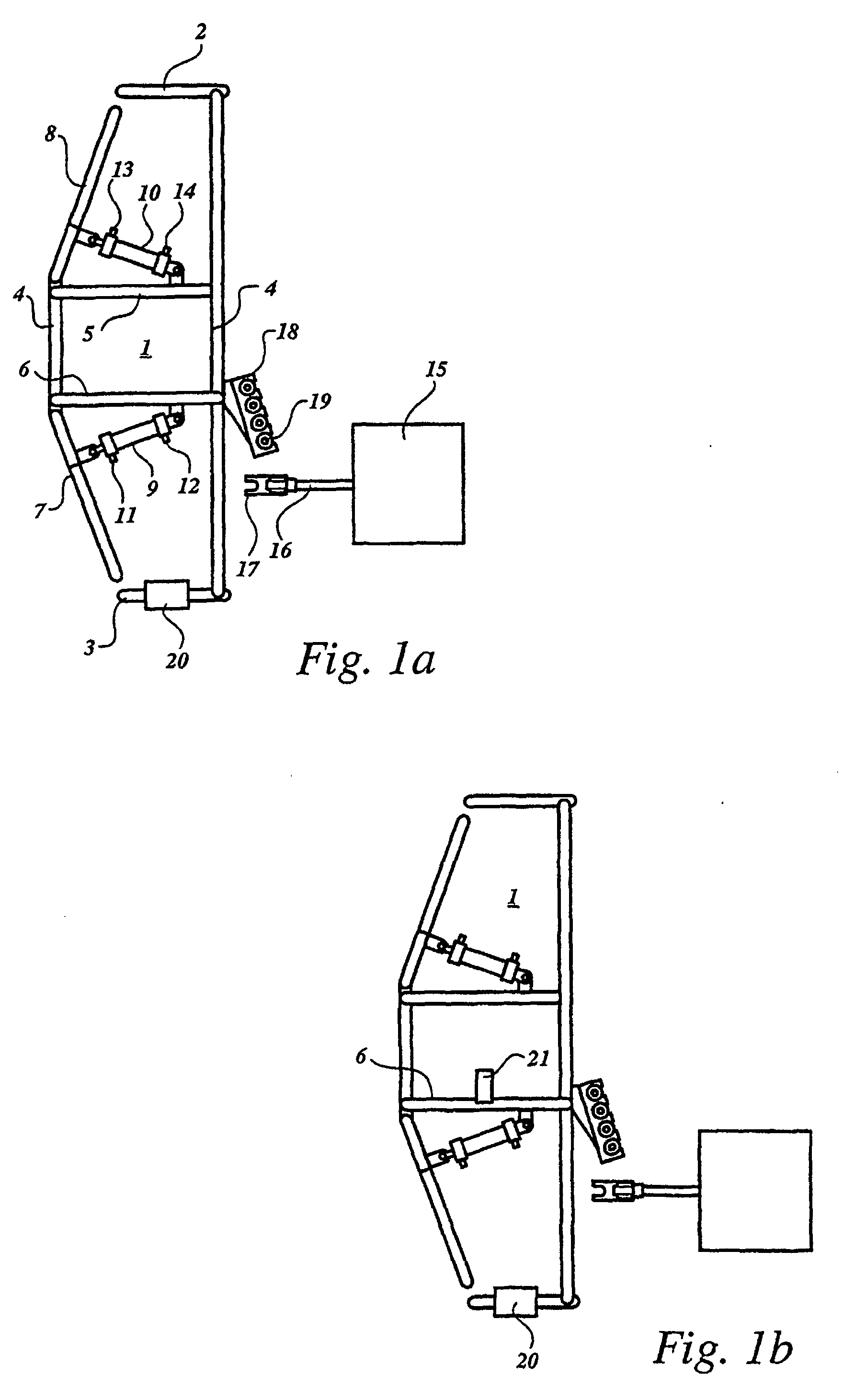
Figures 1a and 1b illustrate an animal stall,
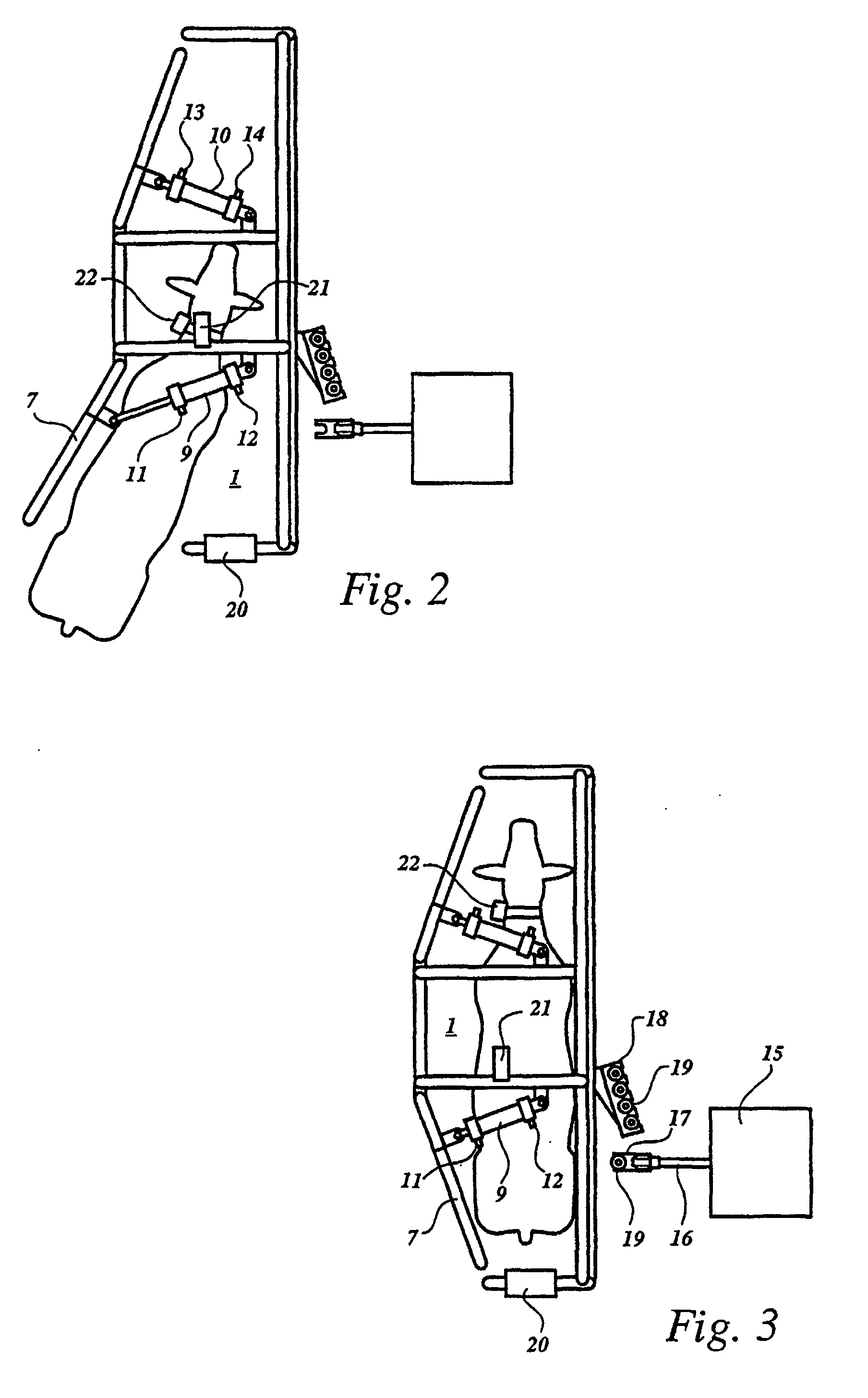
Figure 2 illustrates a cow entering the animal stall shown in figure 1b
Figure 3 illustrates a cow that has fully entered the animal stall shown in figure
1b.
DETAILED DESCRIPTION
[0024] Figure 1a shows a milking stall 1, comprising front, rear and side delimitations
2, 3, 4, in the form of e.g. bars. It further comprises a pair of overhead beams 5,
6 an entrance gate 7 and an exit gate 8. A driving means 9, interconnects the overhead
beam 6 and the stall gate. Furthermore, a driving means 10 interconnects the overhead
beam 5 with the exit gate 8. The driving means 9 and 10 may be in the form of a pneumatic
or hydraulic cylinder or an electric motor. The movement of the driving means 9 and
10, respectively, is controlled by a control means (not shown).
[0025] The driving means 9, 10 are each provided with end stop sensors 11, 12, 13 and 14,
for generating a signal whether the driving means is in a retracted state (sensors
and 12, 14), or in an extended state (sensors 11 and 13), and transmit said signal
to a control means (not shown). In figure 2, the cylinder 9 is shown in an extended
state, whereas the cylinder 10 is shown in a retracted state.
[0026] Figure 1a furthermore shows an apparatus 15 for performing an animal related operation,
such as milking. To this end, a robot arm 16 with a gripper 17 and a teatcup rack
18 with teatcups 19 are provided.
[0027] A transponder reader 20 is provided for identification purposes (see below).
[0028] Figure 1b illustrates the same stall as in figure 1a, but including an animal presence
sensor 21, in the form of a photo cell, a laser sensor or an ultrasonic sensor, arranged
on the overhead beam 6. The sensor 21 is directed towards the floor of the stall and
will generate a signal to be transmitted to a control means (not shown), when a part
of an animal is underneath the sensor 21.
[0029] Figure 2 shows a cow on its way to enter the animal stall 1. The entrance gate 7
is open, which is indicated by the sensor 11 of the cylinder 9. The exit gate is closed,
which is indicated by the sensor 14 of the cylinder 10.
[0030] The cow's head is underneath the animal sensor. Accordingly, the presence of the
cow in the animal stall is now indicated by the sensor 21.
[0031] The cow is provided with a transponder 22, which interacts with the transponder reader
20 connected to a control means (not shown). The control means determines whether
the cow is allowed to enter the animal stall 1.
[0032] In figure 3, the cow has completely entered the animal stall 1. The entrance gate
7 is closed, which is indicated by the sensor 12 of the cylinder 9.
OPERATION
[0033] An animal standing close to an animal stall 1 and wearing a transponder 22, will
be identified by the transponder reader 20. In case the animal is allowed to enter
the stall 1, the gate 7 is opened by operation of the cylinder 9. The sensor 11 indicates
when the gate is fully opened.
[0034] In the embodiment shown in figure 1a, the indication of sensor 11 is the starting
signal for when to start closing the gate 7. Accordingly, after a predetermined period
of time, which is measured by means of a timer - not shown, but preferably included
in the control means- and may be e.g. 10 seconds, the cylinder 9 starts closing the
gate 7 in response to a starting signal from the control means.
[0035] In the embodiment according to figure 1b, the gate will be opened in case an identified
animal is allowed to enter it. The sensor 11 may be used, as an indication of its
function, to indicate when the gate is fully opened, but is not needed as a starting
indicator.
[0036] Instead, the sensor 21 senses the presence of an animal in the stall. If the sensor
21 senses only intermittently that something, like an animal, is present, no indication
is given. However, if the sensor continuously senses the presence of e.g. an animal
in the stall for a predetermined time period, e.g. 4 seconds, the cylinder 9 is controlled
to start closing the gate 7. If, during closing of the gate, the sensor senses that
no animal is present in the stall, the gate is controlled to immediately re-open the
gate.
[0037] In the following, subsequent sequences will be described, which relate to the embodiment
according to figure 1a as well as to the embodiment according to figure 1b.
[0038] When the starting signal is sent to the cylinder 9, the timer is started again. If
the sensor 12 does not sense, within a predetermined period of time, e.g. 5 seconds,
that the gate is closed, there is a risk that
- the animal (or a person) has become clamped by the gate 7; or
- the gate 7 and/or the cylinder 9 and/or the sensors are not working properly; or
- the control means is out of order.
[0039] The gate 7 is opened again so that the animal is allowed to either move away from
the animal stall or to fully enter it.
[0040] After a predetermined period of time, the closing sequence of the gate 7 is started
again. If closing of the gate does not succeed, the gate is opened again.
[0041] If closing of the gate has not succeeded after e.g. three attempts, the gate 7 is
kept completely open. In addition, a signal may be sent by the control means to a
buzzer or the like worn by the dairy maid to immediately visit the animal stall.
[0042] However, if the sensor 12 does sense, within the predetermined period of time, that
the gate 7 is closed, an animal related operation is allowed to be started. The animal
related operation may be performed by the robot 15 and includes performance of e.g.
milking by means of a milking unit, cleaning of the teats by means of a teat cleaning
unit, or grooming by means of a brush.
[0043] It should be noted that the automatic opening and closing of a the entrance gate
is adaptable to the exit gate after performed animal related operation, or if the
cow should be let out of the animals stall for any other reason.
[0044] It should also be noted that the sensor 21 may be a tactile sensor, e.g. a pressure
sensitive sensor in the floor.
[0045] Furthermore, the indication that the gate is closed may be performed by sensing the
position of the gate by means of a tactile sensor, such as a toggle switch, or by
a non-tactile sensor, such as an inductive sensor, a capacitive sensor or a laser
sensor.
[0046] Instead of the overhead beams 5 and 6, a single beam may be arranged to connect the
side limitations 4 with one another. In that case, the sensor 21 should of course
be arranged on that single beam.
[0047] Wherever a cow has been mentioned, it should be understood that the invention also
relates to other milking animals, such as sheep, goats, buffaloes and horses.
1. An animal stall (1) associated with an animal related apparatus (15) for performing
an animal related operation, said stall being provided with an entrance gate (7),
an exit gate (8) and a gate sensor means (12), said gate sensor means being associated
with a control means, and with at least said entrance gate for checking the position
of said gate, characterised in that a first timer means is adapted to meastire a period of time from a defined starting
time, and that in dependence of if said sensor means has not detected that said gate
is closed within said period of time, driving means perform an opening movement of
said gate.
2. An animal stall according to claim 1, wherein said starting time is when the control
means starts controlling said driving means to perform a closing movement.
3. An animal stall according to claim 1 or 2, wherein an animal presence sensor means
(21) associated with the control means is provided to sense the presence of an animal
in the animal stall (1).
4. An animal stall according to claim 3, wherein said animal presence sensor is associated
with a second timer means for measuring the time lapsed from a when the presence of
an animal has been sensed, said second timer means being adapted to generate a signal
to said control means after a predetermined period of time, said control means being
adapted to control said driving means (9) to perform said closing movement in response
to said signal from said second timer means.
5. An animal stall according to claim 4, wherein said animal presence sensor (21) comprises
one of a photo cell, a laser sensor and an ultrasonic sensor.
6. An animal stall according to anyone of the preceding claims, wherein said animal related
apparatus (15) is adapted to perform said animal related operation in response to
said control means in case said entrance gate is closed.
7. An animal stall according to anyone of the preceding claims, wherein said control
means is adapted to keep said gate (9) open in case it has not been possible to close
it properly after a predetermined period of time.
8. An animal stall according to anyone of the preceding claims, wherein said control
means is adapted to keep said gate (9) open in case it has not been possible to close
it properly after a predetermined number of attempts.
9. An animal stall according to anyone of the preceding claims, wherein said animal related
means is provided with a robot arm (16) for performing said animal related operation,
said robot arm being associated with said control means.
10. An animal stall according to claim 9, wherein said robot arm (16) is provided with
a manipulating means (17) for gripping an animal related member.
11. An animal stall according to claim 10, wherein said animal related member is one of
a teatcup (19) and a teat cleaning unit.
12. An animal stall according to anyone of the preceding claims, wherein said gate sensor
means comprises a tactile sensing unit.
13. An animal stall according to claim 12, wherein said tactile sensing unit comprises
a toggle switch.
14. An animal stall according to anyone of claims 1 to 11, wherein said gate sensor means
comprises a non-tactile sensing unit.
15. An animal stall according to claim 14, wherein said non-tactile sensing unit comprises
one of an inductive sensor, a capacity sensor and a laser sensor.
16. A method of performing an animal related operation in an animal stall (1) associated
with an animal related apparatus (15), said stall being provided with an entrance
gate (7), an exit gate (8) and a gate sensor means (12) associated with a control
means for checking the position of at least said entrance gate (7), said control means
being associated with said gate.
characterised by
- defining a starting time
- measuring the time lapsed after said starting time by means of a first timer means
- controlling driving means to perform an opening movement of said gate in case a
predetermined period of time has lapsed and said gate sensor means has not sensed
that said gate is closed.
17. A method according to claim 16, including defining said starting time as being when
the control means starts controlling said driving means to perform a closing movement.
18. A method according to claim 16 or 17, including sensing the presence of an animal
in the animal stall (1) by means of an animal presence sensor means (21) associated
with the control means.
19. A method according to claim 18, including
- measuring the time lapsed from a when the presence of an animal has been sensed
by means of a second timer means
- generating a signal to said control means after a predetermined period of time
- controlling said driving means to perform said closing movement in response to said
signal from said second timer means.
20. A method according to claim 19, including performing said animal related operation
in case said entrance gate (7) is closed.
21. A method according to anyone of claims 16 to 20, including performing said animal
related operation by means of a robot arm (16) provided with a manipulating means
(17).
22. A method according to anyone of claims 16 to 21, including attaching a teatcup (19)
onto a teat of an animal present in the animal stall for performing milking.
23. A method according to anyone of claims 16 to 22, including cleaning at least one teat
of an animal present in the animal stall.
24. A method according to anyone of claims 16 to 23, wherein said control means is adapted
to keep said gate (7) open in case it has not been possible to close it properly after
a predetermined period of time.
25. A method according to anyone of claims 16 to 24, wherein said control means is adapted
to keep said gate (7) open in case it has not been possible to close it properly after
a predetermined number of attempts.
1. Tierkäfig (1), der einer Apparatur (15) zur Durchführung einer tierbezogenen Handlung
zugerodnet ist, wobei der Käfig ein Eingangstor (7), ein Ausgangstor (8) und ein Torsensormittel
(12) aufweist, wobei das Torsensormittel mit einem Steuermittel zusammenwirkt, und
mit mindestens dem Eingangstor um dessen Position zu bestimmen, dadurch gekennzeichnet, dass ein erstes Zeiterfassungsmittel zur Messung der Zeit ab einem vorgegebenen Anfangszeitpunkt
vorgesehen ist, und dass, wenn das Sensormittel nicht innerhalb dieser Zeit festgestellt
hat, dass das Tor geschlossen ist, Antriebsmittel eine Öffnung des Tors bewirken.
2. Tierkäfig nach Anspruch 1, wobei der Anfangszeitpunkt dann ist, wenn das Steuermittel
das Antriebsmittel zur Durchführung einer Schließbewegung ansteuert.
3. Tierkäfig nach Anspruch 1 oder 2, wobei ein mit dem Steuermittel zusammenwirkendes
Tieranwesenheits-Sensormittel (21) vorgesehen ist, um die Anwesenheit eines Tieres
in dem Tierkäfig (1) festzustellen.
4. Tierkäfig nach Anspruch 3, wobei der Tieranwesenheits-Sensor mit einem zweiten Zeiterfassungsmittel
zur Messung der seit der Feststellung der Anwesenheit eines Tieres vergangenen Zeit
zusammenwirkt, wobei dieses zweite Zeiterfassungsmittel nach einer vorgegebenen Zeit
ein Signal für das Steuermittel erzeugt, wobei das Steuermittel das Antriebsmittel
(9) ansteuert, um die Schließbewegung als Reaktion auf das Signal von dem zweiten
Zeiterfassungsmittel zu bewirken.
5. Tierkäfig nach Anspruch 4, wobei der Tieranwesenheits-Sensor (21) eine Photozelle,
einen Laser-Sensor oder einen Ultraschall-Sensor aufweist.
6. Tierkäfig nach einem der vorhergehenden Ansprüche, wobei die einem Tier zugeordnete
Apparatur (15) die tierbezogene Handlung als Reaktion auf das Steuermittel durchführt,
wenn das Eingangstor geschlossen ist.
7. Tierkäfig nach einem der vorhergehenden Ansprüche, wobei das Steuermittel das Tor
(9) geöffnet hält, wenn es nicht möglich war, es nach einer vorgegebenen Zeit ordnungsgemäß
zu schließen.
8. Tierkäfig nach einem der vorangehenden Ansprüche, wobei das Steuermittel das Tor (9)
offen hält, wenn es nicht möglich war, es nach einer vorgegebenen Anzahl von Versuchen
ordnungsgemäß zu schließen.
9. Tierkäfig nach einem der vorangehenden Ansprüche, wobei das tierbezogene Mittel einen
Roboterarm (16) zur Durchführung der tierbezogenen Handlung aufweist, wobei der Roboterarm
mit dem Steuermittel zusammenwirkt.
10. Tierkäfig nach Anspruch 9, wobei der Roboterarm (16) ein Manipulatormittel (17) zum
Ergreifen eines tierbezogenen Organs aufweist.
11. Tierkäfig nach Anspruch 10, wobei das tierbezogene Organ ein Zitzenbecher (19) oder
eine Zitzenreinigungseinheit ist.
12. Tierkäfig nach einem der vorangehenden Ansprüche, wobei das Torsensormittel eine Berührungssensoreinheit
aufweist.
13. Tierkäfig nach Anspruch 12, wobei die Berührungssensoreinheit einen Kippschalter aufweist.
14. Tierkäfig nach einem der Ansprüche 1 bis 11, wobei das Torsensormittel eine berührungsfreie
Sensoreinheit aufweist.
15. Tierkäfig nach Anspruch 14, wobei die berührungsfreie Sensoreinheit einen induktiven
Sensor, einen kapazitiven Sensoroder einen Laser-Sensor aufweist.
16. Verfahren zur Durchführung einer tierbezogenen Handlung in einem Tierkäfig (1) mit
einer tierbezogenen Apparatur (15), wobei der Käfig ein Eingangstor (7), ein Ausgangstor
(8) und ein Torsensormittel (12), das einem Steuermittel zur Feststellung der Position
mindestens des Eingangstors (7) zugeordnet ist, wobei das Steuermittel dem Tor zugeordnet
ist,aufweist,
gekennzeichnet durch
- Bestimmung einer Anfangszeit
- Messung der vergangenen Zeit nach der Anfangszeit mittels eines ersten Zeiterfassungsmittels
- Steuerung eines Antriebsmittels um eine Öffnungsbewegung des Tors zu bewirken, wenn
eine vorgegebene Zeitspanne verstrichen ist und das Torsensormittel nicht festgestellt
hat, dass das Tor geschlossen ist.
17. Verfahren nach Anspruch 16, bei dem die Anfangszeit als die Zeit bestimmt wird, bei
der das Steuermittel anfängt das Antriebsmittel anzusteuern, um eine Schließbewegung
zu bewirken.
18. Verfahren nach Anspruch 16 oder 17, bei dem die Anwesenheit eines Tiers in dem Käfig
(1) mittels eines dem Steuermittel zugeordneten Tieranwesenheit-Sensormitteis (21)
erfaßt wird.
19. Verfahren nach Anspruch 18, bei dem
- die verstrichene Zeit seit der Feststelllung der Anwesenheit eines Tiers mittels
eines zweiten Zeiterfassungsmittels gemessen wird
- nach einer vorgegebenen Zeitspanne ein Signal für das Steuermittel erzeugt wird,
- das Antriebsmittel angesteuert wird, die Schließbewegung in Reaktion auf das Signal
von dem zweiten Zeiterfassungsmittels zu bewerkstelligen.
20. Verfahren nach Anspruch 19, bei dem die tierbezogene Handlung durchgeführt wird, wenn
das Eingangstor (7) geschlossen ist.
21. Verfahren nach einem der Ansprüche 16 bis 20, bei dem die tierbezogene Handlung mittels
eines ein Manipulatormittel (17) aufweisenden Robotorarms (16) durchgeführt wird.
22. Verfahren nach einem der Ansprüche 16 bis 21, bei dem ein Zitzenbecher (19) an einer
Zitze eines im Käfig anwesenden Tiers befestigt wird, um das Tier zu melken.
23. Verfahren nach einem der Ansprüche 16 bis 22, bei dem mindestens eine Zitze eines
in dem Tierkäfig anwesenden Tiers gereinigt wird.
24. Verfahren nach einem der Ansprüche 16 bis 23, bei dem das Steuermittel das Tor (7)
geöffnet hält, wenn es nicht möglich war, es nach einer vorgegebenen Zeit ordnungsgemäß
zu schließen.
25. Verfahren nach einem der Ansprüche 16 bis 24, bei dem das Steuermittel das Tor (7)
geöffnet hält, wenn es nicht möglich war, es nach einer vorgegebenen Anzahl von Versuchen
ordnungsgemäß zu schließen.
1. Stalle (1) pour animal associée à un appareil (15) pour animal pour effectuer une
opération sur animal, ladite stalle étant munie d'une barrière d'entrée (7), d'une
barrière de sortie (8) et d'un moyen formant capteur de barrière (12), ledit moyen
formant capteur de barrière étant associé à un moyen de commande, et à au moins ladite
barrière d'entrée pour contrôler la position de ladite barrière,
caractérisée en ce qu'un premier moyen de minutage est adapté pour mesurer un intervalle de temps à partir
d'un instant de démarrage défini, et en ce que si ledit moyen formant capteur n'a pas détecté que ladite barrière a été fermée pendant
ledit intervalle de temps, des moyens d'entraînement exécutent un mouvement d'ouverture
de ladite barrière.
2. Stalle pour animal selon la revendication 1, dans laquelle ledit instant de démarrage
est celui où le moyen de commande commence à commander lesdits moyens d'entraînement
pour exécuter un mouvement de fermeture.
3. Stalle pour animal selon la revendication 1 ou 2, dans laquelle un moyen formant capteur
de présence d'animal (21) associé au moyen de commande est prévu pour détecter la
présence d'un animal dans la stalle (1) pour animal.
4. Stalle pour animal selon la revendication 3, dans laquelle ledit capteur de présence
d'animal est associé à un second moyen de minutage pour mesurer le temps écoulé depuis
le moment où la présence d'un animal a été détectée, ledit second moyen de minutage
étant adapté pour générer un signal destiné audit moyen de commande après un intervalle
de temps préalablement déterminé, ledit moyen de commande étant adapté pour commander
lesdits moyens d'entraînement (9) pour exécuter ledit mouvement de fermeture en réponse
audit signal provenant dudit second moyen de minutage.
5. Stalle pour animal selon la revendication 4, dans laquelle ledit capteur de présence
d'animal (21) comprend un élément parmi une cellule photoélectrique, un capteur laser
et un capteur à ultrasons.
6. Stalle pour animal selon l'une quelconque des revendications précédentes, dans laquelle
ledit appareil (15) pour animal est adapté pour exécuter ladite opération sur animal
en réponse audit moyen de commande dans le cas où ladite barrière d'entrée est fermée.
7. Stalle pour animal selon l'une quelconque des revendications précédentes, dans laquelle
ledit moyen de commande est adapté pour maintenir ladite barrière (9) ouverte dans
le cas où il n'a pas été possible de la fermer correctement après un intervalle de
temps préalablement déterminé.
8. Stalle pour animal selon l'une quelconque des revendications précédentes, dans laquelle
ledit moyen de commande est adapté pour maintenir ladite barrière (9) ouverte dans
le cas où il n'a pas été possible de la fermer correctement après un nombre de tentatives
préalablement déterminé.
9. Stalle pour animal selon l'une quelconque des revendications précédentes, dans laquelle
ledit moyen pour animal est muni d'un bras de robot (16) pour exécuter ladite opération
sur animal, ledit bras de robot étant associé audit moyen de commande.
10. Stalle pour animal selon la revendication 9, dans laquelle ledit bras de robot (16)
est muni d'un moyen de manipulation (17) pour saisir un élément d'appareil pour animal.
11. Stalle pour animal selon la revendication 10, dans laquelle ledit élément d'appareil
pour animal est un élément parmi un gobelet trayeur (19) et une unité de nettoyage
de trayon.
12. Stalle pour animal selon l'une quelconque des revendications précédentes, dans laquelle
ledit moyen formant capteur de barrière comprend une unité de perception tactile.
13. Stalle pour animal selon la revendication 12, dans laquelle ladite unité de perception
tactile comprend un commutateur.
14. Stalle pour animal selon l'une quelconque des revendications 1 à 11, dans laquelle
ledit moyen formant capteur de barrière comprend une unité de perception non tactile.
15. Stalle pour animal selon la revendication 14, dans laquelle ladite unité de perception
non tactile comprend un élément parmi un capteur inductif, un capteur capacitif et
un capteur laser.
16. Procédé de réalisation d'une opération sur animal dans une stalle (1) pour animal
associée à un appareil (15) pour animal, ladite stalle étant munie d'une barrière
d'entrée (7), d'une barrière de sortie (8) et d'un moyen formant capteur de barrière
(12) associé à un moyen de commande pour contrôler la position d'au moins ladite barrière
d'entrée (7), ledit moyen de commande étant associé à ladite barrière,
caractérisé par les opérations consistant à
- définir un instant de démarrage
- mesurer le temps écoulé après ledit instant de démarrage au moyen d'un premier moyen
de minutage
- commander des moyens d'entraînement pour exécuter un mouvement d'ouverture de ladite
barrière dans le cas où un intervalle de temps préalablement déterminé s'est écoulé
et où ledit moyen formant capteur de barrière n'a pas détecté que ladite barrière
est fermée.
17. Procédé selon la revendication 16, comprenant le fait de définir ledit instant de
démarrage comme étant l'instant où le moyen de commande commence à commander lesdits
moyens d'entraînement pour exécuter un mouvement de fermeture.
18. Procédé selon la revendication 16 ou 17, comprenant le fait de détecter la présence
d'un animal dans la stalle (1) pour animal au moyen d'un moyen formant capteur de
présence d'animal (21) associé au moyen de commande.
19. Procédé selon la revendication 18, comprenant les opérations consistant à
- mesurer le temps écoulé depuis le moment où la présence d'un animal a été détectée
au moyen d'un second moyen de minutage
- générer un signal destiné audit moyen de commande après un intervalle de temps préalablement
déterminé
- commander lesdits moyens d'entraînement pour exécuter ledit mouvement de fermeture
en réponse audit signal provenant dudit second moyen de minutage.
20. Procédé selon la revendication 19, comprenant le fait de réaliser ladite opération
sur animal dans le cas où ladite barrière d'entrée (7) est fermée.
21. Procédé selon l'une quelconque des revendications 16 à 20, comprenant le fait de réaliser
ladite opération sur animal au moyen d'un bras de robot (16) muni d'un moyen de manipulation
(17).
22. Procédé selon l'une quelconque des revendications 16 à 21, comprenant le fait de fixer
un gobelet trayeur (19) sur un trayon d'un animal présent dans la stalle pour animal
afin de réaliser une traite.
23. Procédé selon l'une quelconque des revendications 16 à 22, comprenant le fait de nettoyer
au moins un trayon d'un animal présent dans la stalle pour animal.
24. Procédé selon l'une quelconque des revendications 16 à 23, dans lequel ledit moyen
de commande est adapté pour maintenir ladite barrière (7) ouverte dans le cas où il
n'a pas été possible de la fermer correctement après un intervalle de temps préalablement
déterminé.
25. Procédé selon l'une quelconque des revendications 16 à 24, dans lequel ledit moyen
de commande est adapté pour maintenir ladite barrière (7) ouverte dans le cas où il
n'a pas été possible de la fermer correctement après un nombre de tentatives préalablement
déterminé.