|
(11) | EP 1 043 929 B1 |

| (12) | EUROPEAN PATENT SPECIFICATION |
|
|
| (54) |
CHLOROACETAMIDE MIXTURES WITH SUPPRESSED PRECIPITATION CHLORACETAMID ZUSAMMENSETZUNGEN MIT UNTERDRÜCKTER FÄLLUNG MELANGES DE CHLOROACETAMIDES PERMETTANT DE SUPPRIMER LA PRECIPITATION |
|
|
|||||||||||||||||||||||||||||||||||
| Note: Within nine months from the publication of the mention of the grant of the European patent, any person may give notice to the European Patent Office of opposition to the European patent granted. Notice of opposition shall be filed in a written reasoned statement. It shall not be deemed to have been filed until the opposition fee has been paid. (Art. 99(1) European Patent Convention). |
[0001] The present invention relates to novel mixtures and methods having the effect of lowering the precipitation point of chloroacetamides.
[0002] Chloroacetamides are known herbicides. More particularly, they are plant growth inhibitor herbicides which primarily inhibit growth of roots and shoots of seedlings. Examples of chloroacetamide herbicides are alachlor, metochlor, acetochlor, metazachlor, diethatyl, propachlor and thiophenamines. An example of a known thiophenamine plant growth inhibitor herbicide is dimethenamid, whose chemical name is 2-chloro-N-(2,4-dimethyl-3-thienyl)-N-(2-methoxy-1-methylethyl)-acetamide. Processes for its production, herbicidal compositions containing it and its use as a herbicide are described in U.S. 4,666,502. Dimethenamid consists of 4 stereoisomers as diastereomeric mixtures {1S, aRS (known as S-dimethenamid) and 1R, aRS (known as R-dimethenamid)} and as a racemic mixture (1RS, aRS). References herein to chloroacetamides, including dimethenamid, refer to their various forms, including their various stereoisomers, unless stated otherwise.
[0003] One commercial dimethenamid product is available under the registered trademark FRONTIER® (BASF AG, Germany), which either 6.0 lb/gal. or 7.5 lb/gal. dimethenamid, along with other inert ingredients, such as petroleum distillates, xylene or xylene range aromatic solvents.
[0004] While the use of chloroacetamides, including dimethenamid, as growth inhibitor herbicides is known in the art, one drawback to their commercial use is their precipitation point - i.e. the temperature (at about standard atmospheric pressure) at which liquid chloroactamides begin to solidify to form a solid precipitant. The racemic mixture of dimethenamid has a precipitation point of about 20°C-22°C. As a result of this property, these commercial products tend to precipitate from liquid formulations at temperatures which are common in commerical use of herbicides.
[0005] US 5,457,085 discloses a composition comprising 80% S-dimethenamid in 9.8% of methyl oleate solvent, which does not form any solid precipitate even after long storage periods at low temperature.
[0006] E JOYCE KING & R. A. VERBELEN: "Cold temperature properties of pesticides dissolved in aromatic hydrocarbon fluids." ASTM SPEC. TECH. PUBL. 'PESTICIDE FORMULATIONS AND APPLICATION SYSTEMS', vol. 12, no. 1146, 1993, pages 163-171, discloses compositions comprising about 35 mole percent of alachlor in hydrocarbon solvent that have a precipitation temperature of 0°C without any additive.
[0007] US 4,411,694 teaches that addition of phenol to a chloroacetamide herbicide results in a lower crystallisation temperature of said herbicide. It is expressis verbis disclosed that compositions comprising these ingredients in a ratio herbicide:phenol of 1:0.8 can be stored at -7°C without precipitation.
[0008] For example, the FRONTIER® product comprising 7.5 pounds of dimethenamid per gallon, tends to form a solid precipitant at temperatures of 12-13°C and below. The temperatures experienced by these formulations during normal distribution and field application commonly drop to temperatures well below 12°-13°C, thus resulting in formation of dimethenamid precipitant. This is problematic to commercial users because, among other things, precipitation inhibits the users' ability to uniformly apply the herbicide to crops. Thus, commercial users typically must heat the dimethenamid products prior to use, which can be costly and time consuming. Alternatively, manufactures of dimethenamid products are required to rotate stock of dimethenamid in heated storage with unused dimethenamid at the commercial users' facilities that has been exposed to temperatures below 12°-13°C.
[0009] It is well known that the temperature at which a dissolved liquid freezes, or precipitates, can be lowered by decreasing the mole fraction of the solute in solution of the liquid solvent. The extent to which the precipitation temperature is affected is generally directly proportional to the extent to which the mole fraction of the solvent has been decreased.
[0010] If a solutio is an "ideal" solution, the extent to which the precipitation temperature decreases by addition of a solute is not affected by the composition of the solvent or solute, and a curve made by plotting precipitation temperature versus concentration will not vary when different compounds are used to dilute the liquid. The term "ideal solution" refers to a solution in which little or no specific molecular interaction occurs between its components. An "ideal solution" conforms with Raoult's law.
[0011] Thus, one theoretical alternative approach to avoiding the need to heat chloroactetamide herbicides prior to use is to significantly lower the mole fraction of (i.e. dilute) the herbicide in solution.
[0012] One preferred diluent known as gamma-butyrolactone can be so used to lower the melting point of dimethenamid to minus twenty degrees celsius, but in order to do so, the dimethenamid in the solution must be diluted to twenty mole percent (forty five percent by weight).
[0013] However, by significantly diluting the herbicide, its effectiveness is reduced. Furthermore, significant dilution of the herbicide results in a significant increase in the amount of total product required to achieve the desired herbicidal result. This not only results in greater cost to the user based on the amount of product purchased, but also increases significantly the costs of shipping, handling and applying the product.
[0014] Extensive experimentation was conducted in attempting to lower the precipitation temperature of the chloroacetamide herbicide, dimethenamid, by combining it in solution with various substances, and lowering the temperature of the solutions incrementally while observing them for solid precipitant formation. The dimethenamid precipitation temperature for each solution was determined as the temperature, at about standard atomospheric pressure, at which the solutions yielded at least a trace of solid dimethenamid precipitant. The term "trace" is used herein to mean an amount of solid precipitant that can be detected visibly without the aid of magnification, but which cannot be measured quantitatively without the aid of magnification. If the amount of solid precipitant can be measured visibly without the aid of magnification, then it is considered to be more than a trace.
[0015] It is understood that most substances form ideal, or nearly ideal, solutions with dimethenamid, and therefore, that the melting point of dimethenamid is not depressed substantially without significant dilution of the dimethenamid. Although some compounds have a minor effect on precipitation temperature, the deviation from ideality with these substances is not significant enough to be useful, and the substances are not acceptable in commercial herbicide formulations.
[0016] According, no method of inhibiting solid precipitant growth in chloroacetamide solutions at conventional shipping, storage and application temperatures, other than unacceptable dilution, is currently available. Therefore, commercial users of chloroacetamide herbicides, such as dimethenamid, have been unable to use such liquid products, substantially free of solid precipitant, if such products have been shipped or stored at temperatures substantially below 12°-13°C, without having to heat the product to melt, or re-dissolve, the solid precipitant therein. Because known diluents can depress the precipitation point only by substantially diluting the herbicide, the users' only alternatives in those conditions have been to either use such products containing solid precipitant therein or to emply the costly and time consuming step of heating the products to melt, or re-dissolve, the solid precipitant.
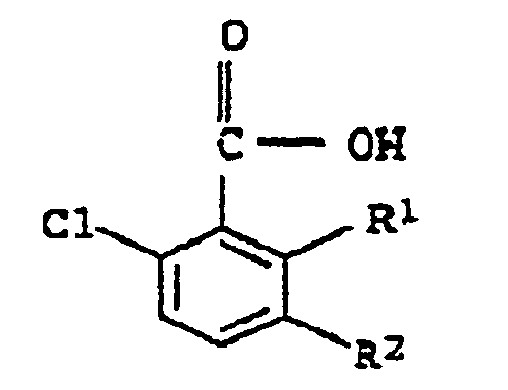
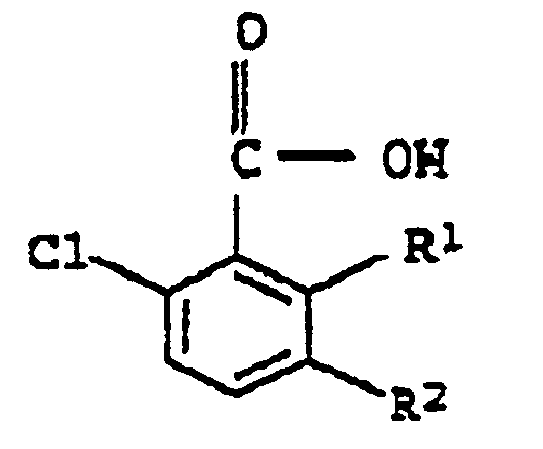
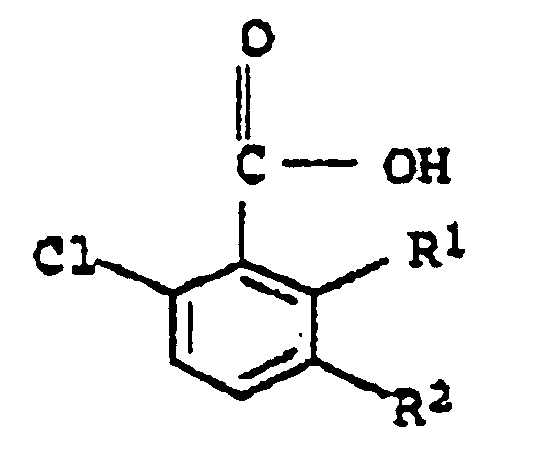
[0017] It has been found surprisingly that the temperature at which the chloroacetamide herbicide, dimethenamid, forms a solid precipitant can be lowered significantly with significantly less dilution of the dimethenamid than has heretofore been available. The invention provides chloroacetamide compositions having improved low temperature stability and methods for lowering the precipitation point of chloroacetamides. The chloroacetamide precipitation temperature is preferably lowered by combining chloroacetamides with chemical compounds of th following formula:
wherein R1 is either chlorine or methoxy, and R2 is, optinally, hydrogen, halogen, or a lower alkyl, a lower alkyl ether, or a lower alkyl halide.
[0018] According to one preferred embodiment of the invention, a herbicidal mixture comprises a herbicidally effective amount of dimethenamid and 3,6-dichloro-2-methoxybenzoic acid, known as dicamba acid, wherein the molar concentration of the dicamba acid is from 30 % to 50 % of the total molar concentration of the dimethenamid and dicamba acid. The mixture can also be diluted with known inert ingredients, such as gamma-butyrolactone, petroleum distillates, xylene or xylene range aromatic solvents, to adjust the concentration of herbicidal components thereof.
[0019] In the drawing which forms a portion of the original disclosure of the invention: FIG. 1 is a graph depicting precipitation point of dimethenamid at various molar concentrations in combination with dicamba and with gamma-butyrolactone.
[0020] The compositions of the invention include a herbicidally effective amount of a chloroacetamide, such as alachlor, metolachlor, acetochlor, metazachlor, diethatyl, propachlor or thiophenamines such as dimethenamid, combined with a precipitation point lowering agent. These are prepared in a ratio of from preferably about 1:1 chloroacetamide to precipitation point lowering agent, on a mole/mole basis, up to about 2.5:1, with a preferred ratio being 1.5:1 to 2:1, in particular about 1.5:1.
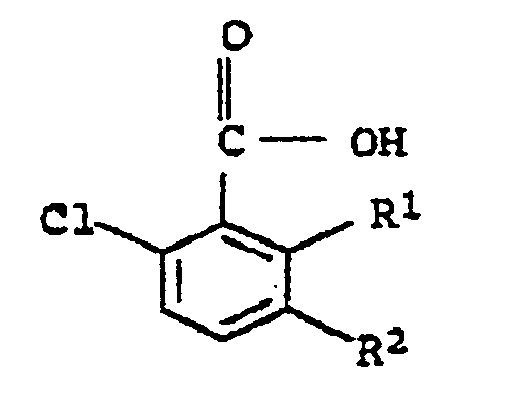
[0021] In accordance with the invention, the precipitation point lowering agents are preferably compounds having the following chemical formula:
wherein R1 is either chlorine or methoxy, and R2 is, optinally, hydrogen, halogen, or a lower alkyl, a lower alkyl ether, or a lower alkyl halide. Examples of such precipitation point lowering compounds include dicamba acid (3,6-dichloro-2-methoxybenzoic acid) and 2,6-dichlorobenzoic acid. Dicamba is a known plant growth regulator herbicide, which is commonly used in post-emergence herbicidal control of broad-leaf weeds in monocot crops. One commercially available dicamba product is known as BANVEL® (BASF AG, Germany), which contains 4.0 lb/gal. of dicamba acid in inert diluents.
[0022] Although dicamba acid and other benzoic acids are known herbicidal plant growth regulators, they have not heretofore been combined with chloroacetamides, such as dimethenamid, in accordance with the ratios of the present invention and have not achieved the precipitation point lowering effects of the present invention.
[0023] Mixtures of these compounds with the chloroacetamide herbicide dimethenamid within the parameters of the above ratios exhibit surprisingly low precipitation temperatures, enabling the temperatures of such solutions to be lowered to below (-20)°C before a trace of solid precipitant is observed. Also, when temperatures of these solutions were lowered to a point where precipitation occurred, the amount of solid precipitant formed was much less, and formed much slower, than when dimethenamid is combined with other known diluents.
[0024] Preferred compositions comprising dimethenamid as chloroacetamide contain the precipitation lowering agent in an amount that the composition is substantially free from solid dimethenamid at a temperature of less than five, in particular less than zero degree celsius. Particularly preferred are compositions being substantially free of solid dimethenamid at temperatures of less than minus ten, in particular less than minus twenty and especially less than minus thirty degree celsius.
[0025] Infrared spectra for mixtures of dimethenamid and dicamba reveal a shift in the carbonyl bands of both dimethenamid and dicamba, as compared with infrared spectra of unmixed dimethenamid and dicamba. Furthermore, both substances, when in stoichiometric excess of the other, exhibited both shifted and non-shifted carbonyl bands, suggesting some chemical bonding in relation to the carbonyl components of the two substances. However, testing of mixtures of dimethenamid and dicamba with thin layer chromatography showed that the two substances are easily separated thereby. This demonstrates that no covalent bond is formed between dimethenamid and dicamba, and that the association between the two substances is fairly weak and dynamic.
[0026] Interestingly, in determining precipitation temperatures for solutions containing varying amounts of dicamba and of 2,6-dichlorobenzoic acid mixed with dimethenamid, it was learned that dicamba and 2,6-dichlorobenzoic acid are soluble in dimethenamid up to molar concentrations about equal to the molar concentration of dimethenamid. When the molar concentration of dicamba or 2,6-dichlorobenzoic acid exceeds that of dimethenamid, the dicamba or 2,6-dichlorobenzoic acid precipitates and requires significant heating to return to the solution.
[0027] To determine whether the anomalous precipitation temperature depression in dimethenamid is attributable to the benzoic acid structure of these compounds, solubilities of other structurally similar benzoic acids in dimethenamid were measured.
[0028] Surprisingly, structurally similar benzoic acids, such as 3,5-dicamba acid, are much less soluble in dimethenamid than are dicamba and 2,6-dichlorobenzoic acid, suggesting a strong structural specificity in the interaction between dimethenamid and both dicamba and 2,6-dichlorobenzoic acid. It is believed that this structural specificity is found in the location of the chlorine and methoxy groups adjacent the acid group in both dicamba acid and 2,6-dichlorobenzoic acid, and that the electron affinity of these groups enhances the interaction of the acid group of those molecules with the carbonyl components of dimethenamid.
[0029] The mixtures and formulations described herein can be prepared by a manner known per se, in particular by stirring compounds and the other usual formula adjuvants into the dimethenamid while stirring and optionally while heating. In a preferred embodiment, the dimethenamid is heated to about 115° F before adding dicamba thereto. Also, the concentration of the components can be varied by combining the mixtures, using methods known per se, in particular by stirring the compounds with known diluents.
[0030] As used herein, the term diluents means any liquid or solid agriculturally acceptable material which may be added to the components to provide a more easily or improved applicable form, or to achieve a usable or desired strength of activity. Examples are gamma-butyrolactone, petroleum distillates, xylene, or xylene range aromatic solvents. One preferred embodiment of the present invention comprises about 5 pounds per gallon dimethenamid and about 1 pound per gallon dicamba with commercially known diluents such as petroleum distillates, xylene or xylene range aromatic solvents. At this concentration, the dicamba has the desired effect of lowering the precipitation temperature of dimethenamid, and the mixture has a desirable viscosity to facilitate application by commercial users.
[0031] The formulations of the present invention can also include other ingredients or adjuvants commonly employed in the art, including penetrants, surfactants, crop oils, drift control agents, defoaming agents, preservatives, wetting agents, adherents, antimicrobial agent, and the like, including mixtures thereof, as are also well known in the art and disclosed, for example, in the aforementioned U.S. Patent No. 4,666,502.
[0032] Herbicidally acceptable additives can be added to the mixtures, using methods known per se, in particular by stirring, including other compounds having similar or complementary herbicidal activity or compounds having antidotal, fungicidal or insecticidal activity. Particular formulations, to be applied in spraying form, can contain surfactants such as wetting and dispersing agents, for example, an ethoxylated alkylphenol or an ethoxylated fatty alcohol. Also, compatibility enhancing agents, such as emulsifiers, can be used to improve compatibility of the formulations when combined by an end user, for example, with products containing water. For example, in one embodiment, the formulations of the present invention are combined with a blend of nonionic/anionic surfactants, and a phosphate ester to emulsify the formulations of the present invention in water. Moreover, the mixtures and formulations descripbed herein can be used in various herbicidal applications as are known, per se, in the art, and as are described in the above-mentioned U.S. Patent No. 4,666,502.
[0033] The following examples set forth the dimethenamid crystallization point lowering effects of several combinations of the present invention.
Examples
[0034] Solutions were prepared at room temperature and about standard atmospheric pressure. The solutions were cooled to (-20)°C. The precipitation temperatures for the solutions of dimethenamid with dicamba were recorded as the temperature below which at least a trace of solid dimethenamid formed in the solution. The results are set forth in Table 1 below:
Table 1
| Dimethenamid Mole Fraction | Dimethenamid Weight Percent | Dicamba Mole Fraction | Dicamba Weight Percent | Precipitation Temperature °C |
| 0.938 | 95 % | 0.062 | 5 % | 19 |
| 0.878 | 90 % | 0.122 | 10 % | 17 |
| 0.820 | 85 % | 0.180 | 15 % | 16 |
| 0.762 | 80 % | 0.238 | 20 % | 12 |
| 0.706 | 75 % | 0.294 | 25 % | 9 (trace) |
| 0.652 | 70 % | 0.348 | 30 % | -20 |
| 0.598 | 65 % | 0.402 | 35 % | -20 |
| 0.546 | 60 % | 0.454 | 40 % | -20 |
| 0.495 | 55 % | 0.505 | 45 % | -20 |
| 0.445 | 50 % | 0.555 | 50 % | 81* |
| 0.396 | 45 % | 0.604 | 55 % | 89* |
| 0.348 | 40 % | 0.652 | 60 % | 94* |
| 0.301 | 35 % | 0.699 | 65 % | 96* |
| 0.256 | 30 % | 0.744 | 70 % | 100* |
| 0.211 | 25 % | 0.789 | 75 % | 102* |
| 0.167 | 20 % | 0.833 | 80 % | 104* |
| 0.124 | 15 % | 0.876 | 85 | 108* |
| 0.082 | 10 % | 0.918 | 90 % | 110* |
| 0.040 | 5 % | 0.960 | 95 % | 112* |
| * The solid formations at dicamba concentrations of 0.505 mole fraction, and below, were dimethenamid precipitant. Above that concentration, dicamba precipitant formed, which required significant heating to dissolve back into solution. |
[0035] As shown in Table 1 above, when dicamba is present in concentrations of greater than about 0.30 mole percent (i.e., greater than 25 % weight), the dimethenamid precipitation temperature is depressed significantly.
[0036] For comparison, the precipitation temperature of dimethenamid was measured in similar fashion in solutions with varying concentrations of gamma-butyrolactone ("Gamma Blo"), a known diluent. The dimethenamid precipitation temperatures in those solutions are set forth in Table 2 below:
Table 2
| Dimethenamid Mole Fraction | Dimethenamid Weight Percent | Gamma-Blo Mole Fraction | Gamma-Blo Weight Percent | Precipitation Temperatur °C |
| 0.856 | 95 % | 0.144 | 5 % | 18 |
| 0.737 | 90 % | 0.263 | 10 % | 18 |
| 0.639 | 85 % | 0.361 | 15 % | 18 |
| 0.555 | 80 % | 0.445 | 20 % | 17 |
| 0.484 | 75 % | 0.516 | 25 % | 15 |
| 0.421 | 70 % | 0.579 | 30 % | 13 |
| 0.367 | 65 % | 0.633 | 35 % | 9 |
| 0.319 | 60 % | 0.681 | 40 % | 7 |
| 0.276 | 55 % | 0.724 | 45 % | 4 |
| 0.238 | 50 % | 0.762 | 50 % | -7 |
| 0.203 | 45 % | 0.797 | 55 % | -20 |
| 0.172 | 40 % | 0.828 | 60 % | -20 |
| 0.144 | 35 % | 0.856 | 65 % | -20 |
[0037] As shown in Table 2 above, a significantly greater amount of gamma-butyrolactone is required to lower the precipitation temperature of dimethenamid, as compared with the amount of dicamba required to achieve a similar dimethenamid precipitation temperature. The amount of dicamba necessary to achieve a dimethenamid precipitation temperature of (-20)°C is about 30 % w -- equivalent to a mole fraction of about 0.35. By comparison, the amount of gamma-butyrolactone necessary to achieve a precipitation temperature of (-20)°C is about 55 % w -- equivalent to a mole fraction of about 0.8.
[0038] The difference in precipitation temperature depression achieved with dicamba as the precipitation temperature lowering agent, in comparison to the normal depression caused by dilution of dimethenamid, is more easily seen in the graph shown in Figure 1. In Figure 1, the curve 1 indicates the precipitation temperature observed in solutions of dimethenamid and dicamba. As seen in Figure 1, the precipitation temperature of dimethenamid is depressed significantly by dicamba beginning at the point where the dimethenamid mole fraction is approximately 0.70 and the dicamba mole fraction is approximately 0.30.
[0039] Line A-A indicates the approximate point at which dicamba begins to precipitate and requires significant heating to return the dicamba to the solution. The curve 2 in Figure 1 illustrates depression of the dimethenamid precipitation temperature by dilution with gamma-butyrolactone. As Figure 1 illustrates, in order to depress the dimethenamid precipitation temperature significantly with gamma butyrolactone, the mole fraction of dimethenamid must be diluted significantly more than with dicamba. For instance, with dicamba, the mole fraction of dimethenamid at which dimethenamid has a precipitation temperature of 10°C is approximately 0.70, whereas, with gamma-butyrolactone, the mole fraction of dimethenamid at which the dimethenamid has a precipitation temperature of 10°C is approximately 0.37. Similarly, with dicamba as the precipitation temperature lowering agent, dimethenamid has a precipitation temperature of (-20)°C with a dimethenamid mole fraction of approximately 0.65. With gamma-butyrolactone as a diluent, in order to lower the dimethenamid precipitation temperature to (-20)°C, the dimethenamid mole fraction must be lowered to approximately 0.20.
[0040] Tests of a similar protocol were conducted using combinations of dimethenamid with 2,6-dichlorobenzoic acid. The results of these tests showed a similar precipitation point suppression as was exhibited with combinations of dimethenamid with dicamba acid. The results are set forth in Table 3 below:
Table 3
| Dimethenamid Mole Fraction | Dimethenamid Weight Percent | 2,6-Di-Choro-Mole Fraction | 2,6-Di-Chloro-Weight Percent | Precipitation Temperature °C |
| 0.929 | 95 % | 0.071 | 5 % | 18 |
| 0.862 | 90 % | 0.138 | 10 % | 16 |
| 0.797 | 85 % | 0.203 | 15 % | 15 |
| 0.735 | 80 % | 0.265 | 20 % | -20 |
| 0.675 | 75 % | 0.325 | 25 % | -20 |
| 0.618 | 70 % | 0.382 | 30 % | -20 |
| 0.563 | 65 % | 0.437 | 35 % | -20 |
| 0.510 | 60 % | 0.490 | 40 % | -20 |
| 0.458 | 55 % | 0.542 | 45 % | 49** |
| 0.409 | 50 % | 0.591 | 50 % | 71** |
| 0.362 | 45 % | 0.638 | 55 % | 73** |
| 0.316 | 40 % | 0.684 | 60 % | 91** |
| ** As with the precipitation temperature determination relating to dicamba, beginning at the point where the mole fraction of 2,6-dichlorobenzoic acid exeeds the mole fraction of dimethenamid, the 2,6-dichlorobenzoic acid precipitates and requires significant heating to dissolve in the dimethenamid. Also, as with dicamba, infrared sprectra for mixtures of dimethenamid and 2,6-dichlorobenzoic acid reveal a shift in the carbonyl bands of both substances, further suggesting some chemical bonding in relation to the carbonyl components of the two substances. |
[0041] To demonstrate the commercial utility of the precipitation temperature suppression provided by this invention, formulations of dimethenamid and dicamba acid were prepared at dimethenamid:dicamba weight ratios of 2:1 and 3:1, which correspond to mole ratios of 1.6:1 and 2.4:1, respectively. With gamma-butyrolactone, a known diluent, samples of the formulations were diluted so that the concentration of total active ingredients (i.e. dimethenamid and dicamba) were 8 pounds per gallon, 7 pounds per gallon and 6 pounds per gallon.
[0042] The diluted samples, and samples of the undiluted 2:1 and 3:1 weight ratio dimethenamid to dicamba mixtures, were then cooled in 10°C increments, seeded with solid dimethenamid and solid dicamba after each cooling increment, and observed for solid precipitant growth. At (-20)°C, none of the samples exhibited precipitation, even after seeding. At (-30)°C, four days after seeding, the undiluted samples and the 3 to 1 mixture that had been diluted to 8 pounds per gallon gegan to show slight traces of solid precipitant. The mixtures were then cooled to (-40)°C and again seeded with solid dimethenamid and solid dicamba. Three days after seeding, the mixtures comprising 2 to 1 weight ratio of dimethenamid to dicamba showed only traces of solid dimethenamid. The mixtures comprising 3 to 1 weight ratio of dimethenamid to dicamba showed more significant solid precipitant growth.
[0043] The solutions were then heated in 1°C increments up to a temperature of 0°C to observe temperatures at which only a trace of the solid precipitant remained and at which all solid precipitant returned to the liquid solution. The results are shown in Table 4 below:
Table 4
| Weight Ratio Dimethenamid to Dicamba | Concentration After Dilution | Only Trace Solids Remaining °C | No Solids Remaining °C |
| 2:1 | No Dilution | N/A* | N/A* |
| 2:1 | 8 lbs/gal. | N/A** | -9 |
| 2:1 | 7 lbs/gal. | N/A** | -11 |
| 2:1 | 6 lbs/gal. | N/A** | -11 |
| 3:1 | No Dilution | -39 | N/A*** |
| 3:1 | 8 lbs/gal. | -10 | -3 |
| 3:1 | 7 lbs/gal. | -15 | -8 |
| 3:1 | 6 lbs/gal. | -16 | -12 |
| * Only trace solid precipitant present at beginning of warm-up (-39°C) and also at end of warm-up (0°C). | |||
| ** Only trace solid precipitant present at beginning of warm-up (-39°C). | |||
| *** Trace solid precipitant remained at end of warm-up (0°C). |
1. A composition suitable as a herbicide comprising a herbicidally effective amount of
a chloroacetamide herbicide and a chloroacetamide precipitation temperature lowering
agent, which comprises at least one compound having the formula
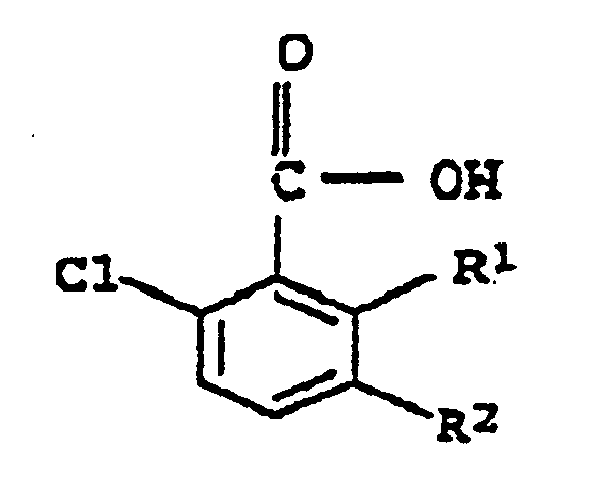
wherein R1 is either chlorine or methoxy, and R2 is, optionally, hydrogen, halogen, lower alkyl, lower alkyl halide, or a lower alkyl ether,
said composition comprising at least about a 40 mole percent concentration of the chloroacetamide herbicide, and said precipitation temperature lowering agent being present in a sufficient quantity that said composition is substantially free from solid chloroacetamide at a temperature less than about ten degrees celsius.
wherein R1 is either chlorine or methoxy, and R2 is, optionally, hydrogen, halogen, lower alkyl, lower alkyl halide, or a lower alkyl ether,
said composition comprising at least about a 40 mole percent concentration of the chloroacetamide herbicide, and said precipitation temperature lowering agent being present in a sufficient quantity that said composition is substantially free from solid chloroacetamide at a temperature less than about ten degrees celsius.
2. A composition according to Claim 1, wherein said chloroacetamide herbicide is selected
from alachlor, metolachlor, acetochlor, metazachlor, diethatyl, propachlor and thiophenamines.
3. A composition according to Claim 2, wherein said chloroacetamide herbicide comprises
a thiophenamine.
4. A composition according to Claim 1, wherein said chloroacetamide herbicide comprises
dimethenamid.
5. A composition according to claims 1 to 4 wherein said precipitation temperature lowering
agent consists essentially of dicamba acid, 2,6-dichlorobenzoic acid, or combinations
thereof.
6. A composition according to Claim 5 wherein said precipitation temperature lowering
agent comprises dicamba acid.
7. A composition according to Claim 5 wherein said precipitation temperature lowering
agent comprisees 2,6-dichlorobenzoic acid.
8. A composition according to any of Claims 1 to 7 comprising a herbicidally effective
amount of dimethenamid and a dimethenamid precipitation temperature lowering agent,
the molar ratio of the dimethenamid to the precipitation temperature lowering agent
being in a range from about 1:1 to about 2.5:1.
9. A method for forming a low-temperature storage-stable dimethenamid composition comprising
combining dimethenamid with a dimethenamid precipitation temperature lowering agent
which comprises at least one compound having the formula
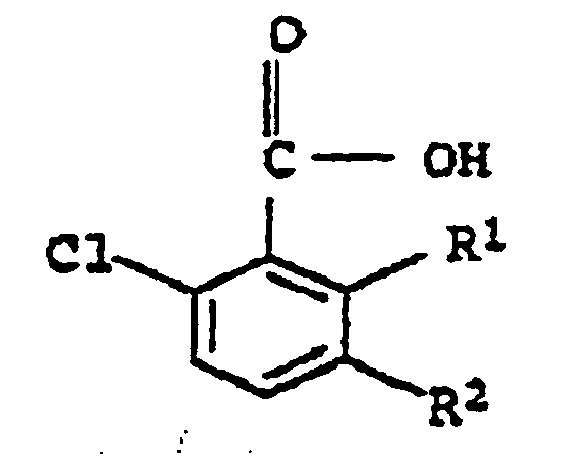
wherein R1 is either chlorine or methoxy, and R2 is, optionally, hydrogen, halogen, lower alkyl, lower alkyl halide, or a lower alkyl ether
and with from 0 mole percent to about 50 mole percent of an agriculturally acceptable diluent, to form a composition having a molar concentration of dimethenamid of greater than about 40 mole percent based on the total amount of said dimethenamid, precipitation temperature lowering agent, and diluent in said composition, said precipitation temperature lowering agent being present in a quantity sufficient that said composition is substantially free from solid dimethenamid at a temperature less than about zero degrees celsius.
wherein R1 is either chlorine or methoxy, and R2 is, optionally, hydrogen, halogen, lower alkyl, lower alkyl halide, or a lower alkyl ether
and with from 0 mole percent to about 50 mole percent of an agriculturally acceptable diluent, to form a composition having a molar concentration of dimethenamid of greater than about 40 mole percent based on the total amount of said dimethenamid, precipitation temperature lowering agent, and diluent in said composition, said precipitation temperature lowering agent being present in a quantity sufficient that said composition is substantially free from solid dimethenamid at a temperature less than about zero degrees celsius.
10. A method according to Claim 9 wherein the concentration of the precipitation temperature
lowering agent in said composition is less than about 40 mole percent based on the
total amount of said dimethenamid, precipitation temperature lowering agent, and diluent
in said composition.
11. A method for forming a low-temperature storage-stable dimethenamid composition comprising
combining dimethenamid with from about 30 mole percent and about 50 mole percent dicamba
or 2,6-dichlorobenzoic acid and from 0 mole percent to about 50 mole percent of an
agriculturally acceptable diluent, to form a composition having a molar concentration
of dimethenamid of greater than about 40 mole percent based on the total amount of
said dimethenamid, dicamba and diluent in said composition, said dicamba being present
in a quantity sufficient that said composition is substantially free from solid dimethenamid
at a temperature less than about minus twenty degrees celcius.
1. Zusammensetzung, die sich als Herbizid eignet, enthaltend eine herbizid wirksame Menge
eines Chloracetamidherbizids und eines die Ausfällungstemperatur des Chloracetamids
absenkenden Mittels, enthaltend wenigstens eine Verbindung der Formel
wobei R1 entweder für Chlor oder Methoxy steht und R2 gegebenenfalls für Wasserstoff, Halogen, Niederalkyl, Niederalkylhalogenid oder Niederalkylether steht,
wobei die Zusammensetzung wenigstens etwa eine 40 molprozentige Konzentration des Chloracetamidherbizids enthält und das die Ausfällungstemperatur absenkende Mittel in einer Menge vorhanden ist, die ausreicht, um die Zusammensetzung bei einer Temperatur von unter etwa 10°C im wesentlichen frei von festem Chloracetamid zu halten.
wobei R1 entweder für Chlor oder Methoxy steht und R2 gegebenenfalls für Wasserstoff, Halogen, Niederalkyl, Niederalkylhalogenid oder Niederalkylether steht,
wobei die Zusammensetzung wenigstens etwa eine 40 molprozentige Konzentration des Chloracetamidherbizids enthält und das die Ausfällungstemperatur absenkende Mittel in einer Menge vorhanden ist, die ausreicht, um die Zusammensetzung bei einer Temperatur von unter etwa 10°C im wesentlichen frei von festem Chloracetamid zu halten.
2. Zusammensetzung nach Anspruch 1, wobei das Chloracetamidherbizid ausgewählt ist aus
Alachlor, Metolachlor, Acetochlor, Metazachlor, Diethatyl, Propachlor und Thiophenaminen.
3. Zusammensetzung nach Anspruch 2, wobei das Chloracetamidherbizid ein Thiophenamin
enthält.
4. Zusammensetzung nach Anspruch 1, wobei das Chloracetamidherbizid Dimethenamid enthält.
5. Zusammensetzung nach einem der Ansprüche 1 bis 4, wobei das die Ausfällungstemperatur
absenkende Mittel im wesentlichen aus Dicambasäure, 2,6-Dichlorbenzoesäure oder Kombinationen
davon besteht.
6. Zusammensetzung nach Anspruch 5, wobei das die Ausfällungstemperatur absenkende Mittel
Dicambasäure enthält.
7. Zusammensetzung nach Anspruch 5, wobei das die Ausfällungstemperatur absenkende Mittel
2,6-Dichlorbenzoesäure enthält.
8. Zusammensetzung nach einem der Ansprüche 1 bis 7, enthaltend eine herbizid wirksame
Menge an Dimethenamid und ein die Ausfällungstemperatur von Dimethenamid absenkendes
Mittel, wobei das Molverhältnis von Dimethenamid zu dem die Ausfällungstemperatur
absenkenden Mittel im Bereich von etwa 1:1 bis etwa 2,5:1 liegt.
9. Verfahren zur Herstellung einer bei niedriger Temperatur lagerungsstabilen Dimethenamidzusammensetzung,
bei dem man Dimethenamid mit einem die Ausfällungstemperatur von Dimethenamid absenkenden
Mittel, das wenigstens eine Verbindung der Formel
enthält, wobei R1 entweder für Chlor oder Methoxy steht und R2 gegebenenfalls für Wasserstoff, Halogen, Niederalkyl, Niederalkylhalogenid oder einen Niederalkylether steht,
und mit von 0 Molprozent bis etwa 50 Molprozent eines landwirtschaftlich unbedenklich Verdünnungsmittels kombiniert, unter Bildung einer Zusammensetzung mit einer molaren Dimethenamidkonzentration von mehr als etwa 40 Molprozent der Gesamtmenge an Demethenamid, dem die Ausfällungstemperatur absenkenden Mittel und dem Verdünnungsmittel in der Zusammensetzung, wobei das die Ausfällungstemperatur absenkende Mittel in einer Menge vorhanden ist, die ausreicht, um die Zusammensetzung bei einer Temperatur von weniger als etwa 0°C im wesentlichen frei von festem Dimethenamid zu halten.
enthält, wobei R1 entweder für Chlor oder Methoxy steht und R2 gegebenenfalls für Wasserstoff, Halogen, Niederalkyl, Niederalkylhalogenid oder einen Niederalkylether steht,
und mit von 0 Molprozent bis etwa 50 Molprozent eines landwirtschaftlich unbedenklich Verdünnungsmittels kombiniert, unter Bildung einer Zusammensetzung mit einer molaren Dimethenamidkonzentration von mehr als etwa 40 Molprozent der Gesamtmenge an Demethenamid, dem die Ausfällungstemperatur absenkenden Mittel und dem Verdünnungsmittel in der Zusammensetzung, wobei das die Ausfällungstemperatur absenkende Mittel in einer Menge vorhanden ist, die ausreicht, um die Zusammensetzung bei einer Temperatur von weniger als etwa 0°C im wesentlichen frei von festem Dimethenamid zu halten.
10. Verfahren nach Anspruch 9, wobei die Konzentration des die Ausfällungstemperatur absenkenden
Mittels in der Zusammensetzung weniger als etwa 40 Molprozent der Gesamtmenge an Dimethenamid,
dem die Ausfällungstemperatur absenkenden Mittel und dem Verdünnungsmittel in der
Zusammensetzung beträgt.
11. Verfahren zur Herstellung einer bei niedriger Temperatur lagerungsstabilen Dimethenamidzusammensetzung,
bei dem man Dimethenamid mit von etwa 30 Molprozent bis etwa 50 Molprozent Dicamba
oder 2,6-Dichlorbenzoesäure und von 0 Molprozent bis etwa 50 Molprozent eines landwirtschaftlich
unbedenklichen Verdünnungsmittels kombiniert, unter Bildung einer Zusammensetzung
mit einer molaren Dimethenamidkonzentration von mehr als etwa 40 Molprozent der Gesamtmenge
an Demethenamid, Dicamba und Verdünnungsmittel in der Zusammensetzung, wobei das Dicamba
in einer Menge vorhanden ist, die ausreicht, um die Zusammensetzung bei einer Temperatur
von unter etwa -20°C im wesentlichen frei von festem Dimethenamid zu halten.
1. Composition appropriée comme herbicide comprenant une quantité efficace sur le plan
herbicide d'un herbicide à base de chloro-acétamide et un agent abaissant la température
de précipitation du chloro-acétamide, laquelle comprend au moins un composé répondant
à la formule
dans laquelle R1 désigne soit un chlore soit un méthoxy et R2 désigne en option : hydrogène, halogène, alcoyle inférieur, halogénure d'alcoyle inférieur ou éther d'alcoyle inférieur,
ladite composition comprenant au moins une concentration d'environ 40 moles pour cent de l'herbicide à base de chloro-acétamide, et ledit agent abaissant la température de précipitation étant présent en quantité suffisante de manière à ce que ladite composition soit essentiellement exempte de chloro-acétamide solide à une température inférieure à environ dix degrés Celsius.
dans laquelle R1 désigne soit un chlore soit un méthoxy et R2 désigne en option : hydrogène, halogène, alcoyle inférieur, halogénure d'alcoyle inférieur ou éther d'alcoyle inférieur,
ladite composition comprenant au moins une concentration d'environ 40 moles pour cent de l'herbicide à base de chloro-acétamide, et ledit agent abaissant la température de précipitation étant présent en quantité suffisante de manière à ce que ladite composition soit essentiellement exempte de chloro-acétamide solide à une température inférieure à environ dix degrés Celsius.
2. Composition selon la revendication 1, dans laquelle ledit herbicide à base de chloro-acétamide
est sélectionné parmi un alachlore, un métolachlore, un acétochlore, un métazachlore,
un diéthatyl, un propachlore et des thiophénamines.
3. Composition selon la revendication 2, dans laquelle ledit herbicide à base de chloro-acétamide
comprend une thiophénamine.
4. Composition selon la revendication 1, dans laquelle ledit herbicide à base de chloro-acétamide
comprend du diméthénamide.
5. Composition selon les revendications 1 à 4, dans laquelle ledit agent abaissant la
température de précipitation comprend essentiellement de l'acide dicambaïque, de l'acide
2,6-dichlorobenzoïque, ou des combinaisons de ces acides.
6. Composition selon la revendication 5, dans laquelle ledit agent abaissant la température
de précipitation comprend de l'acide dicambaïque.
7. Composition selon la revendication 5, dans laquelle ledit agent abaissant la température
de précipitation comprend de l'acide 2,6-dichlorobenzoïque.
8. Composition selon l'une quelconque des revendications 1 à 7, comprenant une quantité
efficace sur le plan herbicide de diméthénamide et un agent abaissant la température
de précipitation du diméthénamide, le rapport molaire entre le diméthénamide et l'agent
abaissant la température de précipitation se situant dans une plage comprise entre
environ 1:1 et environ 2,5:1.
9. Méthode pour la formation d'une composition de diméthénamide à stockage stable aux
basses températures comprenant la combinaison de diméthénamide avec un agent abaissant
la température de précipitation du diméthénamide, qui comprend au moins un composé
répondant à la formule
dans laquelle R1 désigne soit un chlore soit un un méthoxy et R2 désigne en option : hydrogène, halogène, alcoyle inférieur, halogénure d'alcoyle inférieur ou éther d'alcoyle inférieur
et avec un pourcentage compris entre 0 mole pour cent et environ 50 moles pour cent d'un diluant acceptable sur le plan agronomique de manière à former une composition possédant une concentration molaire de diméthénamide supérieure à environ 40 moles pour cent sur la base de la quantité totale desdits diméthénamide, agent abaissant la température de précipitation et diluant dans ladite composition, ledit agent abaissant la température de précipitation étant présent en quantité suffisante pour que ladite composition soit essentiellement exempte de diméthénamide solide à une température inférieure à environ zéro degré Celsius.
dans laquelle R1 désigne soit un chlore soit un un méthoxy et R2 désigne en option : hydrogène, halogène, alcoyle inférieur, halogénure d'alcoyle inférieur ou éther d'alcoyle inférieur
et avec un pourcentage compris entre 0 mole pour cent et environ 50 moles pour cent d'un diluant acceptable sur le plan agronomique de manière à former une composition possédant une concentration molaire de diméthénamide supérieure à environ 40 moles pour cent sur la base de la quantité totale desdits diméthénamide, agent abaissant la température de précipitation et diluant dans ladite composition, ledit agent abaissant la température de précipitation étant présent en quantité suffisante pour que ladite composition soit essentiellement exempte de diméthénamide solide à une température inférieure à environ zéro degré Celsius.
10. Méthode selon la revendication 9, dans laquelle la concentration de l'agent abaissant
la température de précipitation dans ladite composition est inférieure à environ 40
moles pour cent sur la base de la quantité totale desdits diméthénamide agent abaissant
la température de précipitation et diluant dans ladite composition.
11. Méthode pour la formation d'une composition de diméthénamide à stockage stable aux
basses températures comprenant la combinaison de diméthénamide avec d'environ 30 moles
pour cent à environ 50 moles pour cent d'acide dicambaïque ou d'acide 2,6-chlorobenzoïque,
et d'environ 0 mole pour cent à environ 50 moles pour cent d'un diluant acceptable
sur le plan agronomique, de manière à former une composition possédant une concentration
molaire de diméthénamide supérieure à environ 40 moles pour cent sur la base de la
quantité totale desdits diméthénamide, dicamba et diluant dans ladite composition,
ledit dicamba étant présent en quantité suffisante pour que ladite composition soit
essentiellement exempte de diméthénamide solide à une température inférieure à environ
moins vingt degrés Celsius.