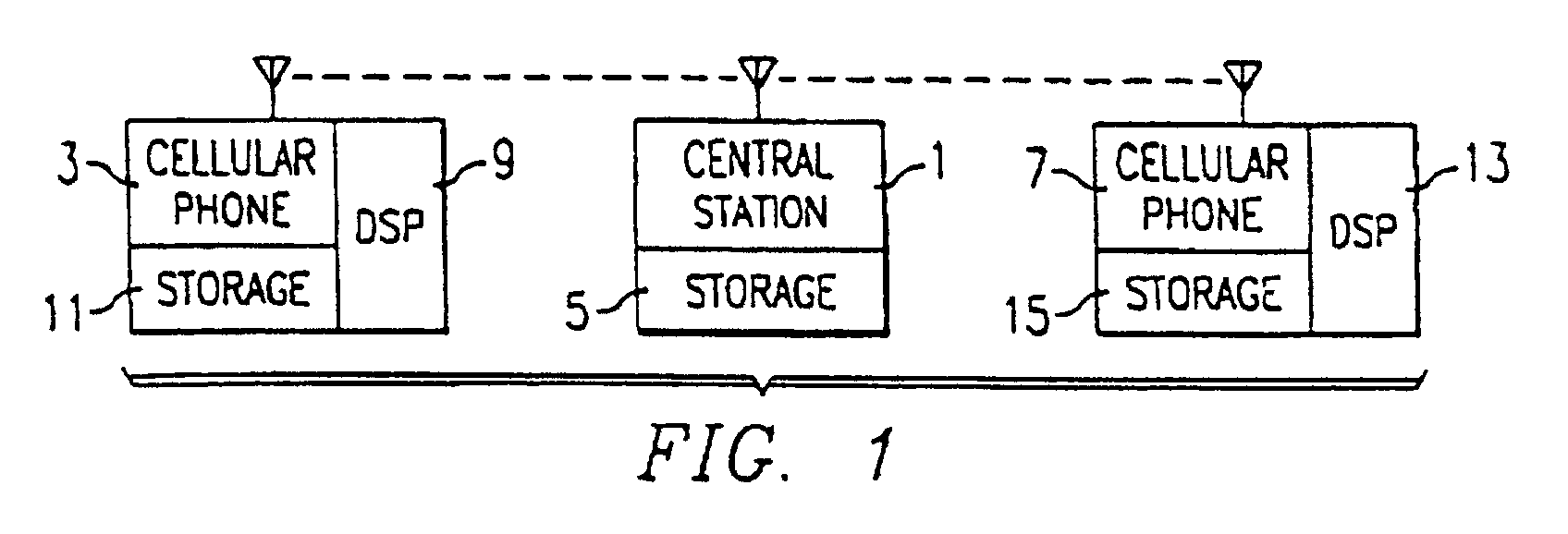
(57) A method of communication and the communication system wherein, there is provided
a first telephone for receiving information, time-compressing the information, storing
the information and transmitting the information to a central station. There is provided
at least one and generally a plurality of spaced apart central stations for receiving
the time-compressed information from the first telephone, storing the time-compressed
information and retransmitting the time-compressed information to a second telephone.
A second telephone is provided for receiving the time-compressed information from
the central station, one of storing the time-compressed information and, responsive
to call-up, time-decompressing and transmitting the time-decompressed information
or time-decompressing the time-compressed information and storing the time-decompressed
information and then, responsive to call-up, transmitting the time-decompressed information.
A feedback signal is provided from the central station to the first telephone responsive
to reception of the time-compressed information at the central station and a feedback
signal is provided from the second telephone to the central station responsive to
reception of the time-compressed information at the second telephone. Both the first
telephone and the central station, when having information in storage for transmission,
continually attempt to access the central station and second telephone respectively
until access is obtained.
|
|
